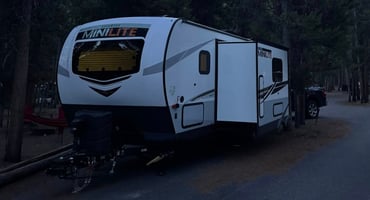
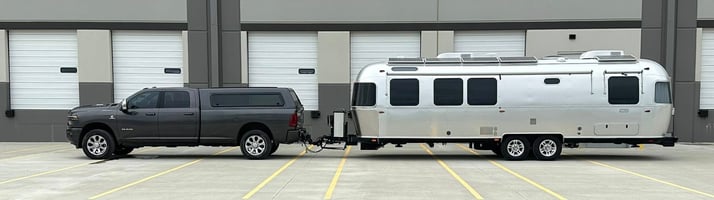
Trailer length is one of the most misunderstood factors in towing stability.
Many RV owners focus almost entirely on:
- Tow vehicle size
- Hitch weight
- Payload ratings
- Engine power
But experienced engineers know something deeper:
Trailer length dramatically changes the physics of towing.
Understanding How Trailer Length Changes Stability Dynamics helps explain why some trailers feel calm and predictable while others feel nervous, reactive, and exhausting to tow.
Because when it comes to sway, length changes everything.
Why Trailer Length Matters More Than Many Drivers Realize
Every trailer acts like a moving lever behind the tow vehicle.
As trailer length increases:
- The lever becomes longer
- Aerodynamic forces increase
- Rotational forces become stronger
Longer Trailers Magnify Motion
Even small movements at the hitch can become amplified across the full length of the trailer.
This is one reason long RVs often feel more sensitive in:
- Crosswinds
- Passing traffic
- Emergency maneuvers
The Physics of Rotational Leverage
Trailer sway is fundamentally a rotational problem.
Rotation Around the Pivot Point
In conventional towing systems:
- The trailer pivots at the hitch ball
- The pivot point sits behind the rear axle
This allows the trailer to rotate side-to-side.
Longer Trailers Create More Torque
Torque increases with distance.
τ=F×r\tau = F \times rτ=F×r
Where:
- τ\tauτ = torque
- FFF = applied force
- rrr = distance from the pivot point
Why This Matters
As trailer length increases:
- The distance from the pivot increases
- External forces create more rotational torque
- Stability decreases
This is why longer trailers are more prone to sway.
Aerodynamics Become More Powerful With Length
Longer trailers also present:
- More side surface area
- Greater wind exposure
- Increased aerodynamic leverage
Crosswind Effects Multiply
When wind strikes a long trailer:
- Pressure acts across a larger surface
- Torque increases dramatically
- Yaw motion becomes stronger
This creates more instability than many drivers expect.
Passing Trucks Affect Long Trailers More
Pressure waves from passing trucks become increasingly noticeable with trailer length.
Airflow Disruption
Large trailers experience:
- Stronger push-pull effects
- Longer pressure exposure
- Greater rotational movement
This is why many RV owners report that long trailers feel especially unstable on busy highways.
Longer Trailers Amplify Driver Inputs
Every steering correction affects the trailer.
Small Inputs Become Larger Movements
With longer trailers:
- Steering changes propagate farther
- Oscillation takes longer to settle
- Overcorrection becomes easier
This creates a cycle where instability can grow rapidly.
Why Longer Trailers Feel More Fatiguing
Even when sway never becomes severe, long trailers often create:
- Constant steering corrections
- Mental fatigue
- Increased stress during highway driving
Driver Workload Increases
Longer trailers demand:
- More attention
- More anticipation
- More precision
Over long travel days, this becomes exhausting.
Wheelbase vs Trailer Length Ratio Matters
One of the most important stability relationships is:
Tow Vehicle Wheelbase vs Trailer Length
A short-wheelbase vehicle towing a long trailer creates:
- Increased leverage imbalance
- Reduced directional stability
- Greater sway sensitivity
Why This Happens
The trailer can exert more rotational influence over the tow vehicle.
The Hidden Dynamic: Oscillation Amplification
Long trailers are more susceptible to oscillation.
Once Sway Begins
Longer trailers:
- Carry more momentum
- Swing farther
- Transfer more energy side-to-side
This can rapidly amplify instability.
Common Misconceptions About Trailer Length
“Heavier Trailers Are More Stable”
Not necessarily. Long heavy trailers can still sway significantly.
“A Bigger Truck Solves Everything”
A larger truck helps, but cannot eliminate unstable hitch geometry.
“Sway Control Fixes Long Trailer Problems”
Most sway-control systems only reduce movement after it starts.
They do not eliminate the underlying leverage problem.
Why Geometry Becomes More Important as Trailers Get Longer
As trailer length increases:
- The leverage increases
- Aerodynamic torque increases
- Rotational instability increases
This makes hitch geometry critically important.
Traditional Hitch Limitation
- Pivot behind the rear axle
- Allow free side-to-side rotation
- Permit oscillation to develop
Long trailers amplify these weaknesses dramatically.
The Engineering Solution: Controlling the Pivot Point
To truly stabilize a long trailer, the system must:
- Prevent rotational leverage
- Eliminate yaw initiation
- Change the pivot geometry itself
This is where advanced hitch engineering becomes essential.
Why the ProPride 3P® Hitch Excels With Longer Trailers
The ProPride 3P® hitch was specifically engineered to solve the geometric instability that becomes more severe with long travel trailers.
Pivot Point Projection Technology
Instead of allowing the trailer to pivot behind the rear axle, the ProPride 3P®:
- Projects the effective pivot point forward
- Near the rear axle of the tow vehicle
What This Changes
- Eliminates trailer sway
- Prevents rotational leverage
- Stops oscillation before it begins
Real-World Benefits for Long Trailers
Owners towing large RVs consistently report:
- Dramatically improved highway stability
- Reduced wind sensitivity
- Less driver fatigue
- Confidence during passing traffic and long-distance travel
This is why the ProPride 3P® is widely considered the most advanced sway elimination hitch available for large travel trailers.
Unlike friction-based systems that merely resist movement, the ProPride 3P® eliminates the instability at its source.
Tips for Improving Stability With Long Trailers
Maintain Proper Tongue Weight
Aim for balanced loading with sufficient forward weight bias.
Reduce Speed in Wind
Aerodynamic forces increase rapidly with speed.
Match Vehicle and Trailer Carefully
Pay close attention to:
- Wheelbase
- Payload
- Hitch system quality
Choose the Right Hitch
Long trailers benefit enormously from advanced geometry-based sway elimination systems.
FAQs About Trailer Length and Stability
1. Are longer trailers harder to tow?
Yes. Longer trailers create more leverage and aerodynamic force.
2. Why do long trailers sway more?
Because external forces generate greater rotational torque.
3. Does trailer weight matter less than length?
Both matter, but length often has a greater effect on sway dynamics.
4. Can sway control fix long trailer instability?
It can reduce movement, but it does not eliminate the root geometry problem.
5. Why are long trailers more tiring to tow?
They require more steering correction and driver attention.
6. What’s the best hitch for a long travel trailer?
A sway elimination system like the ProPride 3P® hitch.
Conclusion
Understanding How Trailer Length Changes Stability Dynamics reveals a fundamental truth about towing:
Long trailers don’t just weigh more—they change the entire physics of the towing system.
Increased leverage, aerodynamic pressure, oscillation potential, and pivot dynamics all combine to make long trailers significantly more challenging to control with conventional hitch systems.
That’s why experienced RV owners eventually realize that true stability isn’t about brute force or friction—it’s about geometry.
The ProPride 3P® hitch solves the root cause of instability by eliminating the rotational dynamics that allow sway to begin in the first place.
And when towing a long trailer across highways, mountains, and crosswinds, that difference becomes impossible to ignore.