Have you ever noticed your steering feel light or floaty the moment you hit highway speeds with your trailer? That unsettling sensation isn't just a quirk of your truck; it's a clear sign that your weight distribution is fundamentally off. Most people treat their hitch like a simple bracket, but it's actually a precision tool that dictates how your vehicle handles under pressure. Mastering how to adjust a weight distribution hitch is the only way to eliminate trailer sway anxiety and reclaim total control over your driving experience.
We understand that technical manuals are often more confusing than helpful, leaving you to guess if your setup is actually safe. You deserve to understand the why behind the how so you can tow with absolute confidence. This guide breaks down the precise science of Front Axle Load Restoration and the 50% rule, giving you actionable steps to level your load perfectly. We'll show you how to move beyond basic equipment to meet The Responsible Towing Standard, ensuring every trip is defined by stability rather than stress. It's time to stop worrying about your equipment and start enjoying the journey again.
Key Takeaways
- Understand the physics of Front Axle Load Restoration to ensure your steering remains responsive and safe, meeting The Responsible Towing Standard.
- Master the precise measurements required for how to adjust a weight distribution hitch to achieve a perfectly level towing setup every time.
- Learn how to use a standard tape measure to verify that weight is correctly redistributed from the rear axle to the front of your vehicle.
- Identify and fix common issues like trailer sway or front-end float by fine-tuning your hitch head angle and spring bar tension.
- Discover how precision weight distribution jacks can replace the frustrating trial-and-error process of traditional washers and chains.
Understanding the Critical Role of Weight Distribution Adjustment
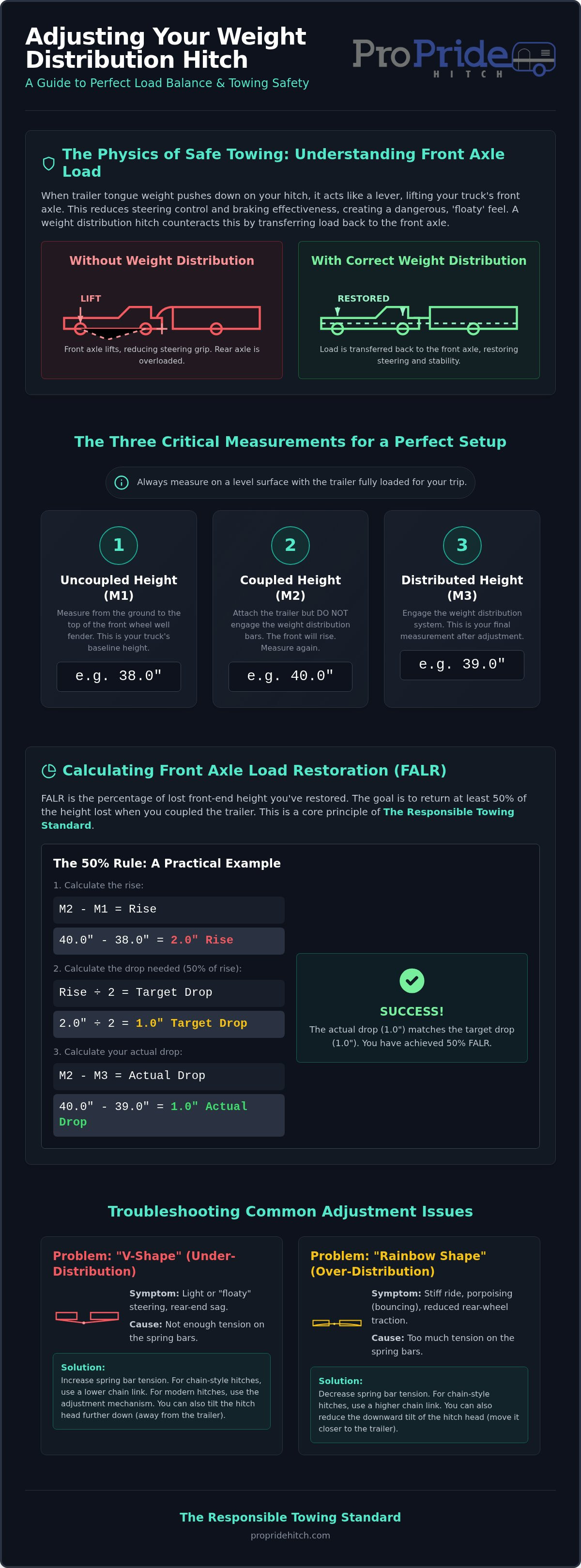
Towing a heavy trailer changes the fundamental physics of your vehicle. When you lower a trailer onto your truck's hitch ball, the rear axle acts as a fulcrum. This weight creates a leverage effect that lifts the front of your tow vehicle, reducing the pressure on your steering tires. Mastering how to adjust a weight distribution hitch is about more than just making your rig look flat. It's about using mechanical leverage to force that weight back onto the front axle where it belongs. This process ensures your tires maintain a firm grip on the road for reliable steering and braking.
We define this commitment to precision as The Responsible Towing Standard. Many drivers confuse "leveling" with "distributing." While a level trailer is a good visual indicator, true weight distribution focuses on restoring the balance of the entire system. A weight-distributing hitch is a specialized tool designed to manage these forces. Without proper adjustment, you risk front-axle lift, which makes your truck feel floaty and prone to dangerous trailer sway. This isn't just a matter of comfort; it's a critical safety requirement for protecting your family and your investment.
Why Traditional Dealer Setups Often Fail
Most dealerships set up your hitch when the trailer is empty. This dry setup rarely reflects your actual towing conditions. Once you load up your gear, fill your propane tanks, and add water to your holding tanks, the weight dynamics shift significantly. A setup that worked at the lot might be completely inadequate for a cross-country trip. You need to understand your equipment well enough to make adjustments as your load changes. Taking ownership of this process is the only way to ensure stability on the road.
Identifying the Signs of Poor Adjustment
You can identify a poor setup by looking for specific visual and physical cues. If your truck and trailer form a V-shape, you have too much weight on the rear axle. If they form a Rainbow or an inverted V, you've over-distributed the weight, which can lift your rear tires and cause traction loss. On the road, pay attention to porpoising, which is that rhythmic bouncing after hitting a bump. Weight distribution is the mechanical restoration of tow vehicle steering geometry. If your steering feels vague or your truck wanders within the lane, it's a sign you need to learn how to adjust a weight distribution hitch to better suit your current load.
Essential Measurements: Establishing Your Baseline for Safety
Precision is the foundation of The Responsible Towing Standard. You can't guess your way to a safe setup. Before you touch a single bolt or jack, you must find a perfectly level surface. Even a slight incline can skew your measurements and lead to an imbalanced rig. Grab a high-quality tape measure and a notebook. You also need to ensure your trailer is in "trip-ready" status. This means your water tanks are filled to your usual travel level and your gear is packed. Learning how to adjust a weight distribution hitch requires a commitment to accuracy that most casual towers overlook.
Maintaining a methodical record of these numbers will simplify your life. When you know exactly how to adjust a weight distribution hitch based on specific data, you eliminate the guesswork. This data allows you to replicate a stable ride every time you head out. A dry trailer at the dealership behaves differently than a loaded trailer on the open road; your records should reflect your actual travel weight.
The Three Critical Measurements
To establish your baseline, you need three specific measurements taken from the center of your tow vehicle's front wheel well. Measure from the ground up to the fender lip and record each one carefully.
- Measurement 1: The uncoupled height. This is your truck's "natural" state without the trailer attached.
- Measurement 2: The coupled height without weight distribution. Hook up the trailer but don't engage the bars or jacks. You'll likely see the front end rise as the rear squats.
- Measurement 3: The coupled height with weight distribution engaged. This shows you how much weight you've actually moved back to the front axle.
Calculating Front Wheel Well Return (FALR)
Front Axle Load Restoration, or FALR, is the technical term for how much of that original front-end height you've recovered. If your truck started at 38 inches (M1) and rose to 40 inches (M2) when coupled, your goal is to bring it back toward 38 inches. Most vehicle manufacturers recommend a restoration of 50% to 100%. If you return the height to 39 inches, you've achieved 50% restoration. While it's tempting to aim for 100%, never go beyond that. Over-adjusting can lift the rear of your truck too much, reducing traction on your drive tires and creating a pivot point for sway. For those who value engineering over trial and error, the ProPride 3P Hitch provides the granular control needed to hit these targets with absolute precision.
Step-by-Step: Adjusting Your Weight Distribution System
Once you have your baseline measurements, you must begin the mechanical process of shifting weight. This is the stage where many towers get frustrated. Traditional friction-based systems require a physical teardown and rebuild to make even minor changes. Understanding how to adjust a weight distribution hitch effectively means being prepared for a process of trial and error. You'll likely need to connect and disconnect your trailer several times to get the geometry exactly right. It's a methodical task, but it's the only way to reach a safe balance.
The Responsible Towing Standard demands more than just a "close enough" setup. Every adjustment you make changes how the forces of physics act on your truck's frame. If you find that your front wheel well is still too high after your initial setup, you have two primary levers to pull: the hitch head angle and the bar tension. Precision in these steps is what separates a stable rig from one that feels unpredictable at highway speeds.
Modifying the Hitch Head Tilt
Most standard weight distribution hitches use a stack of metal washers or a specialized adjustment pin to tilt the hitch head. Adding washers increases the downward angle of the head. This tilt forces the spring bars closer to the ground, which requires more leverage to hook them into place. That extra leverage is what pushes more weight toward your front tires. If your front end is still floating, you need to add another washer or adjust the rivet to increase that tilt. Always use a torque wrench to ensure every bolt meets the manufacturer's specific requirements. Loose hardware is a safety risk that can lead to catastrophic equipment failure on the road.
Setting Spring Bar Tension
The spring bars are the engine of your weight distribution system. On older chain-style hitches, you adjust tension by moving up or down a link. Rigid bar systems usually require you to move the L-brackets on the trailer frame. These brackets must be at the correct height to keep the bars parallel to the trailer frame. If you find that the setup is still imbalanced, you may need to move the brackets up to increase tension. This repetitive process of unhooking, adding a washer, re-hooking, and re-measuring is exactly why many drivers settle for a sub-par setup. For a more precise experience, you can learn about Properly Tensioning Your 3P Jacks. Instead of wrestling with greasy chains or heavy bars, you can use a drill or a socket to make microscopic adjustments until your measurements are perfect. Precision engineering eliminates the guesswork and ensures your family's safety.
Troubleshooting Common Issues: Fine-Tuning for a Stable Ride
Even after following the initial setup steps, your first road test might reveal subtle handling issues. Troubleshooting how to adjust a weight distribution hitch is a matter of interpreting what your vehicle is telling you through the steering wheel and seat. If your truck feels floaty or the front end seems to wander, you haven't restored enough weight to the front axle. Conversely, if the steering feels overly sensitive or twitchy, you've likely over-distributed the weight. This can compromise rear tire traction and create an unstable pivot point. Achieving The Responsible Towing Standard requires a willingness to refine these settings until the physics of the rig are perfectly balanced.
One common symptom of poor adjustment is porpoising. This rhythmic bouncing occurs when the spring bars lack the necessary tension to control the vertical movement between the truck and trailer. If you experience this on highway dips, you need to increase the tension on your bars or jacks. However, if you find yourself constantly fighting to keep the trailer centered despite perfect measurements, you may be facing the inherent limitations of your equipment. For those seeking a permanent fix to these issues, the ProPride 3P Hitch utilizes Pivot Point Projection to eliminate these variables entirely.
Fine-Tuning the Road Feel
Road feel is your best diagnostic tool. Floaty steering indicates that the front tires aren't biting the pavement, meaning you need to add more washers or increase jack height. If the truck feels like it wants to dart into turns too quickly, you've moved too much weight forward and need to back off the tension. A practical tip for any owner is to always re-measure your wheel well height after making a two-washer adjustment. Small changes in hitch head tilt can have outsized effects on axle loads. Never assume a visual check is sufficient; let the tape measure confirm the engineering.
The Limitations of Friction-Based Adjustments
It is vital to recognize when adjustment isn't the solution. Traditional friction-based hitches rely on physical resistance to slow down sway after it already starts. In high winds or when passing large semi-trucks, these systems often reach a white-knuckle threshold where no amount of fine-tuning can provide stability. If you've mastered how to adjust a weight distribution hitch but still feel unsafe, the problem is likely the friction design itself. You can explore more advanced Trailer Sway Solutions to understand why engineering beats friction every time. When you reach the limit of traditional equipment, upgrading to a system that prevents sway from occurring is the only logical conclusion for a responsible traveler.
The ProPride Difference: Simplifying Adjustment with Precision Engineering
Understanding how to adjust a weight distribution hitch doesn't have to involve a day spent wrestling with heavy wrenches and greasy washers. While traditional systems rely on a rigid, trial-and-error teardown process, the ProPride 3P is engineered for those who value precision and efficiency. By replacing outdated chains and L-brackets with high-performance weight distribution jacks, we've transformed a complex mechanical chore into a simple, repeatable task. This shift in design is the cornerstone of The Responsible Towing Standard, allowing you to focus on the road ahead rather than the limitations of your equipment.
Traditional friction-based hitches force you to choose a single setting and hope it works for every road condition. The 3P system uses Pivot Point Projection to eliminate sway at its physical source. This means your adjustment efforts are focused solely on axle balance rather than fighting wind or passing trucks. This engineering advantage provides the ultimate peace of mind for the discerning traveler who refuses to settle for "good enough" solutions. When you understand the physics of your rig, you realize that precision is the only logical conclusion for a safe journey.
Operating the 3P Weight Distribution Jacks
This commitment to precision can also be applied to your vehicle's powertrain. For drivers who want to optimize their engine's performance for the demands of heavy hauling, StageX Performance OÜ offers professional ECU tuning services that improve power and torque delivery for a more capable towing experience.
Adjusting the 3P jacks is an effortless experience compared to the manual labor required by standard setups. You can use a power drill or the provided handle to raise or lower the jacks to the exact height required for your load. Because you can measure the jack height directly with a tape measure, you can achieve a perfect, repeatable setup every time you hook up. This precision also allows for quick adjustments if you notice your load balance shifting as you use fuel or water during a long trip. The 3P design also allows you to maintain full weight distribution even during tight turns, ensuring that your steering geometry remains consistent regardless of the maneuver.
Investing in Peace of Mind
Choosing the right equipment is an investment in your family's safety and the protection of your investment. The ProPride 3P Hitch carries the Jim Hensley design legacy, offering a level of engineering excellence that traditional hitches simply cannot reach. You won't have to deal with the constant disassembly and re-torquing of bolts that define other systems. Instead, you get a specialized partner in your lifestyle that values durability and the total elimination of risk. When you invest in The ProPride 3P Hitch, you're choosing "The Best Hitch on the Planet" and securing a stress-free future for every mile of your journey. It's the final step in mastering how to adjust a weight distribution hitch with total confidence.
Elevating Your Towing Experience
Mastering the mechanics of weight transfer is what separates a stressful trip from a safe, predictable journey. You now understand that measuring Front Axle Load Restoration is a non-negotiable requirement for maintaining steering control and braking effectiveness. While learning how to adjust a weight distribution hitch is essential for any responsible owner, you shouldn't have to settle for the physical burden and limitations of traditional, friction-based equipment.
By embracing Jim Hensley's legendary design, you can move beyond the frustrating trial-and-error of washers and chains. Our patented Pivot Point Projection technology eliminates sway at its source, proving why this is The Best Hitch on the Planet. Our expert support and lifetime warranty ensure you are never alone on the road. It's time to stop managing risk and start eliminating it entirely with a system designed for those who demand engineering excellence and total peace of mind.
Experience The Responsible Towing Standard with the ProPride 3P Hitch
You have the knowledge and the tools to tow with absolute confidence. Safe travels are ahead, and we are proud to be your partner on the open road.
Frequently Asked Questions
How do I know if my weight distribution hitch is too tight?
You'll notice the steering becomes overly sensitive or twitchy if the tension is too high. This happens because you've moved too much weight off the rear axle, which reduces the traction of your drive tires. Check your front wheel well measurements. If the front of the truck is lower than its original uncoupled height, you've over-distributed the weight. This imbalance can lead to poor braking performance and an unstable pivot point during turns.
Can I adjust my weight distribution hitch while the trailer is hitched?
You can make adjustments while coupled, but you must use your trailer's tongue jack to take the pressure off the spring bars first. Attempting to move chains or L-brackets under full tension is dangerous and can lead to equipment damage or personal injury. If you use a system with precision jacks, the process is safer and easier. However, always ensure the weight is supported by the jack before you begin fine-tuning the tension.
Why is my truck front end still bouncing after adjusting the hitch?
This rhythmic bouncing, often called porpoising, usually indicates that your spring bars lack sufficient tension to control the vertical forces between the truck and trailer. It suggests that your current setup hasn't reached the necessary level of Front Axle Load Restoration. Re-measure your wheel wells to see if you've restored at least 50% of the lost height. If the front end is still high, you need more leverage to stabilize the rig.
How many washers should I use in my weight distribution hitch head?
Most traditional hitch heads utilize between five and eight washers to set the tilt, but the exact number depends on your specific load. There is no universal setting because every truck and trailer combination has unique weight dynamics. You should start with the manufacturer's baseline and add or remove one washer at a time. Always re-measure your vehicle's height after each change to verify how the weight is shifting across your axles.
Does a weight distribution hitch help with trailer sway?
A properly adjusted hitch improves stability, but standard friction-based systems cannot eliminate sway entirely. While mastering how to adjust a weight distribution hitch ensures your truck handles correctly, it doesn't address the physics that cause a trailer to pivot. For total peace of mind, you need a design that utilizes Pivot Point Projection. Proper adjustment is the first step toward safety, but the mechanical design of the hitch is what ultimately prevents sway.
Is it possible to have too much weight distribution?
Yes, over-distribution is a serious safety risk. If you return more than 100% of the weight to the front axle, you've effectively lifted the rear of your tow vehicle. This reduces the friction between your rear tires and the road, which is critical for traction and braking. The goal of The Responsible Towing Standard is balance. You want to restore steering geometry without compromising the stability and grip of your truck's rear tires.
How often should I check my hitch adjustments?
You should verify your setup before every major trip or whenever your cargo weight changes significantly. Adding gear, filling water tanks, or even changing your propane levels can alter your tongue weight. A responsible tower keeps a record of measurements for different loading scenarios. This methodical approach ensures that you aren't guessing about your safety. Consistency in your setup is the only way to guarantee a stress-free experience on the open road.
What happens if I don't use a weight distribution hitch?
Without a distribution system, the trailer's tongue weight creates a leverage effect that squats the rear axle and lifts the front tires. This loss of front-end pressure makes your steering feel floaty and significantly increases your stopping distance. You'll likely experience dangerous trailer sway and a lack of control during emergency maneuvers. Learning how to adjust a weight distribution hitch is a fundamental requirement for anyone towing a trailer that exceeds 50% of their vehicle's weight.