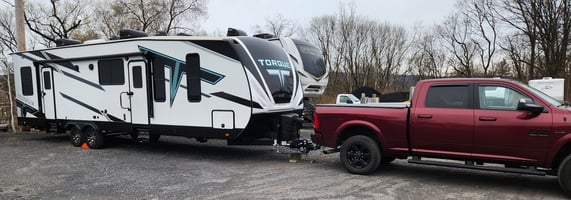
Mountain driving is where towing weaknesses are exposed.
Steep grades, sharp curves, sudden wind shifts, and long descents create the perfect conditions for trailer sway to appear—or worsen. Even experienced RV owners often find mountain routes stressful, not because of speed, but because of control.
This is where true trailer sway elimination becomes more than a convenience—it becomes a critical safety advantage.
Why Mountain Terrain Amplifies Trailer Sway
Mountain roads introduce forces that flat highways don’t:
- Crosswinds funneled through valleys
- Tight curves with elevation changes
- Long downhill braking zones
- Uneven pavement and road camber
Each of these adds lateral energy to the trailer. If the trailer can pivot freely on the hitch ball, sway has a clear path to develop.
The Hidden Danger of Descents
Descending is often more dangerous than climbing.
On long downhill grades:
- Braking shifts weight forward
- Trailer push increases
- Side-to-side movement becomes harder to control
If sway begins during braking, it can:
- Pull the tow vehicle off line
- Force emergency corrections
- Escalate rapidly
This is why downhill sway incidents are often severe.
Why Friction-Based Anti-Sway Struggles in the Mountains
Friction-based systems depend on resistance—but mountains challenge that approach.
Problems include:
- Heat buildup reducing friction effectiveness
- Moisture or dust altering resistance
- Delayed reaction after sway begins
On steep grades, forces can overwhelm friction quickly, allowing sway to build when control matters most.
Why Weight Distribution Alone Isn’t Enough
Weight distribution hitches improve:
- Vehicle leveling
- Steering response
- Brake balance
But they don’t prevent the trailer from pivoting side to side. In mountain conditions, that pivot point becomes a liability.
When gravity and lateral forces combine, sway can escalate even in a properly balanced rig.
How ProPride Changes the Physics of Mountain Towing
The ProPride 3P® Hitch eliminates sway by design.
Using patented Pivot Point Projection™, it:
- Projects the trailer’s pivot point forward
- Places it near the tow vehicle’s rear axle
- Prevents free side-to-side pivoting on the ball
With the pivot point moved forward, the trailer behaves like a stable extension of the vehicle—even on grades and curves.
Why ProPride Excels on Curves and Switchbacks
On winding mountain roads:
- The trailer follows the tow vehicle’s path
- Side forces don’t initiate oscillation
- Steering inputs feel precise and predictable
Instead of reacting to trailer movement, the driver controls the entire rig confidently through every turn.
Stability During Long Descents
During downhill braking:
- The trailer remains centered
- Lateral movement is eliminated
- The tow vehicle stays straight
This stability reduces:
- Panic braking
- Overcorrection
- Loss of control during emergencies
Drivers often describe the descent as calm—even on grades that previously caused anxiety.
Crosswinds Stop Dictating the Route
Mountain wind gusts are unpredictable.
With trailer sway eliminated:
- Gusts don’t trigger oscillation
- Speed adjustments are less drastic
- Route planning becomes simpler
ProPride owners often report no longer avoiding mountain passes or timing travel around weather.
Reduced Driver Fatigue in High-Stress Terrain
Mountain driving demands focus. When sway is present, that demand becomes exhausting.
ProPride reduces fatigue by:
- Eliminating constant corrections
- Allowing relaxed steering input
- Maintaining predictable handling
Drivers arrive at their destination alert—not drained.
Final Takeaway
Mountain routes don’t have to be white-knuckle experiences.
The forces that make mountain driving challenging—gravity, wind, and curves—are exactly the forces that expose hitch limitations. The ProPride 3P® Hitch removes the pivot geometry that allows sway to exist, delivering true stability where it matters most.
With ProPride, mountain towing becomes controlled, confident, and safe—both uphill and down.