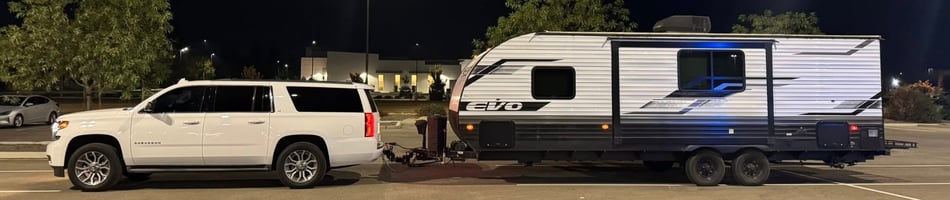
Ask experienced RV owners what type of trailer offers the best towing stability and you'll often hear the same answer:
"A fifth wheel."
For decades, fifth wheels have earned a reputation for:
- Excellent highway stability
- Reduced trailer sway
- Better handling in crosswinds
- Greater driver confidence
Meanwhile, conventional travel trailers are often associated with:
- Trailer sway
- White-knuckle driving
- Highway fatigue
- Sensitivity to passing trucks
But here's the surprising truth:
The stability difference is not primarily about the trailer itself.
It's about hitch geometry.
Understanding that distinction can save RV buyers tens of thousands of dollars and help them achieve fifth-wheel-like stability without giving up the flexibility of a travel trailer.
Why Stability Matters More Than Most RV Buyers Realize
Most RV shoppers focus on:
- Floorplans
- Sleeping capacity
- Storage
- Tow ratings
Stability is often an afterthought.
Until the first long highway trip.
A stable towing setup improves:
- Safety
- Driver confidence
- Passenger comfort
- Emergency handling
- Travel enjoyment
And for many owners, it becomes the single most important factor in choosing a towing system.
What Causes Trailer Sway in the First Place?
Before comparing fifth wheels and travel trailers, it's important to understand what causes sway.
Hitch Position and Leverage
The primary cause of trailer sway is leverage.
When a trailer pivots behind the rear axle of the tow vehicle, outside forces can create rotational movement.
Those forces include:
- Wind
- Road irregularities
- Steering inputs
- Passing vehicles
The farther behind the axle the pivot point exists, the greater the leverage.
Crosswinds
Crosswinds apply lateral pressure to the side of the trailer.
That force attempts to rotate the trailer around its pivot point.
If enough leverage exists, sway begins.
Passing Semi-Trucks
Anyone who has towed a travel trailer has likely experienced:
- The push as a semi approaches
- The pull as it passes
- The need for steering correction
These aerodynamic forces reveal how stable a towing setup really is.
Why Fifth Wheels Are Known for Stability
Fifth wheels are not inherently stable because of their size.
They are stable because of where they pivot.
Forward Pivot Point
A fifth-wheel hitch is mounted in the bed of the truck, typically over or slightly ahead of the rear axle.
This dramatically changes the towing geometry.
Instead of pulling from behind the axle, the trailer's forces act much closer to the truck's center of control.
Reduced Trailer Leverage
Because the pivot point is positioned near the axle:
- Side forces have less leverage
- Oscillation is minimized
- Sway is virtually eliminated
This is the primary reason fifth wheels feel more stable.
Better Force Distribution
The hitch location allows towing forces to be distributed more efficiently through the tow vehicle.
As a result:
- Steering feels more predictable
- Highway tracking improves
- Driver workload decreases
Why Travel Trailers Often Get a Bad Reputation
Travel trailers aren't inherently unstable.
The issue is the conventional hitch design used to tow them.
Conventional Hitch Geometry
Most travel trailers pivot at the hitch ball located behind the tow vehicle's rear axle.
This creates a leverage arm.
That leverage allows outside forces to influence the tow vehicle.
Longer Lever Arm Effect
The farther the pivot point sits behind the axle:
- The more leverage exists
- The easier sway begins
- The more steering correction becomes necessary
Driver Fatigue
This is why many travel trailer owners experience:
- White-knuckle driving
- Stress in crosswinds
- Fatigue after long trips
The trailer is constantly influencing the tow vehicle.
Fifth Wheel vs Travel Trailer Stability Comparison
| Feature | Fifth Wheel | Conventional Travel Trailer |
| Sway Resistance | Excellent | Moderate |
| Crosswind Stability | Excellent | Variable |
| Passing Truck Stability | Excellent | Variable |
| Driver Fatigue | Low | Often Higher |
| Hitch Location | Over Rear Axle | Behind Rear Axle |
| Trailer Leverage | Minimal | Significant |
| Steering Corrections | Minimal | More Frequent |
| Highway Confidence | High | Depends on Hitch Setup |
This comparison explains why so many RV owners believe a fifth wheel is automatically safer.
But there is more to the story.
The Hidden Costs of Switching to a Fifth Wheel
Many RV owners consider upgrading solely for stability.
That decision often comes with significant costs.
Truck Upgrade Requirements
Most fifth wheels require:
- Heavy-duty pickups
- Larger payload capacities
- More expensive tow vehicles
It's not unusual for owners to spend tens of thousands of dollars upgrading trucks.
Higher Trailer Costs
Comparable fifth wheels typically cost substantially more than travel trailers.
The investment can be significant.
Loss of Truck Bed Space
A fifth-wheel hitch occupies valuable truck bed space.
This reduces:
- Cargo capacity
- Utility
- Flexibility
For many owners, that's a major compromise.
The Real Question: Is It the Trailer or the Hitch?
This is where many buyers misunderstand the stability discussion.
The reason fifth wheels feel stable is not because they are fifth wheels.
It's because they move the effective pivot point closer to the tow vehicle's rear axle.
If a travel trailer could achieve similar geometry, it could achieve similar stability.
That's exactly what Jim Hensley spent decades engineering.
How the ProPride 3P® Changes the Equation
The ProPride 3P® uses Pivot Point Projection™ technology to fundamentally change how a travel trailer behaves.
Pivot Point Projection Technology
The ProPride 3P® projects the effective pivot point of the trailer forward toward the rear axle of the tow vehicle.
This dramatically reduces trailer leverage.
Eliminating Trailer Sway
Unlike friction-based sway control systems that attempt to resist movement after it begins, the ProPride 3P® eliminates the geometry that allows sway to develop.
The result is a fundamentally more stable towing system.
Mimicking Fifth-Wheel Geometry
This is the key advantage.
The ProPride 3P® allows a bumper-pull travel trailer to behave much more like a fifth wheel when subjected to outside forces.
Without:
- Buying a new trailer
- Upgrading trucks
- Losing bed space
Real-World Driving Scenarios
The difference becomes obvious in challenging situations.
Crosswinds
Crosswinds that once caused anxiety become far more manageable when trailer leverage is eliminated.
Mountain Roads
Steep descents, curves, and changing weather demand stability.
This is where hitch geometry matters most.
Interstate Travel
Long highway drives become less stressful because steering corrections are dramatically reduced.
Emergency Maneuvers
Emergency lane changes and sudden braking events are safer when the trailer remains aligned behind the tow vehicle.
Fifth Wheel vs ProPride 3P® Travel Trailer Comparison
| Feature | Fifth Wheel | Travel Trailer with ProPride 3P® |
| Sway Elimination | Yes | Yes |
| Crosswind Stability | Excellent | Excellent |
| Truck Bed Access | No | Yes |
| Requires New Trailer | Yes | No |
| Requires New Truck | Often | Usually No |
| Hitch Geometry Advantage | Yes | Yes |
| Travel Trailer Flexibility | No | Yes |
| Overall Value | Variable | Exceptional |
Why Many RV Owners Choose ProPride Instead of Upgrading Trailers
Many owners discover they don't need a different trailer.
They need a different hitch.
Rather than spending:
- $15,000–$30,000 on a truck upgrade
- Tens of thousands on a fifth wheel
They can achieve dramatically improved towing stability by addressing the geometry responsible for sway.
Who Benefits Most from the ProPride 3P®?
The ProPride 3P® is ideal for owners who:
- Love their current travel trailer
- Tow long distances
- Travel in windy regions
- Want safer highway handling
- Experience towing fatigue
- Desire fifth-wheel-like stability
FAQs
Is a fifth wheel safer than a travel trailer?
Generally, fifth wheels are more stable because their hitch point is located near the rear axle. Stability comes from geometry, not necessarily the trailer itself.
Why do fifth wheels resist sway better?
Because the pivot point is located over the truck's rear axle, reducing trailer leverage.
Can a travel trailer be as stable as a fifth wheel?
With the right hitch geometry, it can achieve very similar towing characteristics.
What makes the ProPride 3P® different?
The ProPride 3P® uses Pivot Point Projection™ technology to eliminate sway by changing the effective pivot point of the trailer.
Do I need a bigger truck if I install a ProPride 3P®?
In many cases, no. The ProPride 3P® allows owners to safely utilize the towing capacity of their existing properly rated vehicle.
Is a ProPride 3P® cheaper than upgrading to a fifth wheel?
For most RV owners, yes. It is significantly less expensive than purchasing a new truck and fifth-wheel trailer combination.
Conclusion
When comparing fifth wheel vs travel trailer stability, the answer isn't as simple as choosing one trailer type over another.
The real difference lies in hitch geometry.
Fifth wheels achieve superior stability because their pivot point is located near the rear axle, reducing leverage and preventing sway.
The ProPride 3P® applies the same engineering principle to travel trailers through Pivot Point Projection™ technology.
The result is a towing experience that delivers:
- Exceptional stability
- Reduced driver fatigue
- Improved safety
- Greater confidence
- Fifth-wheel-like performance
Without giving up the flexibility, convenience, and affordability of a travel trailer.
For many RV owners, that makes the ProPride 3P® one of the smartest towing upgrades available today.