
A passing truck can move your trailer, but loading and towing choices affect how strongly you feel it. Eliminating push-pull from passing trucks starts with a balanced trailer, appropriate tongue or pin weight, and enough space to reduce the effect of the truck’s turbulence.
That side-to-side nudge can feel unsettling, especially in close traffic. Some movement is normal, and it tends to be stronger when vehicles pass near each other. The goal isn’t to react sharply or expect one adjustment to erase every sensation. Instead, make deliberate choices that help your rig behave more predictably.
This guide explains how cargo placement and trailer weight affect stability, what hitch setup can and can’t change, and why passing distance matters. You’ll also find practical steps for managing a pass safely, so you can make informed towing decisions and travel with greater confidence.
Key Takeaways
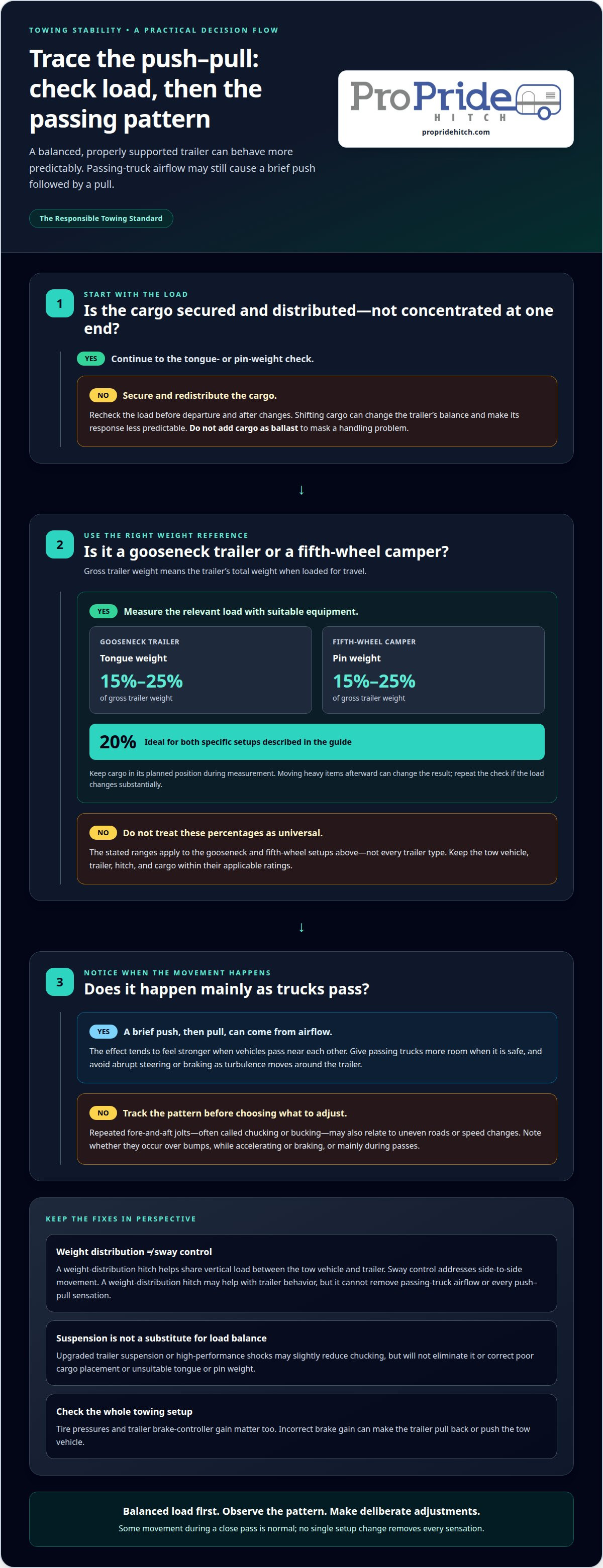
- Place cargo securely and distribute it to maintain appropriate tongue or pin weight; for the setups discussed, the recommended range is 15% to 25% of gross trailer weight, with 20% as the ideal.
- A weight-distribution hitch can help manage trailer behavior, but it may not remove every push-pull sensation from passing traffic.
- Give passing trucks more room when it’s safe, and avoid abrupt steering or braking as air turbulence moves around the trailer.
- Check trailer brake-controller gain and tire pressures as part of a careful towing setup; incorrect brake gain can make the trailer pull back or push the tow vehicle.
Trailer load and push-pull effects
A passing semi can create a brief push, followed by a pull, as air moves around the truck and trailer. The sensation can feel stronger when the trailer is lightly loaded. Some enclosed-trailer owners report more noticeable push from trucks when towing empty than with cargo aboard. That experience doesn’t mean adding weight is a safe fix. The tow vehicle, trailer, hitch, and cargo must stay within their applicable ratings.
Load placement matters as much as the amount carried. Shifting cargo can change the trailer’s balance on the road, making its response less predictable. Secure each item and distribute the load instead of concentrating heavy cargo at one end. Before departure, check that the cargo hasn’t moved and the trailer sits in a stable towing position. Don’t add cargo as ballast to mask a handling problem.
Tongue weight is the downward force a conventional trailer applies at the hitch. Pin weight is the corresponding load carried by a fifth-wheel hitch. The recommended ranges differ by setup: a gooseneck trailer tongue weight should be 15% to 25% of gross trailer weight, with 20% as the ideal. A fifth-wheel camper pin weight should also be 15% to 25% of gross trailer weight, with 20% as the ideal. These figures describe those specific setups, not every trailer type.
To use those percentages, start with the trailer’s gross weight, its total weight when loaded for travel. Then measure the tongue or pin load with equipment suited to the trailer and hitch arrangement. Keep cargo in its planned position during measurement. Moving heavy items afterward can change the result, so repeat the check if the load changes substantially. The goal is a balanced, properly supported combination, not simply a heavier trailer.
Reported examples show why load conditions deserve attention. A separate report described side push during a 2,800-mile trip with a 3,000-pound, 17-foot cargo trailer. These are individual experiences, not universal predictions. Trailer size, cargo position, hitch arrangement, and passing distance all shape what the driver feels.
Chucking and bucking describe repeated fore-and-aft jolts between the tow vehicle and trailer. A rigid fifth-wheel hitch or gooseneck coupler can transfer shocks between them. Passing turbulence may trigger the movement, but uneven roads or speed changes can contribute too. Notice whether it happens mainly during truck passes, over bumps, or while accelerating and braking. The pattern helps distinguish a brief air disturbance from repeated motion that needs attention.
Suspension changes have limits. Upgraded trailer suspension or high-performance trailer shocks may slightly reduce chucking, but they won’t eliminate it. They also won’t correct poor cargo placement or unsuitable tongue or pin weight. Treat suspension as one part of the setup, not a substitute for checking load balance. Air-ride hitches isolate the tow vehicle from the trailer and dampen chucking and bucking, addressing a different part of the motion.
- Secure and distribute cargo, then recheck the load after changes.
- Use the recommended tongue or pin weight range for the applicable trailer setup.
- Track when chucking occurs before deciding whether load, suspension, or hitch setup needs attention.
For drivers focused on eliminating push-pull from passing trucks, load setup is a practical starting point. It can improve the trailer’s behavior, but it can’t remove the airflow created by a passing truck. A balanced load, appropriate tongue or pin weight, and attention to repeated jolts give you a clearer basis for assessing the entire towing setup.
Trailer weight distribution hitches
A weight-distribution hitch changes how the tow vehicle and trailer share vertical load. Spring bars connect the hitch head to the trailer frame, helping transfer some load away from the tow vehicle’s rear axle. When correctly matched and adjusted, this can improve the combination’s balance. It may also help reduce the effect of passing trucks, but it can’t remove the air disturbance itself.
Weight distribution and sway control are related, but they aren’t the same. Weight distribution addresses how the trailer’s downward force affects the tow vehicle. Sway control addresses side-to-side movement. A hitch may include features that influence both, but the terms describe different functions. This distinction matters when diagnosing a trailer that feels unsettled during a pass. Weight distribution can help, but drivers report that it doesn’t always eliminate every push or pull.
Set up the hitch with the loaded combination, not an empty trailer in the driveway. Cargo, passengers, and equipment change the tow vehicle’s stance and the forces at the hitch. Follow the hitch manufacturer’s adjustment procedure for the trailer’s actual travel condition. Check that the hitch head, spring bars, and frame attachments are seated and secured as instructed. Then assess whether the tow vehicle and trailer sit in a stable, level position. Don’t compensate for a poor load by increasing spring-bar tension without guidance.
Spring-bar tension affects how load transfers through the system. Too little adjustment may leave more of the hitch load on the tow vehicle’s rear. Too much can alter axle loading and the trailer’s attitude. The correct setting depends on the tow vehicle, trailer, hitch, and loaded condition. Make one adjustment at a time, then recheck the combination instead of changing several components together. This makes it easier to identify which change affected handling.
A weight-distribution hitch won’t correct every cause of movement. Cargo that shifts during travel, for example, can change balance even if the hitch was set up properly before departure. Tire pressure matters too: truck and trailer tires should be appropriate for the gross trailer weight. If you find worn tread or need replacements fitted at home before a trip, Mobile Tyre Service can help get your rig road-ready. Trailer brake-controller gain is a separate adjustment that can affect how the combination behaves while slowing.
On a clear road, test brake-controller gain at 25 mph by applying the brakes. If gain is too high, trailer brakes may grab harder than the truck brakes, pulling the trailer back. If gain is too low, the trailer may push the tow vehicle and surge back and forward. This test evaluates braking response, not weight distribution, so don’t use it to judge spring-bar adjustment.
Use a deliberate sequence when assessing the setup:
- Load the trailer for travel and secure cargo against movement.
- Adjust the weight-distribution hitch according to its instructions.
- Check the tow vehicle and trailer’s stance after adjustment.
- Assess braking separately, using the controller’s recommended procedure.
If a truck’s pass still produces a noticeable nudge, avoid abrupt steering corrections. A weight-distribution hitch can help manage the towing combination, but passing distance, cargo stability, tire condition, and braking response also shape what you feel. Consider each as a separate part of the setup. This helps inform your next adjustment and avoids expecting one hitch setting to solve every handling issue.
Owner reports reflect this limitation: one forum member said a weight-distribution hitch didn’t eliminate all push-pull while towing an enclosed trailer. Another said a weight-distribution hitch can help with push-pull from passing trucks. These experiences are a reminder to treat the hitch as one part of the setup, not a guarantee against every disturbance. Continue assessing the loaded combination and adjusting it according to the hitch manufacturer’s instructions.
Passing distance and truck turbulence
A passing truck can create changing air pressure around a trailer. The trailer may first feel pushed away, then drawn toward the truck as it moves ahead. The disturbance can be more noticeable when vehicles pass close together. You can’t control the truck’s path, but you can manage your speed, lane position, and response. Keep both hands ready and look ahead instead of focusing only on the truck.
Give the passing vehicle as much room as traffic and the road safely allow. If a truck approaches from behind, avoid drifting toward it or making a sudden steering correction. Keep the tow vehicle and trailer in your lane. When the truck is alongside, maintain a steady course and wait until it moves ahead before making any gradual adjustment. A sudden correction can add instability rather than reduce it.
Are SUVs and small cars more vulnerable to passing-truck wind gusts? A lighter vehicle may react more noticeably to a gust than a heavier one, but the trailer, load, road position, and wind all affect what you feel. For example, a small SUV towing a broad enclosed trailer may respond differently from the same SUV driving without a trailer.
When a truck begins passing, ease off the accelerator if needed to reduce speed smoothly. One forum recommendation suggests slowing to counter wind turbulence. Avoid braking hard or accelerating to race the truck. If the road has a safe, usable shoulder, moving slightly toward it may create more separation, but don’t leave your lane or enter an unsafe area. Road edges, soft shoulders, and nearby traffic can make that move hazardous.
Use your mirrors to follow the pass from approach to completion. Check the approaching lane, note the truck’s position, and keep watching until it is clearly ahead. Don’t steer back toward the lane center abruptly after it passes. A trailer may respond a moment after the tow vehicle, so hold a steady line and let the combination settle before changing lanes or speed.
Do traffic laws or driver manuals provide guidance for passing trucks in the United States? Driving guidance and traffic rules vary by state and road situation, so don’t assume one universal passing-gap number applies everywhere. Professional commercial operators study these wind-wake dynamics and road-sharing protocols during CDL training at programs like Lone Star Truck Driving Academy, reinforcing why maintaining a buffer matters for both vehicles. When towing, follow posted signs and applicable road instructions, maintain control, and leave as much safe space as traffic permits.
Use this sequence when a truck approaches from behind:
- Check mirrors and keep the tow vehicle and trailer centered in the lane.
- Reduce speed smoothly if conditions call for it; avoid abrupt braking or steering.
- Allow the truck to move fully ahead before changing lanes or adjusting position.
- Reassess the road before using a shoulder or making any other movement.
Repeated, strong movement deserves attention beyond a single truck pass. Note whether it occurs with every large vehicle, only in crosswinds, or on a particular stretch of road. The pattern can help distinguish passing turbulence from a broader handling concern. Respond consistently: hold your course, preserve safe space, and don’t try to cancel each gust with a sharp correction.
Distance reduces how directly the truck’s air disturbance affects your trailer, but traffic may limit the space available. Make the safest adjustment the road allows, not the most dramatic one. A controlled speed change and steady lane position give you time to respond while keeping the tow vehicle and trailer moving predictably.
Push-pull from passing trucks
A large truck can create a short push, then pull, as it passes a tow vehicle and trailer. This is a familiar effect of close passing and can feel stronger when vehicles are nearer. The key is to manage the towing combination’s response, not steer against every change in airflow. A calm, consistent approach gives the trailer less extra movement to react to.
What are the risks of braking or making sudden steering corrections near a passing truck? Abrupt braking can change the forces between the tow vehicle and trailer, while a sharp steering input can make the trailer react after the tow vehicle. Together, these corrections can add instability while passing airflow is already disturbing the combination.
As a truck approaches from behind, check your mirrors and keep a steady lane position. Hold the wheel firmly without gripping it so tightly that you overcorrect. Let the truck pass and keep tracking its position until it moves ahead. If you need to reduce speed, ease off the accelerator smoothly rather than braking hard. A sudden speed change gives the trailer a different force to respond to.
Some drivers recommend moving toward the shoulder as a truck approaches, if it’s safe. Treat this as an option, not a fixed maneuver. A narrow shoulder, soft road edge, barrier, or nearby vehicle can make moving over more dangerous than holding your lane. Don’t cross a lane line or give up control to create extra space. Choose the safest position available on the road you’re driving.
Distance can reduce how strongly a passing vehicle’s air disturbance reaches your trailer. Traffic may not leave room for a large gap, so don’t treat any one distance as a universal target. Instead, preserve the space available, avoid accelerating to compete with the truck, and let it complete the pass. Once it’s ahead, wait for the trailer’s movement to settle before changing lanes or speed.
A sway-control bar is a hitch component that helps limit side-to-side trailer movement by resisting the trailer’s sway. It may make a difference for some trailer combinations affected by passing trucks, but it doesn’t remove the airflow around the rig. A weight-distribution hitch can also help manage the towing combination without eliminating every push or pull. These are different parts of the setup, and neither makes abrupt steering or braking a sound response. You still need to maintain a controlled course as traffic changes.
Pay attention to the pattern. If the trailer moves briefly only as a truck passes, note how close the truck was and whether wind or road position played a part. If movement continues after the truck is gone, or occurs without passing traffic, treat it as a separate handling concern. Don’t assume every repeated movement comes from truck turbulence alone.
Use this practical sequence during a pass:
- Check mirrors as the truck approaches and keep the rig within its lane.
- Hold a steady course; reduce speed gradually if conditions call for it.
- Use shoulder space only when it is clear, stable, and safe to enter.
- Wait until the trailer settles before making another maneuver.
For drivers focused on eliminating push-pull from passing trucks, the clearest takeaway is simple: create safe space when possible, maintain a steady line, and avoid sharp corrections. A passing truck can still produce a brief nudge. Managing your response helps keep that moment from becoming an unnecessary steering or braking event.
ProPride
ProPride is a natural next step if you’ve improved your load and towing habits but still want a hitch designed to address trailer sway. The ProPride 3P Hitch uses patented Pivot Point Projection technology, which changes where the trailer pivots so it turns around a point closer to the tow vehicle’s rear axle. This helps the hitch resist trailer sway. Sway is different from the brief push-pull caused by a truck’s airflow, so safe spacing and steady driving still matter during a pass. That informed approach reflects The Responsible Towing Standard.
If you’re weighing hitch design as part of your towing setup, explore the ProPride 3P Hitch and how its approach addresses sway. Contact ProPride with your questions as you consider your next step.
Make Your Next Towing Decision With Confidence
A useful next step is to turn each uncomfortable pass into information you can act on. After a trip, note when the trailer moved, the traffic and road conditions, and whether the movement stopped once the truck passed. Those observations can help distinguish a brief response to surrounding airflow from a handling pattern that deserves closer attention.
A thoughtful approach to eliminating push-pull from passing trucks doesn’t depend on one adjustment. It comes from understanding how your towing setup behaves, making changes deliberately, and judging the result under comparable conditions. If you’re considering whether a different hitch design fits your towing needs, bring your questions to ProPride and explore the available information before deciding.
Contact ProPride about your towing setup and take your next step toward more informed, responsible towing.
Frequently Asked Questions
What causes the push-pull effect when a truck passes a car?
It comes from pressure changes around the truck as it moves past the car. The effect can be more noticeable beside a large, flat-sided vehicle, which moves a substantial amount of air. A wide trailer also presents more side surface than a compact car. If the sensation continues after the truck has moved ahead, note that separately; it may point to handling behavior beyond the passing event.
How can drivers safely pass a truck without being pushed or pulled?
Before pulling out to pass, make sure you can see far enough ahead and have room to complete the maneuver without cutting back in. When towing, account for the trailer’s length as well as the tow vehicle’s. If the opening is tight or your view is blocked, wait behind the truck for a clearer opportunity. Once alongside, avoid staying in the truck’s blind spot longer than necessary.
