
A correctly rated hitch can still tow poorly if it isn’t set up properly. Common WDH setup mistakes often start with skipped measurements, rushed adjustments, or an inconsistently loaded trailer. The result can be uncertainty about how the system is working and handling that doesn’t inspire confidence.
If you’re unsure which measurements matter or you’ve received conflicting advice about setup order, pause before making changes. Weight distribution depends on the tow vehicle, trailer, load, and hitch working together. Hitch design matters, but it doesn’t replace careful setup.
This guide explains how to spot common setup errors, why they matter, and which measurements and instructions to revisit before your next trip. You’ll also learn why guessing at adjustments or expecting a hitch to correct poor loading can undermine the result. Finally, we’ll look at how hitch design fits into responsible towing, including the ProPride 3P Hitch and its Pivot Point Projection technology. The goal is a clearer, more informed setup and greater confidence in the system you’re towing with.
Key Takeaways
- Follow the hitch maker’s instructions and use consistent measurements to catch common WDH setup mistakes.
- Keep passengers and cargo consistent when comparing measurements, so changes reflect the adjustment rather than a different load.
- Adjust spring-bar tension in measured steps, changing one thing at a time instead of relying on guesswork.
- Check the hitch connections and components before towing, then verify weight distribution separately from the hookup.
- Compare hitch designs carefully: sway control and weight distribution serve related but distinct purposes.
Common WDH setup mistakes: what they can change on the road
A weight distribution hitch (WDH) helps spread some of the trailer’s tongue load across the tow vehicle and trailer axles. That can help the tow vehicle sit and handle more evenly, but only when the equipment is compatible and adjusted according to the manufacturer’s instructions. The Weight-distributing hitch article offers background on how this type of system works.
Weight distribution is the adjustment of a hitch system to share some of the trailer’s tongue load across the tow vehicle and trailer axles. It doesn’t make the trailer’s load disappear, and a WDH can’t correct every issue in a towing setup. The right settings depend on the hitch, tow vehicle, trailer, and how they’re loaded. A setting that works for one combination may not suit another.
How can an incorrect WDH setup affect towing?
If weight isn’t being distributed as intended, the tow vehicle may sit differently than expected, including a noticeable change in its front-to-rear stance. That shift can affect steering feel, and the trailer may feel less settled behind the vehicle. These are possible effects, not proof of a specific setup fault. Tire condition, loading, road surface, and other parts of the towing system can also influence what you feel.
A vehicle that appears nose-high or a trailer that looks uneven deserves a closer check, but appearance alone can’t confirm a mechanical failure or identify the cause. Don’t compensate with an unmeasured adjustment. Record what you observe, then compare your measurements and setup steps with the instructions for your hitch and vehicle.
Which warning signs deserve a closer setup check?
Look for changes in how the tow vehicle and trailer sit when hitched, especially if their stance differs from your usual baseline. While driving, note unusual steering response, a new feeling of instability, or trailer movement that concerns you. A symptom is a prompt to investigate, not a diagnosis. If handling feels unsafe, stop somewhere safe rather than trying to troubleshoot while moving.
Before changing anything, review the complete setup: the trailer load, hitch connection, components, and measurements specified in the product instructions. Write down the conditions and observations so you can compare them after a controlled adjustment. The broader Travel Trailer Towing Mistakes guide can help you consider other towing habits that may contribute to concerns.
Start by establishing consistent measurements and loading conditions, then adjust in a deliberate, trackable sequence. This helps you distinguish a setup that needs correction from a problem that calls for closer mechanical inspection. Recognizing common WDH setup mistakes isn’t about guessing from one road symptom. It’s about checking the whole system methodically and treating accurate setup as part of responsible towing.
Measurements and loading errors to catch before adjusting a WDH
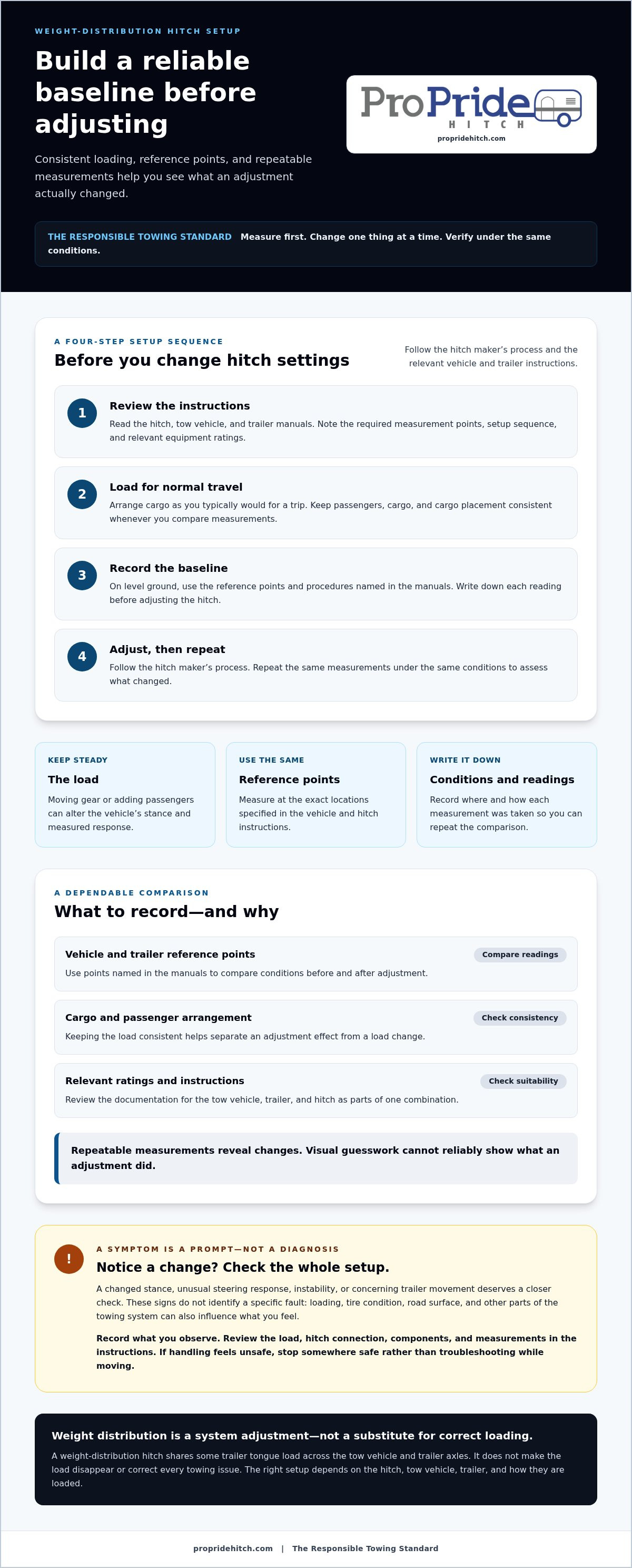
Before changing hitch settings, establish what you’re measuring and under what conditions. A shifted cargo load, added passenger, or different measurement method can make two sets of numbers seem comparable when they aren’t. Set a consistent baseline so you can adjust based on evidence rather than a changing setup.
- Review the instructions. Read the hitch, tow vehicle, and trailer manuals. Note the required measurement points, setup sequence, and relevant equipment ratings.
- Load for normal travel. Place cargo as you typically would for a trip, and keep passengers and cargo consistent during comparisons.
- Record measurements. On level ground, follow the manufacturers’ procedures and write down each measurement before adjusting the hitch.
- Adjust only after the baseline is clear. Follow the hitch maker’s process, then repeat the same measurements under the same conditions to assess the change.
Why does loading the trailer inconsistently lead to setup errors?
Cargo placement and load changes affect the condition you’re measuring. Moving gear, adding passengers, or changing what’s carried in the tow vehicle can alter its stance and the hitch’s measured response. Record your normal travel load, including where cargo is placed, and keep it consistent when comparing results. Otherwise, you may mistake a load change for an adjustment effect.
Which measurements should you record before making adjustments?
Use level ground and the exact reference points named in your vehicle and hitch instructions. Depending on those procedures, you may need to record measurements of the tow vehicle and trailer before and after hitching or adjustment. Note the location and conditions for each reading, then repeat them consistently. Repeatable measurements reveal changes; visual guesswork can’t reliably show what an adjustment did.
| What to measure or record | Why it matters |
|---|---|
| Vehicle and trailer reference points specified in the manuals | Creates a consistent comparison before and after adjustment. |
| Cargo and passenger arrangement | Shows whether the load stayed the same between readings. |
| Relevant ratings and instructions | Helps confirm the equipment and setup are suitable for the combination. |
How can incompatible ratings or instructions undermine setup?
Compare the relevant ratings in the tow vehicle, trailer, and hitch documentation. Ratings describe limits for different parts of the towing combination, so don’t assume one component’s rating overrides another. The most restrictive applicable rating can constrain the complete combination. If instructions differ, don’t blend procedures or choose a setting by guesswork. Follow the directions for the specific equipment and vehicle involved.
These checks address common WDH setup mistakes before you adjust tension or other settings. If you’re comparing hitch designs alongside their setup requirements, learn about the ProPride 3P Hitch. Whatever system you use, keep compatible ratings, consistent loading, and instructed measurements at the center of your setup.
WDH adjustment mistakes: avoid guessing at spring-bar tension
Once you have a consistent baseline, adjust the hitch using the procedure for that specific model. Some weight-distribution hitches use spring bars, components that apply leverage between the tow vehicle and trailer to help redistribute load. How the bars are positioned or tensioned varies by hitch design. There’s no universal setting or adjustment sequence that can replace the manufacturer’s instructions.
Separate general principles from model-specific directions. Make a controlled change, then check the result using the measurement method specified for your equipment. The hitch instructions determine the adjustment points, tools, and limits. Don’t borrow a procedure from a different model just because its parts look similar.
What goes wrong when you adjust by appearance alone?
A level-looking vehicle or trailer can be reassuring, but it doesn’t prove that weight is distributed correctly. Stance can be affected by suspension, load placement, and the ground beneath the rig. Use visual checks to notice changes, then compare your recorded measurements with the hitch and vehicle instructions. Appearance is one useful observation, not a complete verification method.
For example, if the trailer looks more level after an adjustment, that alone doesn’t tell you whether the hitch is within its prescribed setup range. Measurements provide a repeatable basis for comparison. If readings don’t match the process or targets in the relevant instructions, pause rather than continuing to adjust until the setup looks right.
Why can excessive or insufficient adjustment cause problems?
Too much or too little adjustment can leave the system behaving differently than intended. You might notice a change in vehicle stance, steering feel, or ride, but none of those signs confirms a single cause. Treat them as reasons to recheck the setup, not as a diagnosis or a reason to keep tightening or loosening components by feel. Each hitch has its own method and limits.
Use a measured, incremental approach:
- Record the starting settings and measurements.
- Make one adjustment allowed by the hitch instructions.
- Repeat the prescribed measurements under the same conditions.
- Write down the result before deciding whether another adjustment is needed.
Changing several settings at once makes it difficult to know which change affected the result. Without a record, you also can’t reliably retrace your steps if the outcome is unexpected. Return to the manufacturer’s procedure instead of compensating with another guess.
These are common WDH setup mistakes because visual confidence and “close enough” tension can feel like shortcuts. But the goal isn’t simply to make the rig look level or the bars feel tight. Follow the specific instructions, compare measured results, and stop if you can’t verify that the setup is within the hitch’s stated limits. Separating observation, adjustment, and verification is central to responsible towing.
Connection and verification mistakes to correct before towing
A secure hookup is necessary, but it doesn’t prove that the weight-distribution setup is correct. Connection checks confirm that the hitch is attached as intended; measurement checks help show whether its adjustment is producing the result specified for your combination. Treat these as related but separate steps.
Which connection checks belong in a WDH pre-tow routine?
Use the hitch manufacturer’s instructions as your checklist, including its names for each connection and component. Confirm that the hitch is attached and engaged as directed, then look over the hookup components for anything visibly out of position or damaged. Don’t assume a connection is secure just because it looks familiar or the trailer is coupled.
Check the safety chains and electrical connection according to the instructions for your towing system. Connect the chains as directed, and make sure the electrical connection is seated so the trailer’s systems can function as intended. Follow the manual’s sequence rather than assuming there’s a universal order, since designs and procedures differ. A broader A Pre-Trip Towing Safety Checklist can complement these hitch-specific checks, while mobile electronics specialists like Music In Motion can help ensure your tow vehicle's wiring and camera systems are properly integrated.
This quick review is not a full maintenance inspection. It helps verify the hookup before travel, but it doesn’t replace the inspection and care described in the equipment manuals. If you see damage or looseness, or a component won’t engage as instructed, don’t treat the setup as ready based on appearance alone.
How do you confirm an adjustment instead of assuming it worked?
Repeat the measurements you recorded before the adjustment. Keep the tow vehicle and trailer on the same level surface, with the same passengers and cargo arrangement, and use the same measurement points. Compare the readings with the relevant hitch, vehicle, and trailer instructions. If conditions changed, the comparison may not show whether the adjustment itself made a difference.
A successful hookup only confirms that the components came together; it doesn’t establish that weight distribution is correct. A change in appearance or handling also isn’t enough to prove that an adjustment worked. Record the readings and the adjustment you made. If the results don’t align with the applicable instructions, pause and revisit the procedure rather than making another untracked change.
Recheck the setup after a material change, such as a different cargo arrangement or a change to towing equipment. Those changes can alter the conditions your earlier measurements described, so don’t assume the previous verification still applies. A pre-tow setup review focuses on attachment, engagement, and whether the measured adjustment follows instructions. A full maintenance inspection addresses the wider condition of the equipment over time.
Common WDH setup mistakes are easier to avoid when connection checks and measurement verification stay distinct. If a concern persists after a careful review, use system-specific troubleshooting instead of guessing at the cause. If you’re considering a hitch design for your towing setup, explore the ProPride 3P Hitch and keep correct setup central to your decision.
Choose a WDH design that supports responsible, correctly verified towing
Hitch design is one part of a towing system, not a substitute for getting the setup right. A weight-distribution hitch helps distribute load, while sway-control design addresses how the system responds to trailer sway. These considerations are related, but they aren’t interchangeable. A hitch’s design can’t correct incompatible equipment, inconsistent loading, or adjustments that haven’t been verified against the instructions.
How does hitch design fit into the setup equation?
Weight-distribution and sway-control approaches vary. Some use friction to resist trailer movement; other designs use a different mechanical approach. The ProPride 3P Hitch uses patented Pivot Point Projection technology, an approach rooted in the design legacy of inventor Jim Hensley. In simple terms, pivot point projection changes where the trailer pivots in relation to the tow vehicle. For a deeper look at this design, see The ProPride 3P Hitch: The Ultimate Engineering Solution for Trailer Sway Elimination.
That difference may matter as you compare hitch designs, but it doesn’t remove the need for careful setup. Follow the instructions for the specific hitch, vehicle, and trailer. Load consistently, use the prescribed adjustment procedure, and verify the result with the required measurements. Design and setup work together; neither replaces the other.
Keep the distinction clear as you assess a setup concern. If the vehicle stance or trailer behavior seems different, don’t assume a particular sway-control design is the cause or the cure. Revisit the measurements and instructions first. Then consider whether the hitch’s design suits your towing priorities and equipment, without treating a design feature as proof that the complete setup is correct.
What is a responsible next step after finding setup concerns?
Before towing, return to the instructions for the exact hitch, tow vehicle, and trailer combination. Confirm that the equipment ratings are compatible, the load reflects your intended travel conditions, and the setup follows the required procedure. If an adjustment doesn’t produce results you can verify, pause and resolve the uncertainty rather than making further untracked changes.
The Responsible Towing Standard starts with preparation, continues through measured setup, and includes careful verification. It’s a practical way to make decisions based on the system in front of you, not assumptions about how a hitch should look or feel. The common WDH setup mistakes in this guide point to the same principle: responsible towing depends on both sound engineering and disciplined use.
The ProPride 3P Hitch brings Pivot Point Projection together with Jim Hensley’s design legacy as a distinct sway-control option. If you’re considering that approach for your travel trailer, explore the ProPride 3P Hitch and review how its design fits your towing system and setup process.
Make your next towing decision with confidence
Let your next decision reflect how you actually travel. Consider the trailer you tow, the vehicle you pair it with, and the level of confidence you want from your towing system. If your needs or equipment change, reassess your choices rather than assuming what worked before will always fit.
Choosing thoughtfully takes time, and that preparation is part of responsible towing. The common WDH setup mistakes discussed here are a reminder to keep learning and make decisions that suit your towing plans.
The Responsible Towing Standard means approaching each decision with care. Explore the ProPride 3P Hitch as you consider which hitch design aligns with your priorities.
With a clear understanding of your needs, you can move forward with greater confidence and make your next towing decision deliberately.
Frequently Asked Questions
Can an incorrectly set up WDH affect how my trailer tows?
Yes. It can change how the tow vehicle responds or how settled the trailer feels, but those sensations don’t identify the cause. If steering feels different only after hitching, consider the entire combination rather than assuming the hitch is at fault. Tire condition, road surface, and load can also affect handling. If the change feels unsafe, stop in a safe place and assess the situation before continuing.
How do I know if my weight distribution hitch is adjusted correctly?
There isn’t one visual cue or road feel that confirms every hitch setup. Use the procedure and outcome specified for your particular equipment. Keep a brief record of your vehicle, trailer, and load configuration alongside your setup results. That gives you a reference if handling changes later or you need to distinguish a new condition from one you’ve encountered before.
What happens if a WDH is adjusted too tightly or not tightly enough?
Either condition can leave the hitch outside its intended operating range and may affect ride or vehicle response. Don’t treat a rough ride or unusual steering feel as proof that tension is the only issue. Avoid forcing components beyond the adjustment limits in the hitch instructions. If you can’t tell whether the setting is within those limits, stop adjusting and use the system’s troubleshooting guidance before towing.
Should I adjust a weight distribution hitch with the trailer loaded?
Set up the trailer in the condition specified by the hitch and vehicle makers. An empty trailer may not represent a typical trip if you normally carry clothing, tools, or recreational gear. Use a realistic travel configuration, and secure loose items so their position doesn’t shift during the process. If your planned load is unusual, such as bulky equipment, account for it before relying on the setup.
Can a weight distribution hitch stop trailer sway on its own?
No single assumption applies to every hitch. Weight distribution and sway control are related functions, but a WDH doesn’t automatically provide the same sway-control design as another model. Trailer movement can also have causes beyond the hitch. If sway occurs, don’t assume an adjustment alone will resolve it. Follow the tow vehicle and trailer guidance for responding to sway, and address the cause before resuming travel.
Do I need to repeat WDH measurements after changing my trailer load?
Reassess the setup if a load change could affect how the trailer couples to the tow vehicle. For example, adding a heavy item to a storage compartment can change the load at the hitch even if the trailer’s overall appearance seems unchanged. Keep cargo secured and distributed as directed by the trailer maker. Use the resulting setup information as a new reference rather than relying on readings from a different load condition.
Can the same WDH setup work with a different tow vehicle or trailer?
Don’t assume a previous setup transfers to a new combination. A different receiver height, vehicle, or trailer can change how the components meet and what the manufacturers specify. A hitch that physically connects may still require a different configuration or may not suit that combination. Treat the new pairing as its own setup, and confirm that it meets the relevant ratings and instructions before towing.

