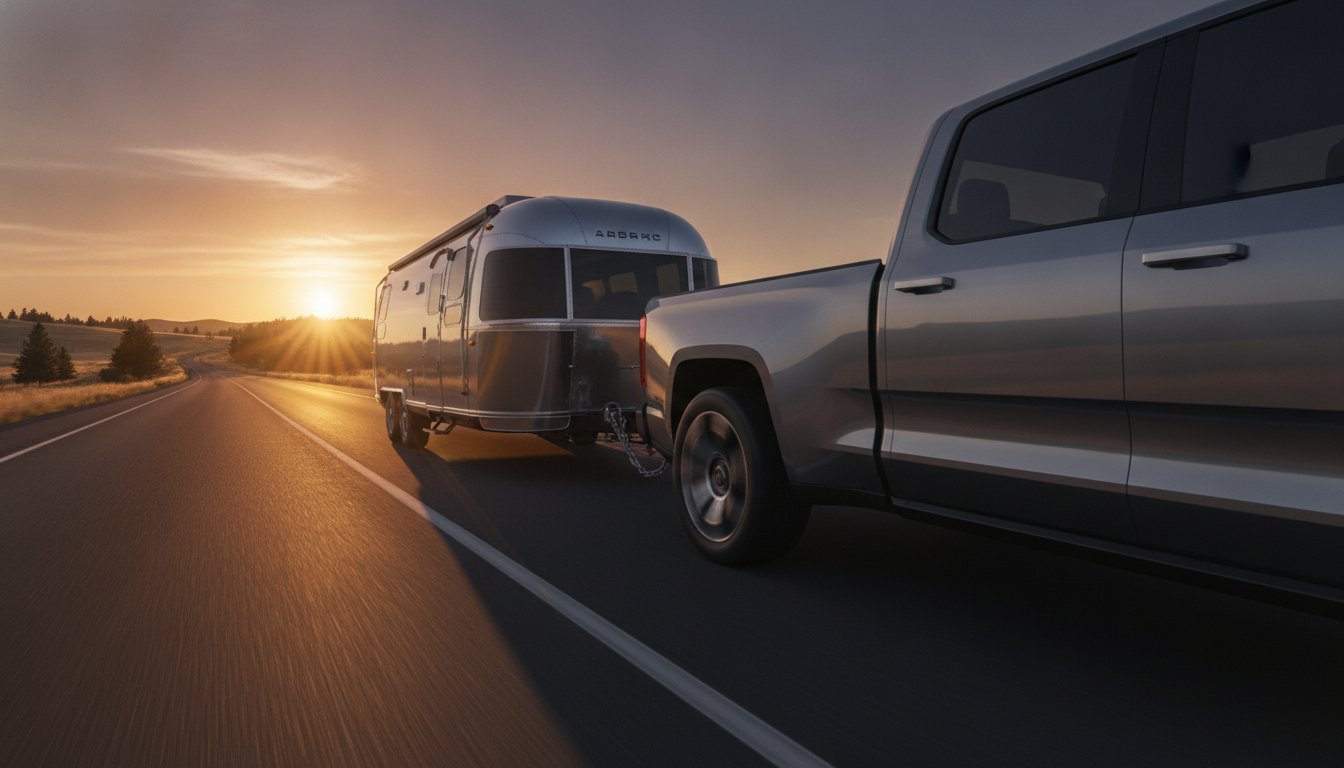
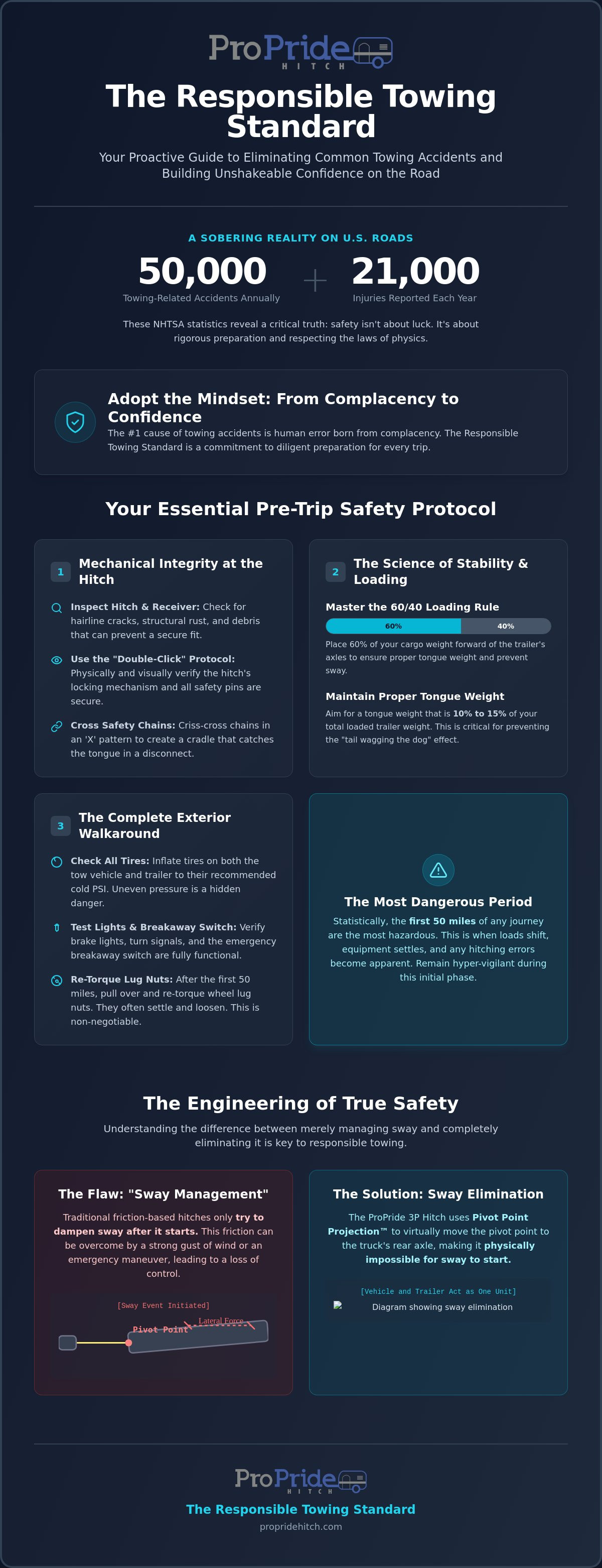
Did you know that approximately 50,000 towing-related accidents occur every year, resulting in around 21,000 injuries? It's a sobering statistic from the NHTSA that explains why so many drivers feel a surge of anxiety when a crosswind hits or a heavy semi-truck passes. You likely value the safety of your family above all else, yet the fear of the "death wobble" or an insecure hitch can make every trip feel like a gamble. Understanding common towing accidents and how to prevent them is the first step toward reclaiming your confidence behind the wheel.
We agree that safety isn't about luck; it's about rigorous preparation and respecting the immutable laws of physics. This guide promises to provide you with the engineering-backed checks and loading protocols necessary to eliminate trailer sway for good. By following The Responsible Towing Standard, you can ensure your rig feels like it's on rails. We'll preview the 2026 Safety Checklist, covering critical details from weight distribution to the Jim Hensley design legacy. You'll learn why Pivot Point Projection is the secret behind The Best Hitch on the Planet and how it keeps your investment protected on every mile of the journey.
Key Takeaways
- Adopt The Responsible Towing Standard by replacing complacency with a commitment to education and thorough mechanical preparation.
- Implement the "Double-Click" protocol to verify your hitch's locking mechanism and ensure every safety pin is structurally sound.
- Master the 60/40 loading rule and tongue weight targets to understand common towing accidents and how to prevent them using physics.
- Protect your family by following a strict exterior walkaround that includes re-torquing lug nuts after the first 50 miles of every season.
- Learn how integrating pre-trip checks with routine maintenance ensures your weight distribution system provides maximum stability on the road.
The Psychology of Safety: Why Common Towing Accidents Happen
Safety on the road begins long before you put the truck in gear. It starts with a mental shift toward what we call The Responsible Towing Standard. This isn't just a catchy phrase; it's a commitment to education and thorough preparation that treats every trip with the gravity it deserves. Most common towing accidents and how to prevent them can be traced back to a single human factor: complacency. When we've towed a trailer a dozen times without incident, it's easy to assume the thirteenth trip will be identical. This mindset leads to mechanical oversight, where small details like a loose safety pin or slightly low tire pressure are ignored.
Statistically, the first 50 miles of any journey are the most dangerous. This is when equipment settles, loads shift, and any errors in hitching become apparent. It's also the period where drivers are most likely to realize their "sway management" system is actually just a friction-based band-aid rather than a true solution. True safety requires sway elimination, not just management. While traditional hitches try to dampen sway after it starts, the ProPride 3P Hitch utilizes Pivot Point Projection to stop it from occurring in the first place.
To better understand the physical factors that lead to these incidents, watch this helpful video:
The Reality of Trailer Sway Accidents
Physics doesn't care about your experience level or how much you paid for your trailer. A minor gust of wind or the pressure wave from a passing semi-truck can instantly trigger a sway event. In these moments, the trailer begins to act as a lever, pushing the rear of the tow vehicle side to side. Many drivers instinctively over-correct, which only escalates the lateral forces and can lead to a devastating jackknife. Understanding foundational towing hitch mechanics is essential because it reveals why "good enough" friction equipment often fails during emergency maneuvers. This mechanical limitation is a primary reason why many travelers find themselves in dangerous situations despite their best efforts.
Adopting the Responsible Towing Mindset
The most successful towers treat their rig like a professional pilot treats an aircraft. They don't just "check" the hitch; they follow a ritualized pre-trip walkaround. This involves educating yourself on the laws of physics before you ever drop the coupler onto the ball. You must understand how weight distribution affects steering and how wind resistance impacts stability. By committing to this level of diligence, you move beyond being a casual traveler and become a specialized partner in your family's safety. Adopting this proactive approach is the core of understanding common towing accidents and how to prevent them, ensuring total confidence behind the wheel regardless of the road conditions ahead.
Mechanical Integrity: Preventing Hitch and Connection Failures
Mechanical integrity isn't a suggestion. It's the physical foundation of your safety. When we analyze common towing accidents and how to prevent them, we must start at the receiver. Inspect the hitch head for structural fatigue, hairline cracks, or rust that could compromise the metal. Even small amounts of debris trapped in the receiver tube can prevent a flush fit, leading to micro-vibrations that weaken the assembly over time. This type of neglect is one of the primary common towing hazards that can lead to a catastrophic disconnection at highway speeds.
We advocate for the "Double-Click" protocol. This means verifying the locking mechanism and safety pins twice: once during the initial hookup and again after a short test drive. Safety chains are another area where "good enough" isn't acceptable. Crossing them in an "X" pattern under the coupler is the only method that meets The Responsible Towing Standard. This configuration creates a cradle that catches the trailer tongue if it ever disconnects, preventing it from digging into the pavement. Finally, test your breakaway switch and umbilical cord. Ensure the cord has enough tension to pull the pin if the trailer separates, but isn't so tight that it triggers during a sharp turn.
Pivot Point Projection and Connection Security
Traditional hitches allow the trailer to pivot on the ball, which creates a lever that lets the trailer steer your truck. The ProPride 3P Hitch uses Pivot Point Projection to move that pivot point forward over the rear axle. This effectively makes the trailer and truck move as one solid unit. To maintain peak performance, verify that your weight distribution jacks are tensioned correctly for your specific load. If the bars aren't properly engaged, you lose the mechanical advantage that eliminates sway entirely. If you want a rig that feels like it's on rails, consider exploring the ultimate sway elimination solution.
Electrical and Braking Synchronization
A secure mechanical connection is useless if your brakes don't fire when needed. Check your 7-way plug for green corrosion or loose wires, as this plug is the lifeline between your truck and trailer. Calibrate your brake controller "gain" every time you change road conditions, such as moving from dry pavement to mountain passes. You must also ensure your trailer battery is fully charged. Without a healthy battery, your emergency breakaway system won't have the power to stop the trailer in a crisis. Taking these steps is the only way to move beyond anxiety and toward total confidence on the open road.
The Exterior Walkaround: Eliminating Tire and Light Failures
A professional-grade towing experience doesn't end with a secure hitch. It extends to every square inch of your trailer's exterior. By performing a ritualized walkaround, you address the root causes of common towing accidents and how to prevent them before you ever leave the driveway. This process is about moving beyond "visual checks" and into the realm of measurable safety metrics. You are looking for the small discrepancies that the laws of physics will inevitably exploit once you reach highway speeds.
Tire pressure is your first line of defense. Always measure pressure when the rubber is "cold," meaning the trailer hasn't been moved for at least three hours. "Hot pressure" readings taken after driving are misleading because friction naturally increases air temperature and pressure inside the tire. Additionally, metal expands and settles under load. This is why re-torquing your lug nuts after the first 50 miles of every season is a non-negotiable part of The Responsible Towing Standard. Finally, never trust tread depth alone. Trailer tires often rot from the inside out due to UV exposure and inactivity. We follow the "5-Year Rule," which dictates that tires should be replaced every five years regardless of how "new" the tread looks. To ensure your lights are fully operational, perform a sweep with a spotter to verify turn signals, markers, and brake lights are synced with the tow vehicle.
Preventing Tire Blowout Accidents
UV rays are the silent enemy of rubber. During your walkaround, look closely for "sidewall checking," which are small cracks that indicate dry rot. You must also ensure your tire load ratings meet or exceed your trailer's GVWR. GVWR stands for Gross Vehicle Weight Rating, which is the maximum total weight your trailer is engineered to carry safely. A tire rated for less than this weight is a blowout waiting to happen. Don't forget to check the spare tire. A spare with low pressure or dry rot is nothing more than dead weight when you're stranded on the shoulder of an interstate.
Visibility and Mirror Alignment
Visibility is your primary defense against side-swipe collisions. Adjust your tow mirrors so you can see the entire length of the trailer and the lane beside you. This eliminates blind spots that traditional mirrors miss. At dusk, verify that your marker lights are bright; they help other drivers gauge your total footprint on the road. If your rig is equipped with a rear-view camera, ensure the lens is clean and the signal is unobstructed. Clear communication between your trailer's signals and the drivers behind you is essential for maintaining total confidence behind the wheel.
Weight Distribution and Loading: The Science of Stability
Many travelers treat trailer sway as an unpredictable ghost that haunts the highway. In reality, sway is a preventable mechanical event governed by the laws of physics. When we examine common towing accidents and how to prevent them, the trail often leads back to improper weight distribution. If your trailer isn't loaded with scientific precision, you are essentially creating a giant pendulum that is waiting for a gust of wind to start swinging. Stability isn't a matter of luck; it's a matter of leverage.
The 60/40 rule is a non-negotiable principle for anyone following The Responsible Towing Standard. You must place 60% of your cargo weight in front of the trailer axle. This keeps the center of gravity forward and ensures the trailer follows the truck rather than trying to lead it. You should also aim for a tongue weight between 10% and 15% of the total trailer weight. Too little weight on the tongue leads to "tail wagging the dog" instability, while too much weight can lift the front tires of your tow vehicle, compromising your steering and braking. Additionally, be wary of "liquid slosh." Towing with half-full fresh or grey tanks allows hundreds of pounds of water to shift violently during cornering, creating dynamic forces that can overwhelm a standard friction hitch.
Calculating and Verifying Tongue Weight
Precision matters when your family's safety is on the line. While some rely on the "squat test" to see how far the truck's rear bumper drops, this is a subjective and dangerous metric. Use a dedicated tongue weight scale to get an exact number. If you find your trailer is prone to oscillating after hitting a bump, you likely need to move more gear toward the front of the rig. For a deeper dive into these protocols, read our comprehensive guide on how to properly load a travel trailer.
Towing in High Winds: A Survival Protocol
High winds turn your trailer into a massive sail. To survive these conditions, you must lower the trailer's center of gravity by placing your heaviest items as low as possible on the floor. The Responsible Towing Standard suggests that if sustained winds or gusts exceed your comfort level or the mechanical limits of your equipment, the only responsible choice is to pull over. You can learn more about these safety thresholds in our guide for towing in high winds.
To eliminate the risk of weight-induced sway entirely and ensure your rig stays stable regardless of how you load it, upgrade to the ProPride 3P Hitch, the only system engineered to neutralize these forces through Pivot Point Projection.
Beyond the Checklist: Maintenance and Engineering
Safety doesn't end when you reach your destination. It's a continuous cycle of vigilance that separates the casual traveler from those who uphold The Responsible Towing Standard. When we look at common towing accidents and how to prevent them, many incidents are the result of neglected maintenance that finally reached a breaking point. By treating your equipment with the respect a master engineer would, you ensure that every journey is as stress-free as the last. Quality equipment deserves quality care, and your family's safety depends on it.
A critical part of this process is integrating your pre-trip checks into a formal ProPride hitch maintenance routine. This involves greasing the pivot points of your hitch assembly and checking for any signs of wear on the weight distribution bars. Friction and road vibration are constant forces. If you don't keep these components lubricated and inspected, you risk mechanical fatigue that can lead to failure. One practical tip is to check for "hot hubs" every time you stop. By carefully feeling the temperature of your trailer's wheel hubs, you can catch bearing failures or dragging brakes before they cause a roadside disaster. The ProPride 3P Hitch is the final step in the evolution of towing safety, providing a rig that feels like it's on rails.
Post-Trip Inspection: Preparing for the Next Journey
Your work isn't done when you unhitch at the end of the day. Take the time to clean road grime and salt from the hitch assembly to prevent corrosion. Salt is incredibly aggressive and can damage the finish and moving parts if left to sit. Inspect the trailer frame for any stress cracks, especially after long hauls over uneven terrain. If you noticed any unusual handling characteristics during the drive, report them for professional review. Addressing a small "quirk" now prevents a major mechanical failure during your next trip.
The Jim Hensley Legacy and Modern Safety
Jim Hensley's engineering solved the sway problem at its mechanical source. By choosing the ProPride system, you're joining a community of towers who refuse to compromise on safety. They understand that "good enough" equipment is a gamble they aren't willing to take with their families or their investments. Jim Hensley's legacy is built on the principle that physics can be mastered through superior design. Final thought: safety is a choice you make before you ever put the truck in gear. It's about preparation, the right engineering, and a total commitment to acting responsibly on the open road.
Master the Open Road with Total Confidence
Mastering the road requires more than just a truck and a trailer. It demands a lifelong commitment to The Responsible Towing Standard. We have explored how a ritualized exterior walkaround and the 60/40 loading rule can transform your towing experience from stressful to seamless. Your knowledge of common towing accidents and how to prevent them is now anchored in the immutable laws of physics rather than guesswork. By focusing on mechanical integrity and consistent maintenance, you move from a place of anxiety to a place of absolute authority behind the wheel.
Safety is a deliberate choice you make before you ever pull out of the driveway. Traditional friction hitches only attempt to manage sway after it begins, but you deserve a solution that eliminates it entirely. The ProPride 3P Hitch utilizes patented Pivot Point Projection engineering to ensure your rig feels like it is on rails. This is the ultimate way to protect your family and your investment. You have done the research and educated yourself; now it's time to equip your rig with the best technology available.
Experience The Best Hitch on the Planet: Get the ProPride 3P
Your next adventure is waiting. With the right knowledge and the best engineering on your side, you can drive with the peace of mind you have always wanted. Safe travels.
Frequently Asked Questions
What is the #1 cause of towing accidents for RVers?
Human error is the leading cause of these incidents, often manifesting as excessive speed or improper weight distribution. Complacency leads many drivers to skip essential pre-trip inspections, which is how they overlook common towing accidents and how to prevent them through basic mechanical checks. Maintaining a safe speed and adhering to strict loading protocols are your best defenses against losing control on the highway during your travels.
Does a weight distribution hitch prevent all types of trailer sway?
No, a standard weight distribution hitch only helps level the load; it doesn't eliminate sway forces. Traditional hitches use friction to dampen movement after it starts, which is a reactive approach. Only a hitch utilizing Pivot Point Projection can physically prevent the trailer from swaying by moving the pivot point forward. This engineering difference is why many "good enough" hitches fail to provide stability in high-wind scenarios or during emergency maneuvers.
How often should I check my lug nuts while on a long trip?
You should check your lug nuts after the first 50 miles of any trip and then perform a quick check every morning before you hit the road. Vibration and heat cycles can cause nuts to loosen, especially on newer trailers or after a wheel has been recently removed. Carrying a calibrated torque wrench ensures you meet The Responsible Towing Standard for wheel security on every leg of your journey across the country.
Is it safe to tow a travel trailer in 30 mph winds?
Towing in 30 mph winds is high-risk and requires extreme caution or the decision to pull over. While Pivot Point Projection technology provides superior stability, the lateral force on a large travel trailer is immense at these speeds. If you feel the wind pushing the entire rig or if gusts become unpredictable, the only responsible choice is to find a safe place to stop until conditions improve. Safety always outweighs your arrival time.
How do I know if my tongue weight is too low?
You'll know your tongue weight is too low if the trailer feels light or begins to oscillate, often called "the tail wagging the dog." This wandering usually happens at higher speeds or when you are being passed by large vehicles like semi-trucks. Low tongue weight shifts the center of gravity too far back, which is a major factor in common towing accidents and how to prevent them through proper cargo placement within the trailer.
What should I do immediately if my trailer starts to sway?
If sway starts, do not slam on your vehicle's brakes or turn the steering wheel sharply. Instead, maintain a steady speed and manually activate the trailer brake controller using the override lever. This applies the trailer brakes independently, which pulls the trailer back into alignment behind the tow vehicle. Once the rig is stable, slow down gradually and pull over to inspect your load distribution and hitch settings immediately before continuing.
Why are friction sway bars considered 'inferior' to Pivot Point Projection?
Friction sway bars are inferior because they are reactive, meaning they only attempt to slow down sway that has already begun. They rely on physical resistance that can be easily overcome by strong winds or sudden maneuvers. Pivot Point Projection is a proactive engineering solution that changes the mechanical relationship between the truck and trailer. It makes the two units move as one, effectively eliminating the possibility of sway before it can ever start.
Can I use this safety checklist for a boat trailer or utility trailer?
Yes, the core principles of this checklist apply to any towed load, including boat and utility trailers. While the specific tongue weight percentages might vary slightly between trailer types, the need for secure connections, proper tire pressure, and functional lighting remains constant. Adopting The Responsible Towing Standard ensures that whether you're hauling a camper or a boat, you're doing so with the highest level of preparation and engineering-backed safety protocols.