
Why are we still relying on mid-century chain technology to secure our modern, high-tech family investments? If you've spent any time on the interstate, you've likely experienced the white-knuckle tension that comes when a passing semi-truck sends your trailer into an unpredictable oscillation. You might even be tired of the constant clunking and grinding noises or the greasy mess that ruins your clothes during every hookup. These common problems with chain weight distribution hitches are more than just annoyances; they're symptoms of a mechanical design that manages weight but fails to master the physics of sway.
You take your responsibility as a driver seriously, and you shouldn't have to settle for "good enough" when it comes to your family's safety. We're going to explore why traditional friction-based systems often fall short of providing the stability you need on the open road. You'll discover how moving beyond 70-year-old designs to Pivot Point Projection technology creates a towing experience where your trailer feels truly locked to your truck. By understanding the mechanical difference between friction and projection, you can uphold The Responsible Towing Standard and enjoy the total confidence that comes with using The Best Hitch on the Planet.
Key Takeaways
- Understand the mechanical limitations and common problems with chain weight distribution hitches that lead to unpredictable trailer movement in high winds.
- Learn why a standard ball and coupler acts as a hinge, and why relying on chains alone cannot stop the trailer from swaying independently of your tow vehicle.
- Discover how to eliminate the "grease factor" and the disruptive grinding noises common with traditional hitch systems by choosing a cleaner engineering design.
- Identify how driver fatigue is tied to constant steering corrections and how upgrading your equipment supports The Responsible Towing Standard for your family.
- Explore the engineering behind Pivot Point Projection, a technology that effectively moves the trailer's pivot point to the rear axle of your truck to eliminate sway entirely.
The Evolution of Towing and the Inherent Limits of Chain Hitches
For over 70 years, the chain-style weight distribution hitch has been the default choice for the RV community. It was a revolutionary step forward during an era when trailers were smaller and highway speeds were significantly lower. The design relies on a relatively simple mechanical principle: using spring bars and safety chains to create a lever effect that lifts the rear of the tow vehicle. While this was a massive improvement over a standard ball and coupler setup, the industry has largely remained stagnant while trailers have grown larger, taller, and more complex.
How Chain Hitches Distribute Weight
A traditional weight-distributing hitch works by applying tension to metal spring bars through a set of heavy duty chains. By tightening these chains, you're essentially prying the tow vehicle and trailer together to shift weight from the rear axle of the truck to the front axle. This helps keep your headlights level and ensures your front tires maintain enough contact with the pavement for reliable steering and braking in a straight line. Weight distribution is the management of vertical tongue load.
You can see the results immediately. The sagging rear end of your truck rises, and the front end settles back into its proper stance. This leveling is essential for basic vehicle control. It prevents the "light" steering feeling that occurs when too much weight is concentrated on the hitch ball. However, many owners don't realize that managing vertical weight is only half of the safety equation.
The "Good Enough" Trap for Modern RVers
Many people fall into a trap by believing that because their truck sits level, they're safe. The common problems with chain weight distribution hitches stem from the fact that they were never designed to eliminate the lateral forces of sway. Modern trailers are taller and catch more wind than the aerodynamic shells of the mid-20th century. Relying on traditional equipment for a 35-foot modern travel trailer often leads to a false sense of security that disappears the moment a semi-truck passes you at 70 miles per hour.
Responsible owners understand that basic leveling is just the first step. To meet The Responsible Towing Standard, you have to look beyond simple weight management. While chains might be "good enough" for some, they don't address the underlying physics that cause a trailer to act as a giant sail. Identifying these problems with chain weight distribution hitches is the first step toward upgrading to a system that provides the stability your family deserves. When you're ready to move past legacy technology, you'll find that ProPride offers the ultimate solution for those who refuse to compromise on safety.
To ensure your setup is truly secure, it's helpful to regularly measure your wheel well height before and after tensioning your chains. This simple tip helps you verify that your weight is actually moving to the front axle, though it won't solve the inherent sway issues that chains can't reach. For a total solution, many drivers eventually choose the ProPride 3P trailer sway control hitch to achieve the stability of "The Best Hitch on the Planet."
Why Chain Hitches Struggle with Total Trailer Sway Control
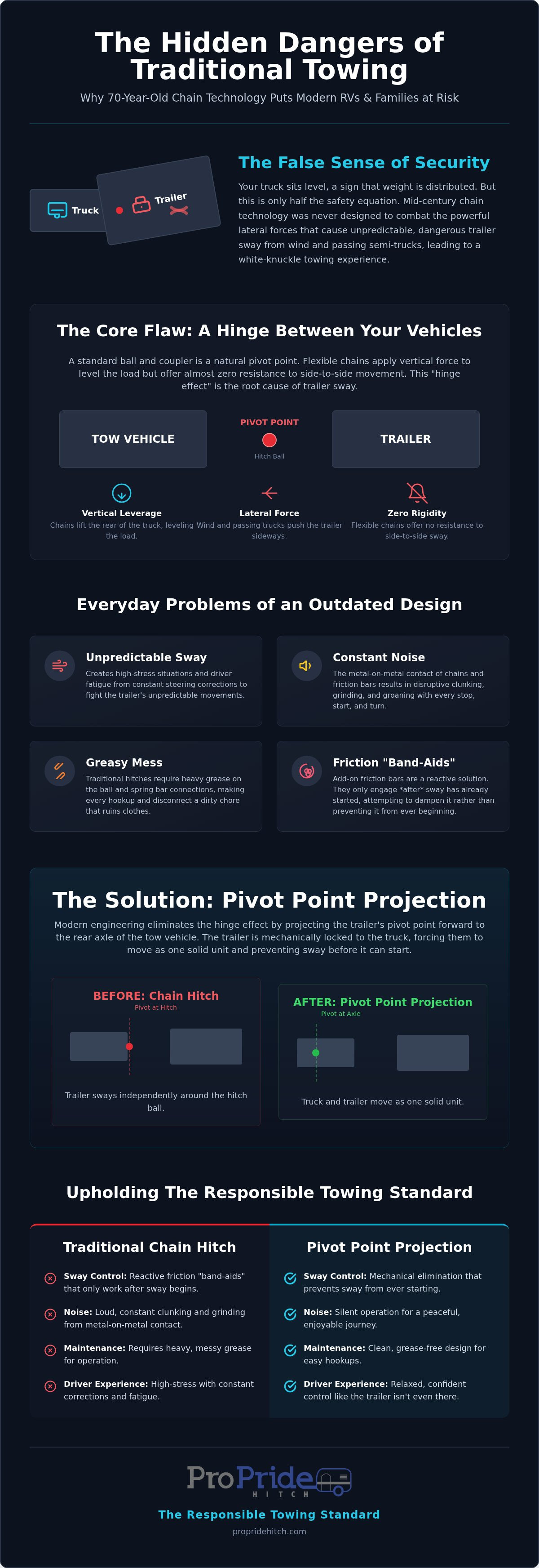
While leveling your truck is vital, it's a mistake to assume that weight distribution automatically provides sway control. These are two separate mechanical functions. One of the most significant problems with chain weight distribution hitches is that they leave the "hinge" between your truck and trailer wide open. The ball and coupler design is a pivot point by nature. While chains apply vertical leverage to level the load, they offer almost zero lateral rigidity to stop side-to-side movement.
When a crosswind hits or a semi-truck passes you, the resulting "bow wave" of air pressure forces your trailer to move. Because chains are flexible, they allow the trailer to swing independently of the tow vehicle. This creates a dangerous scenario where the trailer begins to dictate the direction of the truck. Many manufacturers try to fix this by adding friction sway bars, but these are merely reactive band-aids that don't address the underlying physics of the connection.
Friction vs. Mechanical Elimination
Friction-based sway control requires sway to actually start before the friction can begin to resist it. This creates a constant tug-of-war behind your vehicle. Research into the dynamics of trailer hitches suggests that these systems can sometimes suffer from a pendulum effect. This happens when the friction isn't enough to stop the momentum once it reaches a certain frequency, potentially amplifying the sway rather than stopping it.
The ProPride 3P doesn't rely on friction. Instead of trying to resist sway after it starts, it uses mechanical linkage to project the pivot point forward toward the truck's rear axle. This is why it's known as "The Best Hitch on the Planet." By mechanically locking out the sway before it can begin, you're upholding The Responsible Towing Standard and protecting your investment from unpredictable road conditions.
The Impact of Chain Tension on Turning Radius
Another overlooked issue is how chain tension affects your maneuverability. To get enough weight distribution for a heavy trailer, you often have to crank the chains extremely tight. This tension can restrict your truck’s natural movement during slow-speed maneuvers. In extreme cases, a sharp turn can cause a chain to "pop" or even snap a mounting bracket due to the immense lateral stress.
Actionable Tip: Before you attempt a tight U-turn or back into a narrow campsite, always double-check your chain clearance. If the chains look dangerously taut or are binding against the frame, you may need to temporarily decrease tension to avoid mechanical failure. If you're tired of managing these constant trade-offs, you might consider how the ProPride 3P trailer sway control hitch removes these variables from your journey entirely.
Daily Maintenance and Operational Hurdles of Chain Systems
Beyond the white-knuckle driving and physics-based failures, the practical reality of living with a chain-style system is often a source of daily frustration. These common problems with chain weight distribution hitches turn what should be a relaxing getaway into a series of labor-intensive chores. From the moment you start hitching up to the time you settle into your campsite, traditional equipment demands a level of physical effort and maintenance that modern engineering has made obsolete.
The metal-on-metal contact inherent in these designs also creates significant noise pollution. The grinding, popping, and groaning sounds you hear during low-speed turns aren't just annoying; they're the sound of friction resisting your vehicle's natural movement. For many, this is a constant reminder that their connection is based on outdated mechanics rather than precision engineering.
The Messy Reality of Traditional Towing
If you've used a chain system, you're familiar with the "black grease" that seems to find its way onto everything you own. Traditional spring bar sockets require heavy, constant lubrication to prevent excessive wear and galling. This grease doesn't stay on the hitch. It ends up on your hands, your clothes, and your storage compartments. It is a messy, outdated requirement that many RVers simply accept as an inevitable part of the lifestyle.
Actionable Tip: If you're currently using a chain-based system, keep a dedicated pair of "hitching gloves" and a roll of shop towels in a sealed plastic bin. This helps contain the mess, though it won't solve the underlying maintenance requirements of the equipment itself.
Hitching Fatigue and the "Unhitching Dance"
The physical toll of these systems is significant. To properly tension the chains, you typically have to jack the trailer and truck up together to reduce the resistance before snapping the brackets into place. This repetitive strain on your back and your power jack is a direct result of the design's reliance on manual leverage. Additionally, if you use friction-based sway bars, you often have to remove them before backing into a tight spot to avoid damaging the hardware. This "unhitching dance" in the middle of a narrow campground road is exactly what The Responsible Towing Standard seeks to eliminate.
Precise chain-link counting is another area where human error can compromise your safety. One link too loose or too tight can drastically change how your vehicle handles on the highway. By choosing the ProPride 3P trailer sway control hitch, you remove these variables entirely. There are no chains to count and no friction bars to remove before you back up. It’s a cleaner, more efficient way to tow that reinforces your commitment to quality. When you experience the ease of "The Best Hitch on the Planet," the old problems with chain weight distribution hitches quickly become a distant memory.
The Safety Gap: When "Good Enough" Becomes Dangerous
"White-knuckle" driving is a term frequently used in the RV community, but it describes a very real physiological state. When your trailer begins to oscillate behind you, your body releases adrenaline, your heart rate spikes, and your grip on the steering wheel tightens instinctively. This isn't just uncomfortable; it's exhausting. One of the most overlooked problems with chain weight distribution hitches is the cumulative effect of driver fatigue. When you're constantly making micro-corrections to keep the trailer centered, your mental and physical energy drains rapidly. Over a long journey, this fatigue can make the difference between a safe arrival and a dangerous lapse in judgment.
Safety is measured by stability under stress, not just level towing. While a traditional setup might look perfectly fine in a parking lot, its true value is tested the moment things go wrong on the highway. Upholding The Responsible Towing Standard means choosing equipment that protects you during the worst-case scenarios, not just during the easy miles.
The Physics of an Emergency Lane Change
In a straight line on a calm day, chains might feel sufficient. However, their mechanical limitations become clear during a sudden swerve. If you have to avoid road debris or an aggressive driver, the trailer's momentum creates a lateral force that flexible chains simply cannot contain. This leads to the "tail-wagging-the-dog" scenario, where the trailer's weight begins to push the rear of the truck sideways. Because the connection point remains a simple hinge, the trailer can easily reach a point of no return, potentially leading to a rollover even if the weight was technically "distributed."
Protecting Your Investment and Your Family
Taking a proactive stance on safety is the hallmark of a responsible owner. While traditional hitches are often chosen for their lower entry cost, they don't account for the potential financial and emotional toll of a sway-induced accident. High-end consumers who value engineering excellence recognize that true value lies in the total elimination of risk. Projection technology doesn't just manage the sway; it fundamentally changes the mechanical relationship between your truck and trailer to ensure they move as a single, stable unit.
Actionable Tip: Pay close attention to your physical state during a tow. If you find yourself gripping the wheel so hard your forearms ache, or if you feel a sense of dread when a semi-truck appears in your mirror, your equipment isn't providing the stability you need. These are clear physical indicators that your hitch is failing to manage the forces acting on your trailer.
Choosing to upgrade to the ProPride 3P trailer sway control hitch is an investment in your family's safety and your own peace of mind. By moving beyond the problems with chain weight distribution hitches, you can finally experience the total confidence that comes with using "The Best Hitch on the Planet."
Moving Beyond Chains: The Pivot Point Projection Solution
The transition from a traditional setup to a ProPride system represents a fundamental shift in how you perceive towing. While we've explored the inherent problems with chain weight distribution hitches, the solution lies in the evolution of Jim Hensley’s legendary design. Pivot Point Projection technology isn't a minor adjustment; it's a complete mechanical reimagining of the truck-to-trailer connection. By utilizing a series of heavy duty links, the ProPride 3P effectively moves the trailer's pivot point from the hitch ball to the rear axle of the tow vehicle.
This mechanical shift is significant because it creates a "lock" against sway. In a traditional system, the trailer can push the truck's rear end sideways. With the 3P, the trailer is physically incapable of moving laterally unless the truck itself initiates the turn. This is why many experienced RVers consider it the ultimate engineering solution for safe travel. You're no longer fighting the physics of a hinge; you're using the laws of convergence to ensure your trailer follows your truck with absolute precision.
How the ProPride 3P Eliminates the Chain Problem
The most immediate change you'll notice is the absence of chains. Instead of counting links and using a snap-up tool, the ProPride 3P uses adjustable weight distribution jacks. These jacks allow for precise, micro-adjustments with a simple socket or drill. It's an effortless process that removes the guesswork and physical strain often associated with legacy hitches. Because the system doesn't rely on the "grease-heavy" sockets found in chain-style designs, your hands, clothes, and trailer A-frame stay clean throughout your trip.
Operational freedom is another core benefit. Unlike friction-based systems that require disconnection during tight maneuvers, the 3P allows for a full turning radius. You can back into a narrow campsite or make a sharp U-turn without ever worrying about snapping a bracket or binding a link. This seamless operation is a hallmark of The Responsible Towing Standard, allowing you to focus on the journey rather than your equipment.
Investing in The Best Hitch on the Planet
For owners of premium trailers such as Airstream, Jayco, or Grand Design, the ProPride 3P is the logical extension of their investment. It's built for long-term durability, often becoming the last hitch an owner ever needs to purchase. When you choose "The Best Hitch on the Planet," you're making a commitment to your family's safety that goes far beyond "good enough" traditional solutions. It's time to leave the frustrations of the past behind and experience the total stability of a professional-grade connection.
Upgrade your towing experience with the ProPride 3P Trailer Sway Control Hitch and discover what it feels like to tow with absolute confidence.
Secure Your Journey with Precision Engineering
Understanding the mechanical limitations of traditional equipment is the first step toward a safer towing lifestyle. As explored throughout this guide, the common problems with chain weight distribution hitches stem from an outdated reliance on friction and flexible links to manage modern, heavy trailers. These systems might succeed at leveling your vehicle, but they often fail to address the core physics of trailer sway. By allowing your trailer to act as a hinge, you're left vulnerable to wind gusts and emergency maneuvers that can quickly become unmanageable on the open road.
You deserve a towing experience defined by stability and peace of mind rather than white-knuckle stress. The ProPride 3P eliminates trailer sway entirely by utilizing patented Pivot Point Projection technology. Backed by the Jim Hensley design legacy, this system is the highest-rated choice for safety-conscious RVers who refuse to compromise on quality. It's time to move beyond "good enough" and embrace a solution that ensures your trailer feels locked to your truck. We invite you to Experience the Responsible Towing Standard with the ProPride 3P and discover why it's known as The Best Hitch on the Planet. Your family and your investment are worth the ultimate protection.
Frequently Asked Questions
Why does my chain weight distribution hitch make so much noise?
Your hitch makes noise because traditional designs rely on metal-on-metal friction to function. As you turn, the spring bars move within their sockets, creating grinding, popping, or groaning sounds. This noise is a symptom of the friction required to resist lateral movement. While some owners use heavy grease to quiet the system, the mess often outweighs the benefit. This is one of the common problems with chain weight distribution hitches that precision engineering can solve.
Can I back up my trailer with a chain-style weight distribution hitch attached?
You can typically back up with the chains attached, but you must be extremely cautious. If your system uses add-on friction sway bars, you must remove them before backing into tight spots. Failure to do so can result in bent bars or snapped mounting brackets as the trailer reaches sharp angles. Responsible owners often find this "unhitching dance" frustrating, leading them to seek systems that don't require hardware removal during maneuvers.
Do I need to remove my friction sway bar before it rains?
Yes, you should remove or significantly loosen friction-based sway bars during rain. Water acts as a lubricant on the friction material, which drastically reduces the system's ability to resist sway. This creates a dangerous paradox where your safety equipment is least effective when road conditions are most hazardous. Upholding The Responsible Towing Standard means choosing a system that relies on mechanical linkage rather than weather-dependent friction to keep your family safe.
What happens if one of my hitch chains breaks while towing?
If a weight distribution chain breaks, you will experience an immediate loss of weight transfer to your front axle. Your truck's rear end will sag, and your steering may feel light or unresponsive. The sudden shift in balance can induce trailer sway, especially at highway speeds. Regularly inspecting your chains for wear or stretch is vital, but the best way to eliminate this risk is to move away from chain-based systems entirely.
Is it normal for my trailer to still sway with a weight distribution hitch?
It is unfortunately common to experience sway with a traditional hitch because weight distribution and sway control are two different mechanical functions. A standard hitch levels the load but doesn't lock out the pivot point. If you feel the "tail wagging the dog" when a semi passes, your hitch is failing to manage lateral forces. These persistent problems with chain weight distribution hitches are why many discerning RVers upgrade to projection technology.
How do I know if my weight distribution chains are tight enough?
To verify chain tension, you must measure the height of your truck's front wheel well before and after hitching. The goal is to return the front axle as close to its uncoupled height as possible. If the front end remains high, the chains are too loose. However, over-tightening can lead to a harsh ride or mechanical failure. This balancing act is a significant hurdle for those who value precision and repeatability in their setup.
Why is the ProPride 3P hitch better than a traditional chain hitch?
The ProPride 3P is superior because it utilizes Pivot Point Projection to move the trailer's effective pivot point forward to the truck's rear axle. Unlike traditional designs, it replaces messy chains with adjustable jacks for effortless, precise weight distribution. It doesn't rely on friction, meaning it works perfectly in rain and never needs to be disconnected when backing up. It is widely considered The Best Hitch on the Planet for total stability.
What is the difference between sway control and sway elimination?
Sway control uses friction to resist movement after it has already started, essentially acting as a reactive band-aid. Sway elimination, powered by the Jim Hensley design legacy, uses mechanical linkage to prevent the trailer from ever initiating a side-to-side movement independently of the truck. By locking the trailer into the truck's geometry, you achieve a level of stability that friction-based systems simply cannot match, ensuring a stress-free experience for the responsible driver.