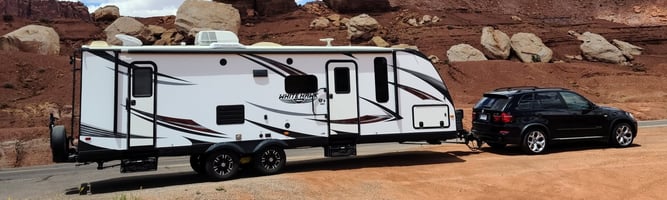
Long travel trailers offer unmatched comfort on the road. They provide more living space, larger kitchens, dedicated bedrooms, and increased storage for extended adventures.
However, every additional foot of trailer length changes the towing dynamics.
A 35-foot travel trailer behaves differently than a 20-foot camper, especially on interstate highways, in crosswinds, or when passing large commercial trucks. While staying within your vehicle's tow ratings is essential, trailer length introduces new stability challenges that many first-time owners don't anticipate.
Choosing the right hitch is one of the most important decisions you can make for a longer trailer. The best hitch doesn't simply distribute weight—it helps create a towing system that remains predictable when outside forces act on the trailer.
Why Longer Travel Trailers Feel Less Stable
Trailer length affects how forces are applied to your towing combination.
A longer trailer typically has:
- More side surface exposed to wind
- Greater distance from the hitch to the rear of the trailer
- Increased leverage when side forces occur
- More momentum during steering corrections
These characteristics don't automatically make a long trailer unsafe, but they do increase the importance of hitch design.
When wind, road irregularities, or passing vehicles apply force to a longer trailer, the resulting leverage can be much greater than with a shorter camper.
Trailer Length Creates More Leverage
Imagine holding a short board and a long board by one end.
Applying the same force to the far end of each board creates a much stronger twisting effect on the longer one.
Travel trailers behave similarly.
As trailer length increases, so does the potential leverage acting on the hitch.
That's why owners of 30-, 32-, and 35-foot trailers often place a higher priority on towing stability than owners of compact campers.
Common Stability Challenges With Large Travel Trailers
Long trailers are more likely to encounter situations such as:
Crosswinds
Large sidewalls create more aerodynamic force during windy conditions.
Passing Semi-Trucks
Pressure waves from commercial trucks affect a greater surface area.
Highway Expansion Joints
Repeated pavement transitions can introduce small steering inputs that become more noticeable with longer trailers.
Emergency Maneuvers
Longer trailers generate greater momentum during sudden lane changes or obstacle avoidance.
These situations don't necessarily cause trailer sway, but they illustrate why hitch performance becomes increasingly important as trailer length grows.
What Makes a Great Hitch for Long Travel Trailers?
The best hitch for a long travel trailer should provide more than basic towing capability.
Important characteristics include:
- Proper weight distribution
- Stable highway handling
- Predictable steering response
- Durable construction
- Compatibility with your loaded hitch weight
- Reliable performance in changing road and weather conditions
Just as importantly, understanding how the hitch creates stability is essential.
The Three Main Types of Anti-Sway Hitches
Today's travel trailer hitches generally fall into three engineering categories.
Friction-Based Sway Control
Friction hitches reduce trailer movement by creating resistance between moving components.
Advantages include:
- Lower purchase price
- Wide availability
- Integrated weight distribution on many models
Considerations:
Because the trailer still pivots at the hitch ball, these systems are designed to resist sway after it begins rather than change the hitch geometry that allows sway-producing leverage.
Capture-Style Systems
Capture-style hitches use spring bars and mechanical retention to limit trailer movement.
Advantages include:
- Quiet operation
- Effective weight distribution
- Straightforward operation for many users
Considerations:
The trailer continues to pivot at the hitch ball, so these systems are designed to manage movement rather than alter the underlying leverage created by a conventional hitch.
Pivot Point Projection™ Technology
The ProPride 3P® uses a different engineering approach.
Rather than relying on friction or spring tension, it uses patented Pivot Point Projection™ (3P) technology.
Its converging-link design projects the trailer's effective pivot point forward toward the rear axle of the tow vehicle.
With a patented one-piece yoke that prevents conventional side-to-side hitch-ball pivoting, this design addresses the leverage responsible for trailer sway.
For long travel trailers that experience greater aerodynamic and mechanical forces, this geometry-based approach offers a fundamentally different method of improving stability.
Why Hitch Geometry Matters More on Longer Trailers
The longer the trailer, the greater the leverage acting through the hitch during side loads.
Traditional sway-control systems attempt to reduce or limit trailer movement.
Pivot Point Projection™ changes the way those forces are transmitted through the towing system.
Instead of depending on resistance, it changes the effective pivot geometry.
This engineering difference becomes increasingly valuable as trailer size and towing demands increase.
Features That Make the ProPride 3P® Well-Suited for Large Travel Trailers
The ProPride 3P® includes several features designed for demanding towing applications:
- Patented Pivot Point Projection™ technology
- Heavy-duty weight distribution system
- Patented one-piece yoke
- Adjustable hitch bar for multiple tow vehicle heights
- Thick converging control links
- Solid steel construction
- Available weight distribution capacities up to 1,400 pounds of loaded hitch weight
- Lifetime Warranty
- Made in the USA
Each feature contributes to durability, adjustability, and towing confidence over the long term.
Comparing Hitch Technologies
| Feature | Friction Hitch | Capture Hitch | ProPride 3P® |
|---|---|---|---|
| Weight Distribution | Yes | Yes | Yes |
| Trailer Pivots at Hitch Ball | Yes | Yes | Conventional side-to-side pivot is prevented by the hitch design |
| Primary Stability Method | Friction | Mechanical capture | Pivot Point Projection™ |
| Designed Around Hitch Geometry | No | No | Yes |
| Adjustable Hitch Bar | Varies | Varies | Yes |
| Lifetime Warranty | Varies | Varies | Yes |
The primary distinction is not simply the number of components or the size of the spring bars—it's the engineering philosophy behind the hitch.
Long-Distance Towing Benefits
Many owners of large travel trailers spend long days on interstate highways.
A stable towing setup can help reduce:
- Constant steering corrections
- Driver fatigue
- Stress during windy conditions
- Anxiety when passing large trucks
- Fatigue over extended travel days
While every towing setup is unique, improving trailer stability can make long-distance travel more comfortable and enjoyable.
Choosing the Right ProPride 3P® Model
The ProPride 3P® is selected based on loaded hitch weight, not simply trailer length.
The model number represents the maximum weight distribution capacity.
For example:
- 3P-1000: Up to 1,000 pounds of loaded hitch weight
- 3P-1400: Up to 1,400 pounds of loaded hitch weight
Choosing the correct model helps ensure optimal weight distribution and towing performance.
Frequently Asked Questions
Does a longer travel trailer sway more?
Longer trailers generally experience greater leverage from wind and road forces, making hitch design increasingly important for stable towing.
Is trailer length more important than trailer weight?
Both matter. Weight affects towing capacity, while length influences leverage and aerodynamic forces that can affect stability.
What hitch is best for a 30- to 35-foot travel trailer?
The ideal hitch depends on your loaded hitch weight, tow vehicle, and towing priorities. Understanding the differences between friction, capture, and Pivot Point Projection™ technologies helps you make an informed decision.
Does the ProPride 3P® work with long travel trailers?
Yes. The ProPride 3P® is available in multiple weight distribution capacities and is designed for a wide range of travel trailer applications.
Why is Pivot Point Projection™ different?
Rather than relying on friction or spring resistance, Pivot Point Projection™ changes the hitch geometry by projecting the trailer's effective pivot point toward the rear axle of the tow vehicle.
Can a premium hitch reduce driver fatigue?
A towing system that reduces the need for frequent steering corrections can contribute to a more relaxed driving experience during long trips.
Conclusion
As travel trailers become longer, towing dynamics become more demanding.
Wind, passing trucks, pavement transitions, and emergency maneuvers all place greater forces on the hitch and tow vehicle.
That's why choosing the best hitch for a long travel trailer involves more than matching weight ratings.
It requires understanding how different hitch technologies create stability.
Traditional systems rely on friction or mechanical capture to manage trailer movement.
The ProPride 3P® takes a different engineering approach by using Pivot Point Projection™ technology to change the hitch geometry that contributes to trailer sway.
For RV owners investing in a large travel trailer—and planning thousands of miles of highway adventures—the right hitch can be one of the most valuable upgrades they make, helping every trip feel more predictable, comfortable, and enjoyable.