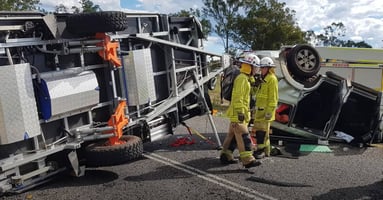
If you have ever experienced trailer sway on the highway, you already know how dangerous and exhausting towing can become.
One moment your trailer feels stable.
The next, a passing semi-truck or strong crosswind sends the trailer moving side-to-side behind your vehicle.
For decades, most towing products have treated sway as something to “control” or “reduce.” But that philosophy ignores the real engineering problem.
A trailer that can pivot freely on the hitch ball can still sway.
That is why choosing the best hitch for eliminating trailer sway matters more than ever in 2026.
In this guide, we compare the most popular trailer sway control hitches on the market — including the Equal-i-zer®, Blue Ox SwayPro®, Husky Center Line® TS, and the ProPride 3P® Jim Hensley Hitch — so you can understand which systems truly solve the problem and which merely dampen it.
Why Trailer Sway Is More Dangerous Than Most Drivers Realize
Trailer sway is not simply an annoyance.
It is a dynamic instability event caused by:
- Aerodynamic side forces
- Improper hitch geometry
- Leverage behind the rear axle
- Delayed driver reaction
Once sway begins, oscillation can intensify rapidly.
This is especially dangerous at highway speeds because the trailer begins exerting leverage on the tow vehicle itself.
Common causes include:
- Crosswinds
- Passing trucks
- Sudden steering corrections
- Uneven pavement
- Tire drop-offs
- Emergency maneuvers
Traditional sway control systems attempt to reduce these forces after sway begins.
The ProPride 3P® takes a completely different approach.
It prevents sway from developing in the first place.
How Trailer Sway Control Hitches Work
Not all anti-sway hitches operate the same way.
Understanding the difference is critical before investing thousands of dollars into towing equipment.
Friction-Based Sway Control
Friction hitches use resistance to slow trailer movement.
Examples include:
- Equal-i-zer®
- Husky Center Line® TS
These systems create friction between hitch components to dampen trailer oscillation.
However, the trailer still pivots on the hitch ball.
That means sway remains mechanically possible.
Passive Sway Capture Systems
The Blue Ox SwayPro® uses chain tension and “capture” mechanics rather than friction.
When sway begins:
- The chains resist outward movement
- The system attempts to limit trailer rotation
But once again, the pivot point remains on the hitch ball.
The trailer can still leverage the rear of the tow vehicle.
Pivot Point Projection Technology
The ProPride 3P® uses Pivot Point Projection™ technology.
Instead of resisting sway, it changes the towing geometry itself.
The system:
- Locks out side-to-side movement at the hitch ball
- Projects the effective pivot point near the rear axle
- Eliminates the leverage arm responsible for sway
This creates towing dynamics similar to a fifth-wheel trailer.
That is a fundamentally different engineering solution.
Best Trailer Sway Control Hitches Compared for 2026
ProPride 3P® Jim Hensley Hitch
The ProPride 3P® is widely considered the most advanced anti-sway hitch available for bumper-pull trailers.
Key features include:
- Pivot Point Projection™ technology
- Patented yoke system
- Solid steel construction
- 3/4-inch thick control links
- Heavy-duty weight distribution jacks
- Lifetime warranty
- Made in the USA
Unlike friction-based systems, the ProPride 3P® completely eliminates trailer sway by changing the effective pivot point of the trailer.
Pros
- Eliminates sway instead of reducing it
- Mimics fifth-wheel stability
- Outstanding crosswind performance
- Reduced driver fatigue
- Excellent resale value
- Precision weight distribution control
Cons
- Higher upfront cost
- Heavier than standard hitches
For serious RV travelers and long-distance towers, the performance difference is dramatic.
Equal-i-zer® 4-Point Hitch
The Equal-i-zer® is one of the most popular friction-based sway control hitches.
It uses:
- Trunnion bars
- Friction points
- Weight distribution spring bars
Pros
- Widely available
- Multiple sizing options
- Familiar design
Cons
- Uses friction-based sway damping
- Loud during operation
- Friction changes in rain and dust
- Does not eliminate sway
- Requires ongoing adjustment
The Equal-i-zer® helps reduce sway in moderate conditions, but the trailer still pivots on the hitch ball.
Blue Ox SwayPro® Hitch
The Blue Ox SwayPro® uses chain tension and passive sway capture rather than friction pads.
Pros
- Quieter than friction systems
- Pre-adjusted head
- Durable construction
Cons
- Requires chain adjustment
- Sway still occurs
- Trailer still pivots on hitch ball
- Oscillation can transfer into chain system
The Blue Ox system attempts to manage sway rather than eliminate it.
Husky Center Line® TS
The Husky Center Line® TS is another friction-based sway control hitch.
Pros
- Lower price point
- Good weight ratings
- Universal brackets included
Cons
- Difficult installation
- Heavy components
- Friction limitations
- Loud operation
- Only dampens sway
Like other friction systems, it relies on resistance rather than geometry correction.
Trailer Sway Control Hitch Comparison Table
| Feature | ProPride 3P® | Blue Ox SwayPro® | Equal-i-zer® | Husky Center Line® TS |
|---|---|---|---|---|
| Sway Elimination | Yes | No | No | No |
| Technology Type | Pivot Point Projection™ | Chain Capture | Friction | Friction |
| Pivot Point on Hitch Ball | No | Yes | Yes | Yes |
| Crosswind Stability | Exceptional | Moderate | Moderate | Moderate |
| Weight Distribution | Independent System | Integrated | Integrated | Integrated |
| Noise Level | Quiet | Quiet | Loud | Loud |
| Environmental Sensitivity | NA | Moderate | High | High |
| Driver Fatigue Reduction | Excellent | Moderate | Moderate | Moderate |
| Warranty | Lifetime | Limited | Limited | Limited |
| Made in USA | Yes | Yes | Yes | Yes |
Why Friction-Based Hitches Cannot Eliminate Sway
The key engineering limitation is simple:
Any hitch that allows trailer pivoting on the hitch ball can still sway.
The Problem with Hitch Ball Pivoting
Traditional sway control systems leave the pivot point behind the rear axle.
This creates leverage.
When crosswinds or side forces act on the trailer:
- The trailer rotates
- The rear of the tow vehicle shifts
- The driver reacts
- Oscillation begins
Friction merely slows this process.
It does not remove it.
Why Environmental Conditions Matter
Friction-based systems become inconsistent when exposed to:
- Rainwater
- Dust
- Road grime
- Heat
- Wear
Water acts as a lubricant.
Reduced friction means reduced sway resistance.
This is one reason many experienced RV owners eventually upgrade to a geometry-based system like the ProPride 3P®.
What Makes the ProPride 3P® Different
The ProPride 3P® is not simply a better sway control hitch.
It is an entirely different category of towing technology.
Pivot Point Projection Explained
The ProPride 3P® attaches directly to the trailer coupler and locks out unwanted side-to-side pivoting.
Instead of the trailer rotating freely around the hitch ball:
- Side forces redirect toward the tow vehicle axle
- The leverage arm disappears
- The tow vehicle remains in control
This dramatically improves stability.
Fifth-Wheel Stability Without a Fifth Wheel
Fifth-wheel trailers feel more stable because their pivot point sits over the truck axle.
The ProPride 3P® replicates this behavior while preserving:
- Truck bed access
- Conventional trailer flexibility
- Lower overall ownership costs
Weight Distribution and Sway Elimination
Unlike many systems, sway elimination and weight distribution are separate functions on the ProPride 3P®.
Its heavy-duty jacks allow precise axle load balancing without compromising sway elimination performance.
Real-World Benefits of the ProPride 3P®
Reduced Driver Fatigue
Many owners describe conventional towing as mentally exhausting.
Constant steering corrections create stress and fatigue.
With the ProPride 3P®, drivers often report:
- Relaxed highway driving
- Less tension
- Increased confidence
Safer Crosswind Handling
Crosswinds are one of the biggest causes of trailer instability.
The ProPride 3P® dramatically improves stability during:
- Open highway gusts
- Passing trucks
- Bridge crossings
- Mountain driving
More Confidence at Highway Speeds
Because sway is eliminated rather than managed, drivers gain significantly more control and predictability.
That translates into a safer towing experience overall.
Is the ProPride 3P® Worth the Investment?
The ProPride 3P® costs more than conventional sway control hitches.
But it also solves the actual problem.
Lower-cost friction systems may help reduce sway under ideal conditions, but they do not eliminate instability.
For many RV owners, the ProPride 3P® becomes a long-term investment in:
- Safety
- Comfort
- Reduced fatigue
- Better towing confidence
- Peace of mind
Many customers who upgrade from friction-based systems say the same thing afterward:
“I wish I had bought it first.”
Frequently Asked Questions
What is the best hitch for eliminating trailer sway in 2026?
The ProPride 3P® is widely considered the best hitch for eliminating trailer sway because it uses Pivot Point Projection™ technology instead of friction-based sway reduction.
Do friction sway control hitches work?
Yes, but only partially. They can reduce sway under certain conditions, but they do not eliminate the underlying pivot mechanics causing instability.
Why is the ProPride 3P® different from Equal-i-zer® and Blue Ox?
The ProPride 3P® changes the trailer’s effective pivot point geometry, while Equal-i-zer® and Blue Ox systems still allow trailer pivoting on the hitch ball.
Can the ProPride 3P® handle heavy trailers?
Yes. The ProPride 3P® supports loaded hitch weights up to 1,400 pounds and gross trailer weights up to 14,000 pounds.
Is the ProPride 3P® hard to install?
Most users report that installation is straightforward, especially compared to repeated adjustment requirements on some friction-based systems.
Does the ProPride 3P® improve towing comfort?
Absolutely. One of the biggest reported benefits is reduced driver fatigue and increased towing confidence.
Final Verdict
If your goal is simply to reduce sway occasionally, friction-based systems may offer partial improvement.
But if your goal is to completely eliminate trailer sway, the engineering answer is clear.
The ProPride 3P® is in a different category altogether.
By removing the leverage dynamics responsible for sway, the ProPride 3P® transforms towing from a constant correction exercise into a stable, predictable driving experience.
That is why more experienced RV owners are moving beyond “sway control” and choosing true sway elimination instead.