
Have you ever wondered why some drivers look perfectly relaxed while towing a massive trailer, while you're gripping the wheel with white knuckles every time a breeze picks up? Many responsible owners believe that trailer sway is just an unavoidable part of the journey. They accept the physical fatigue from constant steering corrections as the price of admission for the RV lifestyle. However, achieving absolute peace of mind while towing your RV isn't about luck or just "getting used to it." It's about applying the immutable laws of physics to your equipment.
At ProPride, we believe in setting The Responsible Towing Standard by replacing fear with precision engineering. In this guide, you'll discover how proper preparation and advanced technology can eliminate the terror of a catastrophic sway event. We'll explore how Pivot Point Projection, which is a mechanical design that projects the trailer's effective pivot point forward to the rear axle of your truck, creates a stable and predictable connection. You will learn actionable steps to protect your family and ensure that every trip is defined by confidence rather than anxiety.
Key Takeaways
- Understand that "white-knuckle" driving is a physical response to mechanical instability, not a reflection of your driving ability.
- Discover how Pivot Point Projection technology creates genuine peace of mind while towing your RV by mechanically eliminating the possibility of sway.
- Learn how to uphold The Responsible Towing Standard by accurately calculating your vehicle's weight ratings and tongue weight before you depart.
- Identify why traditional hitch designs fail to address the core physics of trailer sway and how Jim Hensley's engineering legacy provides a superior solution.
- Explore how a stable towing setup reduces physical fatigue, allowing for longer and more enjoyable journeys with your family.
The Psychology of RVing: Why 'White-Knuckle' Driving Occurs
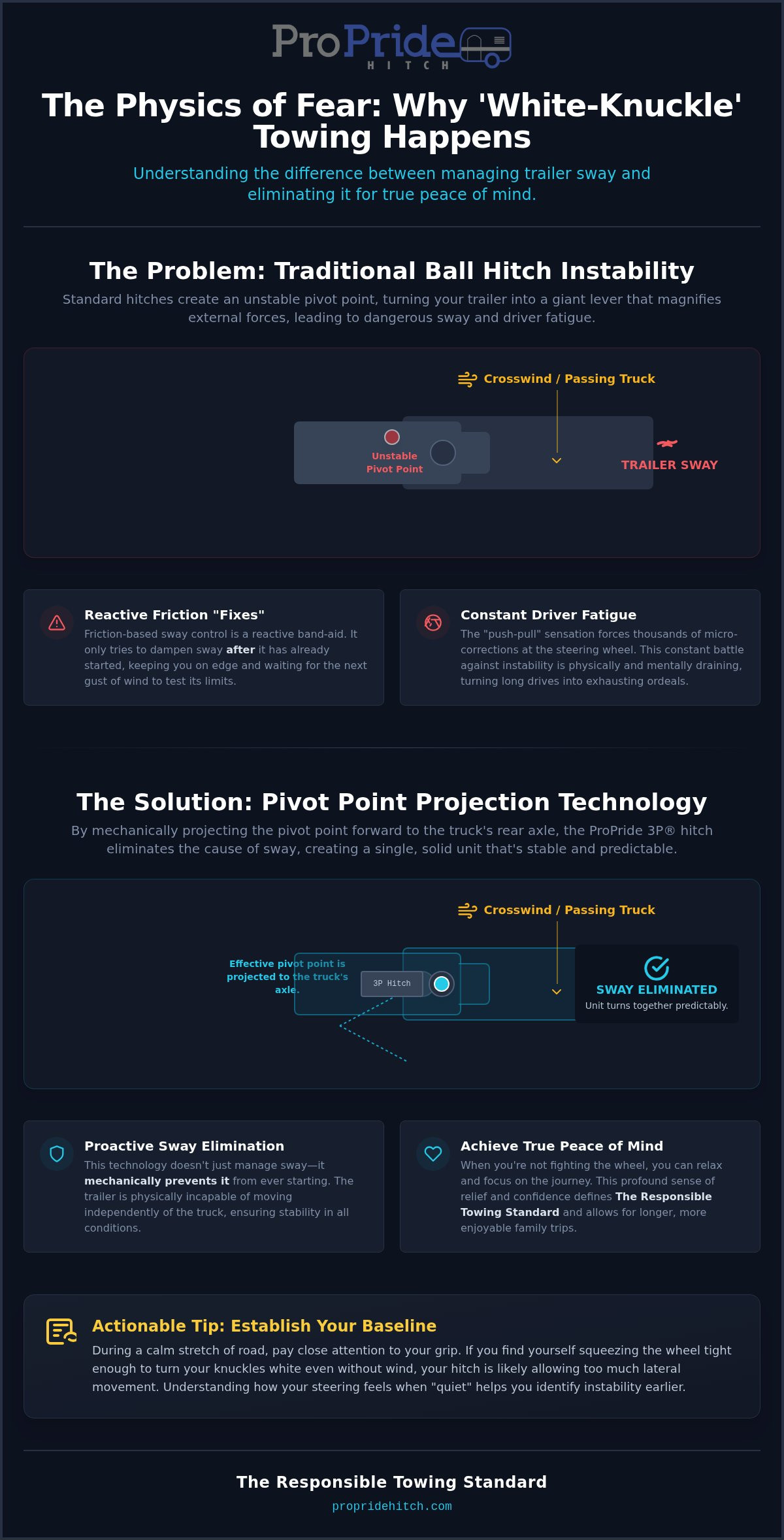
White-knuckle driving is more than just an expression; it's the physical manifestation of mechanical instability. When your trailer begins to oscillate, your body instinctively tenses. Your brain enters a high-alert state because it detects a lack of convergence between your truck and trailer. Convergence simply refers to the truck and trailer working together as a single, stable unit rather than two separate pieces fighting for control. This "tug-of-war" is mentally and physically exhausting. Every time a gust of wind or a passing semi-truck pushes the side of your trailer, you make a micro-correction at the steering wheel. Over a long drive, these thousands of tiny adjustments drain your energy. True peace of mind while towing RV setups isn't just a mood you decide to have; it's an engineering objective that requires the right equipment to achieve.
Identifying the Sensory Triggers of Towing Anxiety
Most experienced drivers recognize the "push-pull" sensation. As a large commercial vehicle approaches from behind, the air it displaces first pushes your trailer away, then pulls it toward the truck as it passes. This happens because a standard ball-and-socket hitch allows the trailer to act as a long lever arm against your tow vehicle. In simple terms, the distance from the trailer's axles to the hitch allows small forces at the back of the trailer to exert huge pressure on your truck's rear. You feel this through the steering wheel as a sudden tug or a persistent shimmy. Understanding these towing safety principles helps you realize that your anxiety is a logical response to a mechanical flaw in traditional hitch designs.
Actionable Tip: Pay close attention to your grip during a calm stretch of road. If you find yourself squeezing the wheel tight enough to turn your knuckles white even without wind, your hitch is likely allowing too much lateral movement. Establishing a baseline for how your steering feels when "quiet" helps you identify instability earlier.
The Difference Between 'Managing' Sway and Eliminating It
Many traditional hitches use friction to dampen sway. This means they try to slow the sway down after it has already started. From a psychological perspective, this keeps you on edge. You're constantly waiting for the next gust to see if the friction pads will hold. By contrast, eliminating sway means the trailer is mechanically incapable of moving independently of the truck. This shift in technology creates a profound sense of relief. When you aren't fighting the wheel, you can focus on the scenery and your family. This is how you establish peace of mind while towing RV trailers and truly meet The Responsible Towing Standard.
The Mechanical Roots of Towing Stress and Instability
To understand why towing often feels like a high-stakes balancing act, we have to look at the physics of the connection. Most trailers are attached to a tow vehicle using a standard ball and socket. While this design is simple and effective for low-speed maneuvering, it creates a natural pivot point that is inherently unstable at highway speeds. This connection acts as a universal joint, allowing the trailer to move independently of the truck in every direction. When you are traveling at 65 mph, that freedom of movement becomes a liability. True peace of mind while towing RV setups requires a connection that doesn't just hold the trailer, but actually controls its movement through superior geometry.
Environmental factors like crosswinds and road ruts exploit this mechanical weakness. Your trailer is essentially a long lever arm. When a gust of wind hits the side of a 30-foot trailer, the force is magnified at the hitch ball. Because the ball is located several feet behind your truck's rear axle, it uses that distance to exert leverage on your vehicle. This is why a small shift in the trailer can feel like a massive shove to the driver. Relying on "good enough" equipment often means you're one unpredictable gust away from losing control. Following The Responsible Towing Standard means acknowledging these physical realities and choosing a system designed to counteract them.
Why Friction-Based Sway Control is a Reactive Band-Aid
Many drivers use friction-based sway control, which relies on heavy-duty pads or bars to create resistance. The problem is that friction is purely reactive. It only starts working after the trailer has already begun to move. Every friction-based system has what engineers call a "break-away" point. This is the moment when the physical force of the sway exceeds the holding power of the friction pads. Once that threshold is crossed, the friction becomes useless, and the sway can escalate rapidly. This creates a false sense of security; you feel stable until the environment becomes too aggressive for the friction to handle.
The Vulnerability of the Traditional Pivot Point
In a traditional setup, your truck's rear axle acts as a fulcrum. When the trailer pushes sideways on the hitch ball, it tries to rotate the truck around that rear axle. This movement lifts or shifts the weight on your front tires, which are responsible for steering. This is the classic "tail wagging the dog" effect. Even the most skilled drivers cannot out-steer a significant sway event because the physics are working against the truck's tires. To solve this, you need a system that moves the effective pivot point forward. You can learn more about how Pivot Point Projection eliminates this vulnerability by locking the truck and trailer into a single, stable unit.
Actionable Tip: Check your trailer's profile. A taller, longer trailer has a larger "sail area," making it more susceptible to the lever effect. If you're towing a high-profile rig, the mechanical limitations of a standard ball hitch are even more dangerous.
Achieving The Responsible Towing Standard through Engineering
If the standard ball and socket connection is the root of instability, then the ProPride 3P® Hitch is the mechanical answer to that problem. Achieving true peace of mind while towing RV trailers requires moving beyond traditional methods that merely try to manage sway. We must instead look toward a solution that changes the physical relationship between the truck and the trailer. This is where engineering excellence meets the road. By utilizing a design that locks the two vehicles into a single, cohesive unit, we eliminate the independent movement that leads to dangerous oscillations. This approach isn't just an upgrade; it's a commitment to The Responsible Towing Standard.
What is Pivot Point Projection? (Technical Concepts Simplified)
To understand the ProPride 3P®, you must understand Pivot Point Projection. Traditional hitches allow the trailer to pivot at the bumper, which is several feet behind the truck's rear axle. This creates a lever that the trailer uses to push the truck around. The 3P system uses a series of heavy duty trapezoidal linkage bars. These bars allow the trailer to turn when you steer the truck, but they prevent the trailer from moving side to side on its own. It effectively tricks the trailer into thinking it's attached directly over the rear axle of the truck, much like a semi-truck's fifth wheel or a gooseneck trailer. Pivot Point Projection is the projection of the trailer's pivot point to the tow vehicle's rear axle.
This geometry ensures that the trailer tracks exactly with the truck's movements. When you turn the steering wheel, the linkage bars shift to allow the pivot. However, when a side force like a crosswind hits the trailer, the linkage bars remain rigid. This forces the entire weight of the truck to resist the movement, making it physically impossible for the trailer to sway independently. It's a proactive mechanical lock rather than a reactive friction-based dampener.
Actionable Tip: When researching hitches, ask specifically if the design uses linkage bars to project a pivot point or if it relies on friction pads. If it uses friction, it's a reactive system. If it uses linkage, it's a proactive system.
The Jim Hensley Legacy: A History of Innovation
The technology behind the 3P hitch didn't happen by accident. It is the culmination of decades of work by Jim Hensley, a legendary figure in the RV industry. Hensley recognized that the "ball and socket" was a flawed design for high speed towing. He dedicated his career to solving the sway problem once and for all through the laws of physics. The ProPride 3P® represents the ultimate refinement of his original concepts, using modern manufacturing and higher strength materials to provide the most stable towing experience available. Choosing this system means you're investing in a legacy of safety that has protected families for generations. You can read more about how this engineering functions in our detailed guide on The ProPride 3P Hitch: The Ultimate Engineering Solution.
By shifting the pivot point, you regain control over your journey. You no longer have to worry about the "tug-of-war" between your vehicles because the 3P hitch has already won that battle through superior geometry. This is how you achieve peace of mind while towing RV rigs, knowing your family is protected by the best engineering on the planet.
Practical Steps for a Stress-Free Towing Experience
True safety isn't just about what you do on the highway. It starts before you even put the truck in gear. Adopting The Responsible Towing Standard means treating your preparation with the same precision as the engineering in your hitch. When you have verified data about your rig, you gain a level of peace of mind while towing RV trailers that a simple "visual check" can never provide. Responsible owners know that guessing is the enemy of safety. By developing a methodical routine, you eliminate the small errors that can lead to big problems on the road.
Understanding Weight Distribution and Tongue Weight
You need to know your numbers. Gross Vehicle Weight Rating (GVWR) is the maximum weight your vehicle can safely carry, while Gross Combined Weight Rating (GCWR) is the total weight of the truck and trailer combined. Most importantly, you must understand tongue weight. This is the downward force the trailer coupler exerts on the hitch. If your tongue weight is too low, the trailer will be prone to sway. If it's too high, it can overload your rear tires and lift the front of your truck.
Actionable Tip: Don't rely on the "dry weight" sticker from the manufacturer. Use a dedicated tongue weight scale or visit a commercial truck scale to find your actual loaded weight. This ensures your rig is balanced for the real world, not just the showroom floor.
Consistency reduces human error. Always follow a written checklist, even if you've hitched up a hundred times. This discipline is what separates a casual traveler from a responsible towing expert. Start with your tires. Check the pressures on both the truck and the trailer, as under-inflated tires are a leading cause of blowouts and instability. Ensure your safety chains are crossed and that your breakaway cable is attached directly to the truck frame, not the hitch itself. Avoiding common Travel Trailer Towing Mistakes Guide is a key part of your self-education. If you want to ensure your setup is truly optimized, you can view the specifications of the ProPride 3P® Hitch to see how it sets the bar for stability.
Transforming Your Journey with the ProPride 3P® Hitch
The ultimate goal of every responsible owner is to reach their destination without feeling like they just ran a physical marathon. When you equip your rig with a ProPride 3P® Hitch, you aren't just adding a piece of hardware; you're fundamentally changing the dynamic of your travel. This transition is what we call the "ProPride Feel." It's the moment you realize that the white-knuckle stress of the past has been replaced by a quiet, firm confidence. Achieving true peace of mind while towing RV trailers means you can finally enjoy the scenery or a conversation with your passengers instead of staring intently at the side-view mirror, waiting for the next gust of wind.
The 'ProPride Feel': Stability on the Open Road
The most immediate change you'll notice is how your rig handles external forces. In a traditional setup, a passing semi-truck creates a "suck-and-sway" effect, where the air pressure first pulls your trailer toward the truck and then pushes it away. With Pivot Point Projection, this sensation is virtually eliminated. Because the trailer is mechanically locked from swaying independently, the wind push acts on the truck and trailer as a single, solid unit. You might feel a slight, uniform nudge, but the terrifying lateral oscillation is gone. This stability allows you to drive longer distances with significantly less physical fatigue, which makes your vacation days more productive and enjoyable for everyone on board.
Actionable Tip: On your first trip with the 3P system, pay close attention to the tension in your shoulders and neck. Most drivers don't realize how much physical stress they hold until the source of that stress is removed. If you arrive at your campsite feeling refreshed rather than drained, you've successfully implemented The Responsible Towing Standard.
Protecting Your Family and Your Investment
Safety is the one area of the RV lifestyle where you should never settle for "good enough." Your travel trailer represents a significant financial investment, and protecting it means looking after both the exterior and the interior. Just as you would use professional solutions from Pro Supply Center for shower waterproofing to protect your rig's interior, choosing "The Best Hitch on the Planet" is a proactive decision to eliminate road risk rather than just hoping your friction-based equipment can handle a crisis. The ProPride 3P® is engineered to be the final hitch you'll ever need to buy, built with the durability to outlast multiple tow vehicles. By investing in superior engineering and the Jim Hensley legacy, you're ensuring that every journey is a safe one. It's time to stop managing sway and start eliminating it entirely. You can invest in your peace of mind with the ProPride 3P® today and experience the difference for yourself.
Towing doesn't have to be a test of your nerves or your physical endurance. By recognizing that "white-knuckle" driving is a symptom of mechanical instability, you've already taken the first step toward a safer journey. We've explored how traditional ball-and-socket hitches create a dangerous pivot point and why friction-based sway control is simply a reactive band-aid. True peace of mind while towing RV setups comes from proactive engineering that eliminates sway before it can ever start.
When you choose to follow The Responsible Towing Standard, you're prioritizing your family's safety and protecting your investment. With patented Pivot Point Projection technology and the authentic Jim Hensley design legacy, the ProPride 3P® Hitch transforms your truck and trailer into a single, stable unit. Backed by a lifetime warranty and expert support, it's the ultimate solution for the discerning traveler. Don't settle for "good enough" when you can have the best. Upgrade to The Responsible Towing Standard with the ProPride 3P® Hitch and rediscover the joy of the open road. Your next trip deserves the confidence that only precision engineering can provide.
Frequently Asked Questions
Is it possible to completely eliminate trailer sway while towing?
Yes, you can completely eliminate trailer sway by moving from a reactive friction-based system to a proactive mechanical linkage. While most hitches try to slow down sway after it starts, the ProPride 3P® uses geometry to make independent trailer movement physically impossible. This level of mechanical control is essential for achieving true peace of mind while towing RV trailers, as it removes the primary cause of towing accidents and driver fatigue.
How does the ProPride 3P differ from a standard weight distribution hitch?
A standard weight distribution hitch only uses spring bars to shift tongue weight to the front axle. The ProPride 3P® does this while also incorporating Pivot Point Projection. This technology uses heavy-duty linkage bars to lock the truck and trailer together. Unlike traditional hitches that allow the trailer to pivot on the ball, the 3P projects the pivot point forward to the truck's rear axle, setting The Responsible Towing Standard.
Do I still need sway control if I have a heavy-duty 3/4 ton or 1 ton truck?
Yes, because a larger truck does not change the physics of a trailer acting as a lever against the hitch ball. Even with a 1-ton dually, a significant crosswind or emergency maneuver can cause the trailer to oscillate independently. While a heavy-duty truck provides better braking and payload capacity, it cannot mechanically prevent sway. Using the 3P ensures your heavy-duty investment is protected by the most stable connection available today.
Can a ProPride 3P hitch be used with any travel trailer brand?
The ProPride 3P® is designed to be compatible with virtually any bumper-pull travel trailer brand on the market. Whether you own a lightweight fiberglass unit or a large tri-axle toy hauler, the system attaches to the standard A-frame of the trailer. It is adjustable to accommodate different frame heights and coupler styles. This versatility makes it a long-term investment that you can move from one trailer to the next as your needs change.
What is the Jim Hensley design legacy in the towing world?
Jim Hensley was a visionary engineer who revolutionized the industry by identifying the inherent flaws in the ball-and-socket hitch design. He moved away from friction-based solutions and invented the concept of linkage-based sway elimination. The ProPride 3P® is the ultimate refinement of his original work, utilizing modern manufacturing and high-strength materials. This legacy provides historical authenticity to our claim of offering "The Best Hitch on the Planet."
How does Pivot Point Projection help in high-wind towing conditions?
In high winds, a standard hitch allows the trailer to act like a sail, pushing against the hitch ball and steering your truck. Pivot Point Projection changes this by mechanically forcing the trailer to track exactly with your tow vehicle. When a gust hits the side of your trailer, the force is transferred to the entire mass of the truck and trailer together. This convergence prevents the "tail wagging the dog" effect during storms.
Is the ProPride 3P hitch difficult to maintain for a responsible owner?
Maintaining the ProPride 3P® is straightforward for any owner committed to The Responsible Towing Standard. The primary requirement is regular lubrication of the main pivot bearings through the provided grease zerts. You should also perform a periodic visual inspection of the linkage bars and weight distribution jacks to ensure everything is tight. Keeping a grease gun in your tool kit makes it easy to ensure the system operates at peak performance for a lifetime.
What should a properly hitched RV feel like at highway speeds?
A properly hitched RV should feel like a single, cohesive vehicle rather than two separate pieces fighting for control. You should experience a "quiet" steering wheel, meaning you aren't making constant micro-corrections to stay in your lane. When a semi-truck passes, you should feel a slight, uniform nudge of the entire rig rather than a sharp tug at the rear. This stable sensation is the key to achieving peace of mind while towing RV setups.

