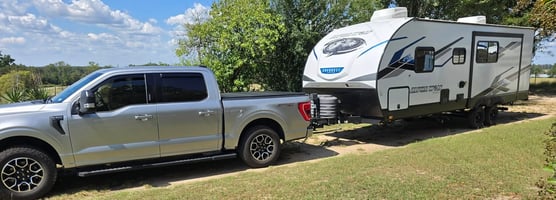
Emergency braking is one of the most critical—and least discussed—moments in towing. Whether it’s sudden traffic, wildlife, road debris, or an unexpected stop ahead, how your trailer reacts during hard braking can determine the outcome in seconds.
Understanding emergency braking trailer sway and its impact on trailer braking safety reveals why many conventional towing setups fail under pressure—and why eliminating sway is far safer than trying to manage it.
Why Emergency Braking Changes Everything
Under normal cruising, your trailer may feel stable. Emergency braking, however, introduces rapid deceleration forces that completely change the physics of towing.
When the tow vehicle slows suddenly:
The trailer’s momentum continues forward
Tongue weight shifts instantly
Lateral forces multiply
Any existing instability is amplified
This is when trailer sway is most likely to start or escalate rapidly.
What Actually Happens During Emergency Braking
1. Forward Momentum Pushes the Tow Vehicle
The trailer doesn’t stop instantly. Its mass continues forward, pushing against the hitch and rear axle of the tow vehicle. This can:
Reduce steering authority
Lighten the front axle
Increase stopping distance
2. The Trailer Tries to Pivot on the Hitch Ball
Because the pivot point is behind the tow vehicle’s rear axle, the trailer is free to rotate side-to-side while braking.
Even a slight angle can turn into:
Sudden fishtailing
Lane deviation
Jackknife conditions
This is one of the most dangerous aspects of emergency braking trailer sway.
3. Driver Corrections Can Make Things Worse
In panic situations, drivers may instinctively:
Overcorrect steering
Release brakes suddenly
Countersteer aggressively
These actions can feed energy into the oscillation instead of stopping it—especially when sway has already begun.
Why Weight Distribution Alone Isn’t Enough
Weight distribution hitches help rebalance axle loads—but they do not prevent pivoting during emergency braking.
Even with perfect weight distribution:
The trailer can still swing
Braking forces can trigger sway
Friction-based sway control can become inconsistent
When seconds matter, systems that rely on friction or resistance may not respond fast enough—or at all.
How Emergency Braking Exposes Weaknesses in Traditional Hitches
Friction-based anti-sway systems depend on surface contact and resistance. During hard braking:
Weight shifts reduce friction effectiveness
Moisture, dust, or heat affects consistency
Sudden force overwhelms the system
This unpredictability is why trailer braking emergencies are so dangerous with conventional setups.
How ProPride Changes Emergency Braking Safety
The ProPride 3P® Hitch addresses the problem at its source: the pivot point.
Using Pivot Point Projection™, ProPride moves the effective pivot point forward, near the tow vehicle’s rear axle. This creates a fundamentally different braking dynamic.
What This Means During Emergency Braking
The trailer cannot pivot side-to-side
Forward momentum stays aligned
Braking forces remain straight and controlled
The rig behaves as a single, stable unit
This is the core of ProPride 3P Hitch safety.
Why Eliminating Sway Matters More Than Reaction Time
In emergency situations:
Reaction time is limited
Conditions change instantly
There’s no margin for correction
By eliminating sway entirely, ProPride removes the need for split-second driver reactions. The trailer simply stays in line—even under maximum braking force.
Real-World Safety Benefits
ProPride owners consistently report:
Greater confidence during sudden stops
Better steering control while braking
Reduced panic in emergency situations
Instead of hoping their hitch reacts fast enough, they rely on a system designed to prevent instability before it begins.
Final Takeaway
Emergency braking is one of the most dangerous moments in towing. When a trailer is free to pivot, sway can appear instantly and escalate violently—even if everything felt fine seconds earlier.
True trailer braking safety comes from eliminating sway, not trying to control it after it starts.
The ProPride 3P® Hitch provides stability when it matters most, keeping your trailer aligned, predictable, and under control—so when seconds matter, your rig responds safely and confidently.