
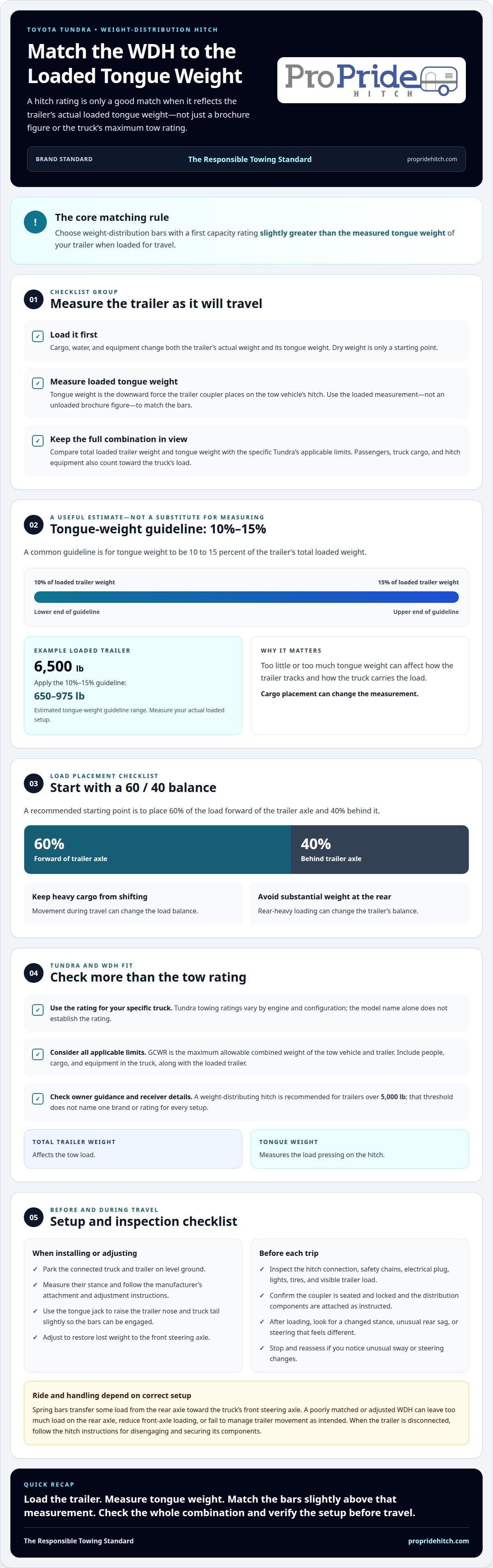
A hitch rating that looks right on paper can still feel wrong on the road. The best WDH for a Toyota Tundra is matched to the trailer’s loaded tongue weight, with the weight-distribution bars’ first capacity rating slightly greater than that tongue weight. A weight-distributing hitch is recommended for trailers over 5,000 pounds.
It makes sense to focus on the Tundra’s towing capacity, but that number alone doesn’t tell you how the truck and trailer will handle together. Loading, tongue weight, and how the hitch transfers weight all affect the setup.
This guide explains how trailer and tongue weight shape your hitch choice, what to consider for ride quality while towing, and why unloaded comfort matters too. You’ll also learn how rating and weight distribution work together, so you can make a more informed choice for your Tundra and trailer.
Key Takeaways
- Choose a hitch based on your trailer’s loaded tongue weight, not its dry weight alone.
- Match the weight-distribution bars’ rating to the measured tongue weight so they can redistribute load without being poorly matched to the setup.
- Consider how the hitch affects both towing stability and the truck’s ride when you’re driving without the trailer.
- Look at your Tundra’s configuration and the trailer’s actual loaded weight together; a tow-package label alone doesn’t determine the right hitch.
- Understand what the truck’s owner guidance says about weight distribution before choosing a setup.
Ride quality while towing and when unloaded
A Toyota Tundra’s towing performance depends on its engine and configuration, not just its model name.
Configuration changes the rating. That figure is not a universal rating for every SR5, much less every Tundra. Use the rating for the specific truck, then account for the loaded trailer, passengers, cargo, and hitch equipment. A truck’s maximum tow rating alone doesn’t establish a safe or comfortable combination.
Weight-distribution adjustment affects ride and steering feel. The hitch bars transfer some load from the rear axle toward the truck’s front steering axle. When set up correctly, they help address the front-end rise caused by trailer tongue weight. Choose bars with a first capacity rating slightly greater than the trailer’s loaded tongue weight. When the trailer is disconnected, follow the hitch instructions for disengaging and securing its components rather than driving with them in an unintended position.
Before each trip, inspect the hitch connection, safety chains, electrical plug, lights, tires, and visible trailer load. Confirm that the coupler is seated and locked, then check that the weight-distribution components are attached as instructed. After loading, look for a changed stance, unusual rear sag, or steering that feels different from when the truck is unloaded. These checks can reveal setup problems before highway speeds add stress.
GCWR, or gross combination weight rating, is the maximum allowable combined weight of the tow vehicle and trailer. Include people, cargo, and equipment in the truck, as well as the loaded trailer. A Tundra may be below its maximum tow rating yet exceed another limit, so consider all applicable ratings together.
WDH prices vary by design and capacity. Compare options against the trailer’s measured, loaded tongue weight rather than choosing by an advertised “popular” price. To install and adjust a hitch, park the connected truck and trailer on level ground, measure their stance, and follow the manufacturer’s attachment and adjustment instructions. Use the tongue jack to raise the trailer nose and truck tail slightly so you can engage the weight-distribution bars, then adjust to restore lost weight to the front steering axle.
A poorly matched or adjusted WDH can leave too much load on the rear axle, reduce front-axle loading, or fail to manage trailer movement as intended. This can affect steering, stability, and ride quality. Match the hitch to the actual loaded tongue weight, and treat unusual sway or steering changes as reasons to stop and reassess the setup.
Travel trailer weight and tongue weight
Dry weight is only a starting point. Cargo, water, and equipment change the trailer’s actual towing weight. When matching a hitch to your Tundra, compare the loaded trailer weight and tongue weight.
Tongue-Weight Guidelines
Tongue weight is the downward force the trailer coupler places on the tow vehicle’s hitch. A common guideline is 10 to 15 percent of the trailer’s total loaded weight. That range matters because too little or too much tongue weight can affect how the trailer tracks and how the truck carries the load.
For example, a loaded trailer weighing 6,500 pounds would have a guideline range of 650 to 975 pounds of tongue weight. This is an estimate based on the 10 to 15 percent guideline, not a substitute for measuring your actual setup. Use loaded weights, since cargo changes both the trailer total and the force at the hitch.
Load placement also affects tongue weight. A recommended starting point is 60 percent of the load forward of the trailer axle and 40 percent behind it. Keep heavy cargo from shifting during travel, and avoid placing substantial weight at the rear, which can change the trailer’s balance.
Brochure figures can help illustrate the difference between unloaded and loaded estimates.
Choosing a WDH Weight Rating
A WDH rating should match the trailer’s loaded tongue weight, not just its dry hitch-weight figure. Choose weight-distribution bars with a first capacity number slightly greater than the measured tongue weight. This gives you a better match for the load the bars need to manage than choosing by trailer length or unloaded brochure figures alone.
Use the loaded trailer as your reference point. For a 6,500-pound trailer, first apply the 10 to 15 percent guideline, then measure the actual tongue weight with the trailer loaded for travel. Cargo placement can shift that measurement, so take it after loading rather than relying on an empty-trailer specification.
Account for the whole towing combination. Total trailer weight and tongue weight answer different questions: total weight affects the tow load, while tongue weight measures the load pressing on the hitch. Consider both alongside the Tundra’s applicable limits before choosing a WDH rating.
What weight-distribution hitch (WDH) does Toyota recommend for the Tundra?
There isn’t one WDH that suits every Toyota Tundra and trailer combination. The relevant choice depends on the specific truck, the loaded trailer, and the hitch’s capacity. A weight-distributing hitch is recommended for trailers over 5,000 pounds, but that threshold doesn’t identify one brand or rating for every setup.
Treat a “recommendation” as a compatibility decision, not a model name. Start with the Tundra’s towing information and receiver details, then compare them with the trailer’s loaded weight and tongue weight. Maximum towing capacity alone doesn’t describe every limit in the combination. Passengers, cargo, and hitch equipment also add to the truck’s load.
A WDH uses spring bars to transfer some of the load pressing down at the hitch toward the tow vehicle’s front axle and the trailer. This can help address the rearward squat and front-end rise caused by tongue weight. It doesn’t increase the Tundra’s rated capacity or make an overloaded combination safe to tow.
Use this sequence to narrow the choice:
- Identify the exact Tundra configuration. Engine and configuration affect the truck’s towing capability, so don’t use another trim’s maximum as your own.
- Use the trailer’s loaded figures. Brochure dry weight won’t include travel cargo, and loading can change tongue weight.
- Match the WDH to the measured tongue weight. The bars’ first capacity number should be slightly greater than that weight.
- Set the distribution correctly. Adjust the system to return lost weight to the Tundra’s front steering axle.
For example, a trailer above 5,000 pounds may call for weight distribution, but its total weight doesn’t tell you the correct bar rating. A lighter trailer can still place substantial weight on the hitch if its load is arranged differently. The loaded tongue measurement helps distinguish those cases.
Don’t choose a WDH solely because its rating is far above the trailer’s advertised dry weight. A forum participant described a rating above 1,000/10,000 as overkill for a half-ton truck, but that opinion isn’t a universal fit rule. Match actual weights and the Tundra’s applicable limits instead.
Before towing, confirm that the selected hitch fits the receiver and that its components are adjusted as instructed. If the trailer’s weight or loading changes, reassess the setup. Safe towing means matching the whole combination, not relying on a Toyota model name or hitch label alone.
How do I choose the correct WDH weight rating for my Tundra and trailer?
Choose a rating based on your loaded trailer’s measured tongue weight, not its dry brochure figure. The weight-distribution bars’ capacity must suit the load they manage. Their first capacity number should be slightly greater than the trailer’s tongue weight. This is a practical starting point, but the complete setup also includes the Tundra, receiver, and loaded trailer.
Start by distinguishing the ratings. Trailer weight describes the entire trailer; tongue weight is the downward force at the hitch. A travel trailer listed at 8,600 pounds unloaded with 850 pounds of tongue weight illustrates why both figures matter. Added cargo can change the trailer’s total weight and its tongue weight, so an unloaded specification alone cannot determine the right bar rating.
Use these steps to narrow your choice:
- Load the trailer for travel. Include the cargo and equipment you plan to carry.
- Measure the loaded tongue weight. Use that value to guide the bars’ capacity selection.
- Compare the hitch and truck ratings. Check the rating information for the hitch components and the Tundra’s receiver.
- Account for the complete combination. The trailer, passengers, cargo, and hitch equipment all contribute to the towing setup.
Then compare your choice with the towing limits for your specific Tundra configuration. That maximum doesn’t apply to every truck, and it doesn’t replace the need to consider the truck’s other limits. A WDH redistributes some load; it doesn’t increase the truck’s capacity.
Don’t select a much higher bar rating just because it sounds safer. One forum participant described a rating above 1,000/10,000 as overkill for a half-ton truck. That comment isn’t a universal sizing rule, but it highlights why matching matters. Follow the hitch maker’s rating guidance and base the decision on the measured, loaded setup, not an isolated forum opinion.
After choosing a compatible rating, adjust the WDH according to its instructions. The goal is to restore lost weight to the Tundra’s front steering axle, not force the truck and trailer into an arbitrary stance. Reassess the setup if cargo placement or the trailer changes. The best WDH for a Toyota Tundra is the one whose rating and adjustment suit the actual combination.
Forum examples illustrate why a single trailer figure cannot settle the choice. The original poster described the travel trailer's dry weight as 8700'. These figures describe different trailers, and neither gives the loaded tongue weight needed to select bars.
A forum participant estimated the maximum bumper-hitch towing weight for these trucks at about ~7200 lbs, varying by trim. The Toyota Tundra's maximum towing capacity is sufficient for most recreational boats up to about 24 feet when the trailer and full fuel tank are included. A forum member reported towing a loaded 27-foot travel trailer with a Toyota Tundra. Another forum member reported that the camper wagged a little in high winds while crossing a couple of interstate bridges without the weight-distributing hitch connected. Treat such accounts as context, not a substitute for checking your measured setup and ratings.
Does a Toyota Tundra with a factory tow package or air suspension need a special WDH?
A factory tow package or air suspension alone doesn’t determine the right WDH for a Toyota Tundra. Choose for the complete towing combination, including the truck’s receiver, the trailer’s loaded tongue weight, and each component’s capacity. A package name or level-looking stance cannot replace those measurements.
Start with the specific Tundra’s owner information and receiver details. A tow package may identify equipment on a particular truck, but its name doesn’t tell you the loaded tongue weight or the capacity of every hitch component. Compare the receiver’s stated limits with the WDH and trailer requirements. The lowest applicable limit still matters.
Air suspension changes how the vehicle’s height is managed, not how much the trailer weighs. Even if the truck appears level after suspension adjustment, it may still carry substantial load at the hitch. Don’t use ride height alone to decide whether weight distribution is unnecessary or properly adjusted. Assess the loaded setup and follow the suspension and hitch instructions together.
Use this compatibility check before selecting a system:
- Identify the exact Tundra configuration. Use its owner information rather than assuming every model year or trim has identical equipment.
- Read the receiver’s limits. Compare its stated capacities with the trailer and hitch requirements.
- Measure loaded tongue weight. Cargo and equipment can make the travel-ready figure differ from the trailer’s brochure value.
- Review both instruction sets. Follow the Tundra’s guidance for towing equipment and the WDH maker’s fitting and adjustment directions.
A weight-distribution hitch shifts some load from the rear axle toward the front steering axle and trailer. Air suspension may change the truck’s height, but it doesn’t make that same transfer. Similarly, a factory tow package doesn’t make an incompatible hitch suitable. The WDH’s rating and adjustment must still match the measured load and vehicle limits.
After installing or adjusting a WDH, compare the truck’s stance and steering response with the loaded trailer attached. If the truck has air suspension, make these observations under the operating conditions specified in its instructions. Don’t compensate for poor weight distribution by changing suspension height alone. Revisit cargo placement and hitch adjustment instead.
For example, a Tundra that stays level under tongue load may still need weight distribution if the trailer and vehicle requirements call for it. Conversely, a tow package doesn’t automatically mean every trailer needs the same hitch. Treat the equipment as part of the setup, then decide based on actual weights, ratings, and instructions.
ProPride
ProPride can help Tundra owners consider sway control alongside the weight and rating decisions covered above. The ProPride 3P Hitch uses patented Pivot Point Projection technology to address trailer sway. It’s a relevant option if you’re evaluating how sway control fits your towing setup, but the hitch choice still needs to account for your trailer’s loaded tongue weight and the Tundra’s applicable limits. No hitch changes the truck’s capacity or replaces careful loading and adjustment. Compare the measured weights and compatibility requirements before deciding whether this approach suits your combination. For a closer look at the ProPride 3P Hitch, contact ProPride with your towing setup in mind.
Make your next towing decision with confidence
Treat the truck, trailer, and hitch as one system. Keep your loaded setup and priorities in view, including ride feel and sway control. The best WDH for a Toyota Tundra is a decision grounded in how you actually tow, not simply a label or a recommendation for another setup.
If trailer sway is a key concern, the ProPride 3P Hitch uses patented Pivot Point Projection technology to address it. Consider how that approach fits your towing needs alongside the weight and compatibility factors you’ve assessed. Thoughtful preparation is part of The Responsible Towing Standard.
Contact ProPride for towing help and take the next step toward a setup that reflects your priorities. An informed choice is a strong foundation for your travels.
Frequently Asked Questions
What are the best WDH models for a Toyota Tundra, and how do they compare?
There isn’t one model that suits every Tundra and trailer, so compare by capacity and design rather than name alone. The ProPride 3P Hitch is available in 600 lb, 800 lb, 1000 lb, and 1400 lb capacity options. Its weight distribution is integrated separately from its sway-control function. Match an option to your towing setup’s measured load and the applicable vehicle and hitch limits.
Which WDH works best for sway control with a Tundra?
The ProPride 3P Hitch uses Pivot Point Projection technology, which projects a virtual pivot point near the tow vehicle’s rear axle. This differs from friction-based damping, which relies on resistance to reduce trailer movement. The 3P also integrates weight distribution independently of sway control. Consider this design if sway control is a priority, while still matching the hitch setup to your Tundra and trailer.
How much do popular WDHs for the Toyota Tundra cost?
Compare options based on the trailer’s measured, loaded tongue weight.