
A Silverado’s maximum towing rating doesn’t tell you how much trailer tongue weight its payload can support. The best WDH for Chevy Silverado 1500 is the one matched to your truck’s actual payload and the trailer’s loaded tongue weight. For the 2027 model year, the Silverado has a minimum towing capacity of 7,200 lbs; models with the 5.7L V8 have a maximum available towing capacity of 13,700 lbs, while models with the 6.6L V8 have a maximum available payload of 1,510 lbs.
Look beyond the headline tow rating: passengers, cargo, and trailer tongue weight all count against the truck’s available payload. Choosing a hitch using the wrong figure can result in a poor fit, even when the trailer is within the advertised towing capacity.
This guide explains how to read Silverado payload and towing figures, account for loaded tongue weight, and assess trailering technology when choosing a weight distribution hitch. Use these steps to narrow your options based on your truck’s configuration and actual towing setup, with safety and careful preparation at the center of the decision.
Key Takeaways
- Use your Silverado’s specific configuration and the trailer’s loaded weights to narrow down an appropriate hitch capacity.
- Compare the hitch’s tongue-weight and trailer-weight ratings with the demands of your complete towing setup.
- Understand why a truck’s maximum tow rating alone can’t determine whether a setup fits.
- Recognize how an incorrectly matched hitch or overloaded truck can affect towing stability and control.
- Learn how available trailering technology and sway-control design can inform your final hitch choice.
What weight-distribution hitch (WDH) capacity is recommended for a Chevy Silverado 1500?
There isn’t one WDH capacity for every Chevy Silverado 1500. Cab style, engine, equipment, cargo, and trailer load all affect the right match. Choose by the weights of your actual towing setup, not by the truck model name alone. The best WDH for a Chevy Silverado 1500 must suit both the trailer’s loaded weight and its tongue weight, while staying within the truck and receiver limits.
A WDH typically lists maximum trailer-weight and tongue-weight ratings. Trailer weight is the fully loaded trailer’s total weight. Tongue weight is the downward force the trailer places on the hitch. These ratings describe different loads, so matching just one does not establish a suitable fit. Check both hitch ratings against your setup.
Start with the loaded trailer, not its empty or advertised weight. Include the gear, supplies, and other items you expect to carry. Then measure the loaded tongue weight with a suitable scale or weighing method. Because loading changes both figures, an estimate based on an empty trailer can lead to a poor match.
- Record the loaded trailer weight.
- Measure tongue weight with the trailer loaded for travel.
- Check the WDH’s trailer-weight and tongue-weight ratings.
- Compare the result with the Silverado and receiver limits.
Each check answers a different question. The WDH’s trailer rating must accommodate the loaded trailer, and its tongue-weight rating must suit the measured tongue load. The Silverado’s payload and receiver limits are separate constraints. A hitch rating cannot raise those truck limits or make an overloaded setup appropriate.
Check how the hitch maker defines its tongue-weight rating. Some products specify a range rather than a maximum. If so, your measured tongue weight should fall within that range. A hitch outside its intended operating range may not distribute weight as designed. Don’t choose a higher capacity just because the number sounds safer.
Consider a Silverado towing a travel trailer loaded with camping equipment. The trailer’s empty weight won’t account for the cargo, and how you pack can change the tongue load. Use travel-ready weights to select capacity. If the load varies between trips, reassess the match for the heaviest configuration.
Weight distribution transfers some of the trailer’s load across the tow vehicle and trailer axles. It doesn’t remove the load or increase the truck’s payload rating. The Silverado still carries passengers, bed cargo, and hitch-related load. Include these when evaluating capacity instead of treating the WDH rating as a substitute.
Follow a clear sequence: establish loaded trailer and tongue weights, identify the Silverado’s applicable limits, then choose a WDH with ratings suited to those loads. Check the receiver and hitch instructions for their limits and setup requirements. This is more useful than choosing by engine badge or picking the largest rating available.
How do you choose WDH tongue-weight and trailer-weight ratings for a Silverado 1500?
Base both ratings on the trailer’s travel-ready load, then compare them with the Silverado’s limits. The trailer-weight rating concerns the trailer’s total weight; the tongue-weight rating concerns the downward load at the hitch. Neither can stand in for the other. A suitable match accounts for both.
Start with the trailer in the condition you expect to tow it, including cargo, water, equipment, and supplies. Weigh the loaded trailer and measure its tongue weight with an appropriate scale. Empty-trailer figures can mislead: added cargo changes the total weight and may shift load toward or away from the hitch.
- Load the trailer as planned for a trip.
- Measure its total loaded weight and tongue weight.
- Compare both measurements with the WDH’s stated ratings.
- Check the Silverado and receiver limits for the same setup.
Read the hitch label and instructions carefully. Some WDHs state a tongue-weight range, while others give a maximum. If there’s a range, compare it with your measured tongue weight. If there’s a maximum, make sure your measured load stays within it. A higher maximum doesn’t automatically make a better match.
For example, a Silverado towing a camper may carry bikes, food, and equipment in different places from trip to trip. Those choices affect the camper’s loaded weight and tongue load. Recalculate when the load changes materially. Don’t select a hitch based on the camper’s brochure weight if the loaded trailer is heavier.
Keep trailer limits separate from truck limits. The WDH rating describes the hitch’s intended load range; it doesn’t increase the Silverado’s payload, receiver, or towing capacity. Passengers, cab and bed cargo, and hitch hardware all contribute to the truck’s load. A correctly rated hitch cannot make it safe to exceed the truck’s stated limits.
Check how the hitch instructions define the ratings. A stated trailer rating may apply only with a particular tongue-weight range or setup. Follow the manufacturer’s adjustment directions because spring-bar tension and hitch height affect load distribution. Don’t try to compensate for a poor rating match with arbitrary adjustments.
If measurements fall outside the hitch’s stated range, reassess the trailer load or choose equipment rated for those weights. If the Silverado’s payload or receiver limit is the constraint, reducing cargo may help; a higher-rated WDH won’t resolve it. Base your decision on loaded weights, not assumptions from the Silverado nameplate or trailer dry weight.
Make a clear comparison: loaded trailer weight against the WDH’s trailer rating, measured tongue weight against its tongue rating, and both against the truck’s applicable limits. Keep the measurements with your towing notes. Recheck them whenever the Silverado, trailer, or travel load changes, since a new configuration can affect the fit.
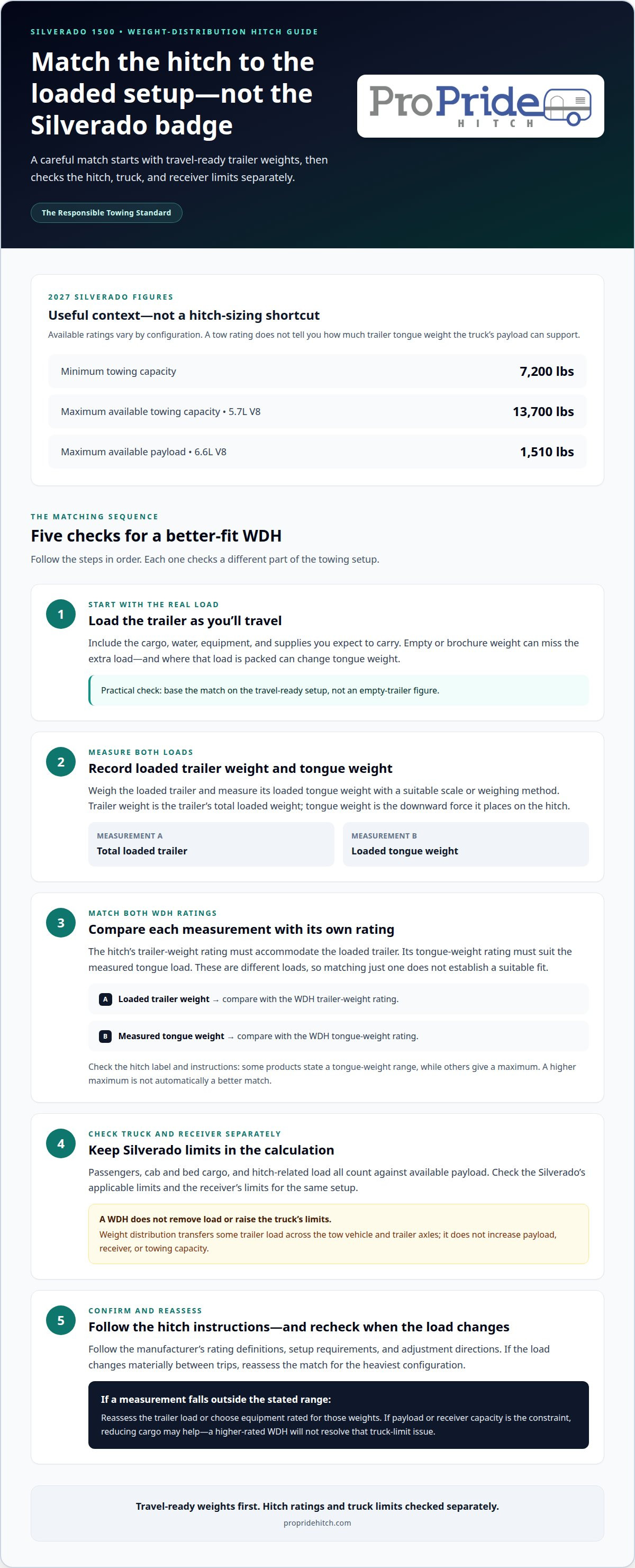
What are the Silverado 1500’s towing, payload, and hitch-weight limits by model year and configuration?
Silverado 1500 limits depend on model year and configuration. For the 2027 model year, the Chevrolet Silverado has a minimum towing capacity of 7,200 lbs. The 2027 Silverado with the 5.7L V8 has a maximum available towing capacity of 13,700 lbs. With the 6.6L V8, its maximum available payload is 1,510 lbs. These figures describe different limits, not one universal capacity.
A maximum towing rating describes the trailer load a particular configuration may tow under specified conditions. Payload is the weight the truck carries, including occupants, cargo, and hitch-related load. Hitch weight is the downward force where the trailer connects. These figures measure different loads, so a high tow rating doesn’t establish available payload or receiver capacity.
Configuration matters. Engine, cab, bed, drivetrain, and installed equipment can change a Silverado’s ratings. The listed 2027 maximums apply to qualifying configurations, not automatically to every truck with the same model year. A different engine or equipment package can have a different rating. Use the values for the exact truck, rather than transferring a maximum from another Silverado.
To find the relevant limits, note the truck’s model year, engine, cab and bed configuration, and installed equipment. Compare the figures for that specific configuration in the owner documentation and on the truck labels. Keep the trailer’s loaded weight separate from the Silverado’s payload figure. Each number answers a different question about the full towing combination.
- Towing capacity: the applicable trailer-weight ceiling for that truck configuration.
- Payload: the truck’s available carrying capacity for people, cargo, and hitch load.
- Receiver and hitch limits: the capacities stated for the equipment connecting truck and trailer.
- Tongue weight: the trailer’s downward load at the hitch, which uses Silverado payload.
Pay particular attention to hitch-weight limits because a receiver and WDH can have separate ratings. Use the Silverado’s stated receiver limits and the hitch maker’s ratings for the intended setup. The applicable component limits constrain capacity: a higher rating for one part doesn’t increase another part’s capacity. Don’t substitute a general Silverado figure for the receiver’s stated rating.
For example, the 2027 maximum available payload of 1,510 lbs applies to the stated 6.6L V8 fact, not every Silverado. Passengers and items in the cab or bed consume payload before considering the trailer’s hitch load. If the actual truck has a lower payload rating, that specific figure governs your planning. The 13,700 lbs maximum available towing figure for a 5.7L V8 does not change this payload calculation.
For your Silverado, identify its exact year and configuration, record its specific towing and payload limits, then check the receiver and hitch ratings. Compare these with the loaded trailer and the truck’s carried load. The lowest applicable component limit constrains the setup. This model-specific check helps prevent mistaking a headline maximum for a rating that fits every Silverado.
What are the risks of choosing an incorrectly rated WDH or overloading a Silverado 1500
A mismatched weight distribution hitch can leave the Silverado and trailer poorly matched to the load. If the hitch rating is below the trailer’s actual demands, its components may face loads beyond their stated range. If the rating is far above the measured tongue weight, the setup may not work as intended. Neither situation corrects an overloaded truck.
Weight distribution changes how the connected load is carried across the tow vehicle and trailer axles. An incorrect setup can leave too much or too little load on the Silverado’s front axle, affecting steering feel and the truck’s response on the road. Select and adjust the hitch for the actual combination, not just the Silverado model name.
Overloading is a separate concern. Passengers, cargo, and hitch-related load all count against the truck’s payload. A WDH cannot add capacity if their combined weight exceeds the Silverado’s applicable limit. Excess load can put added demand on tires, suspension, wheels, and the receiver, while leaving less payload for unexpected items during a trip.
Consider a Silverado carrying several passengers and bed cargo while towing a trailer with a heavy tongue load. A high maximum tow rating doesn’t mean that configuration fits within payload. The truck could be within its trailer-weight limit but exceed another limit. Treat each rating as a separate constraint and assess the full travel-ready setup.
An incorrectly rated hitch can also make adjustment difficult. Spring bars help transfer some of the load and need to operate within the hitch maker’s stated range. Outside that range, changing tension alone may not produce the intended distribution. Follow the equipment instructions instead of trying to correct a rating mismatch with improvised adjustments.
Also account for changes to the combination. Adding trailer cargo can change its total weight and tongue load; adding passengers or equipment to the Silverado uses more payload. A setup suited to one trip may not suit the next. Reassess after meaningful changes to the truck, trailer, or cargo.
- Compare measured trailer and tongue weights with the hitch’s stated ratings.
- Keep the Silverado’s payload, receiver, and towing limits distinct.
- Account for passengers, cab items, bed cargo, and hitch hardware.
- Follow the hitch manufacturer’s setup and adjustment instructions.
- Reassess when the trailer or truck load changes.
If a measurement exceeds a component’s stated limit, reduce or rearrange the load where appropriate, then reassess the configuration. If the Silverado’s own limit is still the constraint, a higher-rated hitch won’t solve the problem. Checking the complete setup is more useful than relying on a single headline number.
For a hitch approach designed around trailer sway control, explore the trailer sway-control hitch design and consider how its design fits your towing priorities.
ProPride
ProPride offers the ProPride 3P Hitch for Silverado owners weighing hitch capacity alongside sway control. Its patented Pivot Point Projection technology is designed to eliminate trailer sway by changing how the trailer pivots behind the tow vehicle. That makes it relevant when your hitch decision involves more than matching weight ratings. The Silverado’s payload, receiver, and the hitch’s own ratings still need to suit your loaded setup.
If you’re comparing hitch capacity and sway-control approaches, consider how the ProPride 3P Hitch fits your towing priorities. Responsible towing starts with matching equipment to the truck and trailer, then understanding how the hitch manages sway. That’s the foundation of The Responsible Towing Standard.
Contact ProPride to discuss the ProPride 3P Hitch and your towing questions.
Make Your Next Tow a Deliberate Choice
Make the hitch decision part of a complete towing plan, considering the Silverado, trailer, and typical travel load together. If your cargo or trailer setup changes, revisit whether your equipment still suits your towing needs. This keeps a careful purchase decision useful beyond the first trip.
The best WDH for a Chevy Silverado 1500 should reflect your priorities as well as the numbers. If trailer sway control is a key concern, consider whether the ProPride 3P Hitch fits your approach to towing. A considered decision starts with clear priorities, then selects equipment designed to address them.
Contact ProPride about your hitch to discuss your towing priorities and the ProPride 3P Hitch. Take the next step with care, and build a setup that supports confident, responsible travel.
Frequently Asked Questions
Which weight-distribution hitches are best for a Chevy Silverado 1500 towing travel trailers?
The right choice depends on your travel trailer’s loaded weights, Silverado configuration, and sway-control priorities. For a setup where trailer sway control matters, the ProPride 3P Hitch combines weight distribution with Pivot Point Projection technology. Its capacity options are 600 lb, 800 lb, 1000 lb, and 1400 lb. Match the selected option to your measured tongue weight and the ratings for your truck, receiver, and trailer.
Can you use a WDH with a Silverado 1500 equipped with air suspension, adaptive ride control, or a factory hitch?
Compatibility depends on the Silverado’s equipment and receiver. Check the truck’s instructions for weight-distribution use and follow any procedures for air suspension or adaptive ride control. The receiver must also be rated for the intended hitch setup. A factory hitch alone doesn’t establish compatibility: its stated limits and the vehicle’s guidance determine whether the combination is suitable. Account for the suspension system when setting up the loaded truck and trailer.