
Your trailer tongue weight isn't just a compliance number to check off before heading out; it's the fundamental leverage point that decides whether your trailer follows your truck smoothly or actively fights it at highway speeds. If you've ever felt that sudden, white-knuckle shudder when a passing semi-truck pushes your rig toward the shoulder, you already know the anxiety of an unbalanced load. You want absolute stability to protect your family and your investment, yet conflicting weight ratings and vague setup guides often make proper hitching feel like guesswork.
Towing with complete peace of mind comes down to respecting the physical forces under your bumper. When you master how downward coupler force works, you take command of your rig's dynamics and uphold The Responsible Towing Standard every time you travel. In this guide, we'll break down the essential 10% to 15% rule, share practical methods to measure your load accurately in your own driveway, and show you how to dial in a rock-solid, sway-free setup.
Key Takeaways
- Calculate your ideal downward coupler load using the proven 10% to 15% target range for bumper-pull setups.
- Identify the critical warning signs of an unbalanced load, from front-tire float to the dangerous sway triggered by incorrect trailer tongue weight.
- Measure your loaded setup accurately before hitting the road using simple driveway checks or multi-pass commercial scale tickets.
- Apply the 60/40 cargo rule to pack heavy gear low and forward of the axles, preventing sudden shifts in your truck's payload balance.
- Learn why meeting The Responsible Towing Standard means moving beyond friction dampers to mechanical solutions like Pivot Point Projection.
What is Trailer Tongue Weight and Why Does It Matter?
Trailer tongue weight is the static downward force that the trailer's coupler presses directly onto the hitch ball of your tow vehicle. Simply put, trailer tongue weight functions as the central stabilizing anchor of your entire combination, dictating whether your vehicle stays firmly planted or gets pushed around on the road.
Getting this downward pressure right follows a strict "Goldilocks" principle. Too little weight lets the back of the trailer drift, while too much overburdens your truck's rear suspension; true safety requires dialing in the sweet spot between those extremes. Mastering this balance embodies The Responsible Towing Standard, ensuring you prepare your rig with engineering precision before your family leaves the driveway.
To see these mechanics demonstrated clearly with real measuring tools, watch this helpful walkthrough:
The 10% to 15% Rule Explained
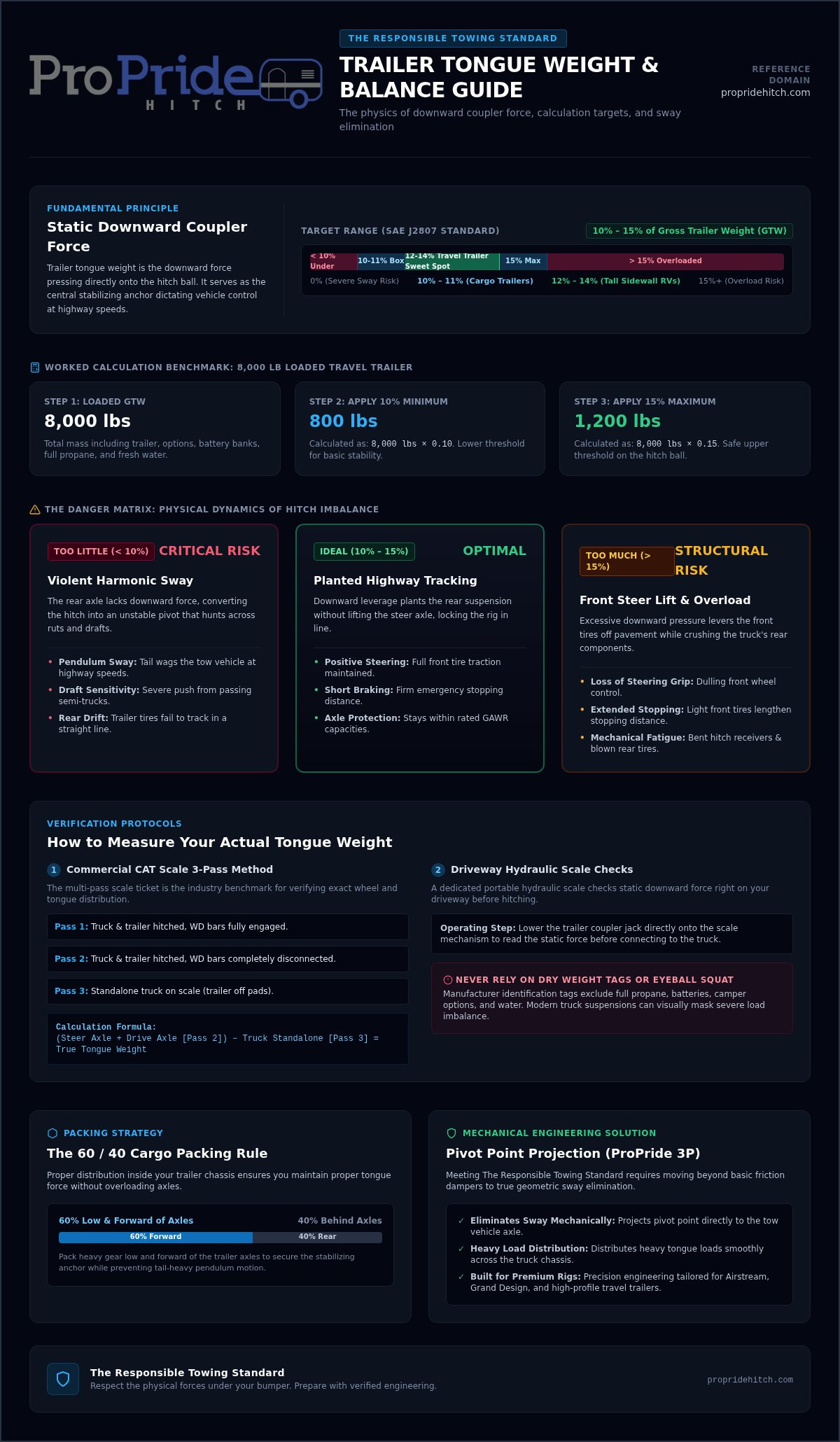
Automotive standards like SAE J2807 establish that conventional bumper-pull trailers require 10% to 15% of their total Gross Trailer Weight resting on the hitch ball. This downward pressure ensures the tires follow the tow vehicle in a stable line rather than hunting across road ruts. While a utilitarian cargo box trailer might pull fine near 10% to 11%, a tall travel trailer with broad, wind-catching sidewalls often demands 12% to 14% to stay planted against lateral drafts.
The Dangers of Ignoring Tongue Weight
Overlooking your hitch balance triggers immediate mechanical failures. An unmanaged setup risks blown rear tires, bent hitch receivers, and sudden harmonic sway that can quickly escalate out of control. Beyond equipment fatigue, the leverage alters your truck's geometry:
- Loss of front steering grip: Heavy rear loading levers the front tires off the pavement, stretching emergency stopping distances and dulling your steering input.
- Rear-axle overload: Pushing too much downward force behind your bumper rapidly exceeds your vehicle's rear axle rating.
- Pendulum sway: Carrying less than 10% tongue weight creates an unstable pivot that whips violently at highway speeds.
Responsible towers do not rely on luck. Understanding these mechanical principles keeps your equipment protected and everyone in your cab secure.
How to Calculate and Measure Your Tongue Weight
Calculating your target trailer tongue weight starts with your Gross Trailer Weight (GTW), the total combined mass of your trailer and everything inside it. To find your target window, multiply your actual loaded GTW by 0.10 and 0.15. If your fully packed trailer weighs 8,000 pounds, your hitch ball should carry between 800 and 1,200 pounds.
Never rely on the dry weight printed on the manufacturer's vehicle identification tag. Factory numbers exclude battery banks, full propane tanks, options, and camping gear. Always measure your rig fully loaded for travel, including full fresh water tanks if you camp off-grid. When towing high-end rigs like an Airstream or Grand Design, precision matters; shifting cargo just slightly can push tongue force outside safe limits. Responsible towers pair verified numbers with a proper setup, often relying on the ProPride 3P trailer sway control hitch to distribute these heavy loads smoothly across the truck's chassis.
Using a Commercial CAT Scale
Running your setup across a certified commercial truck scale provides unmatched accuracy. To dial in exact numbers, use the three-pass weighing method:
- Pass 1: Truck and trailer hitched, with weight distribution bars engaged.
- Pass 2: Truck and trailer hitched, but with weight distribution bars completely disconnected.
- Pass 3: Truck alone on the scale, leaving the trailer parked off the pads.
To calculate true trailer tongue weight, take the combined steer and drive axle weights from Pass 2 and subtract the truck's standalone weight from Pass 3. The difference is the true downward force pushing on your hitch.
Dedicated Tongue Weight Scales and Built-in Tools
Visiting a truck stop before every trip is not always convenient. A portable hydraulic tongue scale solves this by letting you measure coupler weight right on your driveway. You simply lower the trailer jack directly onto the scale mechanism to read the static force before hitching up.
Never trust your eyes or suspension squat to gauge balance. Modern truck suspensions mask heavy loads well, and a level-looking truck bed can easily hide a dangerously light or overloaded hitch. Checking your numbers with dedicated tools upholds The Responsible Towing Standard, replacing gut feeling with verifiable data before you hit the road.
Too Much vs. Too Little: Identifying Weight Imbalance
Your trailer's axle serves as a physical fulcrum. Where you place weight relative to that axle dictates whether your rig tracks true or fights your steering wheel with every passing gust. If the front of your truck feels unusually light or floats across lane grooves, your trailer tongue weight is almost certainly too high, lifting the front tires and compromising directional control.
Conversely, shifting too much cargo behind the axle removes crucial downward force from the hitch ball. When this happens, the trailer coupler stops acting as an anchor and turns into a trigger for lateral oscillation. Diagnosing these handling changes quickly separates proactive drivers from roadside emergencies, reinforcing the discipline required by The Responsible Towing Standard.
The Anatomy of Trailer Sway
Carrying less than 10% trailer tongue weight transforms your trailer into a giant pendulum. Without enough vertical load pinning the coupler down, lateral forces from passing semi-trucks, crosswinds, or sudden lane corrections push the trailer sideways. Because standard hitch balls act as free-swiveling pivot points, that rearward energy transfers straight into your truck's chassis, starting a feedback loop that can escalate into violent fishtailing.
Standard friction dampers simply rub pads against steel to resist this side-to-side rotation after it begins. Rather than relying on friction to fight raw momentum, advanced systems like Pivot Point Projection use mechanical linkage geometry to project the effective turning axis forward to your truck's rear axle. This prevents trailer-induced sway forces from rotating the hitch ball in the first place.
Tow Vehicle Stress and Component Wear
Carrying too much tongue weight damages your tow vehicle long before an emergency stop occurs. Excessive downward hitch force pushes the rear suspension against its bump stops, overloading rear wheel bearings, overheating differential fluid, and stressing the transmission. Because the rear axle acts as a second fulcrum, this heavy hitch load levers weight off the front axle, cutting front tire contact patches and lengthening braking distances significantly.
Basic "good enough" hitches cannot fix an extreme imbalance. A reliable setup requires matching your cargo balance to your vehicle hardware:
- Weight-carrying limit: Check the receiver hitch tag for the maximum downward weight allowed without spring bars.
- Weight-distributing limit: Note the higher threshold permitted only when using an engineered weight distribution system.
- Vehicle payload rating: Remember that tongue weight counts dollar-for-dollar against your truck's door-jamb cargo capacity.
Adjusting Your Load for Optimal Stability
Packing your trailer is a mechanical exercise, not a game of fitting boxes into open spaces. Every heavy item should sit as low to the floor as possible and stay centered directly over the trailer axles. Because your trailer behaves like a balance beam on wheels, shifting 100 to 150 pounds of cargo just 12 inches forward or backward can change your trailer tongue weight by 50 to 100 pounds or more, instantly altering how your truck handles.
Liquid weight adds another dynamic variable. Water weighs roughly 8.34 pounds per gallon, meaning a full 50-gallon fresh water tank adds over 400 pounds to your trailer. If that tank sits forward of the axles, your tongue weight climbs; if your grey or black waste tanks sit behind the rear bumper, filling them on a camping trip steadily strips weight off your hitch. Monitoring these changes during your travels is a core habit that defines The Responsible Towing Standard.
The Cargo Shift Strategy
To keep your rig planted, apply the 60/40 cargo rule: place roughly 60% of your cargo weight in the front half of the trailer, with the remaining 40% resting behind the axles. Never let gear slide loose during transit. Secure heavy items like toolboxes, coolers, and spare batteries using ratchet straps tied to dedicated floor anchors so sudden braking cannot throw your weight distribution off balance.
Avoid attaching heavy cargo racks, generators, or multiple e-bikes to your trailer's rear bumper. Adding weight to the extreme rear acts like a weight on a grandfather clock's pendulum, drastically reducing downward coupler force and amplifying lateral highway drafts.
Weight Distribution vs. Tongue Weight
A common misconception is that a weight distribution hitch reduces your trailer tongue weight. It does not. The vertical load pushing on your hitch receiver remains identical; the spring bars simply act as levers to redistribute that downward load forward to your truck's steer axle and backward to the trailer's axles.
While traditional friction-based sway bars attempt to clamp down on movement, they cannot overcome the physical forces created by fluid tank shifts and gusting crosswinds. If you want true stability that manages heavy tongue loads without relying on friction pads, explore the engineered design of the ProPride 3P Hitch to experience sway-free towing on every journey.
Engineering the Solution: Beyond Weight Management
Dialing in your trailer tongue weight creates the baseline for safe travel, but real-world highway physics don't disappear just because your scale numbers look balanced. Crosswinds, uneven road crowns, and emergency evasive maneuvers constantly exert lateral pressure on your trailer's sidewalls. Meeting The Responsible Towing Standard requires looking beyond manual cargo loading to address the physical connection between your vehicle and trailer.
This is where mechanical engineering takes over. Representing the ultimate evolution of the Jim Hensley design legacy, the ProPride 3P Hitch fundamentally changes how tow vehicle and trailer interact. By altering the geometric connection under your bumper, it ensures your combination tracks true even through minor shifts in trailer tongue weight caused by emptying water tanks or moving supplies.
The Pivot Point Projection Advantage
Traditional hitches mount the ball several feet behind the tow vehicle's rear axle, creating an extended lever arm. When wind pushes against the trailer, that lever arm pushes the truck's rear tires sideways. Standard friction hitches try to resist this motion with clamping pads, merely slowing sway down after it begins.
Pivot Point Projection eliminates that leverage entirely. Heavy-duty converging steel links project the trailer's effective turning pivot point forward, directly over your truck's rear axle. Because of this geometry, the trailer cannot physically push the rear of the tow vehicle sideways. Steering inputs from the driver turn the rig normally, but lateral forces from the trailer lock the linkage rigid, preventing trailer-induced sway from ever starting.
Investing in Peace of Mind
Taking time to calculate and adjust your tongue weight is an essential first step, but engineering your setup with the right mechanical connection is the definitive final step. When you are transporting your family and towing a valuable investment, relying on friction pads and hoping for calm weather isn't enough.
True driving confidence comes from eliminating risk before you leave home. Discover why experienced travelers rely on The Best Hitch on the Planet to deliver total stability, effortless control, and genuine peace of mind on every mile of the open road.
Achieve Total Control on the Open Road
Achieving the proper trailer tongue weight within that crucial 10% to 15% window is the bedrock of safe travel. When you pair disciplined cargo loading with verified scale measurements, you protect your truck's steering geometry and prevent dangerous handling issues before they start. Still, real highway conditions bring unpredictable crosswinds, shifting fluid levels, and sudden evasive maneuvers that challenge even carefully balanced trailers.
True road confidence requires backing up your loading discipline with uncompromising engineering. Built on the Jim Hensley design legacy, the ProPride 3P Hitch uses patented Pivot Point Projection technology to eliminate trailer sway completely. By projecting the trailer's effective pivot axis directly over your rear axle, it delivers rock-solid tracking through harsh crosswinds and turbulent traffic. Invest in the ProPride 3P Hitch and meet The Responsible Towing Standard on every trip. With the right foundation and the right equipment under your bumper, you can pull your trailer anywhere with complete peace of mind.
Frequently Asked Questions
How does tongue weight affect trailer sway?
Insufficient trailer tongue weight is the leading physical cause of trailer sway. When the downward force at the coupler drops below the recommended 10% threshold, the trailer's center of mass acts like an uncontrolled pendulum behind the axle. Air pressure from passing semi-trucks or side gusts easily starts an oscillating fishtail. Keeping adequate downward force pins the trailer firmly against the hitch, helping your tires resist lateral road forces.
Can I have too much tongue weight if my truck isn’t sagging?
Yes, you can easily overload your hitch even if your truck looks completely level. Modern three-quarter-ton and one-ton pickups feature stiff rear leaf springs that disguise excessive tongue loads without visible squatting. Despite the lack of sag, you may still exceed your vehicle's Gross Axle Weight Rating (GAWR) or hitch receiver limits. Relying on visual checks is dangerous; verified scale measurements are the only way to confirm legal, safe operating limits.
Does a weight distribution hitch change my actual tongue weight?
No, a weight distribution hitch does not reduce or remove the actual tongue weight pressing on your vehicle. The static downward mass of your trailer coupler remains identical. Instead, spring bars apply leverage to distribute that downward force forward across your truck's steer axle and backward across the trailer's axles. This mechanical transfer restores front steering traction and balances axle loads without lightening the trailer's real physical hitch weight.
What happens if my tongue weight is less than 10%?
Carrying less than 10% tongue weight leaves your trailer tail-heavy, which creates severe aerodynamic instability at highway speeds. As travel speed rises, side winds or routine steering inputs push the trailer laterally, causing violent harmonic fishtailing that standard braking cannot correct. In extreme cases, negative tongue weight can physically lift the rear of your tow vehicle off the pavement, resulting in a sudden jackknife or total loss of steering control.
Is it better to have a higher or lower tongue weight for stability?
For bumper-pull trailers, staying on the higher side of the 10% to 15% window generally delivers superior aerodynamic stability. Aiming for 12% to 14% prevents lateral oscillation and keeps your trailer tracking straight in heavy crosswinds. However, you must verify that this increased load stays strictly within your tow vehicle's payload capacity, rear axle rating, and hitch receiver limits. Stability should never come at the expense of overloaded vehicle components.
How do I measure tongue weight with a bathroom scale?
For lighter trailers, use a five-foot 2x4 board and two pipe segments to create a horizontal fulcrum scale. Lay the board flat, place one pipe under one end resting on a wood block, and set the other pipe on your bathroom scale. Position your trailer jack exactly one foot from the pivot block and two feet from the scale. This mechanical 3:1 leverage means you multiply the scale reading by three to find total weight.
Does the ProPride 3P hitch help with high tongue weight issues?
The ProPride 3P hitch excels at managing heavy loads by pairing heavy-duty weight distribution jacks with patented Pivot Point Projection technology. Its continuous frame jacks let you dial in precise weight transfer to your front axle, restoring steering geometry without guessing. Simultaneously, its converging mechanical links project the pivot point to your truck's rear axle, ensuring heavy travel trailers remain completely immune to sway even when loaded near upper capacity limits.
How often should I check my trailer tongue weight?
You should check your trailer tongue weight before every major trip and whenever you significantly change your cargo configuration. Filling fresh water tanks, traveling with full waste tanks, or loading heavy camping supplies easily shifts hundreds of pounds across your trailer floor. Making periodic weight checks part of your routine departure checklist upholds The Responsible Towing Standard, ensuring your rig remains balanced, predictable, and safe across every mile of travel.