
Yes, a tow can take longer during rush hour. In Dallas, a 10-mile tow that normally takes 15 minutes could take 30 to 40 minutes in peak traffic. Towing in rush hour traffic safely means planning for delays and giving yourself room to react to drivers around you.
It’s understandable to worry about spending more time in congestion, especially when towing a trailer and accounting for blind spots, lane changes, and stopping distance. With the right preparation, you can stay focused and avoid rushed decisions when traffic slows or the route gets crowded.
This guide covers how to watch surrounding drivers, choose an alternate route when it makes sense, and handle merges, turns, and delays with care. You’ll also learn how the ProPride 3P Hitch fits into a considered approach to towing stability, so you can make informed choices that protect your passengers and investment.
Key Takeaways
- Scan around your vehicle and trailer regularly, and use your mirrors to monitor blind spots before traffic forces a quick decision.
- Plan an alternate route for familiar congestion, but weigh road layout and safe turning options, not just distance.
- Adjust speed and following distance to traffic conditions, leaving room to slow smoothly without abrupt braking.
- Signal early, change lanes deliberately, and position for your exit well before the turn.
- If traffic stops suddenly, stay focused on the space ahead and brake smoothly to keep the trailer under control.
1. Staying alert to surrounding drivers and blind spots
Towing in rush hour traffic safely starts with noticing changes before they reach your trailer. Scan the road ahead, check your mirrors regularly, and watch for vehicles entering the space beside your tow vehicle. Before changing lanes, signal, check the mirrors again, and briefly turn your head if your setup allows. Keep your attention on the road, not your phone, navigation screen, or a passenger conversation.
A trailer can hide a car moving alongside you. Learn your blind spots before entering busy traffic: in an empty parking area, ask someone to walk around the vehicle and trailer while you watch the mirrors. Adjust the mirrors to see the trailer’s sides and nearby lanes. If a vehicle disappears from view, wait until you can see it again before changing position.
In the United States, towing laws and speed limits vary by state and road. Follow posted limits and applicable local rules, and slow down when traffic or road conditions require it. For example, ease off early when brake lights appear ahead instead of waiting for the gap to close.
Before departure, secure the trailer connection and cargo, then test the lights and brakes. Confirm the turn signals and brake lights work, and make sure the trailer remains attached. If a light fails or braking feels abnormal, stop somewhere safe and address the problem before continuing. This check helps you start the drive focused on traffic.
Heavy traffic can leave little time to react. A vehicle may cut into your following space, brake suddenly, or remain beside you where the trailer blocks your view. Reduce distractions, leave room ahead, and avoid abrupt steering. In Dallas, weekday rush-hour periods are 7-9 AM and 4-6 PM; the peak time for driving accidents starts at 4 pm. Use that information to plan, not to rush.
If your vehicle stops on a highway shoulder, stay inside with your seatbelt fastened unless doing so is unsafe. Traffic passing a stopped vehicle on a Dallas highway shoulder may travel at 70 mph, so don’t step into moving traffic to inspect the trailer. If poor visibility, a mechanical problem, or difficulty controlling the setup makes the tow unsafe, stop in a safe place and call a professional tow truck.
To stay calm while towing in rush hour traffic safely, make one decision at a time. Choose music, a podcast, or an audiobook before driving, then keep the volume low enough to hear traffic. If congestion raises your stress, loosen your grip, look ahead, and avoid reacting to every nearby vehicle. A deliberate pace helps you stay attentive as traffic changes.
2. Considering alternate routes
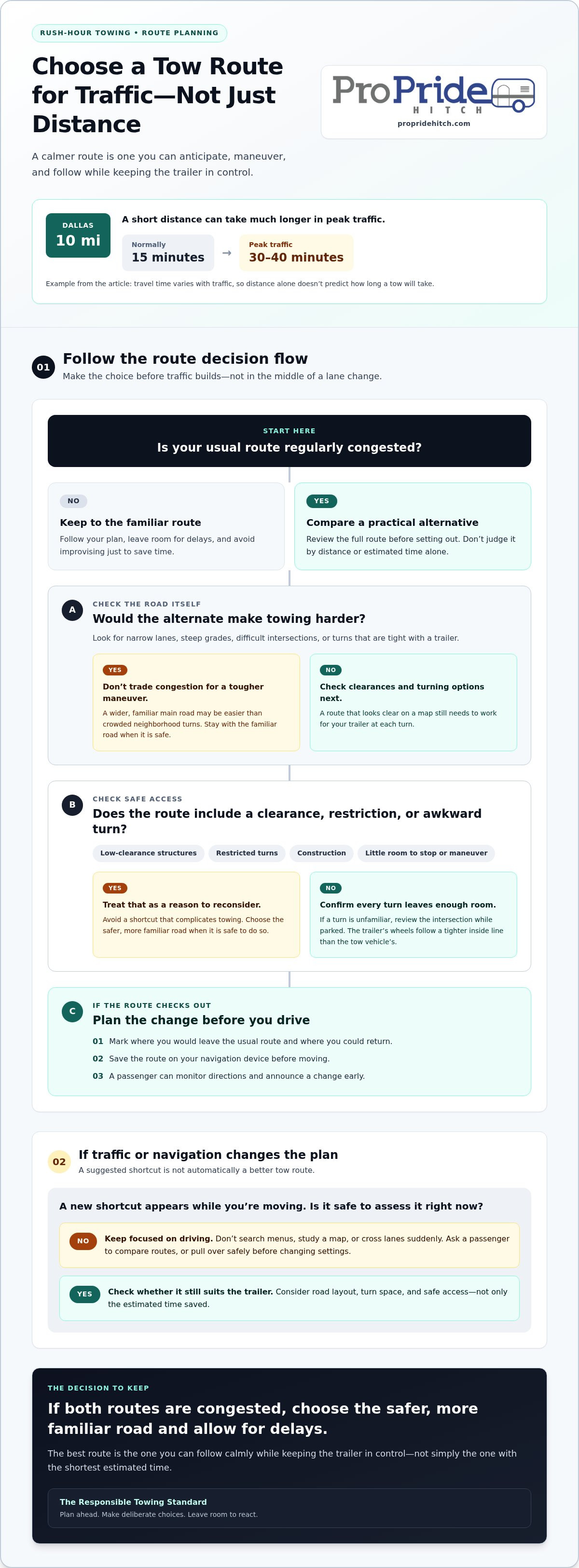
A regularly congested commute may justify choosing a different route, even if it adds distance. In Dallas, a tow-truck arrival that might take 15 minutes at midnight could take over 45 minutes during rush hour. A 10-mile tow that normally takes 15 minutes could take 30 to 40 minutes in peak traffic. These examples show why distance alone doesn’t predict travel time.
Compare the full route before setting out, not just the estimated travel time. Check whether an alternate road has turns, narrow lanes, steep grades, or intersections that may be difficult with a trailer. Smaller streets may bypass a queue but create tighter maneuvering. For example, staying on a wider main road may be easier than turning through crowded neighborhood streets.
Use a map to identify a primary route and a practical alternative before traffic builds. Note where you could switch roads, then consider whether each turn leaves enough room for your trailer. Save the route on your navigation device before driving, so you’re not searching through menus while moving. A passenger can monitor directions and announce a change early.
Don’t let a shorter estimated trip override safe road access. Check for low-clearance structures, restricted turns, construction, and roads where stopping would leave little room to maneuver. If an alternate route includes an unfamiliar turn, review the intersection while parked. Consider the trailer’s length and turning path, since its wheels follow a tighter inside line than the tow vehicle’s.
Once underway, don’t react to every suggested shortcut. A navigation system may send you onto a road that saves time for a car but complicates towing. If traffic slows, focus on driving and ask a passenger to compare routes. Pull over safely before changing settings or studying a map. Never cross lanes suddenly to reach a newly suggested exit.
For a regularly congested commute, compare your usual road with an alternate before departure. If the usual route is consistently busy, a longer option may offer simpler turns and fewer lane changes. If both routes are congested, allow for delays and choose the safer, more familiar road. The best route is one you can follow calmly while keeping the trailer in control, not simply the one with the shortest estimated time.
If your usual route is regularly congested, consider taking an alternate, even if it is longer. Before choosing, weigh how easy it is to stay in the correct lane and complete each turn, not just whether traffic appears lighter. A route that is easier to anticipate may be preferable to one that demands repeated last-minute decisions. Identify where you would leave the usual road and where you could return, and decide before setting off.
Treat an alternate route as an option for managing a difficult commute, not a guarantee of a quicker arrival or a reason to hurry. If conditions make the planned change awkward, remain on the familiar road when it is safe to do so. Choosing in advance can keep the trip deliberate and reduce pressure to improvise while towing.
3. What speed and following distance should you maintain while towing
There isn’t one safe speed for every tow. Choose a pace that suits the road, traffic, visibility, and how your trailer responds. Follow posted limits and any lower limits that apply to your vehicle or route. If traffic bunches near an on-ramp, ease off before reaching it rather than matching the fastest cars. A posted limit doesn’t account for every change in road conditions.
In stop-and-go traffic, look beyond the vehicle directly ahead. Watch several cars forward for brake lights, merging vehicles, or a queue forming around a bend. If traffic begins slowing, lift off the accelerator early and brake progressively. This gives the trailer time to respond and reduces the chance of a sudden jolt. For example, ease down as a line of vehicles approaches a red light.
Set your following distance by the space you need to slow smoothly, not by the gap a car can occupy. Another vehicle may cut in, so leave room to rebuild a safe buffer instead of closing in behind it. If the trailer blocks your view ahead, increase the gap until you can see more of the traffic. Don’t rely on a fixed distance instead of watching the road.
Adjust your pace for curves, wet pavement, road work, and downhill sections. A loaded trailer can affect how the combination handles and stops, so reduce speed before a curve rather than braking sharply in it. On a descent, choose a controlled pace before reaching the slope. If traffic slows at the bottom, you’ll have more room to respond without abrupt steering.
Accelerate gradually when traffic starts moving. Fast throttle inputs can make the trailer tug against the tow vehicle, while sudden braking can unsettle the combination. If a driver merges into your space, ease off and let the gap open again. Don’t accelerate to prevent another vehicle from entering; maintaining control matters more than holding your place in the queue.
Use the speedometer as a reference, then reassess the road continuously. If rain reduces visibility or traffic compresses, lower your speed while keeping a steady path. Avoid staring at the display or following a navigation prompt instead of scanning ahead. A safe pace gives you time to recognize changing traffic and make smooth inputs.
Before a trip, consider how cargo and trailer handling may affect braking. If the setup feels unstable or requires abrupt corrections, find a safe place to stop. Resume only when you can control speed and spacing without rushing. In congested traffic, a calm, consistent pace is more useful than trying to keep up with vehicles that aren’t towing.
Follow posted speed limits and any lower limits that apply to your vehicle or route, adjusting your speed further for traffic, visibility, and road conditions.
4. How should you merge, change lanes, and turn while towing
Plan each lane change before traffic reaches the decision point. In rush hour, enter your exit lane early rather than making a last-minute move that could cut off another driver. Check your mirrors, signal, and wait for a gap that leaves room for both your vehicle and trailer. If traffic closes that gap, stay in your lane and reassess.
Before merging, build a steady pace that suits the traffic flow and available space. Look for a larger opening, signal clearly, then move gradually when the full combination can fit. Avoid accelerating sharply to squeeze ahead of another vehicle. For example, if a car is beside your trailer, let it pass before beginning the merge. A deliberate move gives nearby drivers time to understand your intention.
Make every lane change in stages. Check the mirrors for vehicles beside the tow vehicle and trailer, signal, then check again before steering. Keep the wheel steady as you move across, and avoid drifting between lanes while deciding. If you can’t see a clear opening, continue straight and wait. Missing an exit is safer than forcing a late crossing through crowded traffic.
Allow extra room when turning because the trailer’s wheels track inside the tow vehicle’s path. For a right turn at an intersection, position the vehicle to leave space for the trailer without swinging into another lane or oncoming traffic. Watch the trailer in your mirrors as it follows the turn. If a curb, parked vehicle, or cyclist limits your space, wait for a clearer path.
Left turns also need planning. Choose a position that keeps the trailer clear of the curb and other vehicles, then turn smoothly rather than cutting across the corner. At a busy intersection, wait until you can complete the turn without stopping in the path of cross-traffic. If the opening disappears, remain behind the line and wait for another safe opportunity.
In slow traffic, avoid changing lanes simply because another lane appears to move faster. Repeated moves create more blind-spot checks and increase the chance of meeting a vehicle in your trailer’s path. Pick a lane early, keep a predictable position, and use signals before each turn or merge. A passenger can help identify an approaching exit, but you remain responsible for checking the road.
Before an unfamiliar trip, review the planned turns and exits while parked. Note where the road divides, where a turn requires an early lane choice, and where you can safely recover from a missed exit. During the drive, follow the plan without rushing to make up for a missed maneuver. A controlled, predictable path makes your intentions clearer to surrounding drivers.
5. What should you do if traffic stops suddenly while towing
Look well ahead for brake lights, a queue, or a vehicle changing lanes abruptly. When traffic stops, ease off the accelerator and apply steady, controlled pressure to the brake. Keep both hands ready to guide the tow vehicle, and hold your lane. For example, if cars ahead brake near a highway exit, begin slowing as soon as you see the queue. Waiting until the vehicle ahead stops can leave too little room to respond smoothly.
Avoid sharp steering or sudden acceleration when traffic compresses. A quick swerve can move the trailer into a neighboring lane, while abrupt braking can make the combination react unevenly. Focus on the open space ahead and the vehicles beside you. If another driver cuts into your buffer, reduce speed smoothly and let the gap reopen. Don’t chase the space or make a competing lane change.
Keep watching beyond the first stopped vehicle. Traffic may halt in stages, especially near an intersection, lane closure, or exit queue. Check mirrors briefly for vehicles approaching from behind, then return your attention forward. If the line starts moving, wait until you can move without striking the vehicle ahead. Accelerate gently and keep the trailer aligned as traffic begins to flow.
If your trailer begins moving differently from the tow vehicle, keep your steering controlled and avoid overcorrecting. Sudden steering inputs can make it harder to maintain a steady path. Reduce speed gradually when conditions allow, and avoid accelerating sharply to pull away from the movement. Once traffic settles, reassess how the trailer is tracking before continuing at the same pace.
At a complete stop, stay in control and continue monitoring nearby traffic. Keep your foot on the brake while vehicles remain close, and avoid reaching for your phone or changing navigation settings. If a passenger is present, ask them to handle directions while you watch the road. For example, if an exit is approaching during a stop, don’t make a rushed lane change when traffic starts moving.
After the queue clears, rebuild speed gradually rather than trying to make up lost distance. Check that the trailer remains aligned, then resume a steady pace suited to traffic. If the stop involved contact, unusual trailer movement, or a new handling problem, find a safe place to assess the situation before continuing. In heavy congestion, a calm, step-by-step response helps prevent sudden traffic changes from turning into abrupt maneuvers.
Keep watching surrounding drivers and the road ahead, since distracted drivers and blind spots may require a response. During rush hour, enter your exit lane early to avoid a last-minute merge that could cut off another driver. It also helps to understand how your vehicle may react in a crash and consider choosing a vehicle with a higher safety rating.
On a Dallas highway shoulder, a tow operator may coordinate with local police to temporarily block a lane while loading a vehicle. The Texas Department of Transportation allows tow trucks to access highway shoulders during emergencies, including in heavy traffic. If a crash occurs, notify your insurance company and have a police report written.
ProPride: ProPride 3P Hitch
The ProPride 3P Hitch addresses trailer sway, a concern that can feel more pressing in dense, stop-and-go traffic. Its patented Pivot Point Projection technology is designed to completely eliminate trailer sway. That focus can make it a relevant next step for drivers evaluating how their hitch contributes to towing stability.
A hitch doesn’t replace the habits that help manage rush-hour traffic: scan ahead, leave room to respond, and make deliberate lane changes. Consider the ProPride 3P Hitch as part of your towing setup when trailer sway is a key concern. The Responsible Towing Standard begins with informed equipment choices and attentive driving.
Visit propridehitch.com to learn more about the ProPride 3P Hitch.
Make your next tow a deliberate one
Towing in rush-hour traffic safely starts before you turn the key. Treat preparation as part of the drive: consider whether your vehicle, trailer, and equipment are suited to the trip, and give yourself permission to delay departure if conditions feel difficult to manage. A calm decision before entering congestion is better than a rushed correction once traffic closes around you.
Use what you’ve learned to make a plan that fits your route and towing setup. Then keep your attention on the road and make each maneuver deliberately. No hitch replaces attentive driving, but equipment designed to address trailer sway can be part of a thoughtful towing decision.
If you’re considering your next step, contact ProPride for towing help. Prepare carefully, drive with purpose, and make safety the standard for every trip.
Frequently Asked Questions
Will I be stuck in traffic longer if I need a tow during peak hours?
Yes, peak-hour congestion can extend both the wait for a tow truck and the journey after hookup. Those are separate delays, so allow for each when making plans. If you’re arranging a tow, give dispatch your exact location, vehicle type, whether it can roll, and whether anyone is with it. Clear details help the operator understand the situation and locate you.
What towing laws and speed limits apply in the United States
Towing laws and speed limits vary by state and road. Follow posted speed limits and applicable local rules, and slow down when traffic or road conditions require it.