
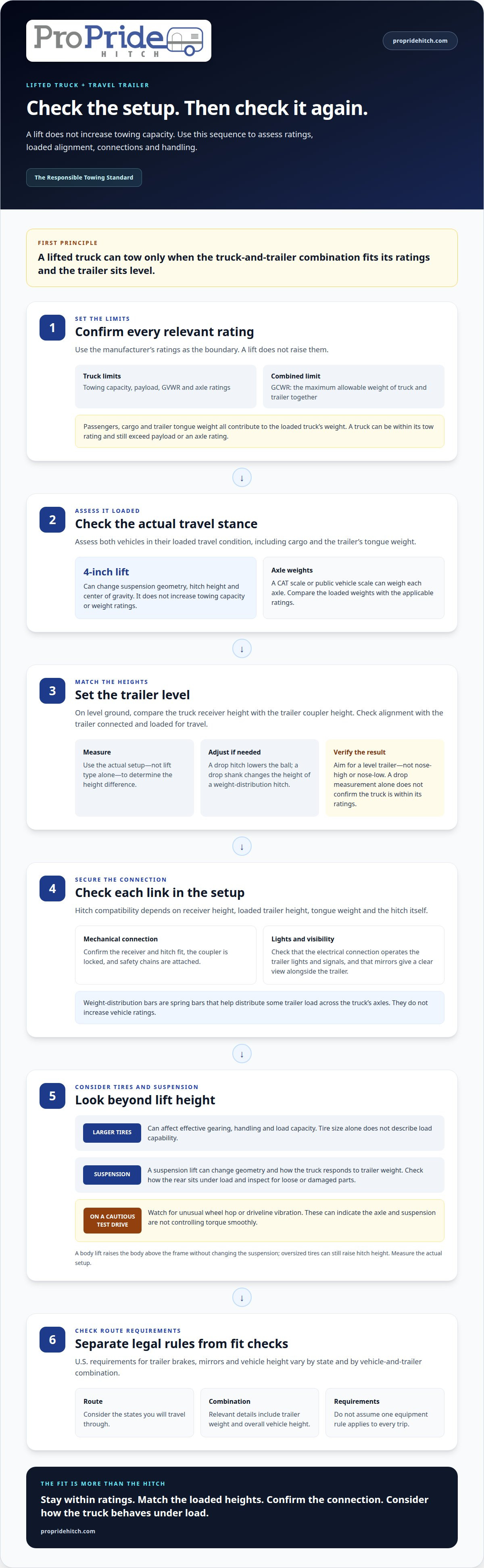
Yes, towing with a lifted truck and travel trailer can work, but a lift does not increase the truck’s towing capacity. Keep the setup within the manufacturer’s ratings, and make sure the hitch positions the trailer level behind the truck. A lift that changes suspension geometry, or larger tires, can also affect handling under load.
Whether the trailer can be connected is only part of the question: the truck and trailer must work together predictably on the road. Lift height changes hitch alignment, while larger tires can affect effective gearing and braking. A leveling kit can also change how the truck sits once trailer tongue weight is applied.
This guide explains how to assess the fit, what lift and tire changes mean for towing, and why leveling matters. Use these checks to judge whether your truck-and-trailer combination is suitable and identify details to address before a trip.
Key Takeaways
- Confirm the truck and trailer stay within the manufacturer’s weight ratings; a lift doesn’t increase them.
- Match hitch height to the trailer so it tows level, and pay attention to the hitch, safety chains, and electrical connections.
- Account for how larger tires can change effective gearing and affect towing performance.
- Understand how a leveling kit or suspension lift can change the truck’s stance and handling under load.
- Learn how a sway-control hitch may help address trailer sway after the truck-and-trailer fit is right.
Can you hook a trailer to a lifted truck?
Yes, a lifted truck can tow a trailer if the hitch fits, the trailer sits level, and the combination stays within the vehicle’s ratings. When towing with a lifted truck and travel trailer, assess both vehicles in their loaded travel condition.
Hitch Connections and Trailer Leveling
A secure towing connection includes the truck’s receiver, trailer coupler, safety chains, and electrical connector. The receiver is the square opening at the rear of the truck that accepts the hitch. The coupler connects the trailer to the hitch ball, chains provide a backup connection, and wiring powers the trailer’s lights and signals.
Check hitch height with the trailer loaded for travel. Adjust the ball height so the trailer frame sits level, not nose-high or nose-low. Before driving, confirm the coupler is locked, the chains are attached, and the electrical connection works.
A lifted truck may need a drop hitch to bring the ball closer to the trailer coupler’s height. Measure both heights on level ground, then check their alignment with the trailer connected.
Hitch Types and Clearance
A drop hitch lowers the ball for a tow-behind trailer. A drop shank changes the height of a weight-distribution hitch. The right drop depends on the difference between the truck’s receiver and trailer’s coupler heights. A reported 10 to 12 inches of drop is an example, not a universal fit.
Fifth-wheel and gooseneck trailers need space between the trailer overhang and truck bed rails. For goosenecks, a commonly cited target is 6-8 inches. Taller tires or a raised truck bed can reduce this clearance, so assess the space during turns as well as while parked.
A body lift raises the body above the frame without changing the suspension. Oversized tires can still raise hitch height, so measure the actual setup rather than choosing a drop hitch based only on the type of lift.
Choosing a Hitch Setup
When towing with a lifted truck and travel trailer, choose a hitch compatible with both vehicles, then use a drop hitch or drop shank if needed for alignment. Weight-distribution bars are spring bars that help distribute some trailer load across the truck’s axles.
The right setup depends on receiver height, loaded trailer height, tongue weight, and hitch compatibility. Tongue weight is the downward force the trailer places on the hitch. Compare the truck and trailer on level ground, accounting for cargo that may change the trailer’s position. A drop measurement alone does not show whether the truck’s ratings are adequate.
There is no single cost to modify a lifted truck for safe travel-trailer towing. It depends on whether the setup needs a different hitch, a drop component, or changes to existing connections. Identify the required fit and equipment before estimating parts and labor.
Towing Laws and Equipment
U.S. requirements for trailer brakes, mirrors, and vehicle height vary by state and by vehicle-and-trailer combination. Relevant details include the states on your route, trailer weight, and overall vehicle height. Do not assume one equipment rule or measurement applies to every trip.
Separate legal requirements from practical checks. Confirm that the hitch connection is secure, the safety chains are attached, and the electrical connection operates the trailer lights. Make sure the mirrors provide a clear view alongside the trailer. These checks support a careful setup but do not replace applicable state requirements.
Does a 4 inch lift affect towing?
Yes. A 4-inch lift can change suspension geometry, hitch height, and the truck’s center of gravity, affecting handling and weight distribution. It doesn’t raise the truck’s towing capacity or weight ratings. To understand the loaded setup, compare axle weights at a CAT scale, a public vehicle scale that weighs each axle, and account for how the suspension sits under load.
Lift Effects on Ratings and Performance
A suspension lift changes the truck’s stance and response to trailer weight. Altered geometry can affect stability, hitch height, and suspension sag, especially when the truck carries cargo or tongue weight. A lift does not increase the truck’s maximum payload, GVWR (Gross Vehicle Weight Rating, the maximum allowable weight of the loaded truck), GCWR (Gross Combination Weight Rating, the maximum allowable combined weight of the truck and trailer), or manufacturer-rated towing capacity.
Those ratings still set the limits. A truck can remain within its tow rating yet exceed payload or an axle rating after passengers, cargo, and hitch load are added. Larger tires can also change handling and load capacity. For example, a 32-inch tire with an E load rating and a 37-inch tire with a D load rating illustrate why tire size alone doesn’t describe load capability.
Suspension Configuration and Axle Wrap
Axle wrap is the rotation of a driven axle housing under acceleration, as engine torque acts against the suspension. Lifted suspension components can change how the axle and springs resist that force, so the truck’s suspension configuration matters when towing.
Under trailer load, spring movement can affect how the vehicle responds when power is applied or released. Inspect the suspension for loose or damaged parts, and watch for unusual wheel hop or driveline vibration during a cautious test drive. These symptoms can indicate that the axle and suspension are not controlling torque smoothly.
Suspension Stability and Sway
Suspension stability describes how well the truck controls body movement and maintains tire contact under load. A lift can raise the center of gravity, while softer rear springs may sag more under cargo or tongue weight. Together, these effects can make steering response and trailer control feel less settled.
Weight-distribution bars can help spread trailer load across the truck’s axles, but they do not increase the vehicle’s ratings. Check the truck’s stance when hitched and assess whether the rear sags or the front feels light. A sway-control hitch addresses trailer sway, not excess load, poor suspension condition, or an overloaded axle.
Checking Tongue and Axle Weights
A CAT scale can show axle loads for the truck alone and for the loaded truck-and-trailer combination. Weigh the truck with its usual passengers, cargo, and fuel, and record each axle group. Repeat with the trailer attached in its normal travel configuration, including the weight-distribution system if you use one.
Compare the readings with the ratings for the truck, its axles, and the trailer. The increase in the truck’s axle load shows how the hitch affects weight distribution. Trailer axle readings, together with the trailer’s total loaded weight, help show how much load rests on the hitch. Keep cargo and setup consistent between weighings for a meaningful comparison.
Effects of larger tires and factory gearing
Larger tires change more than the truck’s appearance. A taller tire travels farther with each wheel rotation, changing the effective gearing at the wheels. The engine may feel less responsive when starting with a trailer or climbing a grade. The effect depends on tire size, axle ratio, engine, and transmission.
For example, 35-inch tires can reduce the effective final-drive ratio and add rotational inertia. Rotational inertia is the resistance a wheel and tire have to speeding up or slowing down. With a trailer attached, that extra resistance can make acceleration and braking feel different. Larger tires don’t strengthen the truck’s springs or raise its weight ratings.
Axle gearing helps determine how engine power reaches the wheels. A numerically higher axle ratio can help offset the gearing change from a larger tire, but the right match depends on the vehicle’s original ratio and intended use. An informal recommendation for trucks with 3.42:1 axle gears is to keep tires around 33 inches. Treat that as a reference point, not a universal fit rule.
Consider the change from 31-inch tires to 37-inch tires. That increase in rolling diameter can make the factory gearing feel taller, especially when towing uphill or accelerating from a stop. Re-gearing may be worth considering after a substantial tire-size increase. The goal is to keep the effective final-drive ratio closer to its original relationship, not to assume that a lift kit or larger tires automatically calls for one particular axle ratio.
Before choosing tires, compare the new diameter and load rating with the truck’s current setup. Then assess how the vehicle behaves under trailer load, including acceleration, shifting, and braking. A 35-inch tire adds different demands than a 37-inch or 40-inch tire; the exact effect also depends on tire weight and construction. Keep the complete loaded combination within the truck and tire ratings.
Use this sequence to make the gearing decision practical: record the factory tire diameter and axle ratio, note the new tire size, then compare towing performance on a familiar route. Pay attention to frequent downshifting, sluggish starts, or increased operating effort on grades. If tire size changes significantly, such as from 31 inches to 37 inches, evaluate the axle ratio as part of the full towing setup rather than judging tire clearance alone.
Gearing changes can improve how power is delivered, but they do not increase the manufacturer’s towing capacity. Check the truck’s weight ratings separately, and treat springs, tires, brakes, and axle gearing as distinct parts of the system. Start with the truck’s actual specifications, rather than assuming larger tires are automatically better for towing.
Leveling kits and towing performance
A leveling kit changes the truck’s front-to-rear stance, which can affect how it sits under trailer load. Most kits raise the front ride height by 1.5-3.0 inches while leaving the rear suspension unchanged. That difference matters because the truck’s factory rake allows the rear suspension to compress when carrying cargo or tongue weight.
With a travel trailer attached, added weight over the rear axle can use up some suspension travel. If the rear settles enough, the truck may develop reverse rake, with its front sitting higher than its rear. Because the hitch and trailer position can change as the vehicle settles, assess the entire loaded combination, not just the empty truck.
Compare the truck’s stance before and after hitching the loaded trailer. Note whether the rear drops or the front rises, and observe how the truck responds over uneven pavement. A leveling kit does not increase payload or towing ratings, and a changed stance does not prove those limits are being met.
Different equipment addresses different effects. Towing airbags can support the rear suspension under load, while oversized bump stops limit suspension travel. Weight-distribution bars can help distribute trailer load across the truck’s axles. Each serves a different role, and none increases the truck’s manufacturer-set ratings.
For example, a truck lifted at the front with a leveling kit may look level when unloaded. Add trailer tongue weight, and the rear can settle while the front lifts. If that changes steering feel or headlight aim, assess the loaded stance before a long trip. A level-looking truck is no substitute for checking its weight ratings.
Suspension choice matters too. A truck mainly used for work, hauling, or towing may suit no lift, a body lift, or a leveling lift better than a setup that substantially changes suspension behavior. A body lift raises the body without modifying the suspension; a leveling kit changes front ride height while leaving the rear unchanged. These are different modifications, so assess the actual hardware rather than relying on its label.
When preparing a leveled truck for towing, record its unloaded stance, hitch it to the trailer in travel condition, then reassess its stance and handling. If the rear sags or the truck feels unsettled, consider whether suspension support or weight distribution is appropriate. Base the decision on the truck, trailer, and load, not the leveling kit’s appearance.
Lifted-truck towing dynamics
A lifted truck can tow a travel trailer, but its altered height and suspension affect road behavior. A stock-height truck is not automatically safer: condition, load, ratings, and setup matter. A lift can raise the center of gravity, increase stopping distance, and make trailer sway more consequential.
Towing Behavior with a Lift
Towing behavior is how the truck and trailer respond together to steering, road surfaces, wind, and braking. A lift can change the truck’s center of gravity and sight lines, affecting how it feels through turns and sudden maneuvers.
These differences matter most when conditions change quickly. A lifted truck may also experience increased aerodynamic drag and operating temperatures while towing. Watch for changes in steering response, temperature, and stability as the road or grade changes. Staying within the vehicle’s capacity is essential, but capacity alone does not describe how the combination handles.
For example, one reported setup used a 6-inch lift, 35-inch tires, and a 5.3-liter engine. That combination illustrates why lift height, tire size, and vehicle power should be considered together, rather than treating lift height as the only factor.
Sway and Braking Risks
Trailer sway is side-to-side movement that can affect the truck’s path. Reduced braking means the loaded combination needs more distance to slow down. A lifted truck’s higher center of gravity can increase rollover risk during turns or sudden maneuvers, making abrupt corrections especially concerning.
Increased stopping distance leaves less room to respond to traffic or road hazards. Before travelling, inspect the truck and trailer brakes, tires, and hitch connection. Leave room to slow smoothly and avoid sudden steering inputs. A sway-control hitch can address trailer sway, but it does not correct excess weight, inadequate braking, or poor handling caused by compromised suspension.
Payload matters too: passengers, cargo, and trailer tongue load all contribute to the truck’s total load. A combination within towing capacity can still handle poorly if its weight distribution or suspension condition is unsuitable. Check sway and braking separately; one component does not solve both.
Stock-Height and Lifted Truck Comparison
A stock-height truck retains its original ride height, while a lifted truck has been raised through its body or suspension. Stock height generally avoids lift-related changes to the center of gravity and sight lines. A suspension lift can alter those characteristics, so compare the complete setups, not height alone.
A body lift leaves the factory suspension in place, unlike a suspension lift, which changes suspension geometry. Either way, towing suitability depends on vehicle condition, load, and manufacturer ratings. A stock truck with worn brakes or an overloaded trailer is not safe simply because it has no lift.
Use the same decision sequence for either vehicle: assess the truck’s condition, confirm the loaded combination stays within its ratings, and evaluate its behavior during controlled driving. A lifted setup calls for particular attention to stability, braking, and sight lines. Choose the setup that maintains control under load, not the one that merely looks level or powerful.
ProPride
ProPride is a natural next step when your truck’s ratings, hitch height, and trailer fit are sound, but sway remains a concern. The ProPride 3P Hitch uses patented Pivot Point Projection technology, which projects the trailer’s pivot point forward toward the tow vehicle’s rear axle to help reduce trailer sway. It can’t guarantee that sway will be eliminated, so it’s not a substitute for suitable vehicle capacity, correct loading, or a properly matched hitch setup.
If you’re weighing sway control for your travel trailer, learn about the ProPride 3P Hitch and how its design works. Contact ProPride to discuss your towing questions.
Prepare for your next trip with confidence
A responsible plan for towing with a lifted truck and travel trailer goes beyond a one-time fit check. Keep a clear record of the truck, trailer, and towing setup, and revisit it whenever something changes. A new load, route, or equipment adjustment can affect how the combination behaves. Deliberate decisions before departure keep safety ahead of convenience.
Use what you’ve learned to decide whether trailer sway control belongs in your setup. The ProPride 3P Hitch is an option for drivers focused on managing sway. Consider it as part of a complete towing plan, alongside sound judgment and attention to your vehicle’s limits. That’s the spirit of The Responsible Towing Standard: informed choices that support control and confidence on the road.
For a next step, Contact ProPride about your towing setup. Keep learning, make each decision carefully, and head out prepared.
Frequently Asked Questions
Does lifting a truck affect tow capacity?
A lift does not add towing capacity, and there is no universal capacity reduction for every truck. The effect depends on the modification, tire size, suspension behavior, and the truck’s published ratings. Use the towing and payload information for your specific vehicle, then account for passengers, cargo, and hitch load. Never exceed a manufacturer’s rating because of a lift.
Do I need to re-gear my truck for towing?
Not necessarily. Re-gearing becomes more relevant when larger tires substantially change the truck’s effective gearing. For example, moving from 31-inch tires to 37-inch tires is a major change worth evaluating with the axle ratio and intended towing use. Notice whether the truck struggles to accelerate, shifts frequently on grades, or feels less responsive under load. Those signs help identify whether the current gearing suits the setup.
How much towing capacity do you lose with a lift?
There is no fixed towing-capacity penalty that applies to every lifted truck. The outcome depends on the vehicle and modifications, especially suspension changes and oversized tires. A lift does not raise the truck’s gross vehicle weight rating (GVWR), the maximum permitted weight of the loaded truck, or gross combined weight rating (GCWR), the maximum permitted weight of the loaded truck and trailer together. Use the manufacturer’s towing limit for the specific truck, and assess payload and axle loads separately. Do not estimate a new capacity from lift height alone.
Can I still tow my trailer?
Yes, if the truck-and-trailer combination stays within the truck manufacturer’s towing and weight ratings and the hitch suits both vehicles. Account for the trailer as loaded for travel, including cargo and water, along with passengers and items carried in the truck. Even within those limits, the combination needs a controlled road test. Pay attention to steering, braking, and the truck’s response under load.
What changes when you lift your tow vehicle?
A suspension lift can alter suspension geometry, raise the receiver, and affect how the truck handles load and suspension sag. Larger tires may change effective gearing and add rotating weight. A body lift raises the body above the frame without modifying the suspension, so it affects the setup differently. Identify whether the changes involve the body, suspension, tires, or several components before assessing towing fit.
Will a lift kit void my towing warranty?
A lift does not automatically mean every warranty claim will be denied. A vehicle manufacturer may not cover a failure directly caused by a modification, such as axle failure or transmission damage associated with oversized tires. The cause matters. Keep records of the lift and related changes, and review your vehicle’s warranty terms to understand how modification-related damage may be handled.
How does a lifted truck affect travel trailer towing stability and handling?
A lifted truck’s higher center of gravity can affect its response in turns or sudden maneuvers, and towing may increase stopping distance. Larger tires and altered sight lines can also change how the combination feels on the road. Assess handling on a familiar route before a demanding trip, and avoid abrupt steering or braking. Trailer sway control addresses sway, but not excess weight or inadequate braking.
How do you calculate towing capacity and payload for a lifted truck with a travel trailer?
Start with the truck manufacturer’s towing, payload, GVWR, and GCWR ratings. Account for passengers, cargo, and hitch load when calculating available payload, then compare the loaded truck-and-trailer weight with GCWR. Weigh the combination by axle to see whether the truck or trailer exceeds its applicable ratings. Use the actual travel load, not an empty-trailer figure, and remember that a lift does not increase these limits.