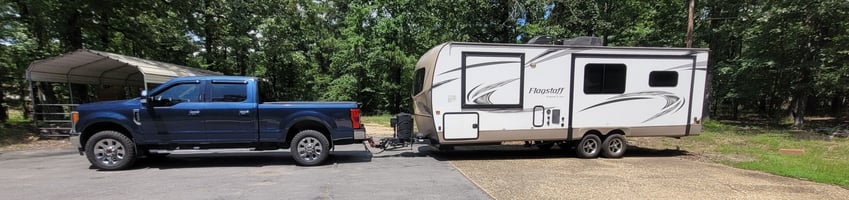
What if that terrifying moment when a semi-truck passes you isn't something you just have to "deal with" as a driver? You've likely felt the sudden push and the frantic steering correction that follows. Knowing how to stop trailer sway from trucks is about more than just a firmer grip on the wheel; it's about understanding the invisible aerodynamic forces at play. You aren't alone in your anxiety, as many responsible owners struggle with the same white-knuckle stress every time they hit the highway.
This guide will teach you the specific physics behind why trucks cause sway and provide the actionable engineering solutions to eliminate it entirely. We'll explore the 60/40 weight distribution rule and why traditional friction-based hitches often fail to meet The Responsible Towing Standard. By the end, you'll understand how a shift in pivot point projection can transform your towing experience from a source of dread into a journey of total control and peace of mind.
Key Takeaways
- Learn the science behind the bow wave and vacuum effects to understand exactly why passing semi-trucks create sudden, dangerous trailer movement.
- Discover how to stop trailer sway from trucks using tactical steering and manual brake override techniques during high-wind encounters on the highway.
- Compare reactive friction bars against proactive engineering to see why traditional equipment often falls short of providing true stability in emergency situations.
- Understand how Pivot Point Projection technology aligns your towing setup with The Responsible Towing Standard for ultimate family safety and peace of mind.
- Explore the Jim Hensley design legacy that allows the ProPride 3P to eliminate sway completely rather than just attempting to damp it after it starts.
Understanding Why Passing Trucks Trigger Trailer Sway
Every driver who has towed a travel trailer knows the heart-dropping sensation of a semi-truck looming in the side mirror. Suddenly, your rig begins to dance, seemingly possessed by a force you can't see. Understanding how to stop trailer sway from trucks starts with identifying the invisible aerodynamic forces at work. It isn't just "wind"; it's a complex interaction of high and low pressure that turns your trailer into a giant sail. This isn't a failure of your driving skills. It's a predictable result of physics that occurs every time a massive object moves through a fluid like air.
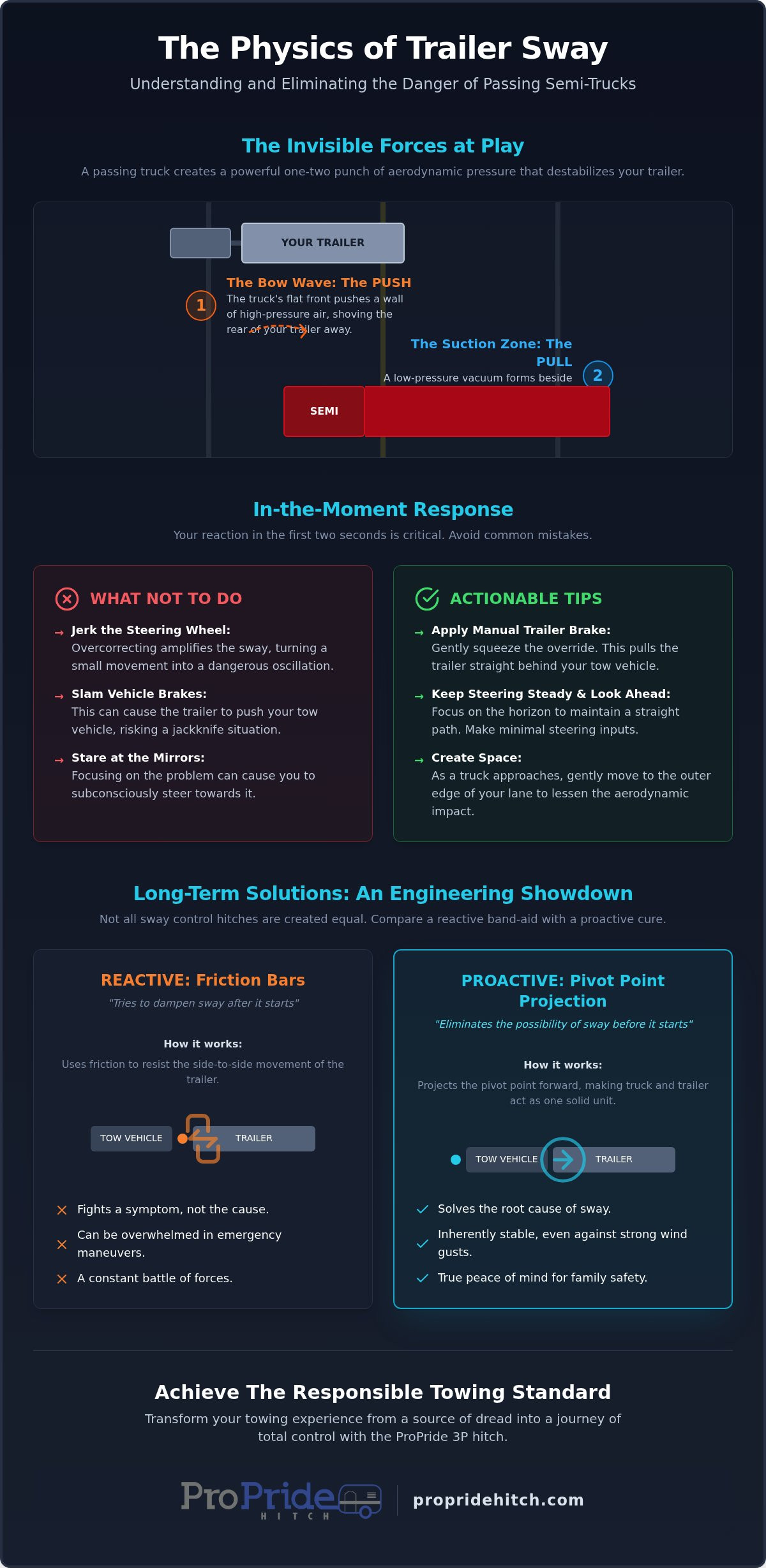
The Bow Wave: The Initial Push
Think of air as a physical fluid, much like water in a pool. As a massive semi-truck moves forward, its flat grill pushes a wall of compressed air ahead of it. This is known as the "bow wave." When that truck begins to pass you, this wall of air hits the rear side of your trailer first. Because your trailer is attached at a pivot point behind your rear axle, this force acts like a giant lever. It pushes the back of the trailer away, which naturally forces the nose of the trailer toward the truck. Longer trailers suffer more because they provide a larger surface area for this initial aerodynamic shove to grab onto, amplifying the leverage against your tow vehicle.
The Suction Zone: The Dangerous Pull
The initial push is only half the battle. Once the truck's cab passes your trailer's midpoint, the air pressure drops significantly. This creates a low-pressure vacuum zone along the side of the truck. This follows the Bernoulli principle, which states that faster-moving air creates lower pressure. Your trailer is literally sucked toward the passing rig as the air tries to fill that vacuum. This "snap" back toward the truck is often what causes the most panic for drivers. If you don't have a mechanical solution like the ProPride 3P trailer sway control hitch, you're left relying on your own reflexes or modern Electronic Trailer Sway Control systems to damp the movement after it has already started.
These forces are amplified by the boxy, flat-front design of modern freight trucks. Unlike a sleek passenger car that slices through the air, a semi-truck creates a massive wake of turbulence. This wake creates a feedback loop where your trailer oscillates back and forth between the high-pressure push and the low-pressure pull. Adhering to The Responsible Towing Standard means recognizing that these laws of physics are immutable. You can't wish them away. You have to engineer a way to counteract them before they compromise your family's safety on the highway.
Immediate Tactics to Handle Trailer Sway When Trucks Pass
When you are in the driver's seat, knowing how to stop trailer sway from trucks isn't just about equipment; it's about your immediate physical response. The second you feel that lateral push from a passing semi, your adrenaline spikes. It's a natural reaction. However, the most critical step is to remain calm and resist the urge to jerk the steering wheel. Overcorrecting is one of the most common towing risks because it turns a minor oscillation into a violent, uncontrollable sway. Keeping a steady hand and a clear head is the first pillar of The Responsible Towing Standard.
Steering and Braking: The Dos and Don'ts
Actionable Tip: Keep your eyes fixed on the horizon, not your side mirrors. When you stare at the mirrors, you tend to subconsciously steer toward or away from the truck, which worsens the sway. Focus on a point far down the road to keep your truck tracking straight. It's also vital that you don't slam on your tow vehicle's brakes. Rapidly decelerating the truck while the trailer is swaying can cause the trailer to push the truck's rear end, leading to a jackknife. Instead, use your manual trailer brake override controller. Give it a firm, steady "squeeze" without locking the wheels. This applies braking force only to the trailer, which creates tension and "stretches" the combination back into a straight line.
Managing Airflow and Lane Positioning
Anticipation is your best defense. Watch your mirrors for approaching big rigs and, as they begin to pass, gently position your vehicle toward the outside edge of your lane. This extra foot or two of space significantly reduces the intensity of the bow wave and the subsequent vacuum effect we discussed earlier. You might also hear the term counter-steering. Counter-steering is the act of making small, controlled steering adjustments in the opposite direction of the trailer's lateral movement to maintain a straight path.
Don't fall for the dangerous myth that speeding up will "pull" you out of a sway. Increasing your speed only adds more energy to the oscillation, making a crash more likely if you lose control. Maintaining a steady, predictable speed allows the trailer to settle as the airflow stabilizes. For those tired of these high-stress manual corrections, investigating a more permanent solution like the ProPride 3P trailer sway control hitch can eliminate the need for these emergency tactics altogether by preventing the sway from starting in the first place.
The Science of Aerodynamics: Why Your Trailer Reacts to Big Rigs
Every travel trailer is essentially a giant sail. When you're out on the highway, the flat, high-profile side walls of your trailer provide a massive surface area for wind to catch. This is why a travel trailer reacts so much more violently to a passing semi than a low-profile utility trailer or a flatbed. Adhering to The Responsible Towing Standard means you must account for this vulnerability before you ever leave your driveway. It isn't just about weight; it's about how much "sail" you're dragging through the air. The faster the passing truck is moving relative to your speed, the more energy is packed into that bow wave of air. If a truck passes you at 75 mph while you're doing 60 mph, that 15 mph differential creates a significant aerodynamic disturbance that your hitch must be able to handle.
The Leverage Problem: Rear Overhang and Pivot Points
The physics of how to stop trailer sway from trucks are rooted in the concept of leverage. Most traditional hitches attach to a ball that sits a few feet behind your truck's rear axle. This distance is known as the rear overhang. It acts like a lever arm. When the wind from a truck pushes the side of your trailer, that force is transferred to the hitch ball, which then uses the rear overhang to pry the back of your truck sideways. This is the classic "tail wagging the dog" scenario. A truck with a shorter wheelbase struggles more because it has less resistance to this prying force. The longer the distance from your rear axle to the hitch, the more mechanical advantage the trailer has to initiate a sway event.
Environmental Factors: Crosswinds and Tunnels
Natural wind conditions often act as a force multiplier for truck-induced sway. If you're already fighting a steady 15 mph crosswind, the added turbulence of a passing semi can be the tipping point that triggers an oscillation. You should also be aware of the "venturi effect." This occurs when air is forced through a narrow opening, like a tunnel or a gap between two mountain peaks, causing the air to speed up and the pressure to drop. This sudden change in pressure can pull your trailer toward the walls or other vehicles with surprising force.
Actionable Tip: Before you head out, check the weather reports for your entire route. If wind gusts are expected to exceed 20 mph, you should consider delaying your trip or reducing your speed significantly. Knowing your rig's limits is a hallmark of a responsible owner. While electronic systems can help, they are reactive measures. True stability comes from understanding these physical laws and choosing equipment that addresses the pivot point projection directly to negate the leverage problem entirely.
Long-Term Solutions: Comparing Friction Bars to Pivot Point Projection
Most drivers looking for how to stop trailer sway from trucks are initially directed toward friction-based sway control. These systems are the most common in the industry, but they operate on a flawed premise. They are reactive. A friction bar uses physical resistance to slow down an oscillation that has already started. It's essentially a damping system, much like a shock absorber, that tries to fight the laws of physics once your trailer has already begun to move out of line. While these can help in mild conditions, they don't address the root cause of the aerodynamic forces we've discussed.
The Friction Fallacy: Damping vs. Elimination
The biggest limitation of friction hitches is that they are inconsistent. Because they rely on the physical rubbing of surfaces, their effectiveness changes based on the environment. In fact, most manufacturers recommend loosening or removing friction bars during rain or icy conditions to prevent the trailer from sliding. This is a direct contradiction to The Responsible Towing Standard, which requires a safety system that remains 100% effective when road conditions are at their worst. Similarly, the electronic stability programs built into modern trucks are reactive. They only engage after the sensors detect a loss of control, applying the brakes to save you from a crash rather than providing a stable, comfortable driving experience.
How Pivot Point Projection Changes the Math
If you want to eliminate the "tail wagging the dog" effect, you have to change the mechanical relationship between the truck and the trailer. This is where Pivot Point Projection comes in. Unlike a ball-and-socket joint that allows the trailer to swing freely, a linkage-based system like the ProPride 3P trailer sway control hitch uses a trapezoidal 4-bar linkage. This design forces the trailer to move only when the truck turns. When a wind gust or a passing semi-truck hits the side of the trailer, the linkage locks the trailer in a straight line relative to the truck's direction of travel.
Pivot Point Projection is an engineering method that uses a four-bar linkage system to mechanically shift the trailer's effective pivot point from the hitch ball to the center of the truck's rear axle, making the rig behave like a single, straight vehicle. By moving this point forward, you eliminate the leverage that the trailer usually has over the truck's rear end. The result is a rig that feels like a single rigid unit, even when a massive semi-truck creates a high-pressure bow wave right next to you. If you are ready to stop managing sway and start eliminating it, you can upgrade to the ProPride 3P today.
Achieving The Responsible Towing Standard with the ProPride 3P Hitch
The history of stable towing isn't built on marketing hype. It's built on a foundation of rigorous engineering that dates back to the pioneering work of Jim Hensley. His designs revolutionized the industry by proving that you don't have to live with the fear of highway turbulence. The ProPride 3P represents the modern evolution of that legacy. When you're determining how to stop trailer sway from trucks, you aren't just looking for a simple part. You're looking for a guarantee that your family and your investment are protected by the immutable laws of physics. This commitment to engineering excellence is why the 3P is widely recognized as The Best Hitch on the Planet.
Why Engineering Trumps Friction Every Time
The core differentiator of a truly stable rig is the mechanical advantage provided by a 4-link system. While traditional hitches rely on friction to damp movement after it starts, the 3P uses geometry to prevent the movement from ever occurring. It's a proactive approach that aligns with The Responsible Towing Standard. You can explore the technical specifications of The ProPride 3P Trailer Sway Control Hitch to see how it manages weight distribution and sway elimination simultaneously. By projecting the pivot point forward to the truck's rear axle, the system ensures that wind gusts from passing semis are met with a rigid, unified response rather than a terrifying oscillation.
Your Path to Stress-Free Towing
Investing in a high-end hitch is a decision made by informed owners who value total control. You've done the research and you understand that "good enough" isn't an option for family safety. For a deeper dive into the mechanical principles that make this possible, read about The ProPride 3P Hitch: The Ultimate Engineering Solution. This level of preparation is what separates a stressful trip from a journey filled with peace of mind. You deserve to arrive at your destination feeling relaxed rather than exhausted from fighting the wheel.
Actionable Tip: Before you make a final decision, take clear photos of your current tow vehicle's hitch receiver and your trailer's A-frame. Having these details ready when you speak to an expert ensures you get the exact fitment and hardware needed for your specific combination. Evaluating your current setup is the first step toward a safer future on the road. When you choose a system designed to eliminate risk rather than just manage it, you're choosing the highest standard of safety available in 2026. Your journey toward total highway confidence begins with a single, responsible choice in engineering.
Take Command of Your Highway Safety
Mastering how to stop trailer sway from trucks requires moving beyond basic driving reflexes and embracing the immutable laws of physics. You now understand that the aerodynamic bow wave and vacuum effects are not just obstacles to be managed; they are forces that can be neutralized through superior engineering. By choosing a system that utilizes Jim Hensley's patented design, you are joining more than 10,000 happy towers who have moved past the inherent limitations of traditional friction bars.
This commitment to precision is the cornerstone of The Responsible Towing Standard. When you equip your rig with a system backed by a lifetime warranty, you gain more than just mechanical stability. You gain the ultimate peace of mind for your family and your investment. It's time to stop white-knuckling through every trip and start enjoying the open road with total confidence.
Ready to experience the ultimate in stable towing? Upgrade to the ProPride 3P: The Best Hitch on the Planet and see why engineering trumps friction every time. You've done the research. Now take the final step toward a safer, more predictable journey.
Frequently Asked Questions
Is trailer sway normal when trucks pass me?
While lateral movement is a common physical reaction to aerodynamic pressure, it shouldn't be accepted as a normal part of your driving experience. Feeling your rig move indicates that the "bow wave" of the passing truck is successfully using your trailer as a lever against your tow vehicle. Understanding how to stop trailer sway from trucks means moving beyond accepting these white-knuckle moments and seeking a mechanical solution that negates these forces before they start.
Can a weight distribution hitch alone stop trailer sway from trucks?
No, a weight distribution hitch is designed to move load from the rear axle to the front axle to improve steering and braking. While proper weight distribution is essential for a level ride, it doesn't address the lateral aerodynamic forces that cause sway. You need a system that specifically manages the pivot point of the trailer to achieve true stability and meet The Responsible Towing Standard on the highway.
How do I use my trailer brake controller to stop sway?
You should use the manual override lever on your brake controller to apply the trailer brakes without touching the truck's brake pedal. This creates a pulling force that tensions the entire rig and "stretches" it back into a straight line. It's an important emergency tactic, but it's a reactive measure. Proactive engineering is always a more reliable way to ensure your family's safety during long trips.
Do anti-sway bars really work in high winds?
Friction-based anti-sway bars provide a damping effect, but they can be easily overwhelmed when wind gusts exceed 20 mph. These bars rely on physical resistance to slow down an oscillation that has already begun. Because they are reactive and lose effectiveness in wet or icy conditions, they often fail to provide the total control required by responsible researchers who prioritize safety in all weather environments.
What is the difference between sway control and sway elimination?
Sway control is a reactive process that uses friction to resist movement after it starts. Sway elimination is a proactive engineering solution that uses a 4-bar linkage to prevent the movement from ever occurring. By using Pivot Point Projection, the ProPride 3P makes the truck and trailer move as a single rigid unit. This is why it's widely considered The Best Hitch on the Planet for those who value precision.
Will a bigger truck stop my trailer from swaying?
A heavier truck has more mass to resist the trailer's push, but it doesn't stop the aerodynamic forces acting on the trailer. Even a one-ton dually can be pushed by a large travel trailer if the pivot point is located behind the rear axle. Upgrading your truck might mask the feeling of sway, but it doesn't fix the underlying physics of the "tail wagging the dog" during high-speed passes.
Does the ProPride 3P hitch require permanent modifications to my trailer?
No, the ProPride 3P is a completely bolt-on system that doesn't require welding or drilling into your trailer's frame. It's designed to fit standard A-frame trailers and can be moved to a different rig if you decide to upgrade your trailer later. This makes it a smart long-term investment for your towing lifestyle while maintaining the structural integrity and resale value of your current RV.
How much tongue weight do I need to prevent sway?
You should aim for a tongue weight between 10% and 15% of your total loaded trailer weight. Following the 60/40 rule, where 60% of your cargo weight is in the front half of the trailer, is a critical part of how to stop trailer sway from trucks. If your tongue weight is too light, the trailer's center of gravity shifts too far back, which significantly increases the risk of violent oscillations.