
What if the most expensive RV safety upgrade isn’t the one that addresses your greatest risk? Choosing RV safety upgrades worth the cost starts with your RV, towing setup, and travel habits, not a one-size-fits-all checklist. A tire pressure monitoring system can alert you to pressure and temperature changes. A towing upgrade addresses a different concern: trailer sway and stability.
It’s reasonable to expect each improvement to provide meaningful protection, especially when the risks are hard to compare. The key is to understand what each upgrade does and doesn’t do, then prioritize the hazards most relevant to your trips. This guide will help you compare practical upgrades, identify when an inspection should come first, and make an informed decision about towing stability.
We’ll also clarify the difference between weight distribution, which helps manage how the trailer’s load affects the tow vehicle, and sway control, which addresses side-to-side trailer movement. The ProPride 3P® Hitch combines both functions and uses Pivot Point Projection™ to position a virtual pivot point near the tow vehicle’s rear axle. It’s one specialized option within a broader safety plan, guided by The Responsible Towing Standard.
Key Takeaways
- Prioritize RV safety upgrades worth the cost by matching each one to the hazards you actually face on the road or at camp.
- Before buying, check your current equipment and identify the specific protection gap an upgrade would address.
- Compare what each system does: some provide warnings, while others change equipment behavior or towing dynamics.
- Use a simple worksheet to record each hazard, existing protection, compatibility needs, and upkeep before choosing an upgrade.
- Evaluate towing-stability options as part of your broader safety plan, considering how the design addresses sway and what it can’t protect against.
RV Safety Upgrades Worth the Cost: Start with the Hazards You Face
Before comparing equipment, ask a more useful question: which improvements address real risks on your trips? The answer depends partly on whether your RV is moving or parked. Travel trailers, motorhomes, and other RVs have different layouts and towing arrangements; the Recreational Vehicle (RV) Overview offers a general look at the terminology. For safety planning, start with how you use your own setup.
During travel, towing stability, tire condition, and visibility matter because they affect how you manage the vehicle and trailer on the road. At a campsite or other parked location, fire detection, awareness of carbon monoxide, and electrical protection may be more relevant. An upgrade aimed at one phase may do little for a hazard in the other. A warning device can alert you to a developing issue, but it can’t replace attentive operation, routine checks, or upkeep.
Which risks change between towing and camping?
Think through a typical trip from departure to arrival. While moving, consider how often you tow, the condition of your tires, how well you can see around the RV, and whether the trailer feels stable with your current equipment. Once parked, consider which detection devices you have, how you use propane, and whether your electrical setup needs added protection. These are different questions, so assess them separately instead of treating “RV safety” as one equipment category.
Your travel pattern helps set priorities, but it doesn’t create a universal ranking. Frequent towing means more time exposed to road-related concerns. Longer stays off-grid may make dependable detection and electrical planning more relevant. Passenger needs matter, too: consider who travels with you and what they may need to respond safely to an alert or changing conditions. Use the RV and equipment manufacturers’ guidance when reviewing inspection and maintenance needs.
What does “worth the cost” mean for an RV owner?
A worthwhile upgrade is matched to a clear risk you actually face, compatible with your setup, and practical to maintain. That definition keeps the decision grounded. Value isn’t simply a matter of whether a device adds a feature. Consider whether it addresses a meaningful vulnerability, works reliably in its intended role, and can be kept ready for use.
For each possible upgrade, consider four points:
- Hazard addressed: Name the specific problem it’s designed to help with.
- Personal exposure: Consider how your routes, trip frequency, passengers, and time off-grid affect your exposure to that hazard.
- Limits: Identify what the upgrade doesn’t do. No single device covers every emergency.
- Upkeep and fit: Check compatibility with your existing setup and account for any inspection, testing, or maintenance it requires.
Start with one real vulnerability, not a shopping list. If you’re unsure where the gap is, review your equipment and recent travel routine before adding another system. That approach helps you compare RV safety upgrades worth the cost based on relevant protection, dependable use, and fit with the way you travel.
How to Evaluate RV Safety Upgrades Before You Spend
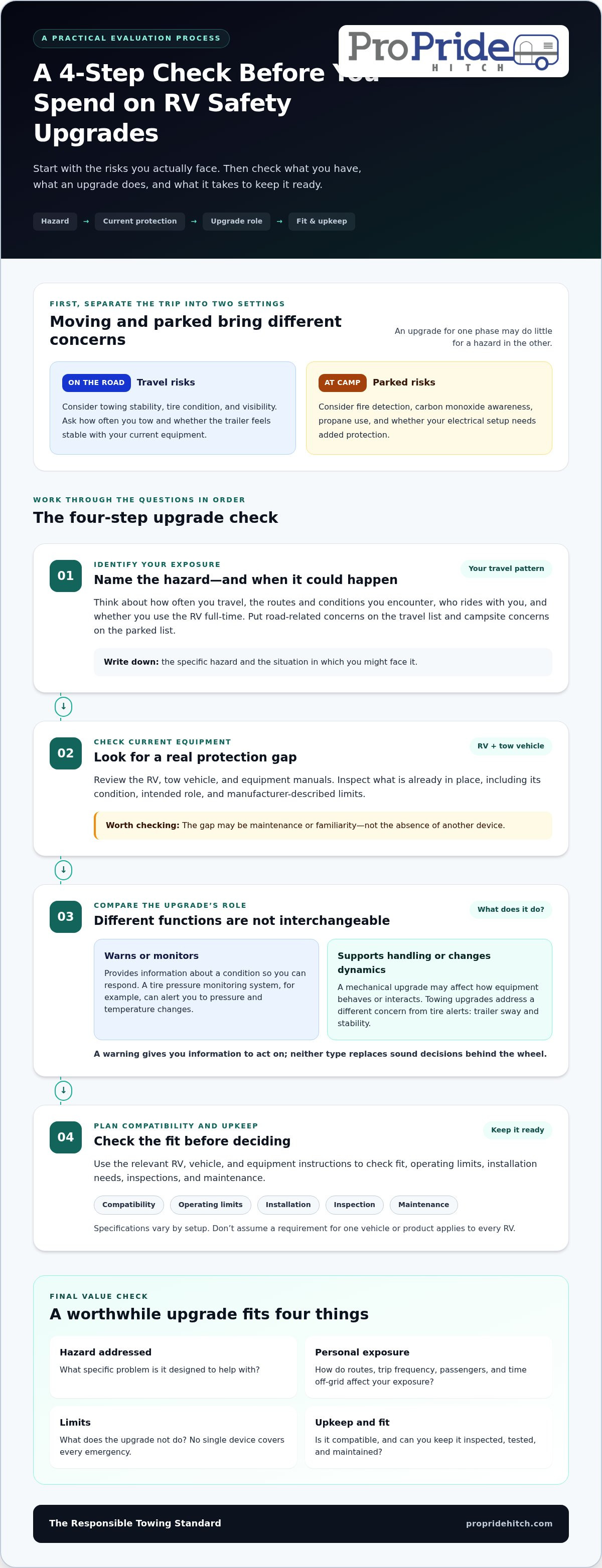
A repeatable process makes it easier to compare upgrades that solve very different problems. Rather than starting with the equipment getting the most attention, work through four questions in order: What are you exposed to? What protection do you already have? What role would the upgrade play? What will it take to keep it ready?
- Identify your exposure. Consider how often you travel, the routes and conditions you encounter, who rides with you, and whether you use the RV full-time. Pin down the hazard and when it could occur. For example, a towing-related concern belongs on the travel list, while a concern that applies when parked belongs on the campsite list.
- Check your current equipment. Review the RV, tow vehicle, and equipment manuals, then inspect what’s already in place. Note its condition, intended role, and any limits the manufacturer describes. This step can reveal that the gap is maintenance or familiarity, not the absence of another device.
- Compare the upgrade’s role. Ask whether it warns you, monitors a condition, supports handling, or changes how equipment interacts. These functions aren’t interchangeable. A warning can give you information to act on; a mechanical upgrade may affect how a system behaves. Neither removes the need for sound decisions behind the wheel.
- Plan compatibility and upkeep. Check the relevant RV, vehicle, and equipment instructions for fit, operating limits, installation needs, inspections, and maintenance. Specifications vary by setup, so don’t assume a requirement for one vehicle or product applies to every RV.
Match an upgrade to your RV use and exposure
Use your actual routine to judge relevance. A full-time traveler, an occasional weekend camper, and someone who regularly tows on varied routes may have different exposure and maintenance demands. Passenger needs can affect how you evaluate warnings and response plans, too. Write down the specific failure or hazard you want to address and when you’re most likely to encounter it. That makes it easier to separate a recurring vulnerability from a feature that simply sounds useful.
For vehicle-safety information and recall resources, consult NHTSA Federal Vehicle Safety Standards. For equipment-specific decisions, the manuals remain essential: they explain the intended use and limits of the RV, tow vehicle, and individual components. If an upgrade’s fit or installation needs don’t suit your existing setup, its potential benefit may not translate into practical value.
Compare protection, limits, and upkeep
Safety equipment works within defined limits. It can support awareness or system performance, but it can’t guarantee that an emergency won’t happen. Include user familiarity in your evaluation. A device you don’t know how to interpret or maintain may not provide the practical support you expect. Before buying, identify its routine checks and whether those tasks fit your travel habits.
This method helps you decide which RV safety upgrades worth the cost address a real gap rather than duplicate protection you already have. If towing stability is the vulnerability you’ve identified, compare the design and function of a trailer sway-control hitch with your towing setup and equipment guidance. Keep the decision tied to the hazard, not the popularity of the upgrade.
Which RV Safety Upgrades Offer Practical Value for Towing?
Different upgrades address different hazards, so compare their purpose and limitations rather than treating them as interchangeable. A monitoring system can provide information, an alarm can alert you to a condition, and a towing-stability system affects the connection between tow vehicle and trailer. None addresses every risk. Use the table to identify which category matches the gap you’ve found in your setup.
| Upgrade | Hazard addressed | What it does | Key limitation |
|---|---|---|---|
| Tire-pressure monitoring | Changes in tire pressure or temperature | Reports tire readings so you can respond to changes. | It doesn’t repair a tire or replace inspections and appropriate follow-up. |
| Fire or carbon-monoxide detection | Fire or carbon monoxide while the RV is occupied | Provides an alert when the device detects the condition it’s designed to monitor. | It doesn’t remove the hazard or replace following the device’s instructions and response guidance. |
| Electrical surge protection | Electrical events that may affect connected equipment | Provides a layer of protection for electrical equipment, depending on the device and setup. | It doesn’t address every electrical fault or make an unsuitable connection safe. |
| Towing stability | Trailer sway and the towing setup’s stability | A hitch system may influence how the trailer and tow vehicle interact. | It doesn’t correct every towing, road, loading, or driving risk. |
Monitoring and warning systems: what they can tell you
A tire-pressure monitoring system (TPMS) can alert you to pressure and temperature changes. That information can help you decide when to stop and assess the situation, but it can’t prevent every tire problem. Fire and carbon-monoxide alarms alert you to what their sensors detect, while surge protection has a defined electrical role. Read each product’s instructions, keep up with recommended inspections, and know how you’ll respond to an alert. RV Industry Association consumer and safety resources can add context; see the RV Industry Association Safety Standards.
Towing stability: why the hitch belongs in the safety discussion
Weight distribution and sway control are related, but they do different jobs. Weight distribution manages how the trailer’s load affects the tow vehicle; sway control addresses side-to-side trailer movement. A hitch can combine these functions without making them interchangeable. The ProPride 3P® Hitch combines sway control with integrated weight distribution and uses Pivot Point Projection™ to project a virtual pivot point near the tow vehicle’s rear axle. Unlike friction-based systems, it addresses sway through this projected pivot point. The hitch is designed to eliminate trailer sway, but it doesn’t remove other towing risks.
To compare trailer sway-control hitch designs, focus on the mechanical approach, the role of weight distribution, and compatibility with your tow vehicle and trailer. The ProPride 3P® uses pivot-point projection rather than friction-based damping. That’s a more useful comparison than assuming every system manages sway in the same way. RV safety upgrades worth the cost address your actual exposure, with limits and upkeep you understand.
How to Prioritize RV Safety Upgrades for Your Own Setup
A useful priority list starts with evidence, not a long list of popular accessories. Review your RV, tow vehicle, trailer, and equipment manuals. Add inspection findings and known equipment limitations, then consider how you actually travel. A concern that affects your towing setup may deserve attention before a convenience feature, but there’s no universal ranking that fits every RV or travel routine.
Build a short, evidence-based priority list
Complete this worksheet for each concern before you shop. Be specific: “trailer stability on regular towing routes” is more useful than “improve safety.” If an inspection or manual points to an existing issue, address that information directly instead of layering on equipment that doesn’t close the gap.
- Hazard: What condition or failure are you trying to address, and when does it matter?
- Current protection: What equipment, maintenance, or operating practice already addresses it?
- Remaining gap: What is still missing, limited, or difficult to manage?
- Fit and compatibility: Does the upgrade suit your RV, tow vehicle, trailer, and existing equipment?
- Upkeep plan: What inspections, maintenance, or user familiarity will it require?
Then weigh each item by its relevance to your use, the seriousness of the hazard, and your ability to maintain the system. Separate a safety concern from a convenience improvement, but don’t assume every safety item outranks every other one. Your records and travel needs should guide the order. Also watch for overlap: two systems may be worthwhile if they have distinct roles, but avoid buying duplicates that address the same gap without a clear reason.
Check towing fit before choosing a hitch upgrade
Before comparing hitch designs, review the tow vehicle and trailer requirements, along with the hitch’s instructions and capacity information. Capacity is only one part of fit; the overall configuration must suit the specific combination. The ProPride 3P® Hitch is available in 600 lb, 800 lb, 1000 lb, and 1400 lb capacity options. Use the equipment documentation to guide your evaluation rather than assuming a particular option fits every setup.
The Responsible Towing Standard means making a deliberate choice based on the equipment, the load, and your real towing needs. It isn’t a promise of risk-free travel. If sway control is a priority in your worksheet, consider how the hitch design addresses that concern and whether its requirements align with your trailer and tow vehicle.
Revisit the worksheet after a change to your RV, tow vehicle, trailer, or travel routine. A new load or different use can shift which gaps matter most, and upkeep needs may change with the equipment. To examine the design as part of your comparison, explore the ProPride 3P® hitch design.
ProPride 3P® Hitch: A Towing-Stability Upgrade to Evaluate
A specialized hitch is one possible response when your priority list points to towing stability. It isn’t a substitute for upgrades that address other hazards, and it won’t make every towing situation risk-free. The ProPride 3P® Hitch is designed for travel-trailer owners to assess against their tow vehicle, trailer, and intended use. Focus on whether its design and setup requirements fit your combination.
What the ProPride 3P® design changes
The hitch uses patented Pivot Point Projection™ technology to project a virtual pivot point near the tow vehicle’s rear axle. This shortens the effective lever arm between the tow vehicle and trailer, improving towing stability. The 3P technology is single-directional: when a turning force comes from the tow vehicle, the effective pivot point shifts to the hitch ball, allowing the combination to turn. Compare this approach with friction-based sway control and the towing concern you’re trying to address. The hitch also integrates weight distribution, a separate function from sway control.
Look closely at the parts that affect setup and everyday use. The adjustable hitch bar helps match different tow-vehicle and trailer heights. The one-piece yoke holds the hitch head square to the trailer front. Weight-distribution jacks sit on top of the frame, and the spring bars bolt into the hitch head. Installation requires no drilling into the trailer frame. These are practical details to consider alongside your trailer’s frame and the product instructions.
The hitch allows up to an 87-degree turn radius when backing. Treat that as a product capability, not a promise that every turn or backing situation will allow that angle. Consider the space and maneuvering your usual destinations require, and review the operating guidance for your setup.
Who should include a specialized hitch in the evaluation?
If you tow a travel trailer and have identified stability as a priority, include hitch design in your broader safety evaluation. Half-ton truck owners can use the ProPride 3P®; assess the specific truck and trailer requirements rather than ruling it out based on truck category alone. Review the manuals and product guidance together, including capacity and configuration, to evaluate fit for your combination.
The Responsible Towing Standard means choosing equipment deliberately and understanding its role, limits, and setup requirements. It doesn’t promise risk-free travel. Keep driving decisions, loading, maintenance, and the condition of the full towing system in view as you weigh any hitch upgrade.
If the design matches the need you identified, view the ProPride 3P® trailer sway-control hitch and compare its details with your setup. A 0.0% APR financing option is offered. Take the time to choose based on fit and function, then use the product guidance to prepare for responsible towing.
Make Your Next Safety Decision With Confidence
Your next step doesn’t have to be a major purchase. Choose the most relevant unresolved risk in your setup, then decide what information or action would help you address it responsibly. Revisit that decision when your equipment, passengers, or travel habits change. A safety plan should reflect the RV you use now, not the one you had when you first made your list.
The right RV safety upgrades worth the cost are the ones that fit your actual needs and that you can use and maintain with confidence. If towing stability is the concern you’re ready to evaluate further, take a closer look at the ProPride 3P® Hitch and its design before deciding whether it fits your setup.
Explore the ProPride 3P® Hitch and take your next step toward more informed towing decisions. With a clear priority and careful research, you can keep building a safety plan that supports confident travels.
Frequently Asked Questions
Are RV safety upgrades worth it for occasional travelers?
They can be, depending on your RV, equipment, and how you travel. Occasional use doesn’t automatically remove towing or parked-site concerns, but it may affect how often you encounter them. Before your next trip, note which systems you’ll rely on and whether anything has changed since your last outing. That gives you a useful starting point for choosing an upgrade that fits your travel pattern, rather than copying a full-time traveler’s checklist.
Does a tire-pressure monitoring system replace checking RV tires?
No. Keep tire checks in your preparation routine, and use the monitoring system according to its manufacturer’s instructions. Before relying on it during a trip, learn what its displays or alerts mean and how to respond. If an alert appears, don’t assume the system has identified the cause or resolved the problem. Use the tire, vehicle, and monitor guidance to decide what further assessment is appropriate.
Can an RV surge protector prevent every electrical problem?
No. Avoid treating a surge protector as a solution for every issue involving an RV’s electrical system. Before choosing one, identify the concern you want to address and compare the device instructions with your RV’s electrical guidance. Keep other electrical symptoms separate in your notes instead of assuming one device covers them all. If you encounter a problem, follow the equipment manufacturer’s direction rather than relying on the protector alone.
Can a sway-control hitch prevent every towing emergency?
No. A sway-control hitch addresses a specific towing concern, not every emergency that may arise on the road. Before travel, review the hitch and vehicle instructions, check that the equipment is set up for your combination, and stay attentive to changing conditions. If the trailer behaves unexpectedly, don’t assume the hitch makes it safe to continue unchanged. Follow the manufacturer’s guidance and make a careful decision based on the situation.
Does the ProPride 3P® Hitch also distribute trailer weight?
Yes. The ProPride 3P® Hitch includes integrated weight distribution, independent of its sway-control function. As you evaluate the hitch, bring together the tow vehicle and trailer information you’ve gathered instead of choosing by vehicle type alone. Confirm that the hitch’s configuration and capacity align with your combination, using product and vehicle guidance. Available capacity options are 600 lb, 800 lb, 1000 lb, and 1400 lb.
Do RV safety upgrades need regular maintenance?
Many do, though the appropriate checks depend on the particular equipment and RV. Keep the manuals accessible and note any manufacturer-recommended inspection or upkeep so those tasks don’t get lost between trips. After adding a system, take time to learn its controls, indicators, and stated limits before you need to rely on it. A maintenance plan is most useful when it fits naturally into your existing RV preparation routine.