
What if the towing upgrade that matters most isn’t another camera or monitor, but the hitch connecting your truck and trailer? Choosing premium travel trailer towing equipment can feel complicated when safety systems, comfort accessories, and fit requirements all compete for attention.
Start by identifying what you want to improve. A hitch, sway-control system, mirror, and monitoring device each serve a different purpose. For example, a camera may help with visibility or maneuvering, but it does not change the hitch connection. Understanding those distinctions makes it easier to focus your research on gear that addresses an actual need.
This guide compares equipment by function, explains how hitch designs differ, and gives you a practical way to match your choices to your setup. You’ll also see where the ProPride 3P® Hitch fits: its Pivot-Point Projection™ technology places a virtual pivot point near the tow vehicle’s rear axle, and its integrated weight distribution operates independently of its sway-control function. The goal is not to buy more gear. It’s to choose deliberately, in keeping with The Responsible Towing Standard.
Key Takeaways
- Choose premium travel trailer towing equipment by the problem it solves, not by a “premium” label or a broad safety claim.
- Separate towing-control equipment from visibility and convenience accessories so you can prioritize the needs that matter in your setup.
- Compare each option’s function, fit, operation, and upkeep before deciding whether it makes practical sense for you.
- Start with your trailer and tow vehicle details, then match equipment to the combination you actually tow.
- When evaluating the ProPride 3P® Hitch, consider its bolted spring bars, top-mounted weight-distribution jacks, adjustable hitch bar, and no-drill installation.
Premium Travel Trailer Towing Equipment: What Solves a Real Need?
“Premium” should mean that equipment has a clear purpose, fits your setup, and is practical for you to use. It should not simply mean a higher price or polished marketing. Before adding anything, name the need: managing trailer movement, improving visibility, monitoring a condition, or making a routine task easier. If you can’t explain the job an item does, it may not belong on your shortlist.
More gear does not automatically make towing safer. Each item works within a larger setup, and a mismatch with your trailer or tow vehicle can make it less useful. Start with the combination you tow, how you load and use it, and the conditions you regularly encounter. Then compare products with those details in mind.
Which towing-equipment categories deserve consideration?
First, separate equipment that affects the trailer-to-vehicle connection from tools that support awareness or convenience. A hitch connects the trailer to the tow vehicle. Sway control and weight distribution address distinct aspects of towing, while mirrors and monitoring aids serve other purposes. For background on hitch configurations and terminology, see Trailer Hitch Types and Classes.
- Hitches and sway-control systems: Consider these when reviewing how the trailer connects to your vehicle and how the hitch manages trailer movement.
- Towing mirrors: These support visibility alongside and behind the trailer. Check whether your current view is adequate for the trailer you tow.
- Monitoring and backup aids: These can provide information or help with awareness during a specific task. They support attentive driving and careful checks, but do not replace either.
Keep the functions distinct. A mirror can improve your view, but it does not change the hitch connection. A monitoring aid can provide information, but it does not correct a mismatch between towing equipment and your setup.
How to distinguish a useful upgrade from an add-on
Ask three questions before buying: What specific task or limitation does this address? Does its function suit my trailer and tow vehicle? Can I understand and use it as intended in my regular towing routine? Clear operating instructions and practical compatibility matter more than words such as “ultimate” or “safer.”
Make the decision concrete. If visibility is the concern, assess whether your mirrors provide the view you need. If you’re evaluating hitch equipment, compare the connection and the function each system is designed to perform. If backing is challenging, consider whether an aid supports that task, while remembering that it cannot take the place of deliberate maneuvering.
Write down the need first, then compare equipment that addresses it. This simple filter keeps premium travel trailer towing equipment focused on real use, rather than letting a long accessories list stand in for a well-matched setup. It’s a practical starting point for The Responsible Towing Standard.
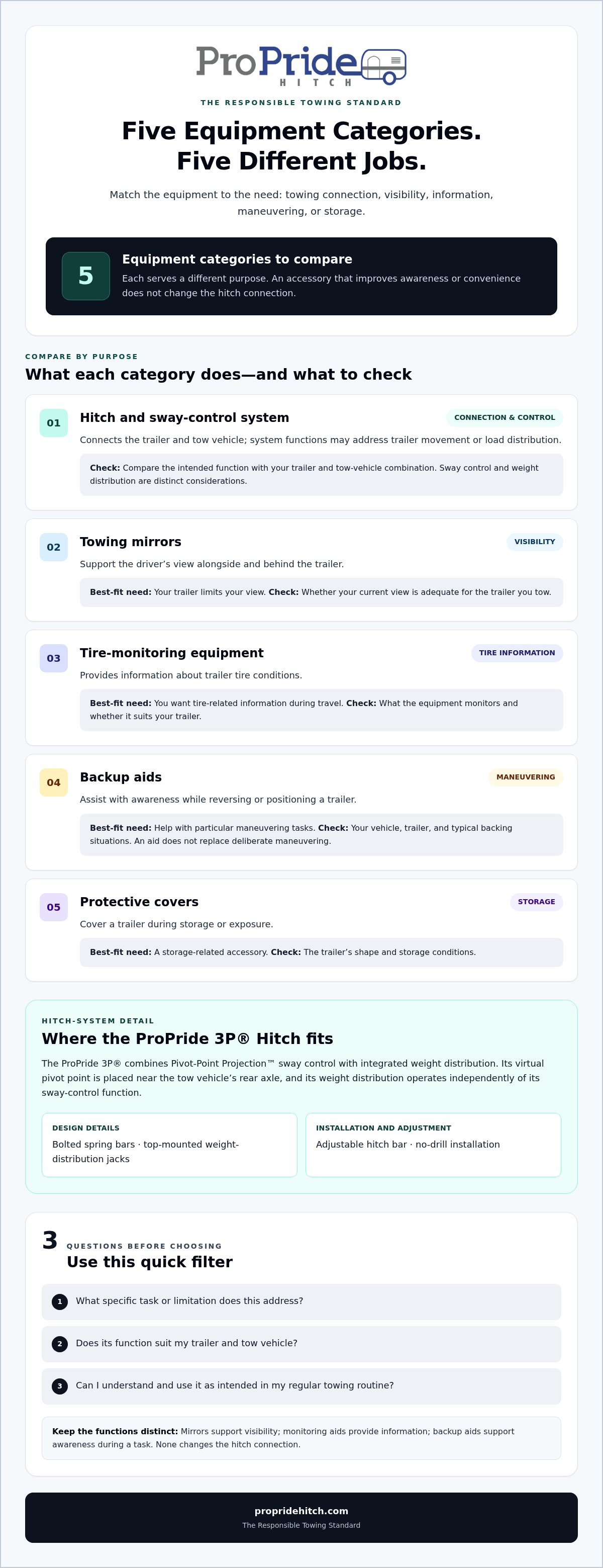
Five Premium Travel Trailer Equipment Categories, Compared by Purpose
These five categories serve different needs. A hitch system addresses the trailer-to-vehicle connection, mirrors support visibility, and monitoring and backup aids provide information or awareness for particular tasks. Protective covers are intended for storage or exposure. Use the comparison to identify the category that fits your need, then compare products within that category rather than treating every accessory as a safety upgrade.
Category
Primary function
Best-fit need
Fit considerations
Hitch and sway-control system
Connects trailer and tow vehicle, with functions that may address trailer movement or load distribution.
Owners assessing hitch design and towing-control priorities.
Compare the system’s intended use with your trailer and vehicle combination.
Towing mirrors
Support the driver’s view alongside and behind the trailer.
Drivers whose trailer limits their view.
Consider the vehicle and the view you need while towing.
Tire-monitoring equipment
Provides information about trailer tire conditions.
Owners who want tire-related information during travel.
Review what the equipment monitors and whether it suits your trailer.
Backup aids
Assist with awareness while reversing or positioning a trailer.
Drivers who want help with particular maneuvering tasks.
Consider your vehicle, trailer, and typical backing situations.
Protective covers
Cover a trailer during storage or exposure.
Owners looking for a storage-related accessory.
Consider the trailer’s shape and storage conditions.
Hitch and sway-control equipment: the core towing connection
Hitch systems vary in design and function. Sway control and weight distribution are related considerations, but they address distinct towing needs. The ProPride 3P® combines Pivot-Point Projection™ sway control with integrated weight distribution. For a wider reference on hitch configurations and terminology, consult SAE J2807 Towing Standard when considering how vehicle capability fits into your equipment decisions.
As you compare hitch systems, note what each function is intended to do, how the product describes its operation, and which details matter for your trailer and tow vehicle. A feature list is most useful when you can connect each item to a real requirement in your setup.
Visibility, monitoring, and protection accessories
Mirrors address sightlines. Tire-monitoring equipment provides tire-related information, while backup aids support awareness during maneuvering. These tools have separate roles; none changes the hitch connection. A protective cover belongs in a different category, since its purpose is storage or exposure rather than towing control.
Use the table to identify a relevant category, then compare each product’s stated function and fit. For owners assessing hitch designs, the ProPride 3P Hitch illustrates a hitch-centered approach that combines sway control with weight distribution. Knowing the distinct roles of your equipment is part of The Responsible Towing Standard.
Is Premium Towing Equipment Worth It? Compare Function, Fit, and Trade-Offs
A premium label doesn’t tell you whether equipment suits your setup. Compare the problem it addresses, its compatibility with your trailer and tow vehicle, how you’ll operate it, and what upkeep it requires. A hitch may be relevant if you’re assessing trailer movement or weight distribution. A monitoring device serves a different purpose. More features do not automatically make either one the right investment.
Look for details you can evaluate: stated functions, adjustment options, compatibility information, and clear operating instructions. Broad claims such as “ultimate” or “safer” aren’t enough on their own. Ask what specific feature supports the claim and whether it addresses a need you actually have.
Equipment
Problem addressed
Fit and operation
Trade-off to consider
Hitch system
Trailer connection, sway control, or weight distribution.
Compare its stated functions with your trailer and tow vehicle.
Understand operation, adjustment, and maintenance needs.
Mirrors or backup aids
Visibility or awareness during maneuvering.
Consider your vehicle, trailer, and typical tasks.
They support awareness but don’t replace attentive operation.
Monitoring equipment
Information about a specific condition.
Check that its stated function suits your intended use.
Know what information it provides and how to use it.
What distinguishes pivot-point projection from friction damping?
Friction-based systems use resistance to damp trailer movement. The ProPride 3P® uses Pivot-Point Projection™ instead, so it does not rely on friction-based damping. Its technology projects a virtual pivot point near the tow vehicle’s rear axle, shortening the lever arm between the vehicle and trailer. When turning force comes from the tow vehicle, the effective pivot point shifts to the hitch ball, allowing the combination to turn. This is a different design approach, not a universal fit for every setup. Compare each system’s stated function, compatibility, and operating requirements. The ProPride 3P Hitch design is one option to assess against those criteria.
What to weigh before choosing an integrated hitch system
Consider whether having weight distribution and sway control within one hitch aligns with your priorities. In the ProPride 3P®, weight distribution is integrated and functions independently of sway control. Its adjustable hitch bar and one-piece yoke are specific design details to weigh alongside fit, operation, and maintenance. The hitch also has no-drill installation, so installation does not require drilling into the trailer frame. Match the product to your intended setup and follow its instructions.
A serious investment makes sense when you can connect its function to a real towing need and understand the trade-offs. When evaluating premium travel trailer towing equipment, compare design and fit rather than relying on a label or a broad promise.
A Practical Checklist for Matching Travel Trailer Equipment to Your Setup
A careful purchase starts with your actual towing combination, not a product label or a feature that sounds impressive. Use this checklist to narrow your choices by what you tow, what you drive, and what you need the equipment to do. It’s a selection process, not an installation guide. Follow the equipment’s instructions for installation and operation once you’ve chosen a suitable option.
- Identify your trailer and tow vehicle. Write down the relevant details for both, including the trailer’s make and model, its current hitch arrangement, and the tow vehicle’s make and model. Keep the information together while comparing products. Equipment fit depends on the combination, so don’t make a decision based on trailer or vehicle details alone.
- Name the recurring need. Decide whether you’re addressing sway control, weight distribution, visibility, tire monitoring, backup awareness, or storage protection. Be specific. “I want better visibility beside the trailer” points to a different category than “I want to compare how my hitch manages trailer movement.”
- Match the product’s stated function to that need. Read the product description and operating instructions. Check that they explain what the equipment does, how it’s meant to be used, and which trailer or vehicle setups it’s intended for. Don’t assume two products perform the same job just because both use safety language.
- Review hitch fit and capacity information. For a hitch, compare its stated capacity and intended function with your towing setup. The ProPride 3P® Hitch is available in 600 lb, 800 lb, 1000 lb, and 1400 lb capacity options. Use the relevant hitch and trailer information to assess fit, rather than treating the capacity designation as a substitute for evaluating your full combination.
- Consider operation and frequency. Think about how often you’ll use the equipment and who will operate it. A device used on every trip should be understandable to its regular users. For equipment used mainly during storage or occasional backing, consider whether its purpose fits those specific situations.
- Set aside appearance and broad promises. A polished design or words like “ultimate” don’t establish compatibility or explain how a product works. Compare clear functions, fit information, and instructions instead. If a product’s purpose doesn’t address a need you’ve identified, leave it off your shortlist.
- Make the selection before planning installation. Match the intended equipment to your combination and use case, then follow the product’s installation instructions. Keep the decisions separate: this checklist helps you choose, but it doesn’t replace product-specific installation guidance.
This method makes premium travel trailer towing equipment a considered part of your setup, rather than a collection of features chosen in isolation. If you’re weighing hitch design against your towing priorities, review the ProPride 3P Hitch details as part of your comparison.
Where the ProPride 3P® Hitch Fits in a Premium Towing Setup
The ProPride 3P® is a hitch for owners comparing sway-control designs and weight-distribution needs. It is not a bundle of towing accessories. Consider it in the context of your trailer and tow vehicle, then weigh its specific construction and operation against the needs of your setup.
Which ProPride 3P® features matter in this roundup?
Several design details can help you assess how the hitch is built and used. Its adjustable hitch bar accommodates different tow-vehicle and trailer heights. Its one-piece yoke holds the hitch head square to the trailer front, and its spring bars bolt into the hitch head. The weight-distribution jacks sit on top of the frame. The hitch also allows a turn radius of up to 87 degrees when backing. These are concrete points to compare with your towing and maneuvering needs, not promises of a particular outcome.
How to take the next step with confidence
Before deciding, consider how the hitch’s design fits your trailer and tow vehicle, and review the product information with those details in mind. If you’re comparing hitch-focused options, the ProPride 3P® trailer sway-control hitch page explains its features so you can assess them against your priorities.
Choosing equipment carefully is part of The Responsible Towing Standard. Review the hitch details and decide whether its design meets your needs. A well-considered choice starts with matching the equipment to the combination you tow.
Make Your Next Towing Upgrade a Deliberate One
Turn your research into a decision you can revisit: note what you want to improve, why it matters on your trips, and what would make an upgrade a good fit. Keep that record with your trailer and tow-vehicle information. It can help you stay focused now and reassess thoughtfully if your equipment or travel habits change.
That’s a stronger basis for choosing premium travel trailer towing equipment than buying based on appearance or a broad promise. A considered setup gives each purchase a clear purpose.
If a hitch designed around sway control is part of your evaluation, review the ProPride 3P® and compare its design with your towing priorities. Explore the ProPride 3P® trailer sway-control hitch and make your next decision with care. The Responsible Towing Standard starts with informed choices.
Frequently Asked Questions
What equipment should every travel trailer owner consider?
No single accessory suits every trailer and tow vehicle, but every owner should assess the hitch connection, visibility, and the information they want while traveling. Consider mirrors if the trailer affects your view, and monitoring or backup aids if they address a recurring need. Protective covers are for storage, not road control. Use your trailer and vehicle details to narrow down premium travel trailer towing equipment rather than buying a standard package of extras.
Is a premium sway-control hitch worth considering for a travel trailer?
It’s worth considering if sway control is a priority and the hitch’s design fits your towing combination. Look beyond the premium label: identify how the system manages trailer movement, what other functions it includes, and whether its instructions suit your routine. A hitch is central to the trailer connection, so compare its operating approach with your needs rather than assuming a higher-end model is right for every owner.
What is the difference between sway control and weight distribution?
Sway control addresses trailer movement, while weight distribution manages how the connected load is carried across the towing setup. They’re related because both involve the hitch and trailer connection, but they aren’t interchangeable jobs. If a hitch includes both, check whether each function is clearly described. That makes it easier to understand what you’re choosing and avoid assuming that a weight-distribution feature alone addresses sway.
Can a ProPride 3P® Hitch be used with a half-ton truck?
Yes, the ProPride 3P® Hitch is used with half-ton trucks. That doesn’t make every truck-and-trailer combination automatically suitable. Compare the specific vehicle, trailer, and hitch setup, including the relevant ratings and how the trailer is loaded. A responsible match depends on the complete combination, not the truck category alone. Keep those details together when evaluating equipment, especially if you change tow vehicles or trailers.
How does pivot-point projection differ from friction-based sway control?
Pivot-point projection and friction-based systems use different approaches to sway control. The ProPride 3P® uses Pivot-Point Projection™; it doesn’t rely on friction-based damping. Its technology projects a virtual pivot point near the tow vehicle’s rear axle. When turning force comes from the tow vehicle, the effective pivot point shifts to the hitch ball, allowing the combination to turn. As you compare options, focus on the mechanism each uses and how it’s intended to work with your trailer and tow vehicle, rather than treating all sway-control hitches as equivalent.
Does the ProPride 3P® Hitch require drilling into the trailer frame?
No. The ProPride 3P® Hitch has a no-drill installation, so drilling into the trailer frame isn’t required. Follow the product’s installation instructions for your setup. Knowing the stated installation method helps distinguish this feature from assumptions based on other hitch designs.
What capacity options are available for the ProPride 3P® Hitch?
The ProPride 3P® Hitch is available in 600 lb, 800 lb, 1000 lb, and 1400 lb capacity options. Compare the relevant capacity information with your trailer and towing setup rather than relying on a single figure in isolation. Capacity is an important matching factor, but it doesn’t replace evaluating the vehicle, trailer, and overall combination together.