
Most trailer owners are betting their family's safety on equipment designed to manage a disaster rather than prevent one. If you've ever felt that sickening tug of a passing semi-truck or fought to keep your RV straight during a crosswind, you know that "good enough" feels very different at sixty miles per hour. You're likely here because you're doing the hard work of justifying a high end trailer hitch against the sea of budget-friendly, friction-based options. It's a common crossroads for those who view their rig not just as a vehicle, but as a significant investment in their family's security and future adventures.
We understand that the price gap between standard equipment and a professional-grade system can seem substantial at first glance. However, safety is never a luxury; it's a fundamental requirement. You'll discover the engineering and safety reasons why a professional-grade hitch is the only logical choice for responsible trailer owners. We'll break down the physics of pivot point projection, explain why traditional sway bars often fail when you need them most, and show you how to evaluate the long-term value of your towing setup. By the end, you'll see why moving to The Responsible Towing Standard is less about spending money and more about securing your peace of mind.
Key Takeaways
- Learn how to distinguish between equipment that merely manages trailer sway and systems that eliminate it entirely through advanced engineering.
- Discover why Pivot Point Projection is the critical mechanical factor in justifying a high end trailer hitch for those who value absolute road stability.
- See how to calculate your setup's true value by weighing the cost of safety equipment against your total RV investment.
- Find out why you're likely to benefit from a geometric sway elimination system based on your trailer's specific profile and wheelbase.
- Understand how the Jim Hensley design legacy helps the ProPride 3P define The Responsible Towing Standard for families on the move.
The Hidden Costs of "Good Enough" Towing Equipment
In the towing world, "good enough" is a dangerous phrase. It usually refers to equipment that manages trailer sway once it has already started, rather than preventing it from occurring in the first place. When you're justifying a high end trailer hitch, you aren't just looking at a piece of steel. You're evaluating the cost of your own peace of mind. Standard setups often leave drivers in a state of constant anxiety, known as "white-knuckle" driving. This isn't just a mental strain. It's a physical toll that leads to exhaustion after only a few hours on the highway. Beyond the driver, inferior equipment places unnecessary stress on your tow vehicle's steering and suspension systems, as the truck is forced to constantly fight the trailer's lateral movements. Adopting The Responsible Towing Standard means choosing equipment that respects the laws of physics and protects your family.
To better understand why proper equipment matters for your safety, watch this helpful video:
The Reality of Friction-Based Sway Control
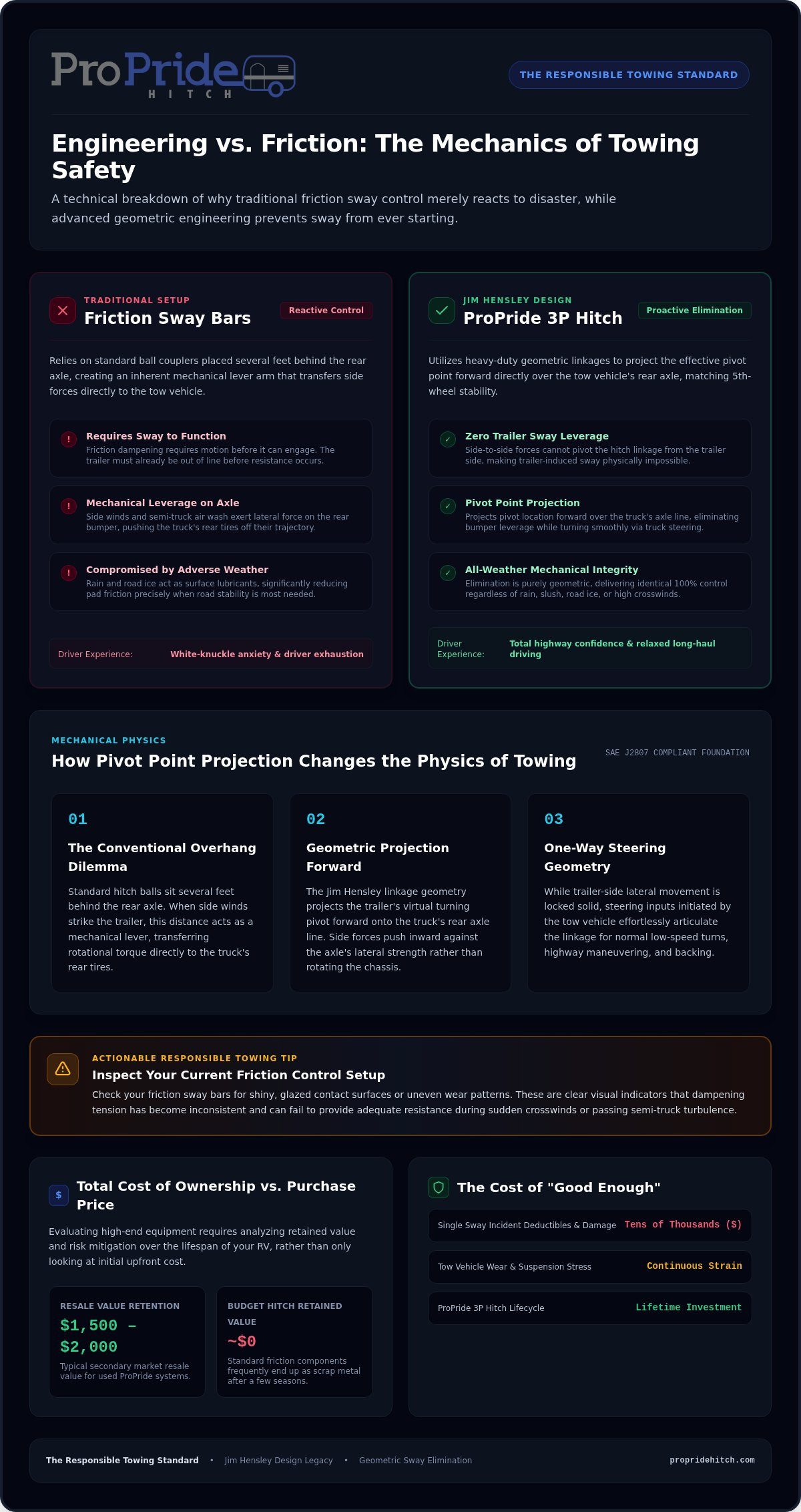
Most traditional setups rely on a weight-distributing hitch combined with friction bars. The fundamental flaw here is that friction requires motion to work. This means the trailer must actually begin to sway before the hitch can attempt to dampen that movement. It's a reactive solution to a proactive problem. Additionally, friction is notoriously unreliable in adverse weather. Rain or ice acts as a lubricant, significantly reducing the effectiveness of the very pads meant to keep you stable. When road conditions are at their worst, you need a system that doesn't rely on surface-level resistance to keep your family safe.
Actionable Tip: Inspect your current friction sway control bars for shiny, glazed surfaces or uneven wear patterns. These are clear indicators that your tension is inconsistent and may fail to provide adequate resistance during a sudden gust of wind.
Why Price is Different from Total Cost of Ownership
It's easy to focus on the initial purchase price, but smart researchers look at the total cost of ownership. A premium system like the ProPride 3P Hitch is an investment that retains significant value. While budget hitches often end up in scrap heaps after a few years, high-end engineering lasts a lifetime. In fact, used units often resell for $1,500 to $2,000, making the net cost much lower than it appears. When you consider that a single minor sway-related accident can cost tens of thousands in repairs or insurance deductibles, the hitch becomes the most affordable insurance policy you can buy for your RV investment.
Engineering vs. Friction: Why Physics Matters for Safety
The standard ball-and-coupler connection is a marvel of simplicity, but it is fundamentally flawed for heavy towing. By placing the connection point several feet behind the tow vehicle's rear axle, you create a mechanical lever. When wind or a passing semi-truck pushes the side of your trailer, that lever applies force to your truck's rear tires, trying to push them out of line. This is the root cause of sway. While SAE J2807 towing standards provide a baseline for vehicle stability, they cannot override the basic laws of physics. Understanding this mechanical reality is the first step in justifying a high end trailer hitch for your family's safety.
The Science of Pivot Point Projection
The Jim Hensley design legacy solved this problem by introducing the concept of Pivot Point Projection. Instead of a single pivot point at the ball, the ProPride 3P Hitch uses a series of heavy-duty linkages to project the effective pivot point forward. Mechanically, the trailer behaves as if it were attached directly over the truck's rear axle, similar to a fifth-wheel or gooseneck setup. This geometry makes it physically impossible for the trailer to exert side-to-side leverage on the tow vehicle. You can read more about the technical physics of the ProPride 3P to see how this four-bar linkage system creates a rock-solid connection.
Elimination vs. Suppression: A Critical Distinction
There is a massive difference between suppressing a problem and eliminating it. Traditional friction hitches are designed for sway suppression. They use brake-pad-like material to create resistance, hoping to slow down a trailer that has already started to swing. This is a reactive strategy. In contrast, the ProPride 3P provides sway elimination. It uses geometry to "lock out" the trailer's ability to move independently of the truck unless you are making a deliberate turn. This proactive approach is why many regard it as The Best Hitch on the Planet. It ensures you are meeting The Responsible Towing Standard every time you pull onto the highway.
Actionable Tip: When researching your next purchase, look closely at the manufacturer's documentation. Check if they use the term "sway control" or "sway elimination." Most budget brands will only claim to control or reduce sway, which is a legal admission that their system cannot stop it entirely.
If you want to experience the difference that true engineering makes, you might consider how a professional-grade system can transform your driving experience.
Calculating the Real Value of Your Towing Setup
When you evaluate a modern travel trailer, you're looking at a significant investment. Mid-range family trailers typically span $25,000 to $60,000, while premium luxury models can easily exceed $100,000. When you pair these with a modern tow vehicle, your total combined rig investment often reaches between $80,000 and $150,000. In this context, justifying a high end trailer hitch is a simple matter of asset protection. A professional-grade system typically represents only 2.4% to 4.5% of your total setup value. This small percentage buys you the engineering certainty required to maintain steering control during high winds or sudden evasive maneuvers.
For owners of high-profile trailers, such as an Airstream or Grand Design, the aerodynamic profile creates a massive surface area for crosswinds to catch. These trailers act like giant sails, making them highly susceptible to lateral forces. Using a ProPride 3P Hitch ensures these forces are neutralized by geometry rather than resisted by friction. This protection directly impacts your quality of life on the road. By eliminating the constant need for steering corrections, you significantly reduce driver fatigue. This allows you to arrive at your destination ready to enjoy your trip rather than needing hours to recover from a stressful drive.
Hitch Tier Comparison: Standard vs. Premium
Entry-level hitches rely on friction bars that you must manually adjust and often remove before backing up. Mid-tier systems might offer dual-cam centering, but they still function by trying to dampen sway that has already begun. A premium 3P system is fundamentally different. It uses a four-bar linkage design to project the pivot point forward, offering superior weight distribution accuracy and the convenience of backing up without disconnecting equipment. For a deeper look at specific brand data, you can review our sway control hitch comparison.
Actionable Tip: Add up the current market value of your truck, trailer, and the cargo inside. Divide the price of a premium hitch by that total. Most owners find that securing their entire investment costs less than the taxes they paid on the trailer alone.
Protecting Your Most Valuable Cargo
While the mechanical components are impressive, the real focus is on the passengers inside the vehicle. A high-end hitch provides a much wider margin for error in dangerous situations. If you encounter a sudden obstacle or a tire blowout, the last thing you want to manage is a swaying trailer. Being a responsible owner means preparing for the worst-case scenario with the best possible equipment. By adopting The Responsible Towing Standard, you ensure that your family is protected by a system that refuses to compromise on safety.
How to Know if You Need a Professional-Grade Hitch
Not every towing setup requires a complex engineering solution. A small utility trailer hauling yard waste behind a heavy-duty truck rarely encounters stability issues. However, the math changes significantly when you step up to a modern travel trailer. You're likely justifying a high end trailer hitch because you've noticed your rig doesn't feel as planted as it should. If your tow vehicle has a relatively short wheelbase, it's naturally more susceptible to being pushed by the trailer. This mechanical disadvantage means that even minor lateral forces can disrupt your steering, making every mile a struggle to stay centered in your lane.
The Trailer Profile Factor
Most modern travel trailers are "slab-sided," meaning they have tall, flat sides that act like massive sails. A 30-foot trailer provides a huge surface area for wind to catch. When a gust hits that side wall, it creates hundreds of pounds of force that a standard ball-and-coupler hitch simply cannot neutralize. This is why owners of premium trailers often seek out more advanced stability solutions. They recognize that their trailer's high-profile design requires a hitch that can handle the specific physics of wind resistance and semi-truck air displacement.
Actionable Tip: Calculate your trailer’s side-surface area to understand its sway potential. Multiply the trailer's exterior length by its height, measuring from the frame to the roofline. If you have over 200 square feet of "sail" area, your susceptibility to sway is high, making a geometric sway elimination system a logical safety upgrade.
Evaluating Your Personal Risk Tolerance
Think about your typical travel environment. If you only tow on calm days to a local park five miles away, basic equipment might suffice. But if you cross mountain passes, coastal bridges, or travel on high-speed interstates, the risks increase. Consider how you feel when a semi-truck passes you at 70 mph. If you feel a "suck and pull" sensation that requires immediate steering correction, your current equipment is failing to provide the stability you need. Arriving at your destination relaxed rather than physically exhausted is a key part of the RV lifestyle.
Adopting The Responsible Towing Standard is a personal commitment to safety that goes beyond just "getting by." It's about ensuring that your family is protected by the best possible engineering, regardless of the road conditions you encounter. If you're tired of the stress caused by an unstable trailer, you can explore the ultimate towing solution to see how a professional-grade hitch transforms the driving experience.
ProPride 3P: Meeting The Responsible Towing Standard
After analyzing the physics of sway and the total cost of ownership, the choice becomes clear. Justifying a high end trailer hitch isn't about buying a luxury accessory. It's about investing in a piece of American-made engineering that removes the variable of human error from the towing equation. The ProPride 3P stands alone as The Best Hitch on the Planet because it doesn't just manage sway; it renders it physically impossible through the Jim Hensley design legacy. This system isn't just a part. It's the culmination of decades of engineering excellence designed to protect your family and your investment.
Many owners worry that a professional-grade system will be difficult to operate. The reality is the opposite. Once the main unit is installed on your trailer’s A-frame, hitching and unhitching becomes a predictable, straightforward process. You won't have to wrestle with greasy friction bars or worry about disconnecting your sway control before backing into a tight campsite. The heavy-duty construction and durable powder coating ensure this is the last hitch you'll ever need to buy. It's built for those who value precision and durability over temporary, "good enough" solutions.
Why ProPride is the Logical Conclusion
The ultimate differentiator remains Pivot Point Projection. By projecting the trailer's pivot point forward onto the truck's rear axle, the 3P system creates a rock-solid link that wind and passing trucks cannot break. This isn't just a marketing theory. It's a patented mechanical reality that provides unparalleled stability. When you invest in a 3P, you're also gaining access to a dedicated community of towers who refuse to compromise on safety. For full technical details and load ratings, you can visit the ProPride 3P product page.
Actionable Tip: When your hitch arrives, take a moment to inspect the precision of the welds and the thickness of the steel components. High-end engineering is visible in these details. A lifetime warranty for the original purchaser is a testament to the confidence we have in this American-made hardware.
Taking the Next Step in Towing Safety
You've done the research. You understand the risks of friction-based systems and the benefits of geometric sway elimination. Now, it's time to make a decision based on data and family security. Justifying a high end trailer hitch is the hallmark of an informed owner who prioritizes the safety of their passengers and the longevity of their RV investment. It's the only way to ensure you are truly prepared for the unpredictable nature of the open road.
Don’t settle for "good enough" when your family’s safety is on the line. We invite you to contact our safety experts for a personalized consultation to ensure your specific rig meets The Responsible Towing Standard. Take the final step toward absolute confidence and a stress-free travel experience.
Secure Your Family's Future on the Road
The open road is unpredictable, but your trailer's behavior doesn't have to be. We've explored how moving from reactive friction bars to proactive geometric elimination transforms your driving experience. By understanding the physics of Pivot Point Projection, you're no longer just managing sway; you're removing it from the equation entirely. When you consider the total value of your RV and tow vehicle, justifying a high end trailer hitch becomes a clear decision for long-term safety and asset protection.
The ProPride 3P continues the Jim Hensley legacy, offering a level of stability that standard equipment simply cannot match. It's about more than just hardware. It's about the confidence that comes with meeting The Responsible Towing Standard. You deserve to arrive at your destination relaxed and ready for memories, not exhausted from hours of white-knuckle driving. Our commitment to the highest safety standards ensures you have the best protection available for your most valuable cargo.
Invest in The Responsible Towing Standard: Shop the ProPride 3P Hitch and experience the difference that true engineering makes. Your next adventure is waiting, and we're here to help you get there safely.
Common Questions About Towing Safety
Is a high-end hitch really necessary for a small travel trailer?
Even small trailers present a significant surface area to crosswinds and semi-truck air turbulence. If you're towing a shorter trailer with a mid-sized SUV or a half-ton truck, the shorter wheelbase makes your rig more sensitive to lateral forces. A professional-grade system ensures that these forces don't turn into dangerous oscillations. Justifying a high end trailer hitch for a smaller rig is about ensuring that your lighter tow vehicle remains in total control at all times.
How does the ProPride 3P differ from a standard weight distribution hitch?
Standard weight distribution hitches rely on friction pads or spring bar tension to resist sway after it starts. The ProPride 3P uses patented Pivot Point Projection technology to eliminate the mechanical possibility of sway. By using a four-bar linkage system, it projects the trailer's effective pivot point forward onto the truck's rear axle. This geometric lockout means the trailer cannot move independently of the truck, providing a level of stability friction hitches can't reach.
Can I install a professional-grade hitch myself or do I need a shop?
You can certainly install the ProPride 3P yourself if you're comfortable with basic hand tools and following a detailed manual. Most responsible owners choose the DIY route to better understand their equipment. The unit bolts onto the trailer's A-frame without the need for welding or specialized shop equipment. If you run into questions, our team provides technical support to ensure your setup meets The Responsible Towing Standard before you hit the road.
Does a high-end hitch improve the fuel economy of my tow vehicle?
While a hitch isn't a dedicated fuel-saving device, it can improve efficiency by reducing drag and steering corrections. When a trailer sways, it saps energy and forces the engine to work harder to maintain speed. By keeping the trailer perfectly in line with the tow vehicle, you minimize wind resistance and eliminate the constant throttle adjustments needed to regain control. This creates a smoother, more efficient towing experience across long distances.
Why is the ProPride 3P more expensive than friction-based sway bars?
The cost difference reflects the move from simple friction to advanced mechanical engineering. Friction bars are inexpensive because they're basic steel rods that wear out over time. The ProPride 3P is a precision-engineered tool featuring heavy-duty linkages and the Jim Hensley design legacy. When you're justifying a high end trailer hitch, remember you're paying for a system that eliminates sway entirely, lasts a lifetime, and maintains a high resale value on the secondary market.
What happens if I need to back up with a ProPride 3P hitch?
You can back up exactly like you would with a standard ball hitch, but with significantly more control. Unlike friction-based systems that require you to get out and remove sway bars before backing into a tight spot, the ProPride 3P stays fully connected. The geometric design allows for a full range of motion during tight maneuvers. This makes arriving at your campsite much less stressful, as you don't have to worry about damaging your equipment while reversing.
Will a high-end hitch prevent all accidents on the road?
No equipment can account for every variable on the road, such as driver distraction or extreme weather events. However, the ProPride 3P is designed to eliminate trailer sway, which is the leading cause of loss-of-control accidents while towing. By providing absolute stability and preventing the trailer from acting as a lever on your truck, it gives you a much wider margin for error. It's the most effective tool for maintaining The Responsible Towing Standard.
How long does a ProPride 3P hitch typically last?
The ProPride 3P is designed to last a lifetime. Built with heavy-duty American steel and protected by a durable powder coat finish, it's engineered for decades of heavy use. We back this durability with a lifetime warranty for the original purchaser, covering replacement parts at no cost. This longevity is why many owners consider it The Best Hitch on the Planet and the last hitch they'll ever need to buy, regardless of how many trailers they own.