
What if the most meaningful hitch innovation isn’t an app or a sensor, but a change in how the trailer pivots? That’s one reason innovations in trailer hitch technology can be hard to assess: impressive-sounding features don’t always explain what changes on the road or whether it matters for your setup.
Look beyond the sales language. A hitch has to suit the tow vehicle and trailer, and each feature should serve a clear purpose. Terms like “weight distribution” and “pivot-point projection” describe different mechanical functions, not simply extra equipment.
This article explains key directions in hitch design and how to assess a feature by its mechanism, purpose, and fit with your towing setup. It covers changes such as integrated weight distribution and projected pivot geometry, using the ProPride 3P as an example. The goal is to help you compare claims and make informed decisions guided by The Responsible Towing Standard.
Key Takeaways
- Assess innovations in trailer hitch technology by the towing problem each feature addresses, not by marketing language alone.
- Friction-based sway damping and pivot-point projection use different mechanisms. Compare what each design changes.
- Before comparing equipment, record your trailer, tow vehicle, and current hitch details so you can assess fit more specifically.
- Compare a hitch’s stated function and fit with your intended setup instead of assuming a new feature suits every combination.
- The ProPride 3P combines weight distribution with a virtual pivot point near the tow vehicle’s rear axle.
Why Innovations in Trailer Hitch Technology Matter to Today’s Towers
A predictable towing setup starts with equipment that suits the trailer and tow vehicle. The hitch is a key part of that connection, but “hitch technology” can mean more than the receiver or coupler. It includes the hardware and mechanisms that connect the trailer to the tow vehicle and manage load and movement. The Tow hitch overview covers common hitch types and general principles. For any design change, the practical question is what it does for the towing combination.
Hitch design and vehicle-based driver assistance are related, but they do different jobs. A change to hitch geometry alters how the trailer and tow vehicle move in relation to each other. Weight-distribution features are designed to manage how load is carried through the setup. A camera or sensor may help the driver see or position the connection, but it doesn’t necessarily change the hitch’s physical mechanism. Separating these categories makes technical claims easier to evaluate.
What counts as an innovation in a trailer hitch?
A hitch innovation changes a mechanism, adjustment method, material, or the way functions are integrated. Examples include geometry that changes the effective pivot point, an adjustable hitch bar that helps position the connection, or a system that combines sway control and weight distribution. These features aren’t automatically new across the industry. Their value depends on how they work and the job they perform.
A cosmetic update may change a product’s appearance without changing how it works. A broad label such as “advanced” says little by itself. A meaningful hitch innovation is a design change with a clear, explainable purpose in the towing system. Ask what moves, what force or movement the design addresses, and how the change relates to your trailer and vehicle.
Why towing owners should look beyond feature lists
Each feature should connect to a practical use. An adjustment feature may help position the hitch. Weight distribution manages how load is carried through the setup. A sway-control mechanism addresses trailer movement. These functions aren’t interchangeable, and a feature list alone won’t tell you whether they suit your combination.
Before comparing products, write down your trailer and tow vehicle details, along with the hitch you currently use. Then match each feature to a specific need: Does it affect alignment, load management, or sway control? Does the design suit your trailer’s connection and vehicle setup? Those questions turn product language into useful comparison points.
For a concrete example of integrated mechanical design, the ProPride 3P Hitch combines weight distribution and sway control. Evaluating features by mechanism and purpose, rather than promotion, reflects The Responsible Towing Standard. It gives you a clearer basis for comparing equipment and understanding how each design works.
How Trailer Hitch Technology Is Evolving: From Geometry to Integrated Functions
Some towing advances change what the hitch physically does. Others help the driver see or manage the connection. Keeping those categories separate helps clarify what a feature can contribute. Mechanical hitch design changes the connection between trailer and tow vehicle; vehicle-based assistance, such as a camera view for alignment, supports the driver without changing the hitch’s physical sway-control mechanism.
A camera and a mechanical sway-control design address different tasks. One can help you observe the hitching process; the other works through the equipment’s physical arrangement. To assess innovations in trailer hitch technology, first identify whether a feature changes geometry, manages load, or provides information.
Mechanical design: pivot points, leverage, and load management
Many conventional trailer connections pivot at the hitch ball. Pivot-point projection uses hitch geometry to create a different effective pivot location. A virtual pivot point isn’t a physical joint or a ball hidden elsewhere. It’s a projected point that describes how the hitch geometry changes the relationship between trailer and tow vehicle.
Think of a lever: its pivot location affects how movement at one end relates to movement at the other. The analogy doesn’t capture every part of towing, but it helps explain why changing the effective pivot point matters. Pivot-point projection uses geometry to position a virtual pivot point, changing the effective pivot relationship between trailer and tow vehicle. That explains the mechanism, not a guaranteed outcome for every vehicle, trailer, or road condition.
The ProPride 3P uses patented Pivot-Point Projection technology to place the virtual point near the tow vehicle’s rear axle. This differs from friction-based sway control, which uses friction to resist movement. These are distinct mechanisms, not interchangeable terms.
Connected aids and integrated hitch functions
Vehicle-based hitch-assist features and hitch mechanisms can be used in the same towing setup, but they do different things. Assistance from the vehicle may help the driver line up or observe a trailer connection. Don’t assume a hitch includes sensors, alerts, live data, or automated functions unless its documentation describes those features. Focus on what the equipment actually does.
Weight distribution is another distinct function. It manages how the load is carried across the tow vehicle and trailer connection; sway control addresses trailer movement. A hitch may combine both, but one function isn’t a synonym for the other. When comparing designs, look for a clear explanation of each function and how the hitch performs it.
The ProPride 3P integrates weight distribution with sway control and projected pivot geometry. For a closer look at this mechanical approach, explore the ProPride 3P hitch design. Understanding the mechanism first gives you a practical way to compare product claims with your towing needs.
How to Judge Whether a Trailer Hitch Innovation Is a Real Improvement
A feature deserves attention when its design addresses a real towing need. The phrase “new technology” doesn’t tell you whether a hitch changes how movement is managed, helps distribute load, or simply looks different. Start with the mechanism and its stated purpose, then consider whether that function fits your trailer and tow vehicle.
Evaluate a hitch feature by its mechanism and stated purpose, not its label. This makes innovations in trailer hitch technology easier to compare without relying on broad claims or assuming every new design suits every setup.
Compare mechanisms, not just product descriptions
Friction-based damping and pivot-point projection use different mechanisms. A friction-based design uses friction to resist movement; pivot-point projection changes the effective pivot relationship through hitch geometry. To assess either approach, ask what movement or relationship it is designed to affect, and look for an explanation of how the hardware does that job.
| Design change | Intended function | Practical question |
|---|---|---|
| Friction-based damping | Use friction to resist movement | What parts create resistance, and how does that function fit the setup? |
| Pivot-point projection | Change the effective pivot relationship through geometry | Where is the virtual pivot point positioned? |
| Adjustable hitch bar | Allow adjustment of the hitch connection’s position | Does the adjustment suit the trailer and tow vehicle combination? |
| Integrated weight distribution | Manage how load is carried through the connection | Is this function built into the hitch, and how is it set up? |
| Turning capability | Allow a stated range of turning movement | What turning limits or setup conditions are documented? |
Check fit, function, and practical trade-offs
A well-designed mechanism can still be the wrong match for a particular combination. Start with your trailer and tow vehicle details, then compare them with the hitch’s stated compatibility, adjustment range, and installation requirements. For example, installation requirements matter: the ProPride 3P is designed to install without drilling into the trailer frame. Don’t assume that feature applies to other hitch designs.
Next, separate the functions. Integrated weight distribution describes how a hitch manages load; it doesn’t, by itself, explain the sway-control mechanism. Look for a clear description of both when a product provides both. Turning capability is another practical consideration. The ProPride 3P has a stated turn-radius capability of up to 87 degrees when backing, so compare that documented capability with your maneuvering needs.
Hitch technology doesn’t replace responsible loading or correct setup. A feature may address one part of towing, but it can’t make an unsuitable combination appropriate. To see an example of geometry-based sway control combined with weight distribution, review the ProPride 3P hitch design and compare its documented functions with your requirements.
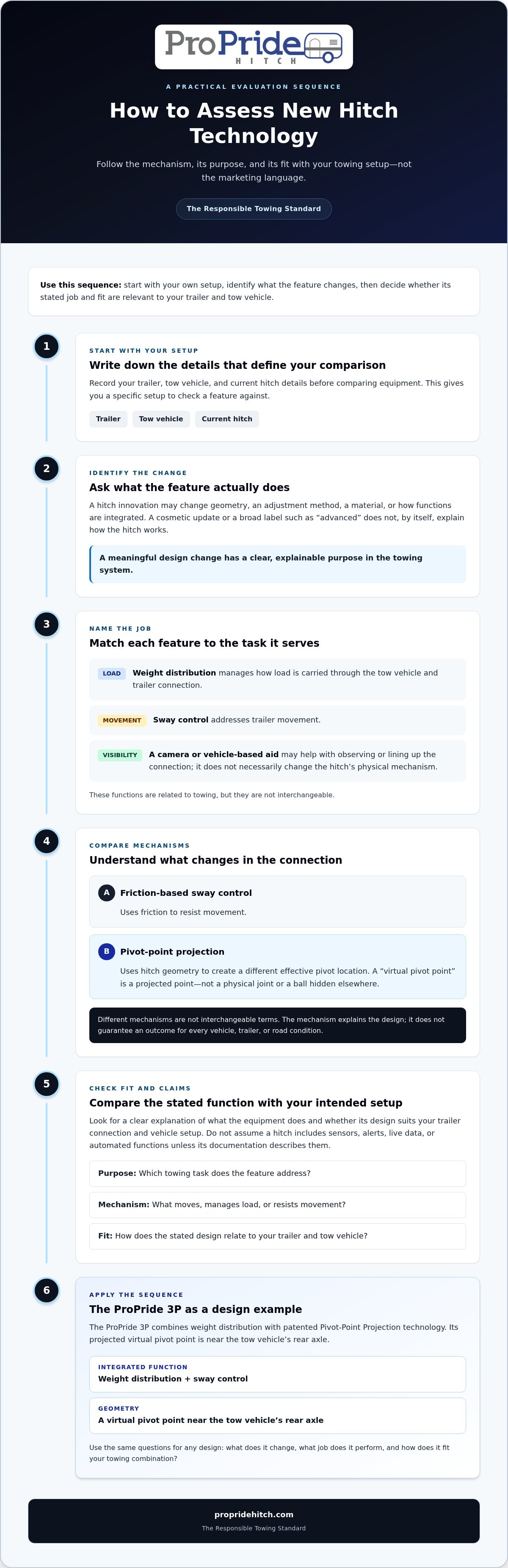
A Practical Way to Assess New Hitch Technology Before Choosing Equipment
Research is more useful when it starts with your towing setup, not a feature list. Record what you have, identify the concern you want to address, and compare a hitch’s documented function and compatibility details with that situation. This makes innovations in trailer hitch technology easier to assess and helps distinguish a vehicle-based aid from a change to the hitch itself.
Start with your towing setup and the problem to solve
Build a short reference sheet before comparing equipment. Record the trailer type, tow vehicle, current hitch, and any towing concern you’ve observed. Be specific: are you researching sway control, weight distribution, or easier alignment when coupling? These are different needs, and a feature designed for one may not address another. Use the documented vehicle and product requirements to assess fit rather than guessing at capacity.
- Trailer: Note its type and the relevant details in its documentation.
- Tow vehicle: Record the vehicle information and applicable towing guidance.
- Current hitch: Identify its design and the functions it provides.
- Concern: Describe what you want to improve, such as sway control, load management, or alignment.
Once you’ve made this list, match each concern to a stated hitch function. If the issue is alignment while coupling, a vehicle camera or hitch-assist feature may be relevant. It can support the driver’s view or positioning, but it doesn’t necessarily change the hitch’s mechanical sway-control design.
Read technology claims with an engineering mindset
Look for a plain explanation of what the mechanism changes and how it is intended to work. A specific description of geometry, adjustment, or load management is more useful than a broad “smart” label. Treat promised outcomes cautiously when the mechanism and conditions aren’t explained. Towing performance depends on the complete setup, not a product label alone.
Then compare the documented compatibility and installation details with your trailer and tow vehicle. Note whether the hitch combines weight distribution with sway control or addresses only one function. Don’t assume a camera, sensor, or electronic aid is built into a hitch unless its documentation says so.
For a deeper look at how sway-control mechanisms differ, use this sway-control hitch comparison guide. For additional context on stable towing, see the trailer sway science and safety guide. Keep your setup notes beside you as you read, and record which features address your actual concern.
Responsible equipment choices begin with clear information. To explore a hitch designed around Pivot-Point Projection and integrated weight distribution, learn about the ProPride 3P Hitch.
The ProPride 3P: A Practical Example of Trailer Hitch Design Innovation
A hitch’s engineering is reflected not only in its central mechanism, but also in how its components are arranged and secured. The ProPride 3P offers a practical example for readers who want to look past broad claims and examine specific construction choices. These details give you concrete points to compare when considering setup and how a hitch is built.
What the ProPride 3P changes in hitch design
The one-piece yoke holds the hitch head square to the trailer front. The weight-distribution jacks sit on top of the trailer frame, and the spring bars are bolted into the hitch head. Each detail describes a particular arrangement or connection. When comparing designs, look at where comparable components sit and how they attach instead of assuming similar feature names mean the same construction.
Other documented details include thicker control links and a reinforced hitch box. The control links are reinforced to handle high loads without bending, while the hitch box is reinforced to prevent its top edge from warping under weight-distribution load. These are specific design purposes, not a promise that equipment can overcome every loading or setup issue. They show how to move from a product label to individual components and their stated roles.
It’s also useful to distinguish component design from the overall result you want. A bolted connection, a yoke, and reinforced parts describe how the hitch is built. They don’t replace the need to consider your trailer, tow vehicle, and intended use as a complete combination.
How the design reflects The Responsible Towing Standard
ProPride, Inc. continues advancing innovative engineering while incorporating distinct changes in construction. Compare the actual parts and documented improvements rather than treating products with a shared historical approach as interchangeable.
As you review product information, keep a short list of questions: How is the hitch head supported? How are the bars secured? Where are the jacks positioned? What purpose do the reinforced parts serve? Clear answers make the engineering easier to understand and connect design choices to your towing priorities.
The ProPride 3P Hitch product details describe its components, while the engineering overview of the ProPride 3P offers further context on the design. Review them alongside your setup information to apply The Responsible Towing Standard to your equipment decision.
Make Your Next Towing Decision With Confidence
Before changing equipment, write down what you want your setup to do better and what information you need. Compare that list with your trailer and vehicle documentation, then assess each feature by its purpose and fit. This gives your research direction and helps keep marketing claims in perspective.
Preparation is part of responsible towing. Take time to understand your options, note unanswered compatibility questions, and base your decision on your actual setup rather than novelty alone. That approach makes it easier to evaluate innovations in trailer hitch technology with confidence.
Ready to continue your research? Explore the ProPride 3P Hitch and its engineering, and take the next step toward a towing setup that reflects your priorities.
Frequently Asked Questions
What does “innovation” mean in trailer hitch technology?
An innovation is a design or functional change with a practical, identifiable purpose. Look beyond a new name: check what has changed, what towing need the design addresses, and what setup information matters. Keep those details with your equipment records so you can compare designs later without relying on memory or promotional descriptions.
Are electronic hitch-assist features the same as sway control?
No. Consider the task you need help with. If you’re lining up the tow vehicle and trailer, an electronic aid may help you see or position the connection. If you’re evaluating how a hitch addresses trailer movement while towing, examine its mechanical design. Keeping those tasks separate helps you determine whether a feature supports hitching, driving, or the equipment’s physical function.
Can a new trailer hitch technology work with any trailer?
No. A design may depend on the trailer’s connection arrangement and available mounting space, so assess compatibility for the specific combination. Gather the trailer and tow vehicle documentation, then compare it with the hitch maker’s stated fit information. Don’t treat a product’s general category or appearance as proof of fit. Record unclear details before deciding whether the design suits your setup.
Does an advanced trailer hitch mean I can ignore trailer loading?
No. Treat loading as its own part of trip preparation, regardless of the hitch. Use the trailer and tow vehicle guidance to check how cargo should be arranged and what limits apply to your combination. Secure items so they can’t shift during travel, and revisit the load when cargo changes. A hitch feature doesn’t make it safe to overlook your equipment instructions.
Can I retrofit a newer hitch design to an older travel trailer?
It may be possible, but age alone doesn’t establish whether an installation is suitable. Before choosing, document the existing connection, frame condition, and any modifications already made to the trailer. Compare those details with the hitch’s installation instructions and fit information. If the trailer has been altered or repaired, include that history in your assessment. A careful review helps avoid assumptions based only on the trailer’s model year.
Should I replace my hitch just because newer technology is available?
No. Newness alone isn’t a reason to replace equipment. Consider whether your current hitch is in suitable condition, whether your towing combination or needs have changed, and whether a newer design addresses a specific concern. Note the reason for any proposed change and compare it with the product’s stated function. If there’s no clear benefit for your setup, continuing your research is a reasonable next step.