
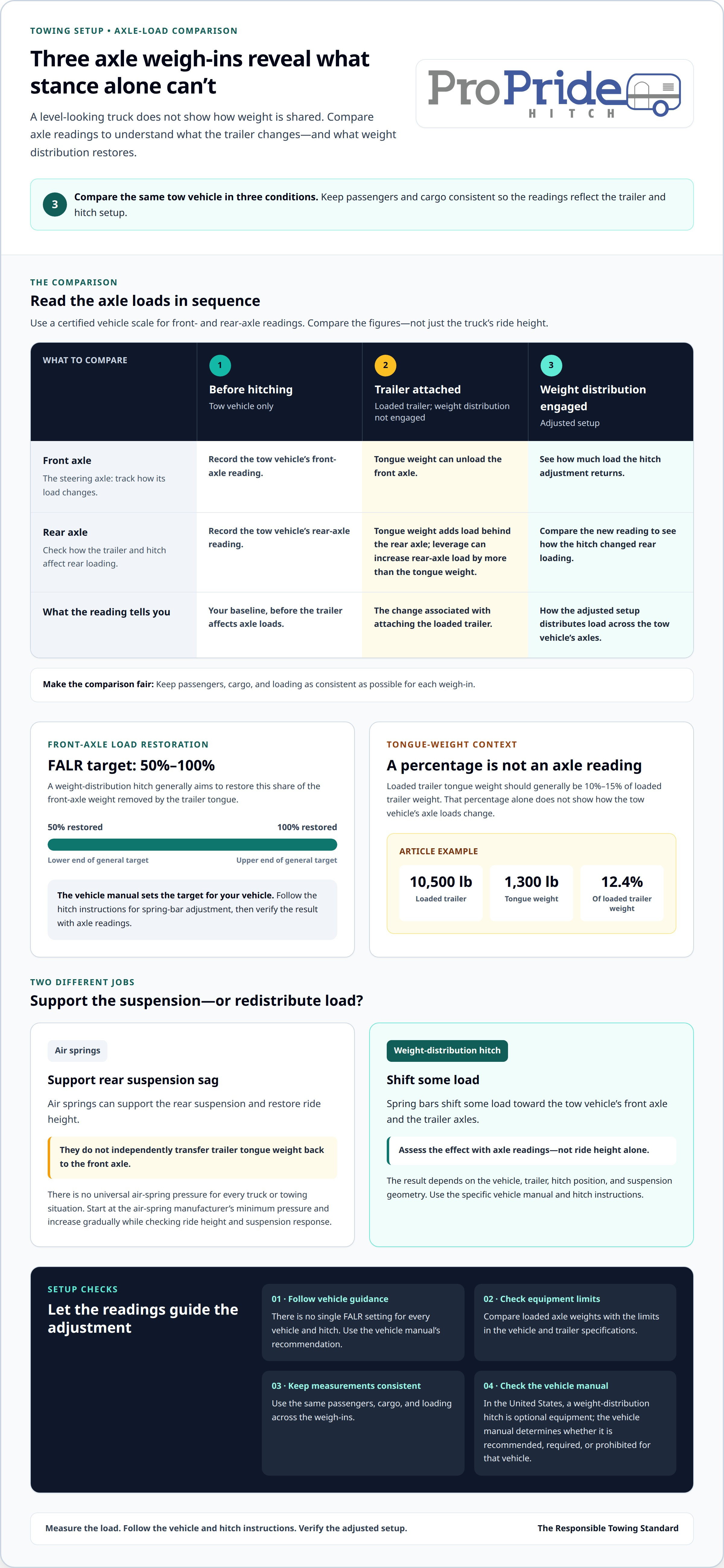
A truck that looks level can still have too little weight on its front axle. The importance of returning weight to the front axle is that trailer tongue weight can unload the steering axle, affecting steering precision, tire traction, and braking. A weight-distribution hitch uses spring bars to restore some of that load and transfer part of it toward the trailer axles. Front axle load restoration generally aims to return 50% to 100% of the weight the trailer removed, with the vehicle’s guidance helping determine the appropriate target.
When checking a towing setup, appearance alone isn’t enough: axle loads matter too. This article explains how tongue weight changes axle loads, how a weight-distribution hitch shifts some of that load, and why restoring front-axle weight supports predictable handling. You’ll also learn why rear suspension support may reduce sag without restoring front-axle load, and what to consider when assessing your setup. The goal is to understand the forces at work before you tow.
Key Takeaways
- Use measured axle loads, not a level-looking truck, to understand how your towing setup is carrying weight.
- Compare loaded axle weights with the limits in your vehicle and trailer specifications.
- Remember that air springs can support rear suspension sag, but they don’t transfer tongue weight back to the front axle on their own.
- Use your vehicle’s guidance to set front-axle load restoration, then assess how the hitch adjustment changes axle loads.
- Understand how a hitch’s sway-control design works alongside its weight-distribution function when choosing equipment for your towing needs.
How does a weight distribution hitch work?
A weight-distribution hitch uses spring bars to shift some load toward the tow vehicle’s front axle and the trailer axles. The importance of returning weight to the front axle comes from how tongue weight can reduce loading on the steering axle. That change can affect steering precision, front-tire traction, and braking. Adjusting the hitch helps manage how the combined vehicle and trailer load is carried.
Steering and braking with a light front axle
A lightly loaded front axle puts less weight on the front tires, which can reduce steering precision and traction. That matters because the front tires help guide the truck and contribute to braking.
When tongue weight presses down behind the rear axle, the front axle can lose load. With less front-tire grip, steering may feel less responsive during a correction. Returning weight to the front axle also matters for braking, since reduced front-axle loading can affect the traction available to the front tires. A weight-distribution hitch shifts some load forward and toward the trailer axles.
Front axle load restoration targets
Front axle load restoration, or FALR, measures how much weight a hitch returns to the tow vehicle’s front axle. A weight-distribution hitch generally aims to restore 50% to 100% of the weight removed by the trailer tongue. The vehicle manual provides the key recommendation for the specific vehicle and setup.
Too little restoration leaves more load removed from the steering axle; too much goes beyond the intended target. There’s no single setting for every vehicle and hitch. Follow the vehicle manual and hitch instructions, then assess the result with axle readings rather than relying on the truck’s appearance.
In the United States, a weight-distribution hitch is optional equipment, not a legal requirement. The vehicle owner’s manual determines whether it’s recommended, required, or prohibited for that vehicle.
Vehicle and hitch manufacturers’ instructions guide adjustment. The vehicle manual provides the front-axle return target, while the hitch instructions explain how to adjust the spring bars. Following both helps ensure the target and adjustment method suit your towing combination.
Compare front-axle readings before hitching, after hitching, and with weight distribution engaged. A certified vehicle scale can measure axle loads. For example, if attaching the loaded trailer reduces front-axle weight, a later reading shows how much the hitch adjustment restores. Keep passengers and cargo consistent so the comparison reflects the setup.
A level stance alone can’t show how weight is divided across the axles. Use the vehicle’s stated target and measured readings to assess the setup, rather than treating a general FALR range as universal.
Trailer tongue weight and axle load transfer
Tongue weight acts behind the tow vehicle’s rear axle, so its effect goes beyond adding weight at the hitch. Leverage can increase rear-axle load by more than the tongue weight while lifting some load from the front axle. The result depends on the truck’s wheelbase, hitch position, trailer load, and suspension geometry.
Consider an illustrative half-ton pickup with a 145-inch wheelbase and a hitch point 50 inches behind the rear axle.
This illustrates why tongue weight alone doesn’t describe the full change in axle loads. The hitch’s distance behind the axle and the tow vehicle’s wheelbase create leverage, so a different truck or hitch position can produce a different result. A weight-distribution hitch uses spring bars to shift some load toward the front axle and trailer axles, changing how the combined load is carried.
Loaded trailer tongue weight should generally fall within 10-15% of the loaded trailer weight. In the example, a 10,500-pound loaded trailer has 1,300 pounds of tongue weight, or 12.4% of its loaded weight. That percentage describes the trailer’s tongue weight; it doesn’t by itself show how the tow vehicle’s axle loads change.
Weight restoration varies among SUVs, pickup trucks, and trailer types because wheelbase, hitch position, trailer load, and suspension geometry affect load transfer. Use the specific vehicle’s manual and hitch instructions to guide the setup; don’t automatically apply one combination’s target to another.
To measure the change, weigh the tow vehicle by axle before hitching, then weigh it again with the loaded trailer attached. A certified vehicle scale can provide front- and rear-axle readings for both conditions. Keep passengers, cargo, and loading as consistent as possible so the comparison reflects the trailer and hitch, not a change in the truck’s load.
Compare the front-axle readings to see how much load the trailer removed. Then compare the rear-axle readings to see how the hitch changed that load. Weighing with the weight-distribution system engaged adds a useful third comparison: it shows how the adjusted setup distributes load across the tow vehicle’s axles.
Common mistakes when correcting sag
A level-looking truck doesn’t prove its axle loads are balanced. Air springs can support the rear suspension and restore ride height, but they don’t independently transfer trailer tongue weight back to the front axle. Relying on appearance alone can leave the front axle carrying less load than intended. Assess axle weights as well as the truck’s stance.
Another mistake is using air pressure to compensate for every change in load. There’s no universal air-spring pressure for every truck or towing situation. Start at the air-spring manufacturer’s minimum pressure, then increase it gradually while checking ride height and suspension response. More pressure generally increases resistance to compression; less pressure provides less supplemental support.
Reassess pressure when the truck’s use changes. If you switch between towing and unloaded driving, a setting suited to the trailer load may not suit the empty truck. Recheck pressure whenever the load changes, and observe whether the suspension responds as expected. Air springs can help maintain suspension travel and reduce the likelihood of bottoming out under load.
Don’t assume a suspension upgrade increases the vehicle’s rated capacity. Air suspension kits don’t increase GVWR, GAWR, payload capacity, or maximum towing capacity. GVWR is the vehicle’s gross vehicle weight rating; GAWR is the maximum rating for an individual axle. Compare measured axle loads with the vehicle’s ratings, even if added support raises the rear.
Skipping axle measurements is another common error. A level stance can hide an axle-load imbalance, so use a certified vehicle scale to measure the loaded setup. Compare front- and rear-axle readings with the vehicle’s ratings and loading guidance. If readings show an imbalance, redistributing cargo or moving heavy items may help address it.
Air springs also need physical inspection, not just pressure adjustment. Look for cracks, abrasion, unusual deformation, or contact with nearby suspension components. These conditions can affect how the springs support the rear suspension. Include an inspection when checking ride height, especially after changing air pressure or switching between towing and unloaded use.
Finally, don’t mistake reduced sag for corrected weight distribution. Adding air, for example, may raise a pickup’s rear while tongue weight still affects front-axle loading. Keep the goals separate: use suspension support to manage rear ride height, and axle measurements to understand load distribution. That distinction prevents a visual fix from being mistaken for a complete towing assessment.
Effects on rear-axle and trailer-axle loads
A weight-distribution hitch changes how the connected vehicle and trailer support their combined load. Spring-bar tension shifts part of the load away from the tow vehicle’s rear axle and toward its front axle and the trailer axles. It doesn’t make the combined load disappear. Each axle still carries weight, so assess how that weight is shared across the towing combination.
A Duramax 2500HD example shows why rear-axle readings deserve attention. Unloaded, the truck’s front axle weighed 4,840 pounds, and its rear axle weighed 3,120 pounds. With the trailer attached, the rear axle weight increased by 1,820 pounds. That change is specific to this measured setup, but it illustrates how the rear axle can take on a substantial share of trailer load.
The trailer axles carry their own portion of the load, too. In the same example, the attached trailer’s axles weighed 7,920 pounds. That reading describes the trailer-axle load, not the tow vehicle’s rear-axle load. Keeping those figures distinct helps show where weight is being carried and prevents one axle reading from being mistaken for the total towing load.
When a weight-distribution hitch is engaged, spring bars apply force through the hitch connection. This can move some load forward on the tow vehicle and back toward the trailer axles. The rear axle may then carry less than it did with the trailer attached and weight distribution disengaged. Actual readings matter because the shift depends on the vehicle, trailer, and adjustment.
Use axle readings to assess the whole combination, not just the truck’s stance. Compare the tow vehicle’s front- and rear-axle weights with its front and rear GAWR, the respective axle weight ratings. Also compare the vehicle’s total weight with its GVWR. Vehicle and trailer specifications provide the relevant limits and loading guidance.
Legal limits matter alongside mechanical balance. Legal weight limits may apply to axle loads and the vehicle while towing. A setup that looks level can still exceed an axle rating, so appearance alone can’t establish that the load is within limits. Use the applicable vehicle and trailer specifications to assess the measured figures.
Read each result as part of a set: tow-vehicle front axle, tow-vehicle rear axle, and trailer axles. If any axle exceeds its applicable rating, adjust the load before travel. Redistributing cargo may change axle loads, but the final assessment should account for every axle and the vehicle’s overall rating.
How much front axle weight should a weight-distribution hitch restore?
Front axle load restoration, or FALR, measures how much weight a hitch returns to the tow vehicle’s front axle. A weight-distribution hitch generally aims to restore 50-100% of the weight the trailer tongue removed. The right target depends on the vehicle’s guidance, so don’t treat the full range as a universal setting. Use the vehicle manual’s recommendation to establish the target for your towing setup.
That example illustrates the calculation, not a target for every vehicle. The measured amount removed is the starting point; the vehicle manufacturer’s instructions guide how much should be returned. Assess hitch adjustment against that target, not just by how level the truck appears.
Begin with comparable axle measurements. Record the tow vehicle’s front-axle weight before hitching, then measure it with the loaded trailer attached and weight distribution disengaged. The difference shows how much front-axle load the trailer removed. After engaging and adjusting the hitch according to its instructions, weigh again. Comparing the readings shows how much load the adjustment returned.
Too little restoration leaves more of the trailer’s effect on the front axle uncorrected. Too much goes beyond the vehicle’s intended target. Neither appearance nor spring-bar tension alone identifies the right result. Use the measured axle change and the vehicle manual together; the target should suit the specific tow vehicle and hitch combination.
Vehicle and hitch instructions serve different purposes. The vehicle manual provides the recommended front-axle return for that vehicle. The hitch manufacturer’s instructions explain how to adjust its equipment. Follow both: the hitch adjustment method can’t replace the vehicle’s target, and the target alone doesn’t explain how to set the hitch safely.
Keep passengers and cargo in the same arrangement during before-and-after measurements. If people or heavy items move between scale readings, the comparison may reflect those changes rather than the hitch adjustment. Record whether the trailer is loaded and whether the hitch is engaged for each reading. These details make the figures useful when reassessing the setup after a loading change.
Use the resulting axle readings to judge the adjustment, then compare them with the vehicle’s axle ratings. A 50-100% restoration range provides context, while the manufacturer’s recommendation determines the applicable target. The practical goal is a measured setup that follows the vehicle guidance, rather than a visual correction that leaves axle loads unexamined.
ProPride
ProPride gives responsible towers an option to consider when axle-load balance and trailer sway control are both part of the decision. The ProPride 3P Hitch uses patented Pivot Point Projection technology to address trailer sway. Weight distribution still needs to be assessed against your vehicle’s recommendations and measured axle loads; sway control doesn’t replace those checks.
If you’re comparing hitch designs after learning how tongue weight affects axle loads, consider whether the ProPride 3P Hitch fits your towing priorities. The right decision starts with understanding your vehicle, trailer, and loading needs. Contact ProPride to discuss the hitch and how its design relates to your towing setup.
Make your next towing decision with confidence
Before your next trip, treat your towing setup as a complete system, not a collection of separate fixes. The importance of returning weight to the front axle becomes practical when measured information guides decisions about loading and hitch adjustment. Keep a record of your loaded setup, and revisit it when your vehicle, trailer, or cargo changes.
That habit gives you a clearer basis for evaluating equipment and preparing for different towing demands. When considering how hitch design fits your priorities, focus on the specific combination you tow and the handling concerns you want to address. Thoughtful preparation is part of The Responsible Towing Standard.
Contact ProPride about your towing setup to discuss your towing needs and the ProPride 3P Hitch. A well-informed decision is a strong next step toward more confident travel.
Frequently Asked Questions
How can rear suspension sag affect front axle weight?
Rear suspension sag can signal that trailer tongue weight is pressing down behind the truck’s rear axle, but ride height alone can’t reveal the front axle’s load. Air springs may raise the rear suspension without returning weight to the steering axle. For a clearer comparison, keep passengers and cargo in the same positions when measuring the setup. A truck can look level while its axle loads remain uneven.
What does returning weight to the front axle mean when towing?
It means using a weight-distribution hitch to return some of the load that hitching the trailer removed from the tow vehicle’s front axle. Think of it as restoring part of the front axle’s pre-trailer load, not adding weight to the vehicle. This distinction matters when reviewing scale readings: compare the truck before hitching, after hitching, and with the hitch adjusted.
Why is restoring front axle weight important for steering and stability?
Front tires need traction to respond to steering inputs, and reduced front-axle loading can affect traction and steering precision. Balanced axle loading also helps reduce the risk of sway or fishtailing. If steering feels less precise after attaching a trailer, for example, don’t rely on a level stance as proof of proper loading. Assess axle loads and follow the vehicle guidance.
How do you adjust a weight-distribution hitch to return weight to the front axle?
Start with the tow vehicle and trailer loaded for travel, then follow the vehicle manual and hitch instructions. Compare the front axle’s loaded reading before and after engaging the hitch. Adjust the spring bars as directed, then recheck the axle readings. Change one setting at a time so you can identify its effect. Use the vehicle manufacturer’s recommended front-axle return as your target.
How does front axle weight restoration affect braking and tire traction?
Restoring some front-axle load can help the front tires maintain traction for steering and braking. More balanced axle loading can also help distribute braking forces more uniformly across the wheels. This doesn’t replace functional brakes or correct loading. If the trailer changes how the vehicle responds during braking, assess axle loads and the vehicle and trailer specifications rather than relying on appearance alone.