
The first step in figuring out how to stop porpoising when towing usually isn’t buying a new hitch. Treat repeated up-and-down bouncing as a reason to inspect your setup. It can make a routine drive uncomfortable and distracting, and replacing equipment before checking the basics may not address the cause.
Consider the whole combination: how the trailer is loaded, whether the hitch is set up correctly, the condition of the suspension, and how the road or driving conditions affect the bouncing. Porpoising is vertical movement; trailer sway is side-to-side motion. They’re different problems, even though some setup issues can contribute to both.
This guide walks through practical checks and safe adjustments to help you identify likely causes before driving again. It also explains where sway-control technology fits. The ProPride 3P Hitch uses patented Pivot Point Projection technology to address trailer sway, not as a proven cure for porpoising. Knowing the difference is part of The Responsible Towing Standard.
Key Takeaways
- To understand how to stop porpoising when towing, review the whole setup instead of assuming one part is at fault.
- Note when the bouncing happens, including road conditions, speed changes, cargo shifts, and hitch adjustments. These details can help narrow down possible causes.
- Before making changes, stop safely and check your vehicle and trailer manuals for the correct ratings and setup guidance.
- Change one thing at a time, then reassess cautiously so you can tell whether the adjustment helped.
- Choose hitch technology for the problem it is designed to address: sway control targets side-to-side motion, not vertical bouncing.
How to Recognize Trailer Porpoising and Respond Safely
Porpoising is repeated up-and-down pitching of a tow vehicle and trailer, with the combination continuing to bounce after an initial movement. The key clue is repetition: the tow vehicle and trailer seem to rise and fall in a continuing rhythm rather than reacting once to a pothole or dip. That pattern helps describe the movement, but it doesn’t identify the cause. Loading, setup, suspension, and the road can all affect how the combination responds.
Pay attention to the direction of movement. Porpoising is primarily vertical; sway is side-to-side movement of the trailer relative to the tow vehicle. A rough patch can cause a sharp jolt, while wind or passing traffic can create other sensations. Don’t assume every bump or vibration is porpoising, or treat vertical bouncing and sway as the same handling issue.
What does porpoising feel like while towing?
Repeated pitching can be felt throughout the combination. You may feel the tow vehicle’s front rise and dip as the trailer moves in sequence, or notice a series of vertical jolts through the seat and steering wheel. The motion can be uncomfortable and distracting, making it harder to focus on traffic and drive steadily.
Notice whether the movement repeats after the original road disturbance. A single bump followed by settling is different from a bounce that continues in a rhythm. The road may still be a factor, so note where it happens and whether it changes as the surface changes. These observations are clues, not a diagnosis. Don’t deliberately drive over rough spots to test the combination.
What should you do when bouncing starts?
Respond smoothly. Ease off the accelerator gradually, keep your steering inputs steady, and look for a safe place to pull over. Avoid abrupt braking or steering corrections, which can make a moving tow vehicle and trailer harder to manage. If stopping immediately would create a hazard, focus on maintaining control while proceeding carefully to a safer stopping place.
Once stopped safely, secure the vehicle before inspecting the combination. From a safe position, look for anything visibly loose, shifted, or damaged, and review the hitch connection and load. Don’t put yourself in traffic or beneath an unsupported vehicle or trailer. Don’t diagnose the cause while moving or adjust equipment at the roadside unless you can do so safely and follow its instructions.
If you’re researching how to stop porpoising when towing, start by noting what happened: the road surface, whether the bouncing continued, and any recent changes to cargo or setup. Check the combination before setting off again. If the motion persists or the rig doesn’t feel controlled, don’t assume a small adjustment has made it safe to continue. A careful pause is part of The Responsible Towing Standard.
What Causes Porpoising? Check the Whole Towing Combination
Repeated bouncing is a behavior of the whole tow vehicle and trailer combination, not proof that a particular component has failed. The trailer’s load, hitch setup, vehicle compatibility, suspension condition, and road surface can all influence how the rig responds. Look for patterns across these factors instead of treating the first suspected cause as certain.
Start with context. Did the motion begin after cargo was added or repositioned? Does it happen on one stretch of road, or continue across different surfaces? Did anything change in the hitch setup? Write down what you observe. A record can help distinguish a possible setup concern from a temporary trigger, such as a dip or uneven pavement, but it cannot confirm the cause on its own.
How can loading and weight distribution contribute?
Cargo placement affects how weight is carried by the trailer and transferred to the tow vehicle. Cargo that shifts during travel can also change how the combination responds. Compare the load with the guidance in the trailer and tow-vehicle manuals, and secure cargo as directed. Don’t rely on a generic target to judge a combination without checking the requirements for your equipment.
Compatibility matters, too. The trailer’s loaded weight and hitch arrangement need to suit the tow vehicle and the equipment being used. Review the ratings and setup instructions for the tow vehicle, trailer, and hitch. If the combination is outside a stated limit, changing cargo placement alone won’t address the mismatch.
How can hitch setup and road conditions affect the ride?
An incorrect hitch adjustment may contribute to poor ride behavior, although its effect depends on the combination. A weight-distribution hitch is intended to help manage how load is shared between the tow vehicle’s axles and the trailer; it must be set up according to its instructions. Sway control addresses side-to-side trailer movement, a separate concern from vertical bouncing. For example, the ProPride 3P sway-control hitch uses Pivot Point Projection technology for trailer sway, not as a verified porpoising cure.
Road conditions can trigger or intensify bouncing. A dip, a stretch of uneven pavement, or a change in surface may set the combination moving. A setup issue may make the motion more noticeable or persistent. Note whether the bouncing settles after the rough patch or continues on smoother pavement. If you’re investigating how to stop porpoising when towing, that distinction can help you decide what to inspect next, but it isn’t a diagnosis by itself.
Changing several variables at once makes it harder to tell which change affected the ride. Record the current load and hitch settings before making an adjustment, then change one factor at a time in line with the manuals. For broader vehicle-engineering context, SAE International is a professional association serving technical fields that include ground vehicles. For your specific setup, the vehicle, trailer, and hitch instructions are the practical reference.
How to Diagnose Porpoising Before Changing Equipment
A useful diagnosis begins with observations, not replacement parts. Compare what you feel with the conditions around it, then check the combination against the instructions and ratings for the tow vehicle, trailer, and hitch. The patterns below are possibilities to investigate, not diagnoses.
- Bouncing starts after cargo changes: Check whether the load is secured and placed according to the vehicle and trailer guidance. Note what changed, but don’t assume cargo is the only cause.
- The motion follows a hitch adjustment: Review hitch height, connection, and any weight-distribution settings against the hitch instructions. Confirm that each part is assembled and adjusted as directed.
- Bouncing occurs mainly on one stretch of road: A dip or uneven pavement may be triggering or intensifying the movement. Record the road and surface rather than deliberately repeating the route to test it.
- The ride feels unusual across different roads: Check the loaded combination against the stated ratings and look for visible tire or suspension damage or an unusual change in condition. A visual check can’t rule out a hidden mechanical problem.
Which setup details should you inspect first?
With the combination parked safely, check that cargo hasn’t shifted and is distributed according to the vehicle and trailer manuals. Review the hitch connection, height, and weight-distribution setup using the equipment instructions rather than copying another rig’s settings. Look over the tires and suspension for visible damage or a change from their normal condition. If anything appears damaged or loose, don’t treat a short test drive as a substitute for addressing it.
Before making changes, write down the current load, hitch settings, and recent adjustments. Compare the loaded trailer and tow vehicle with their stated ratings. Each component’s limits matter, and one rating doesn’t replace checking the others. For broader context on how a towed body interacts with its towing vehicle, the University of Tasmania’s Towed-body system dynamics and interaction examines the movement of connected systems. It offers background, but your equipment manuals guide your specific setup.
How can you distinguish setup issues from road-triggered bouncing?
Keep a simple log during normal trips. Note the road surface, whether speed changed, the load, hitch adjustments, and whether the movement settled after a rough patch or continued on other suitable roads. Don’t speed up, brake sharply, or seek out bumps to recreate the symptom. The aim is to compare ordinary conditions, not provoke the trailer.
If the cause remains unclear or the combination still feels unsettled, stop using it for travel until it can be assessed safely. Don’t continue towing when you’re unsure that the rig is safe. This measured process makes it easier to decide how to stop porpoising when towing without changing several things at once or mistaking a trigger for the underlying problem.
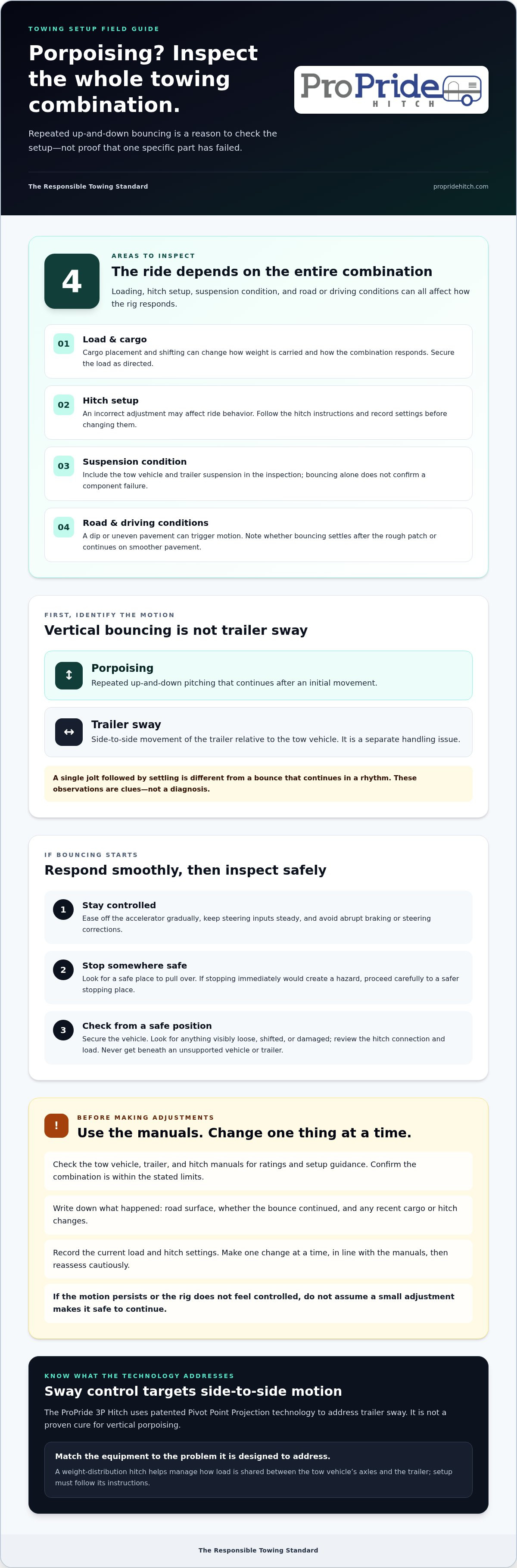
How to Reduce Porpoising: A Safe, Step-by-Step Checklist
Use a controlled process rather than trying several fixes at once. Your vehicle, trailer, and hitch manuals take priority over generic measurements or advice for a different combination. If you’re figuring out how to stop porpoising when towing, use each step to protect the rig and learn whether a specific change affects the ride.
- Stop safely. If bouncing feels severe or handling seems unstable, ease off gradually and pull over where it’s safe. Don’t inspect or adjust the combination while it’s moving.
- Inspect before adjusting. From a safe position, look for cargo that has shifted, a visibly loose connection, or apparent tire, hitch, or suspension damage. If a component looks damaged or something seems unsecured, don’t continue as though an adjustment has resolved it.
- Verify ratings and setup. Compare the loaded combination with the stated ratings for the tow vehicle, trailer, and hitch. Check that cargo placement, hitch height, connection, and any weight-distribution settings follow the instructions for your equipment. Don’t exceed ratings or rely on a measurement intended for a different setup.
- Make one deliberate change. If the manuals support an adjustment, change only that factor. For example, redistribute cargo only as the vehicle and trailer manufacturers allow, or correct a hitch setting according to its instructions. Avoid improvised modifications that may hide a symptom without addressing the setup.
- Document and reassess cautiously. Record what changed and how the combination behaves during ordinary, suitable driving conditions. Don’t accelerate, brake abruptly, or seek out rough pavement to test the result. If the bouncing remains, stop and review the whole setup rather than adding another untracked adjustment.
What adjustments can you make without guessing?
Make only changes supported by the manuals for your equipment. Cargo can be repositioned within manufacturer guidance, and hitch settings can be checked against the hitch instructions. A suspension change is not a shortcut for correcting a loading or compatibility concern. Note the original condition, the single adjustment, and the result. That record makes the next decision more informed.
When should you stop towing and seek help?
Stop if the rig feels unstable, the bouncing is severe, or a component appears damaged. If setup, suspension, or vehicle-trailer compatibility remains uncertain after reviewing the manuals, don’t keep towing on the assumption that the combination is safe. Persistent bouncing warrants a full review of the tow vehicle, trailer, load, and setup. That is a safer basis for decisions than replacing equipment based on an assumption.
If sway is also a concern, keep it separate from porpoising: the ProPride 3P Hitch uses Pivot Point Projection technology to address trailer sway, not as a proven cure for vertical bouncing. Knowing which problem you’re addressing is part of The Responsible Towing Standard.
Where Sway-Control Hitch Technology Fits, and What It Cannot Promise
Choose a hitch for the handling need it is designed to address, not as a shortcut around diagnosing an uncomfortable ride. A sway-control hitch targets trailer movement from side to side. It shouldn’t be treated as a cure for repeated vertical bouncing, and no hitch choice replaces checking loading, equipment ratings, compatibility, and setup.
The distinction is practical. If the trailer moves laterally relative to the tow vehicle, sway-control technology may be relevant to your towing priorities. If the main symptom is repeated rise-and-fall motion, focus first on the combination and its setup. Both movements can occur on the same trip, but that doesn’t make them the same problem or mean one solution will address both.
Does a sway-control hitch stop porpoising?
No. Don’t assume a system designed to manage side-to-side sway will eliminate vertical pitching. In plain terms, sway moves the trailer left and right; porpoising is repeated up-and-down movement. If the bouncing continues, return to the evidence: cargo placement, hitch setup, compatibility, suspension condition, and road conditions. A sway-control device can’t replace those checks.
This is why diagnosis should come before an equipment decision. Note which movement you’re trying to address and whether both are present. Don’t treat a product change as a test. Revisit the vehicle, trailer, and hitch instructions, and address any unresolved safety or setup concern before continuing to tow.
When is the ProPride 3P Hitch relevant to the decision?
The ProPride 3P Hitch is relevant when trailer sway is also a concern. Its patented Pivot Point Projection technology is designed to address sway by changing the trailer’s pivot point, not to fix vertical bouncing. The hitch is a sway-control consideration, not a substitute for correct loading, equipment compatibility, or setup.
If your review points to sway as a separate handling concern, learn more about the ProPride 3P Hitch and its sway-control design. Consider the technology for the problem it is designed to address. Keep investigating persistent porpoising through setup and inspection, and don’t continue towing if the combination feels unsafe or the cause remains unresolved.
The responsible choice matches the symptom. If you’re deciding how to stop porpoising when towing, a sway-control hitch alone isn’t a verified answer. Identify the movement, check the full combination, and make equipment decisions based on the need you’ve found. That clear distinction is central to The Responsible Towing Standard.
Make Your Next Towing Decision With Confidence
Use the time between trips to think about what you want from your towing setup. Consider the kind of travel you plan to do, the handling qualities that matter most, and what you want to understand before choosing equipment. A considered decision at home is easier than weighing options under pressure on the roadside.
If sway control is part of your equipment research, take a closer look at the ProPride 3P Hitch and decide whether its approach aligns with your priorities. Review the product information and consider how its sway-control design fits your towing needs.
Careful research is a meaningful investment in every trip ahead. Keep asking good questions and move forward with confidence.
Frequently Asked Questions
Can I keep towing if my trailer starts porpoising?
Don’t continue if the movement is severe or the rig no longer feels predictable. If you’ve stopped somewhere exposed to passing traffic, stay out of the roadway and avoid placing yourself between the tow vehicle and trailer. If an inspection can’t be done safely or you’re unsure whether it’s safe to move, don’t attempt to continue. Note what you observed once you’re safely parked, while the details are still clear.
Is porpoising the same as trailer sway?
No. Porpoising is vertical pitching; sway is side-to-side movement. If the motion is hard to identify, note where you notice it most, such as repeated lifting and dipping through the seat or lateral movement visible in the mirrors. Make those notes only after stopping safely, or ask a passenger to observe without distracting the driver. Describing the direction clearly can make later troubleshooting more focused.
Can cargo placement cause porpoising when towing?
It can contribute, so compare the load on a trip when bouncing occurs with how the trailer was packed on a trip when it rode normally. A simple packing checklist can highlight items added, removed, or stored in a different area, especially on the return journey. Use the trailer and vehicle manufacturers’ loading instructions to guide changes. Avoid moving cargo repeatedly without recording what changed and when.
Can driving too fast make trailer porpoising worse?
Speed may affect how the movement feels, but a change in speed alone can’t identify the cause. For a useful record, note the approximate speed when you first noticed the motion during ordinary driving, along with the road and traffic conditions. Don’t increase speed or make repeated speed changes to test the rig. A bounce that eases at a lower speed still deserves attention before you assume the setup is sound.
Will a weight-distribution hitch stop porpoising?
Not by itself, and it shouldn’t be treated as a guaranteed cure. A weight-distribution hitch must suit the combination and be adjusted as its manufacturer directs. If the instructions include a setup sequence or measurement points, follow those rather than borrowing another owner’s settings. When deciding how to stop porpoising when towing, base the next step on the complete setup, not on the hitch category alone.
Does the ProPride 3P Hitch eliminate porpoising?
No. The ProPride 3P Hitch is designed to eliminate trailer sway, not vertical bouncing. If you’re comparing hitch options, separate the handling goal you’ve identified from the product’s intended purpose, and review its information alongside your trailer and tow-vehicle requirements. Sway control may make sense if sway is also a concern, but it shouldn’t be used to explain away or mask persistent porpoising.