
The best hitch for full time RVers is the one that matches the trailer’s GVWR, tongue weight, coupler, and the tow vehicle’s capacity. Travel-trailer tongue weight is typically 10-15% of total trailer weight, and the hitch ball must match the coupler, commonly 2 inches or 2-5/16 inches. A hitch that fits physically still needs ratings suited to the loaded combination.
Choosing a hitch for full-time RV travel means balancing stability with the weight and fit limits of your setup. Assess the trailer and tow vehicle together, then choose a hitch type and rating suited to both.
Start by checking the trailer’s weight ratings, the hitch and ball ratings, sway-control needs, and the tow vehicle’s towing and payload limits. Before setting out, inspect the connections and components so your decision reflects the actual RV setup.
Key Takeaways
- Match the hitch and ball to the trailer’s loaded weight, tongue weight, coupler size, and required ball height.
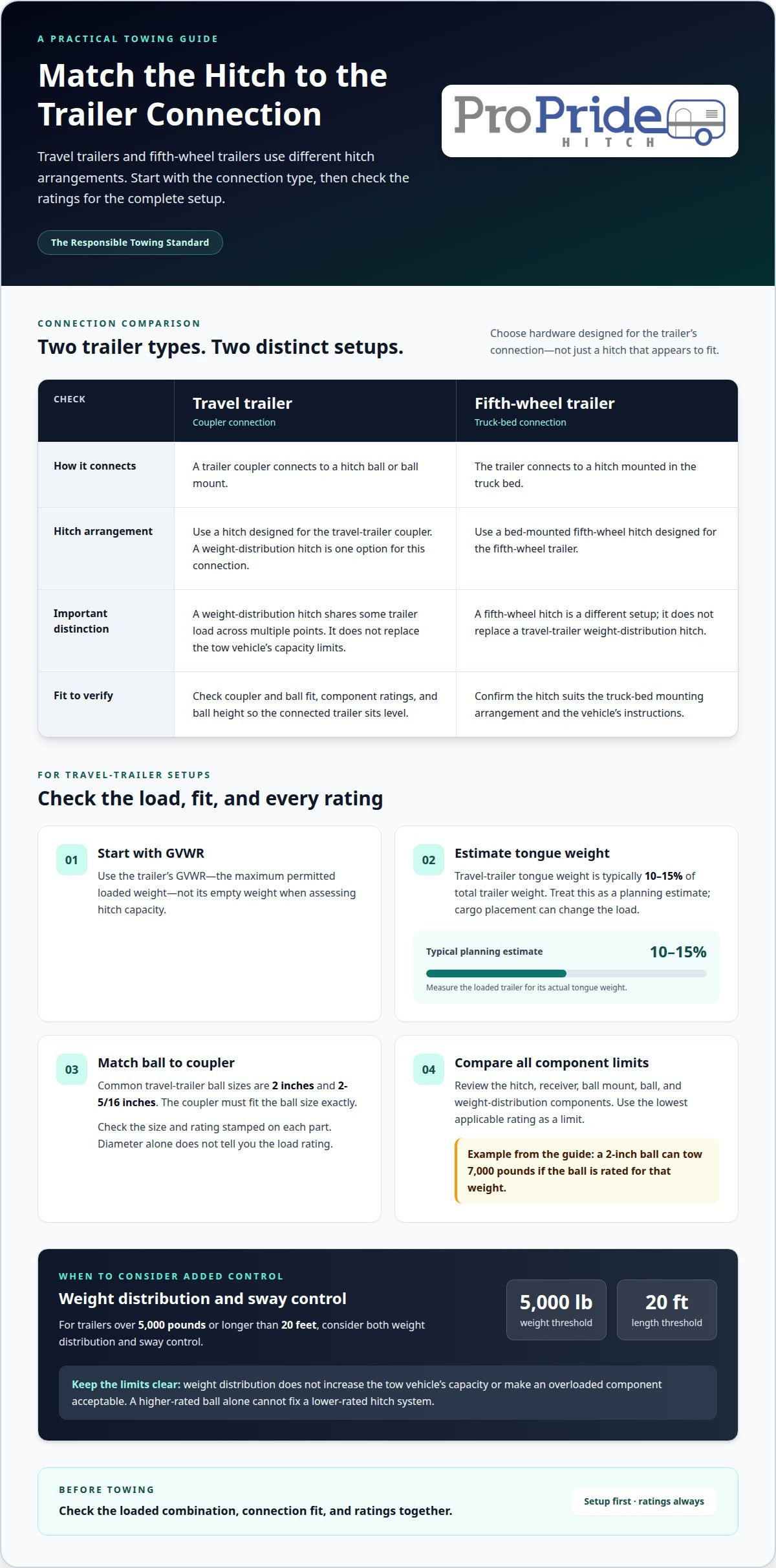
- Use the trailer’s GVWR, not its empty weight, when assessing hitch capacity.
- Consider how trailer length and weight distribution affect sway, then choose a control approach suited to your setup.
- Compare the tow vehicle’s maximum towing capacity with the trailer’s actual loaded weight before setting out.
- Learn how the ProPride 3P Hitch uses Pivot Point Projection to address trailer sway.
Choosing a hitch based on trailer type and weight
- Identify the trailer style before selecting hardware. A travel trailer uses a coupler that connects to a hitch ball, while other trailer designs may require different hitch arrangements. Record the trailer’s loaded weight and gross vehicle weight rating (GVWR), its maximum permitted loaded weight. For a travel trailer, match the hitch system to the actual trailer and tow vehicle, not appearance alone. That gives you a sound starting point for comparing trailer hitch and sway-control design.
- Use the trailer’s weight information to estimate tongue weight. Tongue weight is the downward force the coupler places on the hitch. Travel-trailer tongue weight is typically 10-15% of total trailer weight. Treat the calculation as a planning estimate, not a substitute for measuring the loaded trailer. Cargo placement can change the load at the hitch.
- Match the coupler to the hitch ball before towing. Common travel-trailer ball sizes are 2 inches and 2-5/16 inches, and the coupler must fit the ball size exactly. Check the size stamped on the coupler and ball, then compare their ratings. A correct diameter alone doesn’t establish that either component can handle the trailer’s load. Also set the ball at the height needed to keep the connected trailer level.
- With a short-bed truck, check cab clearance as well as receiver fit. The hitch must suit the truck’s bed geometry and the trailer’s turning needs. OEM puck systems and removable bed setups require a hitch designed for that mounting arrangement. Confirm the vehicle and hitch instructions describe a compatible configuration. A receiver rating alone does not establish bed or cab clearance.
- Account for the states on your route. U.S. state requirements can differ, so review current rules for each state, including any requirements for trailer brakes, lighting, safety chains, and breakaway equipment. Don’t assume one state’s rules apply throughout the trip. Keep the trailer and tow vehicle documents handy, and plan for the rules along your route.
- Plan around the complete setup, not just the hitch. Total costs vary with hitch type, capacity, vehicle mounting arrangement, and installation work. Consider parts and labor together when making your decision. For installation and upkeep, follow the hitch maker’s instructions, use the specified adjustment procedure, and inspect connections and visible components before travel. Loose fasteners, worn parts, incorrect ball fit, or poor loading can contribute to separation or loss of control.
Allow extra stopping distance when towing a trailer: stopping takes longer. Plan for that longer stopping time by leaving more distance ahead, rather than relying on the stopping distance used when driving without a trailer. The key point is simple: towing changes the stopping distance you should allow.
Hitch weight ratings and weight distribution
Compare the hitch’s rated capacity with the trailer load and the vehicle’s limits. Then decide whether weight distribution or sway control suits your travel-trailer setup.
-
Compare Bumper and Weight-Distribution Hitches
First, identify the trailer’s connection type. A travel trailer couples to a ball mount, while a fifth-wheel trailer connects to a hitch mounted in the truck bed. These are different setups, not interchangeable hitch styles. A fifth-wheel hitch does not replace a travel-trailer weight-distribution hitch. Choose a hitch designed for the trailer’s connection.
For a bumper-style receiver, confirm its rating and the ball mount it accepts. A standard 2-inch receiver is described for this setup, but that measurement alone doesn’t establish capacity. A weight-distribution hitch uses additional components to share some trailer load across multiple points, rather than relying only on the hitch ball. Don’t assume the receiver, ball mount, and distribution system share identical ratings.
-
Review Hitch Ratings and Weight Distribution
Next, compare every relevant rating, including the hitch’s capacity with and without weight distribution. A 2-inch hitch ball can tow 7,000 pounds if the ball is rated for that weight. The ball’s diameter does not establish its load rating. Read the rating for each connected component, then make sure the selected combination suits the trailer load.
Consider weight distribution and sway control for trailers over 5,000 pounds or longer than 20 feet. A weight-distribution hitch can help distribute trailer weight across multiple points instead of relying only on the ball. It doesn’t increase the tow vehicle’s capacity or make an overloaded component acceptable. Treat the lowest applicable rating as a limit, not a target to exceed.
For example, if the hitch system has a lower rating than the trailer’s loaded weight, choosing a higher-rated ball alone won’t fix the mismatch. Assess the complete connection, including the receiver and weight-distribution components.
-
Choose Weight-Distribution and Sway-Control Hitches
Choose a system based on trailer type, weight, length, and the vehicle’s hitch arrangement. For a travel trailer, a weight-distribution hitch shares load across multiple points, while sway-control features address trailer movement. The right combination is one whose ratings and design suit the entire towing setup, not just one feature.
Full-time RVers comparing fifth-wheel and travel-trailer setups should start with the trailer’s connection type: bed-mounted fifth-wheel hitches serve fifth-wheel trailers, while weight-distribution hitches are used with travel-trailer couplers. For travel trailers over 5,000 pounds or longer than 20 feet, consider both weight distribution and sway control. Explore this trailer sway-control hitch design as one option to understand how hitch design addresses sway.
Matching hitch class to trailer GVWR
- Start with the travel trailer’s GVWR, not its empty weight. GVWR is the maximum rated weight when the trailer is loaded. An empty trailer can weigh much less than one carrying water, supplies, and personal belongings. Choosing a hitch based only on the empty weight can leave too little capacity for the actual setup. Note the GVWR before comparing ratings. Choosing the best hitch for full time RVers starts with this rating, not a guess based on the trailer’s unloaded condition.
- Identify the receiver class fitted to the tow vehicle. Receiver hitches fall within Classes 1 through 5, but the class label alone doesn’t confirm suitability. Compare the specific hitch’s capacity with the trailer’s GVWR and the vehicle’s towing limit. The complete combination must stay within the lowest applicable rating. A higher class does not override a lower-rated vehicle or hitch component.
- Use Class 3 and Class 4 ratings as reference points, not automatic selections. A Class 3 hitch is listed as suitable for loads up to 8,000 pounds. Class 4 capacity is listed as 10,000-12,000 pounds. If a travel trailer’s GVWR falls near either range, compare its exact rating with the hitch’s specifications. Don’t choose a class solely because its headline capacity appears sufficient.
- Compare ratings across the full connection. Check the receiver, ball mount, hitch ball, and any weight-distribution equipment. Each component has its own rating, and the setup cannot safely exceed its limiting component. For example, a Class 4 receiver doesn’t make a lower-rated ball mount suitable for a heavier trailer. Record each rating together so one strong component doesn’t distract from a weaker link.
- Reassess the figures after loading for a trip. Cargo, water, and equipment can bring the trailer’s actual weight closer to its GVWR. Use GVWR when selecting a travel-trailer hitch, and consider actual loaded weight to understand the operating load. Keep both figures in your notes to check that the planned setup fits the ratings. The right hitch for full-time travel suits the rated setup, not just the trailer’s current light load.
- Make the final comparison before choosing a hitch class. Match the trailer’s GVWR to the hitch rating, then confirm the tow vehicle and every connecting component can handle the intended load. If a Class 3 capacity reaches 8,000 pounds, a trailer rated above that figure needs another suitable option, not an assumption that its lighter empty weight solves the mismatch. Apply the same careful comparison to Class 4’s 10,000-12,000-pound range.
Sway control hitches
For long-trip comfort, compare sway-control design, weight distribution, and adjustment requirements. These features can help manage trailer movement, but they don’t replace suitable loading and careful driving.
- Assess the trailer before choosing a sway-control approach. Consider sway control and weight distribution for trailers over 5,000 pounds or longer than 20 feet. Those thresholds help identify setups that merit closer attention, not automatic guarantees of a particular hitch choice. Note your trailer’s length, loaded condition, and how it behaves behind the tow vehicle.
- Compare weight distribution and sway control as separate functions. A weight-distribution hitch helps share trailer load across multiple points instead of relying only on the ball. Sway control is designed to help manage side-to-side trailer movement. Some systems combine both functions, so read the design details rather than assuming one feature does both jobs.
- Consider how the hitch manages movement between the trailer and tow vehicle. Friction-based sway control resists movement through friction; other designs use different mechanical approaches. Compare how each system connects, adjusts, and responds during turns. Focus on the mechanism and its fit for your trailer, not just the feature name.
- Treat chucking as a separate comfort concern. Chucking means fore-and-aft jolts felt through the tow vehicle and trailer, particularly as forces change during travel. Check how the hitch handles movement at the connection and follow its adjustment instructions. A sway-control label alone won’t tell you how much chucking or noise to expect.
- Consider the full towing setup when assessing comfort. Trailer loading, hitch adjustment, and the connection between trailer and vehicle all affect how movement feels. If noise or jolting starts after a change in cargo or adjustment, stop and inspect the setup before continuing. Look for loose connections or visible wear rather than assuming added noise is normal.
- Choose features around your travel pattern. A full-time RVer may encounter changing road surfaces, crosswinds, and repeated turns. Compare systems based on their sway-control method, weight-distribution function, and adjustment needs. A longer trailer, especially one over 20 feet, is a reason to evaluate these features carefully, not to rely on hitch type alone.
- Keep expectations grounded in what the hitch does. Sway-control and weight-distribution features can help manage movement and load, but they don’t replace proper loading or suitable vehicle capacity. Before a trip, confirm that the hitch is adjusted as instructed and the connection is secure. If handling changes, reassess the setup before increasing speed or continuing.
Tow vehicle capacity and gross trailer weight
Compare the loaded trailer with the tow vehicle’s maximum towing capacity. Follow the vehicle manufacturer’s recommendations and stay within that limit.
-
Check Tow-Vehicle Towing Capacity
Start with the tow vehicle manufacturer’s maximum towing recommendation. Record the limit, then compare it with the trailer’s gross weight for the planned trip. The trailer’s GVWR is its maximum rated loaded weight, while actual weight varies with cargo. Keep both figures clear: neither the hitch rating nor a higher-rated receiver raises the vehicle’s towing limit.
Next, account for how the RV will actually be used. Water, supplies, and personal gear add weight, so an empty-trailer figure doesn’t represent the full travel setup. If the load approaches the vehicle’s stated maximum, reduce cargo or choose a tow vehicle with suitable capacity. A hitch upgrade does not let you exceed manufacturer guidance.
For a full-time RV, repeat the comparison when the load changes. A new cargo arrangement can change the trailer’s gross weight, even if the trailer itself is unchanged. Keep a simple record of the vehicle limit, trailer GVWR, and expected loaded condition. These details make capacity checks more useful than relying on a model name or a past trip.
-
Match Hitch Ratings to Gross Trailer Weight
Compare the hitch rating with the trailer’s loaded weight and GVWR. The hitch must suit the intended load, and the tow vehicle must remain within its maximum towing recommendation. Account for every component in the connection. One component’s higher rating cannot make up for a lower rating elsewhere, and weight-distribution equipment does not increase vehicle capacity.
For example, if the trailer’s loaded weight is within the hitch rating but exceeds the tow vehicle’s stated limit, the combination still exceeds the vehicle recommendation. If the vehicle can tow the trailer but a hitch component has a lower rating, that component sets the limit. Compare the complete setup, not just the receiver label.
Use the trailer’s GVWR when selecting hitch capacity, then consider actual loaded weight to understand the trip load. Keep the values distinct: GVWR is a rating, not a measurement of the trailer on every outing. Recheck your calculations after adding substantial cargo or changing equipment. A careful match accounts for the vehicle, trailer, and every rated hitch component.
Use this capacity-first process before choosing a sway-control setup. For a hitch design intended to address trailer sway, review trailer sway-control hitch details alongside the towing limits you’ve recorded.
Use the vehicle manufacturer’s maximum towing-load recommendation as the final check; keep the planned towing load below it, even when other ratings allow more.
ProPride: ProPride 3P Hitch
The ProPride 3P Hitch uses patented Pivot Point Projection technology to completely eliminate trailer sway. Consider it when sway control is a central concern in choosing a travel-trailer hitch. As with any hitch, match the setup to your trailer and tow vehicle’s ratings; sway control doesn’t replace capacity checks.
For RVers who value careful preparation, this approach reflects The Responsible Towing Standard. Compare the hitch’s role with your trailer type, connection, and towing limits before deciding.
For a conversation about the ProPride 3P Hitch and your towing setup, contact ProPride.
Make your next towing decision with confidence
Your towing setup should fit the way you travel now and support thoughtful choices if your plans or equipment change. Before choosing, note the details that matter in day-to-day use, such as how often you move, where you travel, and what you carry. This practical picture helps clarify which trade-offs deserve attention.
The best hitch for full time RVers isn’t selected by a label alone. It’s a considered choice that connects your travel priorities with a setup suited to your trailer and tow vehicle. If sway control is part of that decision, take the next step by discussing your hitch needs with ProPride.
Contact ProPride about your hitch needs and move forward with a clearer plan for your travels.
Frequently Asked Questions
What types of hitches are best for full-time RVers towing a fifth wheel or travel trailer?
Choose a hitch built for the trailer’s connection: a fifth-wheel hitch mounts in the truck bed, while a travel trailer uses a receiver and ball. Full-time use makes routine setup and compatibility especially relevant. For example, a truck with an OEM puck system needs a hitch designed for that mounting arrangement. Travel-trailer owners who prioritize sway control can also compare designs that address sway through different mechanical approaches.
How do pin weight, tongue weight, and payload limits affect hitch selection?
Pin weight and tongue weight describe the downward load a trailer places on the tow vehicle. Pin weight applies to fifth wheels, while tongue weight applies to travel trailers. Both count against available payload, along with passengers and cargo in the truck. For example, adding a toolbox or travel supplies leaves less payload for the trailer’s hitch load. Choose a setup that fits the vehicle’s payload limit as well as its towing and hitch ratings.
How much do reliable RV hitches cost, including installation?
Costs vary with hitch type, capacity, vehicle mounting arrangement, and installation work.
How do you install, adjust, inspect, and maintain an RV hitch?
Follow the hitch maker’s instructions and adjustment procedure. Before travel, inspect connections and visible components for loose fasteners, worn parts, incorrect ball fit, and poor loading.