
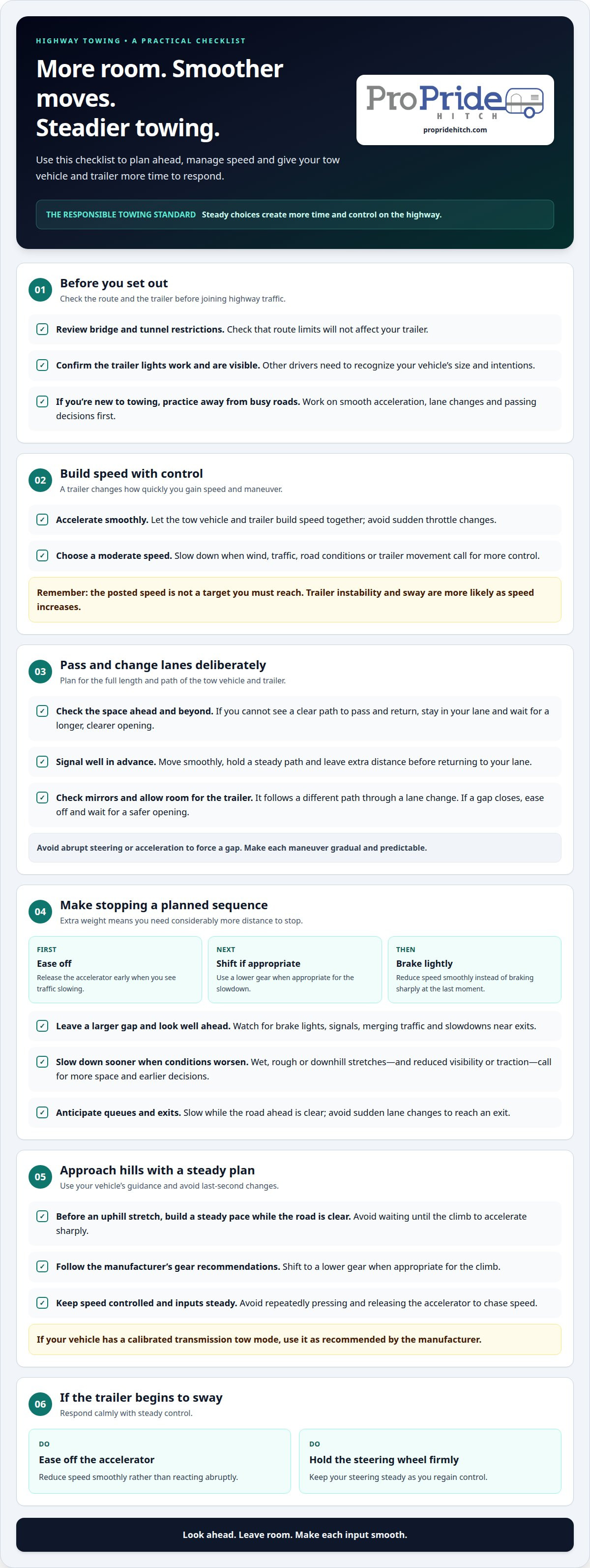
A trailer leaves less room for rushed decisions on the highway. Learning how to handle highway driving with a trailer safely means accelerating smoothly, signaling well before passing or changing lanes, leaving extra room before returning to your lane, and allowing considerably more distance to stop. Keep a moderate speed, use the driving gear recommended for your vehicle on grades, check bridge and tunnel restrictions before setting out, and respond to sway by easing off the accelerator and holding the steering wheel firmly.
It’s reasonable to feel more alert when traffic, wind, hills, and longer stopping distances all affect the same drive. The goal isn’t to rush through those conditions, but to make steady choices that give you more time and control.
This guide explains how to accelerate and pass with a trailer, brake and manage uphill and downhill stretches, plan a suitable route, and respond if the trailer begins to sway. You’ll also find practical guidance for rough roads and curves, so you can prepare for your next highway trip and make decisions with greater confidence.
Key Takeaways
- Build speed gradually, signal early before passing or changing lanes, and leave extra room before moving back in front of traffic.
- Plan for longer stopping distances by anticipating slowdowns and reducing speed smoothly.
- On hills, follow the vehicle manufacturer’s recommended gear guidance and avoid passing on steep grades.
- Before departure, review your route for bridge and tunnel restrictions that could affect your trailer.
- If sway starts, ease off the accelerator, hold the steering wheel firmly, and avoid using the tow vehicle’s brakes to control the trailer.
1. Acceleration and passing
A trailer changes how quickly your vehicle gains speed and how much room you need to maneuver. Accelerate smoothly, letting the tow vehicle and trailer build speed together instead of pressing hard on the accelerator. Sudden throttle changes can unsettle the combination, especially in close traffic or on uneven roads. A reliable way to handle highway driving with a trailer is to make every speed change gradual and predictable.
There isn’t one safe highway speed for every tow vehicle, trailer, and road condition. Travel at a moderate speed, since trailer instability and sway are more likely as speed increases. Slow down when wind, traffic, road conditions, or trailer movement call for more control. Don’t treat the posted speed as a target you must reach.
Before passing, assess the traffic ahead and the open space beyond the vehicle you intend to pass. A tow vehicle and trailer need extra room to accelerate and complete the maneuver. If you can’t see a clear path to pass and return, stay in your lane. Don’t use abrupt steering or acceleration to force a gap. Wait for a longer, clearer opening.
When passing is appropriate, signal well in advance so nearby drivers can see your intention. Move into the passing lane smoothly, hold a steady path, and leave extra distance before returning to your lane. Don’t cut in as soon as the tow vehicle clears the other vehicle. Make sure the trailer has room too, then signal and merge without a sharp steering correction.
Lane changes also take planning. Check your mirrors, signal early, and move gradually only when there’s enough room for the entire tow vehicle and trailer. The trailer follows a different path through a turn or lane change, so a quick correction can bring it too close to another vehicle. If traffic closes the gap before you can merge, ease off the accelerator and wait for a safer opening.
Before entering a highway, confirm that the trailer lights work and are visible. They help other drivers recognize your vehicle’s size and intentions, especially when you brake or change lanes. If you’re new to towing, practice smooth acceleration, lane changes, and passing decisions away from busy roads first. Never allow anyone to ride in or on the trailer. Deliberate preparation helps keep maneuvers controlled rather than reactive.
2. Braking and stopping distance
A tow vehicle pulling a trailer needs considerably more distance to stop than it does without one. The added weight means you should leave a larger gap ahead and begin slowing before traffic forces a hard response. For example, if brake lights appear several vehicles ahead, ease off the accelerator early instead of waiting for the vehicle directly in front to brake. That extra space gives you more time to respond smoothly.
Look beyond the nearest vehicle. Watch for brake lights, traffic signals, merging traffic, and vehicles slowing near exits. If traffic starts to bunch up, release the accelerator and let the combination lose speed gradually. Don’t close the gap while waiting for the lane to clear. A larger following distance also gives you room to respond if the vehicle ahead stops suddenly or changes lanes.
Plan each slowdown in stages. First, ease off the accelerator. Next, shift to a lower gear when appropriate. Then apply the brakes lightly to reduce speed. This sequence helps avoid abrupt braking and keeps speed changes deliberate. For example, as you approach a visible traffic queue, slow down before reaching it instead of braking sharply at the last moment. Smooth inputs matter because the trailer adds weight behind the tow vehicle.
Keep scanning as you approach intersections, work zones, toll areas, and highway exits. These places may require a sudden change in speed or direction. If you see a queue forming before an exit, start slowing while the road ahead is still clear. Don’t assume the driver behind you has noticed the trailer or will leave enough space. Brake steadily and avoid sudden lane changes to reach an exit.
Let road conditions determine how early you slow down. A wet, rough, or downhill stretch can make a late braking decision harder to manage. If visibility or traction worsens, reduce speed in advance and increase the space ahead. Avoid tailgating, even when surrounding traffic moves quickly. A close following distance leaves less room to brake smoothly, while a deliberate buffer helps you respond without a sudden steering correction.
Before a highway trip, learn how your tow vehicle and trailer respond to gentle braking in a safe practice area. Notice whether the combination slows evenly and the trailer feels stable. If slowing feels abrupt, leave more space and begin braking earlier next time. On the highway, keep a steady pace, look well ahead, and treat every visible slowdown as a reason to plan rather than react at the last moment.
3. Driving on upgrades and downgrades
A hill changes what the tow vehicle needs from its engine and transmission. Before an uphill stretch, build a steady pace while the road is clear instead of waiting until the climb to accelerate sharply. Follow the gear recommendations in your vehicle manufacturer’s instructions. They account for the vehicle’s design and help you select a gear suited to the load and slope.
As the road rises, keep your speed controlled and watch for signs the vehicle is straining, such as losing speed despite steady pressure on the accelerator. Shift to a lower gear when appropriate to help provide power for the climb. Avoid repeatedly pressing and releasing the accelerator to chase speed. A steady approach makes it easier to maintain control and respond to traffic ahead.
If your tow vehicle has a calibrated transmission tow mode, use it as recommended by the manufacturer. Tow mode adjusts transmission behavior for towing, though its operation varies by vehicle. Read the vehicle instructions before your trip so you know how to select the mode and when it applies. Don’t assume every vehicle has the same mode or that a button works identically across models.
Plan for the descent before reaching the crest. Once the trailer starts moving downhill, gravity adds to the load the tow vehicle must manage. When towing on a downgrade, downshift to help control speed, using the gear recommended for your vehicle. Select it before the vehicle gathers speed instead of relying on frequent hard braking after the descent begins.
During a long downgrade, keep your speed controlled and don’t let the combination accelerate unchecked. If your speed starts to increase, ease off the accelerator and use the lower gear to help manage the descent. Apply the brakes lightly when needed to reduce speed. Anticipate curves and traffic queues early, since a bend or stopped vehicle may require you to slow down more than the open slope does.
Passing is a poor choice on steep upgrades and downgrades. The tow vehicle may need its available power to climb, while a downhill pass can require extra speed control and room to return. Stay in your lane on a steep grade and wait until the road levels and the passing path is clear. Never force a pass through a limited opening.
Before traveling a route with sustained hills, review your tow vehicle manufacturer’s gear guidance and identify where climbs and descents begin. On an uphill stretch, use the recommended gear and tow mode, if equipped. Before a downhill stretch, slow down and select a suitable lower gear. These decisions are easier to make before the slope, while the road ahead still gives you room to adjust smoothly.
4. Route and restriction checks
Before departure, check your planned route for bridge and tunnel restrictions. A route suitable for a car may not work for a vehicle towing a trailer. Review the approaches as well as the crossing itself, since a restriction can affect your route before you reach the bridge or tunnel. If a restriction applies, choose an alternate route before setting out.
Prepare the vehicle and trailer by reviewing the manufacturers’ instructions, checking the loaded combination, and planning around applicable route restrictions. Before leaving, inspect the tires, lights, brakes, and hitch according to the relevant manufacturers’ guidance. These steps give you a clear starting point for highway travel.
For tire pressure, follow the guidance for your specific vehicle and trailer, and check each tire before the trip. Confirm that the lights work and that the trailer brakes and hitch connection function as described in their manufacturers’ instructions. Don’t rely on a quick glance at the trailer. Inspect each item directly.
Towing capacity and tongue-weight limits depend on the ratings for your specific tow vehicle and trailer. Compare those ratings with the loaded trailer weight and tongue weight, and keep both within the applicable manufacturer limits. Use your vehicle and trailer documentation to find the figures that apply to your combination.
Route planning should account for more than distance. Review the full drive for bridge and tunnel restrictions, then consider whether the route has narrow approaches or few places to turn around. For example, discovering a restriction near a tunnel entrance leaves fewer easy options than finding it during planning. Identify a practical alternate route so you can avoid a restricted crossing without making a rushed lane change.
Before leaving, use the same short inspection routine each time. Check tire pressure guidance and visible tire condition, test the lights, inspect the trailer brake setup, and confirm the hitch is connected as directed. Then review route restrictions once more. A consistent routine makes it easier to spot a failed light or an unexpected route limitation before highway traffic adds pressure.
Make route changes deliberately. If a sign or updated route information indicates a bridge or tunnel restriction, don’t continue toward the crossing while searching for an option. Slow down in good time, maintain a predictable path, and use your planned alternate route when safe. Careful equipment checks and route planning support controlled decisions before the trailer reaches a constrained section of road.
5. Trailer handling and sway
Keep highway speed moderate because trailer sway and instability are more likely as speed increases. Choose a pace that lets you respond smoothly to traffic, wind, and road changes. A gust or pressure change from a passing larger vehicle may start side-to-side movement. Don’t try to outrun it by accelerating. Smooth, measured control gives you more room to respond.
If wind or air pressure from a passing truck causes sway, release the accelerator, slow down, and hold the steering wheel firmly. Keep the tow vehicle pointed steadily along your lane. Avoid sudden steering corrections, which can add movement while the trailer is already swinging. Once speed drops, maintain a calm, steady course and let the trailer settle before returning to your usual pace.
Don’t use the tow vehicle’s brakes to control trailer sway. Braking with the tow vehicle generally makes sway worse, so avoid a hard pedal response when the trailer starts moving side to side. If excessive sway occurs and your setup has an electric trailer brake controller, activate it by hand. This applies the trailer brakes without relying on the tow vehicle’s brakes to address the sway.
Avoid abrupt inputs that can unsettle the combination. Start smoothly, avoid sudden stops, and steer gradually rather than making a sharp lane correction. For example, if traffic slows ahead, ease into the slowdown instead of braking hard at the last moment. Sudden starts, stops, and steering maneuvers can contribute to skidding, sliding, jackknifing, or sway. Look well ahead so a curve, queue, or lane change doesn’t catch you by surprise.
Adjust your pace for bumps, railroad crossings, and ditches. Slow down before reaching the rough surface, then keep the steering steady as the trailer crosses. Make wider turns at curves and corners so the trailer has room to track behind the tow vehicle. A tight turn can pull the trailer close to the inside edge, so check your path and don’t rush through the curve.
Use a steady routine whenever the trailer’s movement changes: ease off the accelerator, hold the wheel firmly, and avoid sudden steering or braking with the tow vehicle. If wind or a passing vehicle triggers sway, let speed fall before making another adjustment. On rough stretches and around curves, reduce speed ahead of time. These deliberate responses help you manage the trailer without adding abrupt movement.
ProPride: ProPride 3P Hitch
The ProPride 3P Hitch uses patented Pivot Point Projection technology to completely eliminate trailer sway. This design addresses sway at the hitch, making it a relevant option for drivers seeking a different approach to trailer stability on highway trips. It doesn’t replace careful driving: moderate speed, smooth inputs, route planning, and proper braking remain essential whenever you tow.
If you’re weighing hitch design as part of your towing setup, learn how the ProPride 3P Hitch works. Visit ProPride’s product page to explore the hitch and decide whether its approach fits your towing needs.
Make Your Next Tow a More Confident One
Knowing how to handle highway driving with a trailer is part of becoming a more deliberate, prepared driver. Carry that mindset into every trip: stay attentive, leave room for calm decisions, and learn from experience. Confidence comes from preparation, not from assuming every drive will unfold exactly as planned.
The Responsible Towing Standard starts with taking your decisions seriously, including how you assess your towing setup. If you’re considering your next step, take time to understand your options and choose with care.
For towing help, contact ProPride. Keep learning and move forward with care on every trip.
Frequently Asked Questions
How much following distance should I leave when towing a trailer?
Leave enough space to see beyond the vehicle directly ahead, not just its rear bumper. A large vehicle can block your view of a slowdown farther up the road. In dense traffic, don’t let repeated merges push you into following more closely than you can manage. If a truck or bus limits your view, create more room or change position when safe.
How do I safely change lanes and pass with a trailer?
Set your mirrors before departure so you can monitor the trailer’s sides and the lanes beside it. During a lane change, check that the trailer follows the tow vehicle’s path without nearing another vehicle or the lane edge. If passing, don’t stay beside the other vehicle longer than necessary. If traffic or road layout interrupts the maneuver, prioritize a safe return to your original lane.
How should I handle trailer sway and crosswinds on the highway?
Leave room around large vehicles and on exposed stretches where wind can affect your combination. If movement begins, focus on keeping the tow vehicle steady instead of chasing the trailer with repeated steering corrections. If the trailer still feels unstable after you’ve slowed, find a safe place to leave traffic and reassess before continuing. Don’t resume highway travel until the combination feels controlled.
How do I brake and descend hills safely while towing a trailer?
Before a long descent, consider where you could safely stop if traffic, visibility, or vehicle response becomes difficult to manage. Pay attention to the road surface and the shape of the grade, since a bend can limit how far ahead you can see. Don’t enter a downhill curve faster than you can comfortably control, and don’t let pressure from traffic behind dictate your pace.
What are the U.S. state laws for trailer speed limits, lane use, and required equipment?
There isn’t one answer that covers every U.S. state. Speed, lane-use, and equipment requirements may depend on the state and the vehicle-trailer combination. Before a multi-state trip, review the rules for each state on your route using its official transportation or motor vehicle agency information. Keep the route in mind when planning: a requirement can change at a state border, even when the road continues unchanged.
What should I do if a trailer tire blows out or the trailer becomes unstable?
After a tire failure or sudden instability, don’t inspect the trailer beside moving traffic. Once you reach a safe stopping place, secure the vehicle and assess the tire, wheel area, and trailer before deciding what to do next. If the trailer appears damaged or still feels unstable, don’t continue as though nothing happened. Protecting people takes priority over reaching your destination on schedule.