
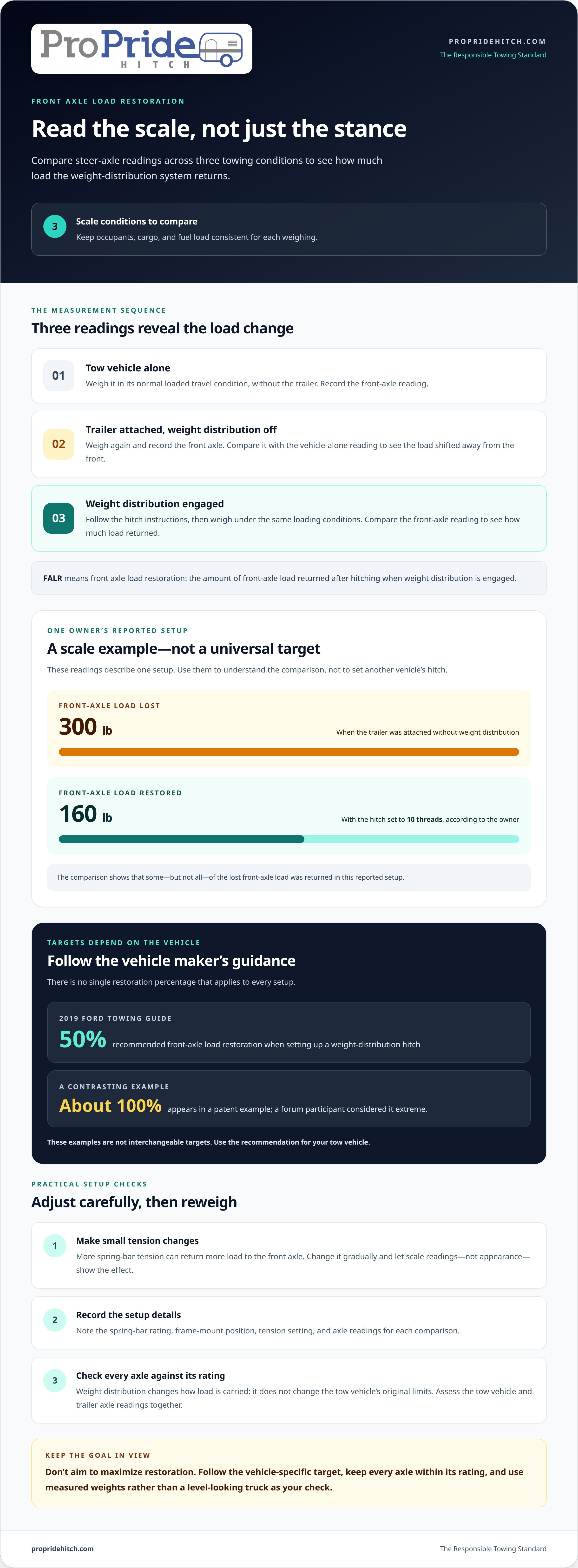
A truck can look level and still have too little load restored to its front axle. To check front axle load restoration, compare the steer-axle weight in three conditions: tow vehicle unloaded from the trailer, trailer attached with weight distribution off, and hitch adjusted with weight distribution engaged. The scale readings show how much load the hitch returns to the front axle.
Look beyond appearance: axle weights show what is happening even when the vehicle stance seems normal. Checking front axle load restoration also means following the tow vehicle’s recommended target, since no single percentage suits every setup.
This guide explains how to read scale results, assess hitch setup and spring-bar tension, and understand how weight distribution affects the tow vehicle’s front and rear axles and the trailer axles. Learning how to check front axle load restoration gives you a practical way to spot adjustments that need attention and tow with greater confidence.
Key Takeaways
- Compare steer-axle scale readings with the tow vehicle unloaded, hitched without weight distribution, and hitched with the system engaged.
- Use your vehicle’s recommended restoration target, then adjust spring-bar tension in small steps and reweigh to see the effect.
- Check spring-bar rating and setup alongside axle weights; a level-looking truck alone doesn’t show how the load is distributed.
- Confirm that the tow vehicle and trailer axles remain within their ratings, since weight distribution doesn’t change the vehicle’s original limits.
- For a hitch designed to address trailer sway, learn how the ProPride 3P Hitch uses Pivot Point Projection.
Spring-bar rating, length, and tension
A spring-bar rating describes the load a weight-distribution bar is designed to handle. Choose bars to suit the loaded trailer and hitch setup, not by appearance alone. An under-rated bar may not provide the needed force, while an overly stiff bar can make adjustment less controlled. Use the tow vehicle, trailer, and hitch manufacturers’ specifications to guide selection. The rating is one consideration, not a front-axle restoration target by itself.
Spring-bar length is the distance from the bar’s working connection to its frame attachment point. That distance affects leverage: changing the attachment point changes how much turning force the bar applies at a given tension. In one setup example, moving frame mounts 2 inches farther back was said to provide 7% more leverage at the same tension. Treat that as an illustration of leverage, not a universal adjustment formula; bar shape and hitch geometry also matter.
Spring-bar tension is the force applied through the bars to redistribute load from the tow vehicle’s rear axle. More tension can return more load to the front axle, but the scale result matters more than a visual impression. A 1/4 inch of spring compression has been described as a guideline, not a rigid limit. The correct setup depends on the vehicle’s stated target and the measured axle loads.
- Read the rating: Identify the bar’s rating and compare it with the hitch maker’s selection guidance and the loaded towing setup.
- Check the geometry: Note the frame-mount position and bar connection before changing anything. A 2-inch change can alter leverage.
- Adjust in small steps: Change tension gradually, then record the new setting and vehicle stance. Avoid treating a compression guideline as a required measurement.
- Reweigh: Use the same loading conditions for each comparison. The steer-axle reading shows whether the adjustment returned load to the front.
For a useful comparison, keep occupants, cargo, and fuel load consistent across weighings. Record the bar rating, mount position, and tension setting alongside each axle reading. If the front axle gains load while the rear axle loses some, the bars are transferring force through the hitch. Trailer axles may also gain load, so assess all axle readings together rather than judging the tow vehicle alone.
Some setups use hand force to tension spring-bar chains rather than a pry bar. That is not a universal method: hitch designs and instructions vary. Follow the instructions for your specific hitch, and never force a bar or chain into position. If a small tension change produces a large difference on the scale, pause and review the rating, attachment geometry, and setup sequence before towing.
Weight-distributing trailer hitch systems
A weight-distributing hitch uses spring bars to transfer some hitch load across the tow vehicle and trailer axles. The bars apply leverage through their frame attachments, changing the load carried by each axle. This transfer can return some load to the tow vehicle’s front axle after trailer tongue weight shifts load rearward.
Front axle load restoration, or FALR, is the amount of load returned to the front axle after hitching. The restoration percentage compares the front axle’s unloaded reading with its reading after hitching, then calculates how much of the lost load returns with weight distribution engaged. It describes load transfer, not the tow vehicle’s total capacity or a new rating.
There is no single restoration percentage that applies to every vehicle. The 2019 Ford towing guide recommends restoring 50% of the front axle load when setting up a weight-distribution hitch. A patent example describes about 100% restoration, while a forum participant considers that extreme. These figures illustrate why the vehicle maker’s guidance should direct the setup, rather than a universal target or a level-looking stance.
Scale readings make the adjustment measurable. One owner reported that attaching a trailer without weight distribution removed 300 lb from the tow vehicle’s front axle. With the hitch set to 10 threads, the owner reported restoring 160 lb. Those are measurements from one setup, not a target for another vehicle. Their value is the comparison: the engaged system returned some, but not all, of the lost front-axle load.
- Weigh the tow vehicle in its normal loaded travel condition, without the trailer, and record its front-axle reading.
- Attach the loaded trailer with weight distribution disengaged, then record the front-axle reading again.
- Engage the system according to its instructions and weigh the setup again under the same loading conditions.
- Compare the readings with the vehicle maker’s target, and adjust the system as instructed before reweighing.
Consider scale results alongside all axle loads. A weight-distributing hitch does not change the truck’s original ratings. Excessive force can transfer too much load toward the front and trailer axles, leaving too little on the rear axle. That balance matters on slippery surfaces, where reduced rear-axle load may affect stability. The goal is not to maximize restoration, but to follow the vehicle-specific target while keeping every axle within its rating.
Some setup advice suggests adjusting the bars until the truck’s rear returns to its unloaded height. This can serve as a visual reference, but it does not replace axle measurements or the vehicle maker’s guidance. Use the scale to confirm the effect of each adjustment rather than relying on appearance alone.
Axle-load compliance
To measure front and rear axle weights, place each axle group on a certified vehicle scale and record its reading. Weigh the tow vehicle alone, then weigh it with the trailer attached and the hitch adjusted. Keep passengers and cargo consistent.
Axle-load compliance means keeping measured axle loads within the applicable ratings for the tow vehicle and trailer. An axle rating is the maximum load assigned to that axle by its manufacturer. Check the vehicle’s certification label and owner’s manual, then compare each scale reading with the corresponding rating. A weight-distributing hitch can shift load, but it does not change the vehicle’s original ratings.
A practical scale record separates the steer axle, drive axle, and trailer axle-group readings. The steer axle is the front axle on a typical tow vehicle; the drive axle is the rear axle. Request individual axle readings instead of relying only on a combined vehicle weight. Take the same measurements with weight distribution disengaged and engaged to see how adjustment changes the load distribution.
- Record the tow vehicle alone: Capture front and rear axle readings with the normal travel load aboard.
- Measure hitched without distribution: Keep the trailer connected, but disengage the weight-distribution system as its instructions direct.
- Measure with distribution engaged: Record the front, rear, and trailer axle readings after setup.
- Compare each axle: Check every reading against the matching rating, not just the total vehicle weight.
One reported scale example shows why axle-by-axle readings matter. The tow vehicle’s steer axle weighed 3,600 lb, while its load axle weighed 3,170 lb. With the trailer attached, the load axle reading was 4,440 lb. These readings describe one setup, not universal limits. The key compliance check is whether the measured load at each axle remains within that axle’s own rating.
Front-axle restoration guidance can also vary by vehicle. For a 2010 Ford F-150, a poster reported that Ford requires 50% front axle load restoration. Treat that figure as specific to the reported vehicle, not as a target for every truck. Use the guidance applicable to your model, and compare it with scale readings rather than assuming the rear suspension’s appearance tells the full story.
Keep a dated record of the vehicle configuration, hitch adjustment, and each axle reading. Changes to cargo, passengers, or trailer loading can affect the measurements. Repeat the scale comparison after a meaningful loading change, and assess the front and rear axles alongside the trailer axles. One compliant reading does not establish that other axle groups are within their ratings.
Effects on tow-vehicle and trailer axles
Front axle load restoration returns some load to the tow vehicle’s front axle after the trailer shifts weight rearward. This can help preserve front-tire contact for steering and braking, while hitch adjustment also changes loads on the rear axle and trailer axles.
Front axle load is the weight carried by the tow vehicle’s front axle. If hitching reduces that load, steering response can change because the front tires carry less weight. Restoring some load helps recover the previous balance, but maximum restoration is not automatically the right goal. Follow the tow vehicle maker’s target and assess all axle readings.
Rear axle load is the weight carried by the tow vehicle’s rear axle. Trailer tongue weight adds load there, while spring-bar tension can transfer some load forward and toward the trailer axles. Too much transfer can leave too little load on the rear axle. That matters because the rear axle still supports the tow vehicle and contributes to its stability, especially when road grip is reduced.
Trailer axle load is the weight carried by the trailer’s axle group. Engaging a weight-distribution system can increase the load carried by those axles as force transfers through the spring bars. An improvement in front-axle load alone does not show whether the full setup is balanced. Compare the steer, drive, and trailer axle readings together.
A reported 2019 Ford Expedition Max example illustrates why ratings matter. Its rear axle weight rating was 4,380 lb, and its measured rear axle load while towing was 4,240 lb. That reading was 140 lb below the stated rating. It describes that particular loaded vehicle, not a target or safety margin for another Expedition or tow vehicle.
FALR matters for steering, braking, and stability because it shows whether the front axle regained load lost after hitching. It does not measure stopping distance or guarantee handling. Those depend on the entire combination, including axle loading, tires, brakes, road surface, and vehicle condition. Use restoration to evaluate load transfer, not as a standalone prediction of how the rig will behave.
Use this sequence to understand the effect on all axles:
- Record front and rear axle readings with the tow vehicle loaded for travel.
- Measure again with the trailer attached and weight distribution disengaged.
- Engage the system, then record the front, rear, and trailer axle readings.
- Compare each reading with its matching axle rating and the vehicle’s restoration guidance.
If front-axle load rises after adjustment, check what happened to both rear and trailer axle loads. If the rear axle approaches its rating, do not assume that adding tension is the answer. Follow the vehicle maker’s target and hitch instructions, then weigh again under the same loading conditions. Consistent measurements show whether the setup improved one axle by shifting too much load elsewhere.
Front axle load restoration (FALR) in towing
FALR compares front-axle load before towing with the load returned through hitch adjustment. A useful check combines consistent scale readings, vehicle-specific guidance, and attention to how each axle responds.
Measurements for Checking Restoration
FALR measurement uses three front-axle weights to show how much lost load the hitch returns. Record the tow vehicle’s front-axle weight when loaded for travel but unhitched. Then weigh it with the trailer attached and weight distribution disengaged, followed by another weighing with the system engaged and adjusted.
Subtract the hitched, disengaged reading from the unhitched reading to find the load removed from the front axle. Compare that difference with the load regained after engaging weight distribution. For example, if the unhitched front axle reads 3,600 lb and the hitched, disengaged reading is 3,500 lb, the lost load is 100 lb. A later reading of 3,525 lb means 25 lb returned, or 25% restoration.
Keep the tow vehicle’s passengers, cargo, and fuel consistent across all three readings. Also record the rear-axle and trailer-axle weights, because restoring front load changes the rest of the load distribution. A newer Chevrolet or GMC 2500HD owner’s manual recommends 25% front-axle load restoration. Use the guidance for the specific vehicle, rather than treating that example as universal.
Common Checking Mistakes
Common checking mistakes are measurement or interpretation errors that make an FALR result misleading. One frequent mistake is comparing scale readings taken with different occupants, cargo, or trailer loads. Another is relying only on the vehicle’s stance: a level-looking truck cannot show the actual weight carried by each axle.
Don’t confuse the restoration percentage with the percentage of the tow vehicle’s total weight. The calculation uses the front-axle load lost after hitching, then the portion of that loss returned by the hitch. A second error is assuming 100% restoration is always the correct target. Vehicle guidance differs, and excessive weight-distribution force can transfer too much load away from the tow vehicle’s rear axle.
Record whether each measurement was taken with weight distribution engaged or disengaged. Mixing these conditions can make a comparison misleading. Check all axle readings together, and use the vehicle’s own target to interpret the result.
Rechecking After Hitch or Cargo Changes
Rechecking means repeating the same axle-weight comparison after a change to the towing setup. Reweigh after changing hitch adjustment, spring-bar tension, or attachment position, since each can change the force transferred among axles.
Repeat the check when cargo or passenger loading changes substantially, or when the trailer’s load is rearranged. These changes affect tongue load and axle distribution, so an earlier FALR result may no longer describe the current setup. Keep the same three measurement conditions to make the new readings comparable.
Some systems use vehicle-height sensors or air-spring pressure transducers to help determine FALR. These measurements offer another view of load changes, but scale readings directly show axle weights. Recheck after setup or loading changes, then compare the result with the tow vehicle’s guidance and all axle ratings.
ProPride
ProPride offers the ProPride 3P Hitch for drivers weighing hitch design alongside axle-load setup. Its patented Pivot Point Projection technology is designed to help control trailer sway, addressing a separate but related towing concern: control of the trailer’s movement.
FALR readings still matter with any hitch setup. Use your vehicle’s guidance and axle weights to assess load distribution; consider the ProPride 3P Hitch when trailer sway control is also a priority. The Responsible Towing Standard starts with understanding what each measurement tells you and choosing equipment to match your towing needs.
For more information, contact ProPride about the ProPride 3P Hitch.
Make Your Next Tow More Deliberate
Turn your measurements into a repeatable baseline for the way you travel. Keep a simple record of the vehicle configuration and hitch settings alongside each weigh-in. If you change equipment or adjust the setup, the record gives you a clear point of comparison instead of relying on memory or appearance. Knowing how to check front axle load restoration helps you make informed decisions, but axle balance is only one part of a towing plan. Consider how the complete combination responds on the road, and address trailer sway as a separate control concern.
For drivers considering a hitch designed to manage sway, ProPride offers the ProPride 3P Hitch. Bring your setup questions and measured results into the next step of your research, and choose equipment with the full towing combination in mind. Ask ProPride about your towing setup. Careful preparation is a practical way to build confidence before your next trip.
Frequently Asked Questions
What is front axle load restoration, and how does it work?
Front axle load restoration describes how much front-axle weight a weight-distribution hitch returns after the trailer is connected. Understanding how to check front axle load restoration starts with recognizing that tongue weight can shift load toward the tow vehicle’s rear axle. Spring-bar force redistributes some load across the tow vehicle and trailer axles. Restoration measures this change, not a sway-control rating or a substitute for checking axle limits.
How do you calculate front axle load restoration percentage?
Divide the front-axle load returned by the load lost when hitching without weight distribution, then multiply by 100. Find the load lost by subtracting the hitched, distribution-off reading from the loaded, unhitched reading. Find the load returned by subtracting the distribution-off reading from the distribution-on reading. Use readings taken with the same occupants, cargo, and vehicle loading for a meaningful comparison.
What is the recommended front axle load restoration percentage for a weight-distribution hitch?
Use the target for your specific tow vehicle, because recommendations vary. The 2019 Ford towing guide recommends restoring 50% of the front-axle load when setting up a weight-distribution hitch, while a newer Chevrolet or GMC 2500HD owner’s manual recommends 25%. These examples are not interchangeable. Follow the guidance for your vehicle and evaluate the complete axle-load picture, rather than applying one percentage to every truck.
How do you adjust a weight-distribution hitch to restore front axle load?
When learning how to check front axle load restoration, use the tow vehicle’s target to guide each adjustment. Follow the hitch maker’s instructions, change spring-bar tension in small increments, then reweigh and compare the front-axle reading. Check rear and trailer axle readings too, since adjustment transfers load among them. Do not assume a level stance means the setup is correct: use measurements and stay within each axle’s rating.