
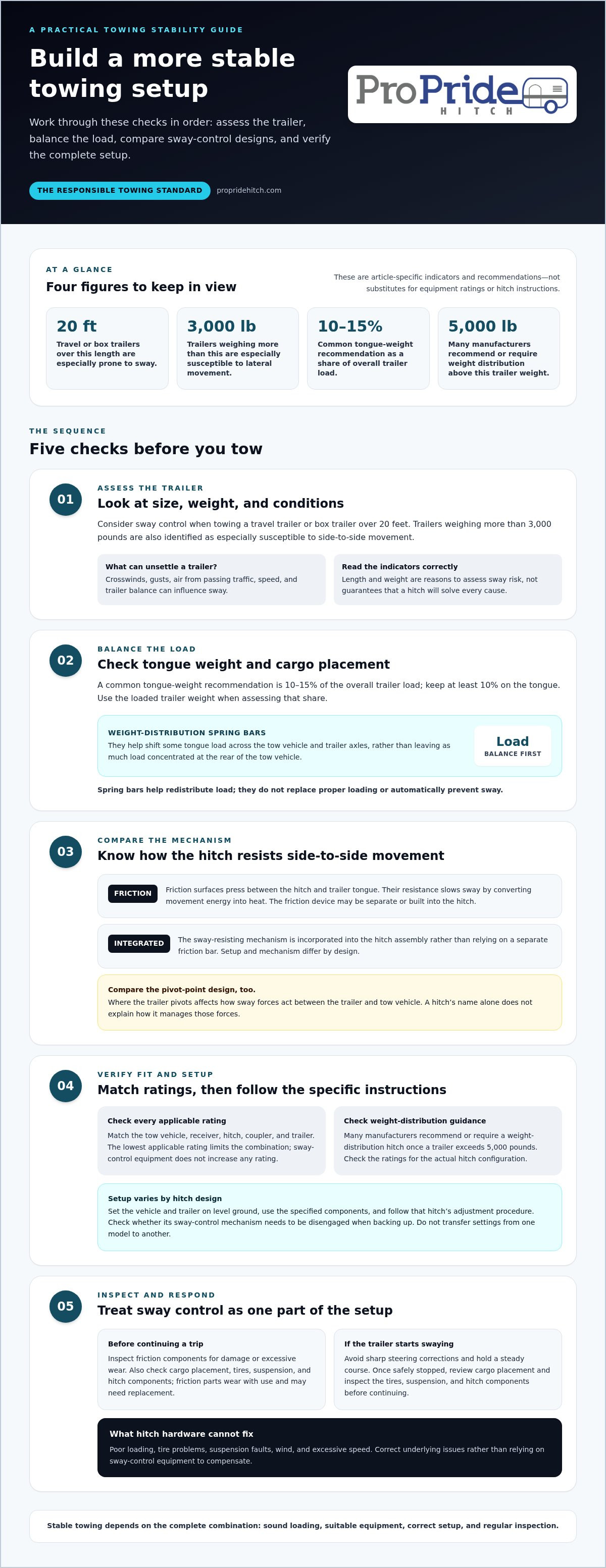
A sway-control hitch is recommended when a trailer is prone to moving side to side, especially travel trailers and box trailers over 20 feet long. Understanding how sway elimination hitches work helps explain why: different systems resist sway through friction, spring-bar linkages, or a change in the trailer’s effective pivot point. These systems can improve stability, but they don’t correct problems caused by poor loading, tires, or suspension.
If you’re concerned about trailer movement, take that concern seriously. Crosswinds and air from passing traffic can challenge a trailer’s stability. The right hitch depends on how it manages those forces, not just on its name.
This article explains when sway control is recommended, how weight distribution affects towing, and how mechanical systems differ. You’ll also learn why pivot-point design matters, what sway-control hitches can and can’t address, and how to think through the options before choosing a setup for your trailer.
Key Takeaways
- Travel trailers and box trailers over 20 feet are especially susceptible to side-to-side movement, so consider sway control when towing one.
- Friction-based systems resist sway through contact between the hitch and trailer tongue; inspect their components for wear over time.
- Weight-distribution spring bars help redistribute load, but proper trailer loading still matters for stable towing.
- A hitch’s pivot-point design affects how sway forces act between the trailer and tow vehicle, making it an important factor when comparing mechanical systems.
- Before choosing a setup, understand how its sway-control mechanism works and whether it needs to be disengaged when backing up.
When is a Sway Control Hitch Recommended?
A sway-control hitch is worth considering when a trailer is prone to side-to-side movement, especially a travel trailer or box trailer over 20 feet. Friction-based sway control presses friction surfaces between the hitch and trailer tongue. That resistance slows sway by converting movement energy into heat. It can help in crosswinds and air pushed by passing traffic, but it can't correct poor loading, tire problems, or suspension faults.
To see how a linkage-based system differs from friction control, watch this mechanical demonstration:
Friction sway control uses a separate friction device or friction components built into a hitch. Integrated sway control incorporates its sway-resisting mechanism into the hitch assembly, rather than relying on a separate friction bar. Both approaches resist trailer movement, but their mechanisms and setup differ.
Changing weather can make sway control more important. Crosswinds on an exposed road can push a trailer sideways, while gusts and air from passing traffic can unsettle it. Friction adds resistance, but it doesn’t make a trailer immune to wind. Secure cargo and distribute weight properly before departure; a hitch can’t compensate for poorly placed cargo.
Are sway-control hitches required by law in the United States? There isn’t one universal requirement for every trailer and tow-vehicle combination. Requirements can depend on the applicable jurisdiction and equipment, so a sway-control hitch doesn’t replace following the rules that apply to your trip.
To install and adjust a sway-control hitch, follow the instructions for that specific hitch and tow vehicle. Set the trailer and vehicle on level ground, attach the specified components, and use the manufacturer’s adjustment procedure. Setup varies by hitch design, so don’t transfer settings from one model to another.
Match the ratings of the tow vehicle, receiver, hitch, coupler, and trailer when choosing equipment. The lowest applicable rating limits the combination; sway-control equipment doesn’t increase any rating. Compare the loaded trailer’s weight with vehicle and hitch capacities, including the cargo you plan to carry.
If the trailer starts swaying, avoid sharp steering corrections. Industry safety guidelines advise holding a steady course rather than trying to compensate for sway. Once safely stopped, review cargo placement and inspect the tires, suspension, and hitch components before continuing.
Friction components wear with use and need inspection and occasional replacement. Check for damage or excessive wear, especially after frequent towing or changing road conditions. Sway control is one part of a stable towing setup, not a fix for mechanical problems or unsafe loading.
Do weight distribution hitches help with trailer sway?
Yes. A weight-distribution hitch can support towing stability by shifting some tongue load across the tow vehicle and trailer axles. Its spring bars help manage load balance, while a sway-control mechanism addresses side-to-side movement.
Spring Bars and Tongue Weight
Spring bars act as levers: they lift at the coupling point and press down on the tow vehicle’s front and the trailer’s rear. This redistributes some tongue load, helping balance the combination rather than leaving as much load concentrated at the rear of the tow vehicle. A common tongue-weight recommendation is 10-15% of the overall trailer load, and trailer owners should keep at least 10% on the tongue. Use the loaded trailer weight when assessing that share.
Sway Causes and Control Limits
Trailer sway is side-to-side movement that can be influenced by wind, speed, loading, and the trailer’s balance. Travel trailers and box trailers weighing more than 3,000 pounds are especially susceptible to lateral movement. Sway control can resist movement, but it can’t correct improper loading or make a combination immune to wind or excessive speed. Balance the load before relying on hitch hardware to help manage sway.
Spring bars and sway-control components serve related but distinct purposes. Bars help redistribute load; a sway-control mechanism resists lateral movement between the tow vehicle and trailer. Some designs use friction, while others use mechanical linkages. Parts vary by hitch, but a setup may include a receiver-mounted hitch head, spring bars, brackets, and a sway-control mechanism.
Many manufacturers recommend or require a weight-distribution hitch once a trailer exceeds 5,000 lbs. That threshold isn’t a substitute for checking the ratings for the tow vehicle, receiver, hitch, and trailer. Use the rating that applies to the actual hitch configuration.
Weight distribution alone doesn’t necessarily prevent trailer sway. It improves load balance, while sway-control features address lateral movement through resistance or mechanical action. Adding equipment without correcting the cause of sway can leave the underlying problem in place. Check cargo placement, tongue weight, and equipment ratings as part of the same towing assessment.
Fifth-wheel and gooseneck trailers are different: their connection sits over or ahead of the tow vehicle’s rear axle, providing inherent stability. Weight-distribution hitches aren’t compatible with those trailer types. For a travel trailer, match the hitch design to the trailer and vehicle, then follow that hitch’s instructions for setup and adjustment. The right combination supports stable towing; sound loading remains essential.
Moving the pivot point behind the vehicle axle
A conventional travel trailer pivots at the hitch behind the tow vehicle’s rear axle. That distance matters: when a trailer turns or shifts sideways, movement at the hitch can affect the tow vehicle’s direction. Imagine a passing truck pushing a trailer sideways. The force acts through the connection behind the axle, where it can encourage the trailer to swing. A geometric pivot-point system changes how that movement transfers between trailer and tow vehicle.
Pivot-point projection systems use a linkage to move the effective pivot point forward, closer to the tow vehicle’s rear axle. The physical hitch remains at the back of the vehicle, but the linkage changes the trailer’s turning geometry. This makes the trailer’s sideways movement less able to steer the tow vehicle through the rear connection. That’s why pivot-point projection works differently from friction, which resists movement at contact surfaces.
Consider passing a semi-truck on an open highway. With a conventional pivot, a gust may push the trailer’s rear outward, creating movement around the hitch connection. A forward-projected pivot changes that leverage and helps prevent sway from developing. It doesn’t change the wind or the trailer’s load; it changes how the hitch geometry responds to those forces.
Fifth-wheel and gooseneck trailers show why pivot location matters. Their pivot point is directly over or in front of the tow vehicle’s rear axle, which provides inherent stability. A travel trailer’s hitch sits behind that axle, so a mechanical linkage can project its effective pivot forward. The physical layouts differ, but both place the pivot nearer the axle than a conventional travel-trailer connection.
When comparing trailer pivot systems, focus on what the linkage changes, not how many parts it uses. A friction device slows movement; a geometric system changes the pivot relationship between trailer and tow vehicle. Consider how the design responds to sideways forces from crosswinds or passing traffic, and how its linkage moves as the trailer turns. These details show whether the mechanism resists sway at contact surfaces or changes the leverage that can initiate it.
Pivot-point design is only one part of stable towing. Load the trailer properly, use compatible equipment, and follow the hitch maker’s setup instructions. A forward-projected pivot can’t correct an unbalanced load or a tire problem. Understanding the geometry helps explain how mechanical sway-control systems differ and why the connection point matters when a trailer moves sideways.
How weight distribution affects sway and vehicle stability
A trailer’s load affects how the tow vehicle responds to steering and road forces. Weight distribution matters because an imbalanced combination can feel less composed, especially during lane changes or on uneven roads.
Weight Distribution and Vehicle Stability
A properly adjusted weight-distribution setup helps balance load across the tow vehicle’s axles and the trailer. This can reduce rear-end squat and help the vehicle maintain a more controlled stance. If the rear sits noticeably lower after coupling, pay attention to whether steering feels lighter or less precise. These changes can signal that the combination needs a closer setup review.
Assess the vehicle and trailer together, not as separate pieces of equipment. Compare the tow vehicle’s stance before and after hitching, then note how it tracks on a straight, level road. If ordinary steering feels different, review the setup before a longer trip. Use the hitch maker’s adjustment guidance rather than changing settings by guesswork.
Reducing Sway Through Weight Distribution
A weight-distribution hitch can support stability by helping the tow vehicle and trailer carry their connected load more evenly. It doesn’t eliminate every force that can start sway. A sway-control mechanism addresses lateral movement, while balanced loading and suitable equipment help reduce other contributing factors.
Consider a highway lane change: the tow vehicle changes direction, and the trailer follows through the hitch connection. If the combination is poorly balanced, the trailer may respond less predictably. Weight distribution can improve the overall balance between vehicle and trailer, but it can’t compensate for shifting cargo or a mechanical fault.
Before departure, inspect the cargo and secure heavy items. If the vehicle’s rear settles sharply, the front feels unusually light, or the trailer wanders during normal travel, stop and reassess the setup safely. Review the loaded combination, hitch adjustment, and equipment ratings together. A weight-distribution hitch isn’t a cure for every stability concern.
Road conditions still matter. Crosswinds, uneven pavement, and passing traffic can challenge a trailer even when the tow vehicle sits level. Weight distribution supports vehicle balance; sway control addresses a different part of the problem. A responsible setup considers both functions alongside secure cargo and well-maintained equipment.
Hitch type also matters when choosing equipment. Fifth-wheel and gooseneck trailers generally don’t need sway control because their pivot point is directly over or in front of the tow vehicle’s rear axle, providing inherent stability. Weight-distribution hitches aren’t compatible with these trailers, so their setup differs from a conventional travel trailer’s. Match equipment to the trailer and hitch arrangement rather than assuming one stability option fits every combination.
Cost can help frame equipment choices, but it shouldn’t replace checking compatibility or following the manufacturer’s guidance. Compare equipment categories and choose products suited to your trailer and intended use. A suitable setup still depends on secure loading, correct adjustment, and sound components.
Mechanical sway elimination
Mechanical sway-control designs use moving parts to influence how a trailer responds to side-to-side forces. One example is cam-and-lever control, which uses spring bars and cam brackets to twist and realign the trailer as sway begins. Its operation depends on how those components interact, not simply on friction between hitch surfaces.
That action differs from weight distribution. A spring bar can help manage load, while a cam-and-lever arrangement uses the bar and brackets to respond to trailer movement. The same component may contribute to both functions, depending on the hitch’s design and adjustment. Read the equipment instructions to understand each part’s role in your setup.
Mechanical response also needs to allow normal turns. A trailer must articulate behind the tow vehicle as the driver steers, so sway control must work without preventing ordinary cornering. In a campground turn, for example, the trailer follows a curve rather than tracking directly behind the vehicle. The hitch design determines how its linked parts respond.
When comparing systems, identify what each mechanism is designed to do. Does it resist movement through contact, use spring bars and cam brackets to realign the trailer, or coordinate movement through a linkage? These differences matter because “mechanical sway control” describes a category, not one uniform design. Match the mechanism to your trailer and towing needs, then follow its maker’s setup guidance.
Use the hitch instructions as a practical reference before travel. Identify which parts connect the trailer to the tow vehicle, which move during a turn, and which adjustments affect sway control. If a component is unclear, consult the model-specific diagrams rather than assuming another hitch works the same way. Design details affect operation.
Mechanical control has limits. It can’t correct shifting cargo, a tire issue, or an unsuitable tow-vehicle and trailer combination. If the trailer behaves differently after loading or a repair, assess those conditions instead of changing hitch settings at random. A mechanical system works as designed only as part of a properly prepared towing setup.
Finally, distinguish the hitch’s job from the driver’s response. Control components affect how forces pass through the connection, but attentive driving is still essential. If movement develops, avoid abrupt steering, find a safe place to stop, and review the trailer and towing equipment before continuing.
ProPride: ProPride 3P Hitch
The ProPride 3P Hitch is designed for travel-trailer owners considering a mechanical sway-control approach. Its safety-focused design reflects The Responsible Towing Standard, supporting informed decisions about towing equipment and preparation.
As you evaluate your setup, consider how you use your trailer and whether this hitch aligns with your towing needs. The ProPride 3P Hitch is one option to explore as part of that decision.
Make Your Next Towing Decision with Confidence
Before your next trip, treat hitch selection as part of a complete towing plan, not a stand-alone purchase. Consider how you use your trailer, the conditions you encounter, and what you’ve noticed behind the wheel. That gives you a clearer basis for choosing a sway-control approach.
Knowing how sway elimination hitches work can help you ask better questions and compare designs by their mechanical principles, not just their labels. Pair that understanding with careful preparation and attention to your full towing setup. Responsible decisions start before you reach the road.
If you’re considering a mechanical sway-control approach for your travel trailer, contact ProPride about sway control. Take the next step with care, and build a towing setup you can approach with greater confidence.
Frequently Asked Questions
How do spring bars work for weight distribution?
Spring bars use leverage to help distribute tongue load across the tow vehicle and trailer axles. After loading camping gear, compare the vehicle’s stance before and after hitching; noticeable rear settling may signal that the setup needs attention. Assess the combination with the trailer loaded for travel, and adjust the bars only according to the hitch maker’s instructions. Spring bars don’t replace balanced cargo placement.
Will this help with wind and passing trucks?
Yes, sway control can help manage sideways forces from crosswinds and air pushed by passing trucks, but it can’t remove those forces or correct unsafe speed and poor loading. If movement starts, hold a steady course and avoid abrupt steering. If the combination feels difficult to control, find a safe place to stop. Before continuing, reassess cargo placement and the towing setup.
How does a sway elimination hitch work?
A mechanical sway-elimination hitch changes how lateral forces travel through the trailer connection. In the ProPride 3P Hitch, patented Pivot Point Projection uses a linkage to move the effective pivot forward. During a turn, the system’s single-directional action shifts the effective pivot to the hitch ball under turning force from the tow vehicle, allowing the driver to control the turn.
What are the risks and limitations of sway control hitches?
Sway control can’t correct poor loading, incompatible equipment ratings, or tire and suspension problems. Components can wear or need adjustment, so follow the hitch maker’s inspection instructions. Some sway-control designs must be disengaged before backing; learn your system’s procedure before maneuvering in a tight campsite. Treat the hitch as one part of the towing setup, not a substitute for sound preparation.