
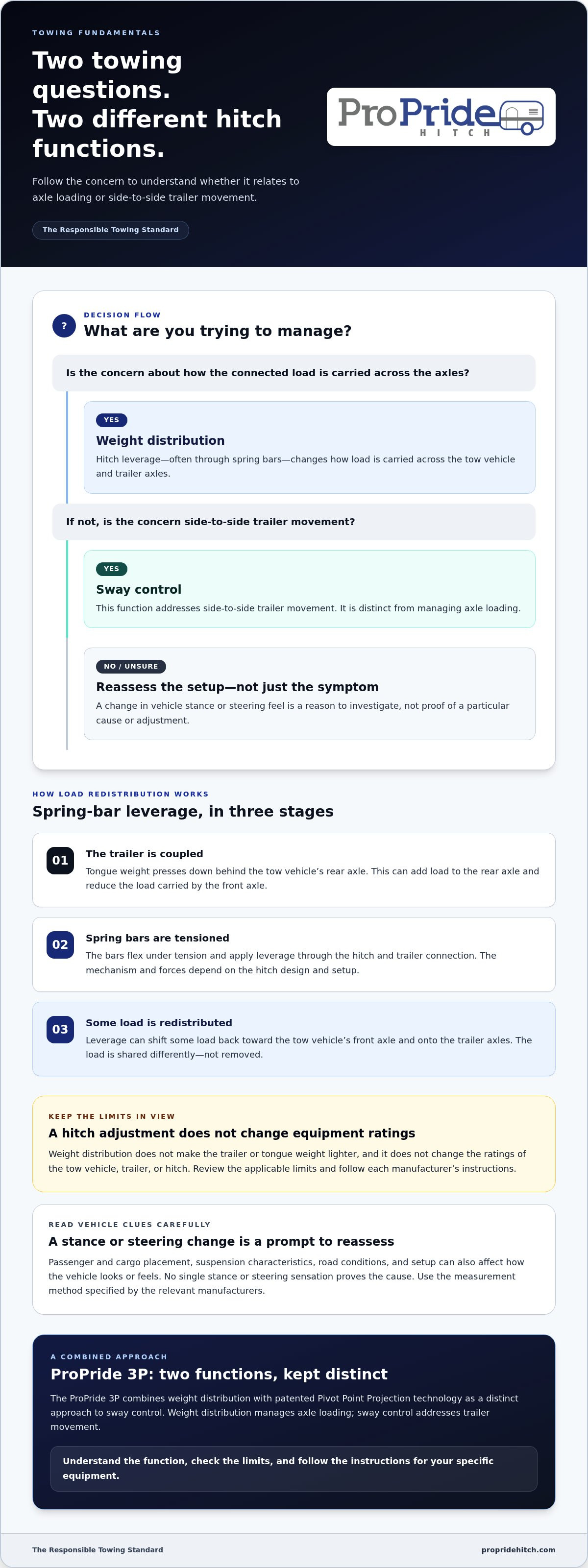
How does a weight distribution hitch work, and why can it change how your rig feels on the road? When trailer tongue weight presses down behind a tow vehicle’s rear axle, it can lift some load from the front axle. Spring bars act like levers, shifting part of that load back toward the front axle and onto the trailer axles. They don’t make the trailer lighter or erase tongue weight. They change how the load is shared.
It’s easy to confuse that job with sway control, especially because some hitch systems address both. But they solve different problems: weight distribution manages vertical axle loading, while sway control addresses side-to-side trailer movement. Knowing the difference helps you assess your setup and choose equipment that respects your vehicle and hitch limits.
This guide explains the load shift in plain language, what a weight distribution hitch can and can’t do, and the setup points to understand before towing. It also explains how ProPride’s 3P uses patented Pivot Point Projection technology as a distinct approach to sway control. That’s The Responsible Towing Standard: informed decisions grounded in how the equipment works.
Key Takeaways
- Understand how does a weight distribution hitch work by tracing how spring-bar leverage shifts some load across the tow vehicle and trailer axles.
- Use changes in vehicle stance and steering feel as reasons to reassess loading and hitch setup, following the applicable manufacturer instructions.
- Keep the two functions distinct: weight distribution manages axle loading, while sway control addresses side-to-side trailer movement.
- Before towing, review your vehicle, trailer, and hitch ratings, then check that loading and setup align with each manufacturer’s guidance.
- Learn how the ProPride 3P combines weight distribution with patented Pivot Point Projection technology to address sway.
How Does a Weight Distribution Hitch Work at the Axles?
A weight distribution hitch uses leverage to shift some of the load carried by the tow vehicle’s rear axle toward its front axle and the trailer’s axles. The load doesn’t vanish, and the trailer doesn’t become lighter. The hitch changes how the connected rig carries the load across its axles. So, how does a weight distribution hitch work? Spring bars apply force through the hitch connection to adjust those axle loads.
What does “weight distribution” mean when towing?
An axle load is the weight carried by one axle. When a trailer is coupled to a tow vehicle, its tongue weight presses down behind the vehicle’s rear axle. This can increase the rear axle load while reducing the load on the front axle. A weight-distribution system counters some of that change by applying leverage through the hitch, shifting load toward the front axle and trailer axles. The aim is a more appropriate balance, not a lighter trailer. A general explanation of a weight-distributing hitch also describes how spring bars help transfer load.
How do spring bars create leverage?
Spring bars flex under tension. When engaged, they push against the hitch and trailer connection, creating leverage. Think of a lever: force applied at one point changes how force is carried elsewhere. Here, that action changes the load on the tow vehicle’s axles and the trailer axles. The mechanism varies by hitch design, so don’t assume every system transfers load in precisely the same way. Follow the instructions for your specific equipment.
Weight distribution doesn’t reduce the trailer’s actual weight or tongue weight, and it doesn’t change the ratings of the tow vehicle, trailer, or hitch. Those limits still matter. The goal is to manage how the connected load is carried, not to make an unsuitable combination safe through adjustment.
For a practical reference, the ProPride 3P Hitch combines weight distribution with a separate sway-control approach. Keep those functions distinct: leverage changes axle loading, while sway control addresses trailer movement. As you learn your setup, follow the applicable manufacturer instructions and treat balanced loading as one part of The Responsible Towing Standard.
How Spring Bars Change the Tow Vehicle and Trailer Load
The load shift happens in stages. First, coupling the trailer places tongue weight on the hitch, adding load behind the tow vehicle’s rear axle. Depending on the combination, that can also reduce the load carried by the front axle. Once spring bars are tensioned according to the hitch instructions, they apply leverage through the connection and change how the load is carried across the tow vehicle and trailer axles.
What happens when trailer tongue weight loads the tow vehicle?
Tongue weight acts downward at the hitch, behind the tow vehicle’s rear axle. That can compress the rear suspension and make the front of the vehicle rise relative to its unhitched stance. If the front axle carries less load than intended, steering may feel different. These are clues to investigate, not a diagnosis. Passenger and cargo placement, suspension characteristics, road conditions, and setup can also affect how a vehicle looks or feels. No single stance or steering sensation proves the cause.
How do the trailer axles participate in load transfer?
When spring bars are tensioned, they act through the hitch and trailer connection. Their leverage can restore some load toward the tow vehicle’s front axle while placing some additional load on the trailer axles. The exact forces depend on the hitch design and setup, so there’s no universal adjustment or ride-height result to assume. The objective is suitable loading across the connected combination, within the applicable limits for the tow vehicle, trailer, and hitch.
Load is redistributed, not removed. The trailer doesn’t become lighter, and weight distribution doesn’t change equipment ratings. That’s the essential point behind how a weight distribution hitch works in a real setup. For a complementary explanation of how weight distribution systems improve handling, see HowStuffWorks.
If the vehicle’s stance or steering feel changes, treat that as a prompt to reassess, not proof that a particular adjustment is needed. Follow the tow vehicle, trailer, and hitch manufacturers’ instructions, and use any measurement method they specify. The ProPride 3P Hitch’s weight-distribution design is one example of a hitch system that manages load distribution alongside a separate sway-control function.
Weight Distribution vs. Sway Control: What Each Function Does
Weight distribution and sway control are related towing functions, but they aren’t interchangeable. One manages how the connected load is carried across the axles. The other addresses the trailer’s side-to-side movement. Understanding the distinction helps you assess what a hitch is designed to do instead of assuming that a weight-distribution feature automatically provides a particular kind of sway control.
| Function | Purpose and mechanical focus | What it doesn’t do |
|---|---|---|
| Weight distribution | Uses hitch leverage, often through spring bars, to adjust how load is carried across the tow vehicle and trailer axles. | It doesn’t make the trailer lighter or, by itself, guarantee that sway won’t occur. |
| Sway control | Uses a separate mechanism or hitch design to address side-to-side trailer movement. | It doesn’t change the vehicle, trailer, or hitch’s weight ratings, or replace sound loading and setup. |
For more background on how weight distribution systems work, HowStuffWorks explains how spring-bar leverage affects load across the combination. That’s different from controlling trailer rotation around the hitch connection, the motion explored in the physics of trailer sway.
Does a weight distribution hitch prevent trailer sway?
Weight distribution alone shouldn’t be treated as a guarantee against trailer sway. It changes axle loading; sway control addresses trailer movement through its own mechanism or design. Some hitch systems combine both functions, but their designs and operation can differ. Keep loading, equipment ratings, and manufacturer setup instructions in view. No hitch feature replaces responsible towing practices.
Where does Pivot Point Projection fit into the explanation?
The ProPride 3P Hitch uses patented Pivot Point Projection technology as its sway-control approach. It’s distinct from spring-bar leverage: weight distribution manages axle loading, while Pivot Point Projection addresses sway through the hitch’s geometry. For details about the 3P’s design, explore the ProPride 3P Hitch. The two functions work toward different goals, and understanding both supports informed setup decisions.
How to Apply Weight-Distribution Basics to a Towing Setup
Knowing how a weight distribution hitch works is useful when you apply that knowledge to your tow vehicle, trailer, and load. Use the manufacturers’ instructions as your guide. Ratings and setup details depend on the equipment, so a general rule or visual guess can’t replace them.
What should you review before hitching up?
Before connecting the trailer, gather the tow vehicle, trailer, and hitch documentation. Check each manufacturer’s applicable ratings and instructions, then consider how passengers, cargo, and trailer contents affect the loaded combination. Tongue weight, the downward load the trailer places on the hitch, is one part of that picture. For a focused explanation of calculating it, use a dedicated trailer tongue-weight calculation guide.
What should you observe after setup?
Once connected, follow the hitch maker’s procedure for setting and checking the system. Vehicle stance, steering feel, and how the combination tracks on the road are useful observations, but none proves by itself that loading is correct. Use the measurements or checks specified by the relevant manufacturers instead of relying on appearance alone.
Work through this sequence before towing:
- Review ratings. Read the tow vehicle, trailer, and hitch documentation, and account for the loaded combination.
- Plan the load. Consider passenger and cargo placement in the vehicle, as well as how supplies and equipment are arranged in the trailer.
- Set up the hitch. Follow the hitch manufacturer’s instructions for connection, spring-bar engagement, and any required checks.
- Reassess when the load changes. Adding, removing, or moving cargo can affect the combination. Recheck the setup using the manufacturers’ guidance before setting out.
- Pay attention to changes. If stance, steering feel, or tracking differs from what you expect, pause and review the load and setup. Treat those signs as prompts to check, not as a diagnosis.
There’s no universal adjustment or visual target for every rig. Vehicle suspension, hitch design, trailer loading, and manufacturer procedures all matter. A careful, repeatable check supports The Responsible Towing Standard: understand your equipment, follow its instructions, and reassess when the setup changes.
To see how these weight-distribution principles are incorporated into a specific hitch design, explore the ProPride 3P Hitch.
How the ProPride 3P Combines Weight Distribution and Sway Control
Weight distribution and sway control address different parts of towing. Weight distribution manages how the connected load is carried across the tow vehicle and trailer axles. The ProPride 3P Hitch combines that function with a separate sway-control design: patented Pivot Point Projection technology. Understanding how a weight distribution hitch works helps clarify why these functions complement each other rather than doing the same job.
What makes the ProPride 3P approach distinct?
Pivot Point Projection changes the geometry of the hitch connection. In plain terms, the design projects the effective pivot point, the point around which the trailer would otherwise turn, forward toward the tow vehicle’s rear axle. This arrangement makes the tow vehicle and trailer work together to address sway, rather than relying on spring-bar leverage alone. The spring bars support weight distribution; Pivot Point Projection is the distinct sway-control principle.
The system builds on decades of advanced hitch-design engineering developed by ProPride, Inc. The ProPride 3P is designed to eliminate trailer sway. That design does not make loading, ratings, or setup instructions less important. Responsible towing still means using the vehicle, trailer, and hitch within their applicable limits.
Where can readers learn more about the ProPride 3P?
To examine how these functions come together in the product, explore the ProPride 3P Hitch details. For broader design context, compare the sway-control approaches described earlier in this guide and consider how each addresses trailer movement. The central distinction remains useful: axle-load management and sway control are related, but separate, engineering tasks.
The Responsible Towing Standard starts with understanding what each part of a hitch is designed to do. Review the ProPride 3P’s design and see how its approach fits the way you assess your towing setup.
Put Towing Knowledge to Work on Your Next Trip
Understanding how a weight distribution hitch works gives you a clearer way to assess your towing setup. Spring-bar leverage changes how load is carried across the axles, but it doesn’t remove weight or change equipment ratings. Weight distribution and sway control can work together, but they address different towing concerns.
Use the tow vehicle, trailer, and hitch manufacturers’ instructions to guide setup, and reassess if your loading changes. If you’re comparing hitch designs, the ProPride 3P combines weight distribution with patented Pivot Point Projection technology, building on the hitch-design legacy associated with inventor Jim Hensley.
Explore the engineering and details of the ProPride 3P Hitch as you consider what fits your towing needs. A thoughtful setup and informed equipment choices help put The Responsible Towing Standard into practice. You’re taking the right steps toward more confident towing.
Frequently Asked Questions
How does a weight distribution hitch work?
A weight distribution hitch uses leverage to change how the connected load is carried across the tow vehicle and trailer axles. In a common spring-bar design, tensioned bars act through the hitch connection, shifting some load toward the tow vehicle’s front axle and the trailer axles. The hitch doesn’t remove weight or change equipment ratings. Follow the hitch, vehicle, and trailer manufacturers’ setup instructions for your combination.
Does a weight distribution hitch reduce tongue weight?
No. It doesn’t reduce the trailer’s actual tongue weight, which is the downward force the trailer applies at the hitch. Instead, the hitch changes how the connected combination carries that load across its axles. Tongue weight remains important when checking whether the tow vehicle, trailer, and hitch are within their applicable limits. Use the manufacturers’ instructions and account for the trailer’s loaded condition when assessing your setup.
Do all travel trailers need a weight distribution hitch?
No single answer applies to every travel trailer and tow vehicle combination. Whether a weight distribution hitch is appropriate depends on the equipment, its ratings, and the relevant manufacturer instructions. Review the tow vehicle, trailer, and hitch documentation before choosing or adjusting a setup. Don’t assume that a hitch is required, unnecessary, or suitable based only on trailer size or appearance. Assess the specific combination and its loaded condition.
Can a weight distribution hitch affect steering or braking?
Yes. By changing how load is carried across the tow vehicle’s axles, a weight distribution hitch can affect vehicle stance and how steering or braking feels. An unexpected change is a reason to review loading and setup, not proof of a particular problem. Follow the hitch maker’s adjustment and checking instructions, and keep the tow vehicle, trailer, and hitch within their applicable ratings.
How do spring bars transfer weight to the trailer axles?
Spring bars flex under tension and apply leverage through the hitch connection. That leverage changes how the combination carries load, shifting some toward the tow vehicle’s front axle and the trailer axles. The precise effect depends on the hitch design, so there isn’t one universal adjustment or result to expect. Use the instructions for your particular hitch, and don’t mistake load transfer for weight being removed.
What is the difference between weight distribution and sway control?
Weight distribution manages how the connected load is shared across the tow vehicle and trailer axles. Sway control addresses the trailer’s side-to-side movement. They’re related towing functions, not synonyms, and one doesn’t automatically tell you how the other works in a particular hitch. The ProPride 3P combines weight distribution with patented Pivot Point Projection technology for sway control, a distinct design approach associated with inventor Jim Hensley’s work.