
A short wheelbase doesn’t automatically rule out towing, but it leaves less room for a mismatch between the vehicle, trailer, and hitch. A hitch for towing a trailer with a short wheelbase vehicle should be properly rated and matched to the load, with weight distribution and sway control considered alongside the vehicle’s limits. Never exceed the tow vehicle’s capacity.
Hitch ratings matter, but the hitch alone can’t compensate for poor trailer loading or a vehicle that isn’t suited to the trailer. Wheelbase affects how the vehicle responds to trailer movement, so setup matters as much as equipment choice. A weight-distribution hitch uses tensioned bars to share some hitch load across the vehicle and trailer axles; sway control helps address unwanted side-to-side movement.
This guide explains how trailer loading and tongue weight affect stability, what hitch ratings mean, and how wheelbase changes towing behavior. You’ll also learn what to consider when choosing a hitch and why matching the vehicle, trailer, and equipment carefully is The Responsible Towing Standard.
Key Takeaways
- Load the trailer carefully and measure tongue weight; the way cargo is positioned can influence stability.
- Match hitch ratings to the trailer and tow vehicle, and never exceed the vehicle’s towing capacity.
- Wheelbase affects how a vehicle responds to trailer movement, so consider the full vehicle-and-trailer combination rather than wheelbase alone.
- A weight-distributing hitch uses tensioned bars to share some hitch weight across the vehicle and trailer axles.
- The ProPride 3P Hitch uses patented Pivot Point Projection technology to eliminate trailer sway.
Trailer loading and tongue weight
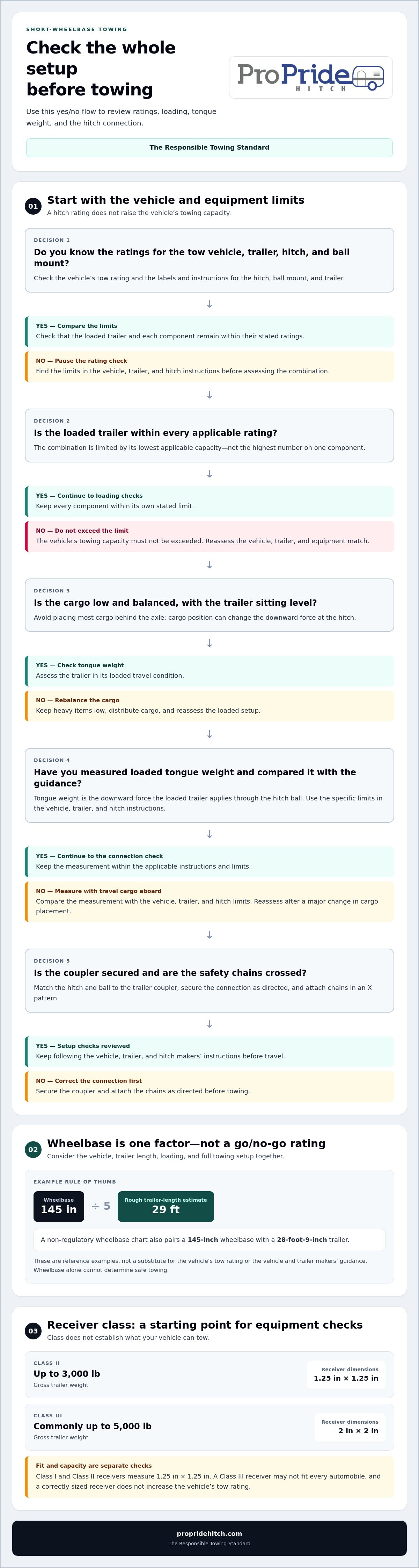
Loading affects how force moves between the trailer and tow vehicle, especially when the vehicle has a short wheelbase. To install, load, and tow safely, follow the vehicle and trailer makers’ instructions, secure the hitch connection, balance cargo, measure tongue weight, and inspect the setup before travel.
Trailer Tongue Weight
Trailer tongue weight is the downward force the loaded trailer applies to the tow vehicle through the hitch ball. It affects how the trailer tracks, so cargo placement matters as much as total load.
For conventional trailers, recommended tongue weight can vary, so follow the guidance for your trailer and tow vehicle. Those figures don’t align as one universal target. Use the specific limits in the vehicle, trailer, and hitch instructions, and don’t exceed the lowest applicable rating. Fifth-wheel and gooseneck trailers have different guidance, with tongue weight around 15% of trailer weight.
Safe Trailer Installation and Loading Steps
Safe trailer installation and loading mean connecting the trailer correctly, balancing its cargo, and checking the loaded combination before towing. Start with the tow vehicle and trailer instructions, then match the hitch and ball to the trailer coupler. Secure the connection as directed and attach safety chains in an X pattern. Crossed chains can help hold the coupler off the road if separation occurs.
- Load low and balance the cargo. Keep heavy items low and distribute them so the trailer sits level. Avoid placing most cargo behind the axle, which can reduce downward force at the hitch.
- Measure the loaded tongue weight. Check it with the trailer carrying its travel cargo, not empty. Compare the measurement with the limits and loading guidance for the tow vehicle, trailer, and hitch.
- Recheck the connection and load. Confirm the coupler is secured, safety chains are crossed, and cargo is restrained before departure. After any major change in cargo placement, reassess the loaded setup.
For example, shifting a heavy storage box from behind the trailer axle toward its center changes how weight acts at the hitch. Don’t use a hitch’s sway-control design as a substitute for correct loading; review sway-control hitch design as one part of the overall setup. Proper tongue weight supports stability, but every component must remain within its own stated limits.
Hitch class ratings and towing capacities
A hitch class is a receiver category associated with load limits and receiver dimensions. It helps narrow equipment choices, but it doesn’t establish how much your vehicle can safely tow.
A vehicle’s tow rating is the manufacturer’s maximum weight limit for towing. For a short-wheelbase vehicle, consider that rating alongside the hitch, ball mount, and trailer ratings. The combination is limited by its lowest applicable capacity, not the highest number printed on a single component.
Installation and towing requirements can vary by state and depend on where you travel. For safe equipment selection, compare the vehicle manufacturer’s tow rating with the hitch and trailer ratings, then follow the vehicle and hitch instructions.
There is no single installation cost that applies to every vehicle and hitch setup. The total depends on the hitch selected, vehicle fit, and work involved, so an estimate requires those details.
Hitch classes offer a useful starting point, but you still need to check each rating. Common receiver-class figures include:
- Class II: Rated to pull up to 3,000 pounds of gross trailer weight.
- Class III: Commonly rated up to 5,000 pounds of gross trailer weight.
Gross trailer weight is the trailer’s total loaded weight. A weight-distribution system uses tensioned bars to share some hitch weight across the vehicle and trailer axles. Ratings can vary by setup, so compare the labels and instructions for the receiver, ball mount, and towing system instead of assuming every hitch in a class has the same limit.
Receiver size is another compatibility check. Class I and Class II receivers have inside dimensions of 1.25 inches by 1.25 inches; Class III receivers measure 2 inches by 2 inches. A Class III receiver may not fit every automobile, so confirm vehicle fit before choosing equipment. A correctly sized receiver still doesn’t increase the vehicle’s tow rating.
Use this sequence: find the vehicle’s tow rating, identify the trailer’s loaded weight, then match the receiver and ball mount ratings. If sway control is also part of your decision, compare trailer sway-control hitch design separately from load capacity. Capacity and sway control address different parts of a towing setup.
Tow vehicle wheelbase and trailer sway
Wheelbase is the distance between a tow vehicle’s front and rear axles. It affects how the vehicle responds to trailer movement, but cannot determine safe towing on its own. Trailer length, loading, and the complete towing setup also matter. A longer wheelbase can help absorb and dissipate sway energy, while a shorter wheelbase can make the vehicle more maneuverable.
A commonly shared rule of thumb divides wheelbase length in inches by five to estimate maximum trailer length in feet. For example, a 145-inch wheelbase gives a rough estimate of 29 feet. This is a rule of thumb, not a regulatory limit or a substitute for the vehicle’s tow rating and trailer guidance.
That estimate is only one way people compare combinations. A non-regulatory wheelbase chart pairs a 145-inch wheelbase with a 28-foot-9-inch trailer. In one discussion, a driver considered that wheelbase with a 29.5-foot trailer. Other participants described towing a 28.5-foot trailer with a 145-inch-wheelbase Ford F-150, or a 30-foot travel trailer with a 119-inch-wheelbase Ford Expedition for thousands of miles. These reports illustrate differing experiences, not guarantees of suitability.
Use such examples as context, not a pass-or-fail test. A forum participant described 145 inches as a good fit for trailers around 28 to 30 feet long. Yet trailer length alone doesn’t reveal its loaded weight, balance, or response to road forces. Compare the actual vehicle and trailer specifications, then treat wheelbase as one factor in the decision.
Trailer sway is side-to-side movement that can grow when the towing setup is poorly matched. A passing truck may push or pull a correctly loaded trailer without causing continued sway. If movement continues or increases, don’t treat lower speed as a fix for an unsuitable setup. Reassess the combination and loading.
- Compare proportions: Note the vehicle wheelbase and trailer length, then use the five-to-one rule only as a rough reference.
- Account for handling: A shorter wheelbase can improve maneuverability and make a trailer react faster while backing.
- Consider practical trade-offs: A longer tow vehicle can improve highway comfort, but tight spaces and parking may become harder. Shorter trailers can also be more difficult to back behind long-wheelbase trucks.
When choosing a hitch for towing a trailer with a short wheelbase vehicle, evaluate the whole combination instead of relying on a single length comparison. A longer wheelbase may add stability, but it doesn’t erase the effects of trailer loading, road conditions, or equipment choice. Base the decision on the vehicle’s limits and how the loaded trailer behaves as part of the complete system.
Weight-carrying and weight-distributing hitches
A weight-carrying hitch transfers the trailer’s tongue weight directly to the tow vehicle through the receiver and ball mount. A weight-distributing hitch uses tensioned spring bars to shift some of that load toward the tow vehicle’s front axle and the trailer’s axles. The key difference is how each setup carries the trailer’s hitch load.
Weight-Carrying Hitch
A weight-carrying hitch supports the trailer at the receiver without spring bars redistributing the load. That direct force can compress the tow vehicle’s rear suspension, especially when the trailer’s tongue weight is substantial. The vehicle may sit lower at the rear, changing its stance and potentially affecting steering response. Check the vehicle and hitch ratings for this specific configuration.
Use the correct ball mount so the connected trailer sits at the angle specified in its instructions. A mismatched mount can create an extreme angle between the trailer and vehicle, potentially contributing to sway or damage. Before towing, compare the trailer coupler height with the hitch ball height on level ground. Adjust the setup with compatible equipment, not by shifting cargo as a substitute.
Weight-Distributing Hitch
A weight-distributing hitch uses tensioned spring bars to share some hitch weight across the tow vehicle and trailer axles. This can help reduce rear-end sag and improve steering and braking by returning some load toward the vehicle’s front axle. It doesn’t make an overloaded vehicle capable of towing more. The vehicle, hitch, trailer, and distribution equipment still need compatible ratings.
Setup matters. Follow the hitch maker’s instructions to connect and tension the bars, then assess the vehicle’s stance and handling. A poorly adjusted system may not distribute weight as intended. With a short-wheelbase tow vehicle, don’t assume spring bars alone resolve sway or compensate for a poorly matched trailer.
Consider a practical example: if the trailer’s tongue load makes the tow vehicle’s rear sit low, a correctly selected and adjusted weight-distributing system may help restore load across the axles. If the trailer and vehicle are within their limits and the receiver instructions call for weight-carrying use, spring bars may not be appropriate. Choose based on equipment ratings and manufacturer guidance.
- Read each rating: Compare the receiver, hitch system, tow vehicle, and trailer limits for the intended setup.
- Match the mount: Select a compatible ball mount that keeps the trailer at the specified towing angle.
- Assess the loaded vehicle: Check stance and handling after connection and adjustment, not just the hitch components.
- Treat sway separately: A weight-distributing hitch shares load; use a properly set-up system with sway control where the combination calls for it.
Start with the vehicle and trailer instructions, then follow the ratings and setup requirements for every component.
What are the risks of towing a trailer that is too heavy for a short-wheelbase vehicle?
Towing a trailer that is too heavy for the vehicle can leave less margin for controlling the combined vehicle and trailer. This mismatch leaves less margin for controlling the combined vehicle and trailer, and a shorter wheelbase generally provides less stability than a longer one. A suitable hitch cannot make an over-capacity combination safe.
A vehicle’s tow rating is its manufacturer’s maximum weight limit for towing. It generally concerns the trailer’s overall weight, not its size. Manufacturers consider factors such as engine, transmission, axle ratio, brakes, chassis, and cooling systems. That is why two vehicles with similar wheelbases can have different tow ratings.
Exceeding the tow rating means asking the vehicle to handle a load beyond its specified towing limit. The vehicle’s brakes, chassis, and cooling system are among the factors manufacturers consider when setting that limit. A properly rated hitch doesn’t raise it. Treat the vehicle’s rating as a firm boundary and account for the trailer’s loaded weight.
Wheelbase affects how the tow vehicle responds to trailer movement. A longer wheelbase generally provides a more stable ride and can help absorb and dissipate sway energy. A short-wheelbase vehicle may respond more quickly to trailer movement, making a poorly matched or loaded combination harder to control. Sway can grow when the setup isn’t right.
Trailer length matters, but it doesn’t tell the whole story. A long trailer can exert substantial leverage through the hitch, while poor loading can further affect its behavior. A passing truck may push or pull a correctly loaded trailer without causing continued sway. If sway continues or grows, reducing speed alone won’t correct the underlying mismatch.
Use these steps before towing:
- Compare ratings: Check the tow vehicle’s stated capacity against the trailer’s overall loaded weight.
- Assess the combination: Consider wheelbase, trailer length, and loading together, not as separate pass-or-fail numbers.
- Address instability: If sway builds during towing, stop in a safe place and reassess the setup before continuing.
- Respect the limit: If the loaded trailer exceeds the vehicle’s tow rating, reduce the load or choose a suitable tow vehicle.
For example, a short-wheelbase SUV may feel manageable with a lightly loaded trailer, yet respond differently when cargo increases the trailer’s total weight. Trailer size alone won’t reveal that change. A responsible towing decision starts with the manufacturer’s tow rating and considers the loaded trailer, vehicle wheelbase, and hitch setup as one system.
ProPride: ProPride 3P Hitch
The ProPride 3P Hitch uses patented Pivot Point Projection technology to completely eliminate trailer sway. Rather than relying on friction to resist side-to-side movement, its design projects the trailer’s pivot point forward, closer to the tow vehicle’s rear axle. This changes how trailer movement affects the towing combination.
For short-wheelbase towing, the 3P Hitch is relevant when sway control is a central concern. It doesn’t change your vehicle’s tow rating or replace correct loading, compatible hitch ratings, and careful setup. Treat it as one part of a responsible towing system, alongside the limits and instructions for your vehicle and trailer.
Explore the ProPride 3P Hitch to learn how Pivot Point Projection fits into your towing decisions.
Make Your Next Towing Decision With Confidence
Choosing a hitch for towing a trailer with a short wheelbase vehicle means considering how the full setup suits your travel plans, not just the hardware. Before your next trip, think about the conditions you’ll encounter, from tight maneuvers to changing road conditions.
A deliberate equipment choice reflects the care you’ve put into researching your setup. That thoughtful approach is The Responsible Towing Standard: make decisions with your family, vehicle, and trailer in mind.
ProPride offers the ProPride 3P Hitch for drivers considering an engineered approach to trailer sway control. To discuss your towing setup, contact ProPride about your towing setup.
Keep asking careful questions and choose your equipment with purpose. Preparation can help make your next trip more confident.
Frequently Asked Questions
How does a short wheelbase affect trailer towing stability and sway?
A short wheelbase can make steering responses feel more immediate, so use smooth inputs. Adjust both mirrors to monitor the trailer, and avoid abrupt steering corrections when traffic or wind shifts its position. If the combination feels unsettled during a trip, stop in a safe place and reassess before continuing. A calm, controlled driving style helps you respond without adding sudden movement.
What is the maximum trailer weight and tongue weight for my vehicle?
Find the exact limits for your vehicle’s model, year, and configuration in its towing information. A trim or powertrain change can affect the applicable figures, so don’t rely on a similar vehicle’s rating. Include people and cargo in the tow vehicle when reviewing its load limits. Keep a written note of the vehicle, trailer, and hitch limits when planning each trip.
What hitch class and receiver size are appropriate for a short-wheelbase vehicle?
Choose a hitch that fits the vehicle’s receiver and meets the ratings for the complete towing setup. Before buying, compare the receiver opening with the hitch shank, then review the rating label and the hitch maker’s fit instructions. Check that the ball mount gives the trailer the required height, too. Wheelbase doesn’t identify receiver fit, so confirm the exact vehicle application.
Can a weight-distribution hitch improve towing with a short-wheelbase vehicle?
A weight-distributing system may help when the hitch load changes the vehicle’s stance, but correct setup is essential. Follow the system’s instructions, then check the tow vehicle and trailer in their loaded travel condition. If you have access to axle-weight measurements, compare them with the setup guidance rather than judging by appearance alone. Don’t use adjustment to compensate for a load or component outside its stated limits.
When should I use a sway-control hitch or sway-control device?
Use a sway-control system when it’s appropriate for the trailer and compatible with the hitch setup. Check the equipment instructions for how the device attaches, adjusts, and works with other towing components. Don’t combine devices unless their manufacturers say the arrangement is compatible. If sway occurs, reassess the complete setup rather than assuming an added device alone addresses the cause.
How do I calculate safe tongue weight and trailer loading?
Calculate tongue-weight percentage by dividing measured tongue weight by the trailer’s loaded weight, then multiplying by 100. Weigh the trailer in its actual travel condition, including the cargo you plan to carry, and measure tongue weight with that same loading. If you move heavy items or add supplies, repeat the measurements. A consistent method makes comparisons meaningful and helps reveal how cargo changes the hitch load.