
Smarter stability technology may expand what towables can do, but it won’t change the limits of physics. The future of safe RV towing will likely combine systems that detect sway and adjust braking or throttle with proper weight limits, a correctly set up hitch, and attentive driving. Electronics can help stabilize a vehicle and trailer, but they can’t make an overloaded or poorly balanced trailer safe.
It makes sense to look to technology for added confidence. Drivers want support when wind, road conditions, or a sudden maneuver unsettles a trailer. Electronic stability control is designed to help by responding to instability and supporting the tow vehicle and trailer.
This article explains what these systems may bring to future towables, how towing limits and hitch setup affect stability, and why driving within your limits remains essential. It also covers how towing-specific adaptive cruise control, enhanced braking, tire-pressure sensors, and hitch-weight monitoring could inform decisions on the road. The Responsible Towing Standard starts with understanding what technology can help with and what still depends on preparation and judgment.
Key Takeaways
- Use the 80% towing guideline as a planning reference, then compare actual loaded weights with your vehicle’s ratings.
- Include passengers, cargo, and liquids when weighing your tow vehicle and trailer; hitch weight also counts against payload.
- Understand how weight-distribution and sway-control hitches affect load balance and trailer movement before choosing a setup.
- Practice with a new trailer in an empty parking lot and leave at least 4 seconds of following distance while towing.
- Electronic stability systems can respond to sway, while emerging sensors and driver-assistance features may provide more useful information on the road.
What Is the 80-Percent Towing Rule and Why Is It Important?
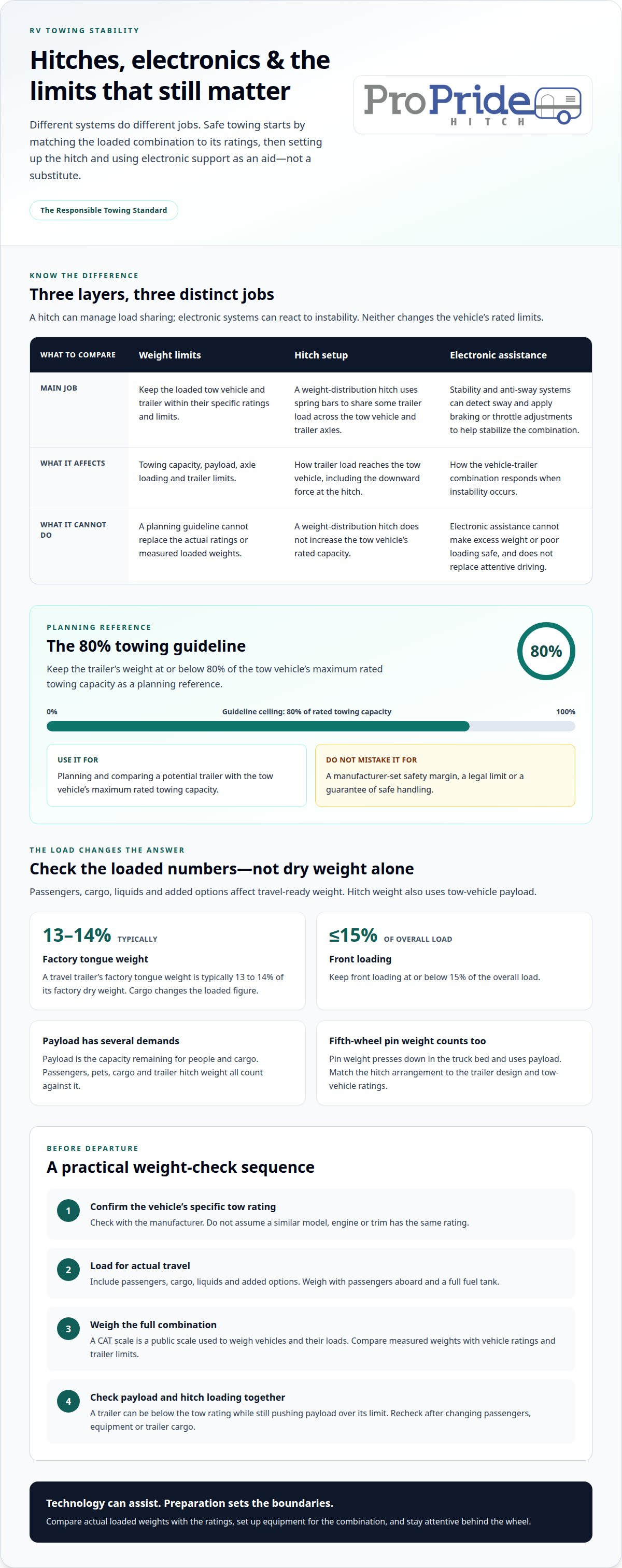
The 80-percent towing rule is a planning guideline: keep a trailer’s weight at or below 80% of the tow vehicle’s maximum rated towing capacity. It isn’t a substitute for vehicle ratings or a guarantee of safe handling.
Loaded Tow Vehicle and Trailer Weighing
Weighing a loaded tow vehicle and trailer at a CAT scale, a public scale used to weigh vehicles and their loads, shows their actual travel-ready weights. This matters because an RV’s dry weight excludes passengers, cargo, liquids, and added options. Its current gross vehicle weight is its dry weight plus those loads. Weigh with passengers aboard and a full fuel tank, then compare the measured weights with the vehicle’s ratings and the trailer’s limits.
Tow Ratings and Manufacturer Safety Margins
A tow rating is the maximum towing capacity assigned to a specific vehicle configuration. The 80% guideline leaves room below that maximum, but it isn’t a manufacturer-set safety margin or a legal limit. Vehicle owners should confirm their specific towing capacity with the manufacturer before buying or towing. Don’t assume a similar model, engine, or trim has the same rating.
Matching Tow Vehicles to Travel Trailers
Matching a travel trailer and tow vehicle means checking their ratings with both loaded for travel. Gross vehicle weight rating, or GVWR, is the vehicle’s maximum permitted loaded weight. Payload is the capacity remaining for people and cargo. Passengers, pets, and trailer hitch weight all count against payload, so a trailer can be below the tow rating while still pushing payload over its limit.
Electric trucks and SUVs vary by model, so neither category is automatically better for towing an RV. Compare the specific vehicle’s towing capacity and payload with the trailer’s loaded weight and hitch weight.
U.S. requirements include equipment standards. The National Highway Traffic Safety Administration (NHTSA) says a trailer or semitrailer’s rear impact guard must be mounted according to the guard manufacturer’s instructions.
There isn’t one cost for newer towing safety systems and equipment. The total depends on what a particular vehicle and trailer need. Compare features only after confirming the combination’s weight limits.
To prepare, confirm the tow rating with the vehicle manufacturer, load the trailer for travel, and weigh the full combination. Compare the results with the tow vehicle’s towing and payload ratings and the trailer’s limits before departure.
Future technology can assist with sway or provide more information, but it can’t correct excess weight or poor loading. Sensors and electronic controls also don’t replace attentive driving or proper equipment setup.
Trailer towing has changed since the 1920s, when John D. Wallace invented the ball hitch. Early trailers often used balls mounted on steel car bumpers and lacked their own brakes, leaving the tow vehicle to slow both. Pickup-style trucks gained popularity by the mid-1930s, but the basic lesson remains: equipment must suit the load.
Weight-distribution and sway-control hitches
Hitch setup affects how a trailer’s load reaches the tow vehicle and how the combination responds on the road. Weight distribution, tongue weight, payload, and sway control are related, but each describes a different part of towing.
Travel-Trailer Loads and Weight Distribution
A weight-distribution hitch uses spring bars to spread some trailer load across the tow vehicle and trailer axles. That matters because a heavy tongue can press down on the tow vehicle’s rear and affect the balance across its axles. A travel trailer’s factory tongue weight is typically 13 to 14% of its factory dry weight, but cargo changes the loaded figure. Keep front loading at or below 15% of the overall load.
Payload and Loaded Tongue Weight
Payload is the tow vehicle’s capacity for occupants, cargo, and the trailer’s hitch load. Loaded tongue weight is the downward force the travel trailer places on the hitch after cargo and liquids are added. It counts against vehicle payload even when the trailer is within the vehicle’s towing capacity. Recheck the total after changing passengers, equipment, or trailer cargo.
Evolving Hitch and Sway-Control Systems
Weight-distribution hitches were introduced in the 1950s, and towing systems now combine mechanical setup with electronic assistance. Modern brake-controller modes can dynamically adjust trailer braking force in real time. Electronic stability and anti-sway technology can detect sway and apply braking or throttle adjustments to help stabilize the vehicle-trailer combination.
These systems have different jobs. A weight-distribution hitch manages how load is shared across axles; sway control addresses trailer movement, while brakes help slow the combination. Electronic assistance can respond to changing conditions, but it doesn’t correct excess weight or poor loading. A sound hitch setup depends on the actual loaded trailer and tow vehicle.
Fifth-wheel trailers use a different connection point from travel trailers. Their pin weight presses down in the truck bed, so it also uses payload capacity. Don’t treat fifth-wheel pin weight as travel-trailer tongue weight or assume the same hitch type applies to both. Match the hitch arrangement to the trailer design and the tow vehicle’s ratings.
For a travel trailer, assess the loaded tongue weight alongside payload and axle loading. A weight-distribution hitch can help share load, but it doesn’t increase the tow vehicle’s rated capacity. Check the hitch and vehicle instructions for setup, then reassess whenever the travel load changes. A carefully selected trailer sway-control hitch design can be part of that overall setup.
Driving within your limits
A tow vehicle’s capacity doesn’t mean every road, speed, or maneuver is suitable for the combination. Safe driving means adapting to the trailer’s length, braking response, visibility, weather, and the driver’s experience. A truck that handles a familiar route easily may need more room and time when towing through traffic or changing road conditions.
Practice before joining fast-moving traffic. An empty parking lot gives you room to learn how the trailer tracks through turns, responds while backing, and behaves during braking. Practice steering and reversing before a trip, rather than trying new techniques on a freeway with four lanes of traffic moving at 60 mph. Use the space to understand the trailer’s turning path and how much extra room each maneuver requires.
Leave at least 4 seconds of following distance while towing. That space gives you more time to respond if traffic slows, but it doesn’t remove the need to look ahead. Scan beyond the vehicle in front for brake lights, lane closures, and traffic bunching. If visibility or road conditions worsen, increase your space and reduce speed smoothly instead of waiting for a sudden stop.
Added weight affects acceleration, slowing, and stopping. Allow extra time for all three, especially before merging or approaching a turn. Avoid abrupt steering, braking, and throttle inputs that can unsettle the trailer. If trailer sway begins, sudden corrections can make control harder. Ease off the accelerator and keep steering steady as you respond to conditions. Don’t treat weight distribution or electronic assistance as a reason to drive faster.
Choose a speed for the full combination, not just the tow vehicle. Posted limits don’t account for your trailer, load, road surface, wind, or tire condition. One forum member reported towing at 63 mph as a safer alternative to 75 mph, while another noted a 75 mph tire speed rating for travel trailers, fifth wheels, motorhomes, and big rigs. Treat a tire’s rating as a ceiling, not a target, and follow the limits that apply to your equipment.
Plan routes and driving periods around the demands of towing. Check that bridges provide enough clearance, and consider whether narrow roads, steep grades, or heavy traffic leave room to maneuver. A forum member said they try to limit RV towing days to about six hours. That is one person’s practice, not a universal rule; fatigue, weather, and road complexity should shape your own stopping plan.
Before setting out, walk around the vehicle and trailer, confirm the hitch connection, and check that the exterior signal lights work. Keep your attention on changing conditions, not just the navigation screen. Respect the tow vehicle manufacturer’s ratings and adjust speed, distance, and route choices as the trip unfolds.
Electronic stability control and sway reduction
Electronic stability control for towing uses vehicle sensors and control systems to help manage instability. In a vehicle-trailer combination, electronic stability and anti-sway technology can detect trailer sway and apply braking or throttle adjustments to help stabilize the combination. As part of the future of safe RV towing, these systems may support safer handling when movement begins, but they don’t replace appropriate loading or attentive driving.
The system responds to movement; it doesn’t change the camper’s physical limits. For example, if a trailer begins oscillating behind the tow vehicle, stability control can apply braking or adjust throttle to help settle the combination. Its response depends on the equipment and how the vehicle and trailer interact. The driver still needs to maintain control and avoid abrupt steering inputs.
Advanced driver-assistance systems may add towing-specific adaptive cruise control and enhanced automated braking. These features could help manage following speed and braking response as traffic changes. Future systems may also assist with lane centering, straight-path control, and backing up. Treat this assistance as support, not a substitute for observation or skill.
Braking deserves particular attention because a loaded trailer adds mass behind the tow vehicle. Modern electronic brake-controller modes can dynamically adjust trailer braking force in real time. Surge brakes work differently: they engage automatically when the trailer senses a reduction in speed. Neither system makes excessive trailer weight appropriate for the tow vehicle.
Electronic support can ease some of the stress of responding to changing traffic, but each feature has a defined role. Stability control reacts to detected sway; a brake controller manages trailer braking; adaptive cruise control may help maintain a selected pace. These functions aren’t interchangeable. Before travel, learn which systems are active, how they respond, and what alerts or controls the tow vehicle provides.
Conditions can challenge sensors and driver-assistance features. A sharp turn, rough road, crosswind, or sudden lane change can alter how the trailer moves. If a camper begins to sway, don’t rely on an electronic correction alone. Keep steering controlled, ease off the accelerator, and give the combination room to settle. Driver judgment remains central.
Some towing setups may use connected features to share information between the tow vehicle and trailer. Tire-pressure sensors, hitch-weight monitoring, and auxiliary cameras can provide real-time information, while some vehicles can test trailer signal lights with a button. These tools can help drivers notice issues sooner, but they don’t correct a poor hitch setup or an overloaded combination.
The future of safe RV towing will pair electronic assistance with proper equipment setup and careful decisions. Stability systems can help detect sway and respond with braking or throttle adjustments, but they don’t remove the need to match the trailer to the tow vehicle, maintain working equipment, and stay attentive throughout the trip.
What safety technologies are emerging for RV towing?
The future of safe RV towing will be shaped partly by technology designed for the extra demands of a trailer. Towing-specific adaptive cruise control could adjust vehicle speed while towing, and enhanced automated braking may support more controlled responses to traffic changes. These systems could help with particular tasks, but their value depends on how they work with the vehicle and trailer combination.
Lane-centering and straight-path assistance may help keep a tow vehicle and trailer aligned during travel. Backing assistance could make it easier to guide a trailer through a tight campground lane by showing its path or supporting steering. Learn how each system behaves in a low-pressure setting before relying on it during a crowded maneuver. Assistance can help, but drivers remain responsible for observing their surroundings.
Connected systems may also change how tow vehicles and trailers share information. Bluetooth or other wireless connections could replace some wiring harnesses and help prevent connection problems caused by dirty terminals. Some tow vehicles can already cycle through a trailer’s exterior signal lights with a button. Use that check before departure to catch a signal problem before entering traffic.
Trailer sensors can make important conditions easier to monitor from the tow vehicle. Tire-pressure sensors can report tire status, hitch-weight monitors can provide loading information, and auxiliary cameras can improve visibility around a trailer. The future of safe RV towing may include these signals in a more connected display, helping drivers notice relevant changes without relying on a single view.
Electronic brake controllers are another area of development. Modern modes can dynamically adjust trailer braking force in real time. This can help coordinate braking as conditions change, but drivers still need to understand the available settings and notice how the combination responds. An automated adjustment doesn’t make every mode suitable for every load, road, or trailer.
At a campsite, self-leveling technology may reduce the manual work of stabilizing a trailer. This feature addresses setup after arrival, not road stability while towing. Keep the functions distinct: campsite leveling doesn’t prevent sway or correct an unsuitable towing setup. Use each feature for its intended task, whether preparing to park or traveling on the road.
As these tools develop, the future of safe RV towing will still require clear limits and informed decisions. Sensors rely on functioning equipment, and assistance features have specific roles. Before a trip, learn what each system detects, how it communicates an issue, and what action it supports. Technology can improve awareness and assist with maneuvers, but it cannot replace attentive driving, appropriate loading, or proper vehicle and trailer setup.
ProPride
ProPride offers the ProPride 3P Hitch for RVers seeking a hitch solution focused on trailer sway. Its patented Pivot Point Projection technology creates a virtual pivot point near the tow vehicle’s rear axle, changing where the trailer pivots relative to the vehicle. The system is designed to help control trailer sway, addressing a key concern that careful loading, suitable towing limits, and attentive driving can’t solve on their own.
Consider this option when you’ve assessed your tow vehicle and trailer but want a hitch engineered specifically around sway control. The hitch is one part of a responsible setup, not a replacement for staying within vehicle ratings or driving to conditions. That’s The Responsible Towing Standard: understand each part of the towing system and the job it performs.
Contact ProPride to discuss whether the ProPride 3P Hitch fits your towing setup.
Make Your Next Towing Decision With Confidence
The future of safe RV towing will be shaped by technology, but progress matters most when it supports thoughtful decisions behind the wheel. Treat every upgrade as part of a complete towing setup, not a shortcut around preparation, sound judgment, or the vehicle’s limits. As you plan your next trip, consider which part of your setup would benefit most from a closer look, and choose improvements that address that need.
Safety is built through informed choices made before the wheels turn. If you’re considering a hitch solution as part of your towing plan, contact ProPride about towing safety. Keep learning, prepare carefully, and take the road with greater confidence.
Frequently Asked Questions
What are the latest RV and tow-vehicle weight and towing-capacity guidelines?
The 80-percent towing rule is a planning guideline, not a legal standard or a replacement for vehicle ratings. Start with the tow vehicle’s rating for its exact configuration, then account for the trailer’s travel-ready load and the tow vehicle’s occupants and cargo. For example, adding bikes or water can change the loaded combination. Compare actual weights with each applicable rating before choosing a trailer or leaving for a trip.
How might autonomous driving and connected vehicle technology affect RV towing?
Future towing systems may assist with tasks such as lane centering, straight-path control, and backing, while connected sensors can relay trailer tire pressure or hitch-weight information. These features could help drivers notice changes and manage specific maneuvers. They won’t make driving decisions independently in every situation or remove the need for attention. Learn what each feature detects, how it signals a problem, and when you must take control.
How much do newer RV towing safety systems and equipment cost?
The total depends on which equipment the particular vehicle and trailer need. Confirm the combination’s weight limits before comparing features.