
You're driving across an open bridge or a flat stretch of highway when a sudden gust hits the side of your trailer. Your knuckles turn white, your heart races, and you find yourself fighting the steering wheel just to keep the rig in your lane. This physical fatigue and anxiety shouldn't be part of your travel experience. If you've spent hours making constant steering corrections, you know that traditional equipment often falls short. You need effective crosswind trailer sway solutions that address the actual physics of the wind's leverage on your trailer.
We understand that as an informed owner, you take safety seriously. That's why we advocate for "The Responsible Towing Standard," a commitment to using engineering to prevent sway before it starts. In this article, you'll learn how to master crosswind stability and discover why Pivot Point Projection is the only engineering solution that truly eliminates trailer sway in high winds. We'll explain how this technology moves the effective pivot point of your trailer forward to the truck's rear axle, ensuring your trailer stays exactly where it belongs. By the end of this guide, you'll have the technical knowledge and confidence required for a truly stress-free driving experience.
Key Takeaways
- Learn how the "sail effect" turns your trailer’s surface area into a lever for the wind and how to counteract this rotational force through physics.
- Discover why Pivot Point Projection offers the most advanced crosswind trailer sway solutions by mechanically shifting the trailer’s pivot point to your truck’s rear axle.
- Identify the limitations of traditional friction-based hitches and why they often fail once wind forces exceed their specific mechanical "friction threshold."
- Master practical driving tactics like lane positioning and pre-trip wind mapping to ensure you stay in control when passing large vehicles or facing sudden gusts.
- Understand why choosing "The Responsible Towing Standard" is a vital long-term investment for the safety of your family and the preservation of your travel trailer.
Understanding Crosswinds: Why Your Trailer Becomes a Rolling Sail
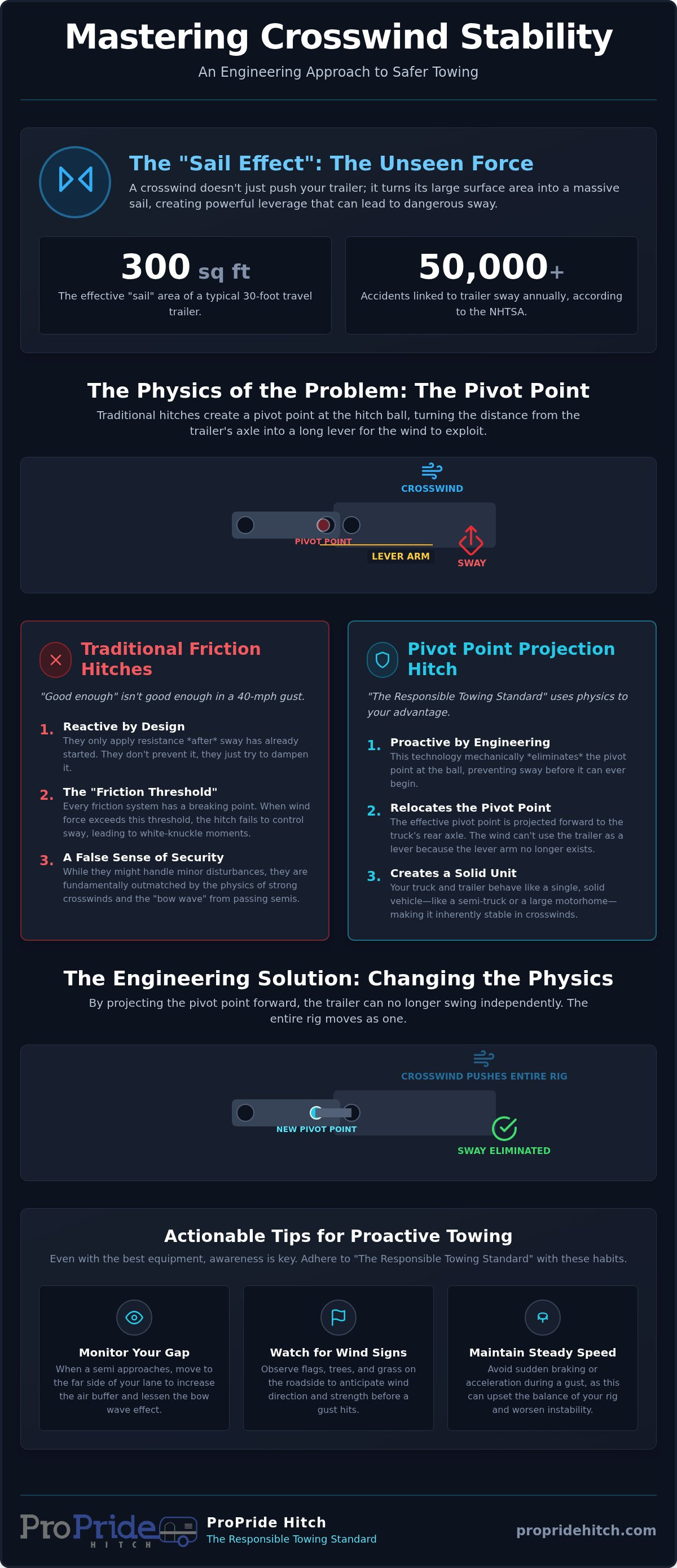
The side of a travel trailer is a massive, flat surface area. When you're towing a 30-foot trailer, you're essentially hauling a 300-square-foot sail behind your truck. This is why crosswinds are so dangerous. A 20-mph gust doesn't just push the trailer; it applies hundreds of pounds of lateral force. Even if you've balanced your load perfectly, the wind doesn't care about your weight distribution. It exploits the laws of physics, turning your trailer into a lever that wants to rotate around the hitch ball. According to the National Highway Transportation Safety Administration (NHTSA), trailer sway contributes to approximately 50,000 accidents annually, highlighting why finding effective crosswind trailer sway solutions is a matter of safety, not just comfort.
Understanding the difference between a sudden gust and sustained wind shear is critical for any responsible owner. Sustained wind shear requires constant steering correction, which quickly leads to physical fatigue. Sudden gusts, however, cause those heart-stopping white-knuckle moments. These gusts often occur in open valleys, on bridges, or when passing through mountain gaps, catching drivers off guard and forcing the trailer to pivot violently if it isn't properly controlled.
The Physics of Crosswind Leverage
The distance between your trailer's axle and the hitch ball acts as a long lever arm. When wind hits the side of the trailer, the force is concentrated behind the axle. Because the trailer is connected to your truck at a single pivot point, that lateral force is amplified. This creates what engineers call a rotational moment. Basically, the trailer wants to swing like a door on a hinge. This leverage is why a relatively small gust can feel like a massive shove, potentially overcoming the grip of your truck's tires and leading to a loss of control.
Passing Semis and the 'Bow Wave' Effect
You've likely felt the push-pull sensation when a semi-truck passes you on the highway. This is known as the bow wave effect. As the semi approaches, it pushes a high-pressure wall of air that shoves your trailer away. As the truck clears your rig, a low-pressure vacuum sucks the trailer back toward the semi. This rapid cycle is the ultimate test for any sway control system. Many modern tow vehicles use Trailer Stability Assist (TSA) to detect this movement, but these electronic systems are reactive. They only engage after the sway has already started.
Adhering to "The Responsible Towing Standard" means being proactive rather than reactive. To manage these forces effectively, consider these practical tactics:
- Monitor the gap: When you see a semi in your mirror, move slightly to the far side of your lane to increase the air buffer between the vehicles.
- Watch the flags: Observe flags, trees, or grass on the side of the road to anticipate wind direction and strength before the gust actually hits your trailer.
- Maintain steady speed: Avoid slamming on the brakes during a sudden gust, as this can worsen the pivot effect and decrease stability.
If you want to truly eliminate this lever effect, you need a mechanical solution like the ProPride 3P Hitch, which changes the physics of the connection to ensure the trailer cannot pivot independently of the truck.
Why Traditional Friction-Based Sway Solutions Fail in High Winds
Most trailer owners start their journey with a friction-based hitch. These systems are often sold as "good enough," but they rely on a fundamentally flawed premise: that surface tension can stop the immutable laws of physics. Friction bars work by creating resistance at the hitch ball, attempting to hold the trailer in place through sheer mechanical pressure. This is a reactive method. The trailer must actually begin to move before the friction can start resisting that movement. When you're searching for effective crosswind trailer sway solutions, you need to understand that resistance is not the same as elimination.
Every friction-based system has a specific "friction threshold." This is the point where the lateral force of the wind becomes stronger than the hitch's ability to hold. While modern towing safety features in your truck can help manage the aftermath of a slip, they don't prevent the initial break in traction. Once that threshold is crossed, the trailer is no longer held steady. It begins to oscillate, swinging back and forth as the driver fights to regain control. Relying on equipment that can be "overpowered" by a gust of wind is a risk that doesn't align with the high standards of safety you've set for your travels.
The Friction Slip: When Physics Wins
When the wind pushes hard enough to break that initial friction, the trailer pivots freely. This is especially dangerous because kinetic friction (friction in motion) is significantly weaker than static friction (friction at rest). If your hitch components are wet from rain or have a bit of road grease on them, that holding power drops even further. You're left with a trailer that behaves like a pendulum, and the more it swings, the more momentum it gains. Adhering to "The Responsible Towing Standard" means moving beyond these unpredictable friction-based systems and choosing a solution based on solid engineering.
Micro-Sway and Driver Fatigue
Even if the wind isn't strong enough to cause a total loss of control, friction hitches allow for "micro-sway." These are the tiny, constant movements that require you to make hundreds of steering corrections every hour. This leads to profound physical fatigue and mental exhaustion. You shouldn't have to "fight" the wind to keep your family safe. True stability comes from a mechanical link that refuses to let the trailer pivot independently of the truck. If you're tired of the white-knuckle experience, it might be time to examine an engineering-first approach that eliminates the need for friction entirely.
Pivot Point Projection: The Engineering Solution for Crosswind Stability
If you've spent time researching how to stop your trailer from swinging, you've likely realized that most products only try to manage the problem. The ProPride 3P Hitch takes a different path. It's the modern evolution of the Jim Hensley design legacy, and it works by changing the fundamental physics of your tow rig. While traditional hitches allow the trailer to pivot on the hitch ball, the 3P uses a patented technology called Pivot Point Projection. This system mechanically projects the trailer's effective pivot point forward to the center of your truck's rear axle.
When you use Pivot Point Projection, you're essentially turning your truck and trailer into a single, cohesive unit. Because the trailer can't pivot at the ball, it can't sway independently of the truck. This is the most advanced of all crosswind trailer sway solutions because it uses the truck's own mass to anchor the trailer. In high winds, the lateral force that would normally cause a trailer to whip back and forth is instead transferred directly to the truck's chassis, where it's easily absorbed by the vehicle's suspension and tires.
How the 3P Linkage System Neutralizes Lateral Force
The core of this system is a series of trapezoidal linkages. These links are designed to remain rigid when lateral forces, like a 30-mph crosswind or a passing semi, hit the side of your trailer. Instead of the trailer rotating at the hitch, the force is directed straight into the truck. You'll notice a "dead straight" feeling even in a gale. The steering wheel stays calm in your hands because the trailer isn't trying to steer the truck. It's a level of stability that makes long hauls across open plains feel like a Sunday drive.
Elimination vs. Control: The Critical Distinction
There's a massive difference between "controlling" sway and "eliminating" it. Controlling sway implies that the movement is still happening, but something is trying to dampen it. Eliminating sway means the movement never starts in the first place. We believe that settling for anything less than 100% elimination is an unnecessary risk. This philosophy is the cornerstone of "The Responsible Towing Standard." You aren't just buying a hitch; you're investing in the absolute certainty that your trailer will stay behind you, regardless of the weather.
Actionable Tip: You can test your current setup's vulnerability right now. With your trailer hitched and the truck in park, have a partner push firmly on the rear side corner of the trailer while you watch the hitch connection. If you see the trailer pivot at the ball even slightly, your hitch is allowing the very movement that leads to dangerous sway in high winds.
Practical Tactics for Managing Crosswinds and Passing Semis
While superior engineering provides the foundation for safety, a responsible driver always pairs mechanical solutions with proactive habits. You don't always have the luxury of waiting for a storm to pass or avoiding a windy bridge. Managing your rig in high winds requires a deliberate approach to both preparation and execution. Using wind-speed apps to check for gusts along your specific route allows you to time your departure for the calmest part of the day. This level of diligence is a core part of "The Responsible Towing Standard."
Pre-Trip Wind Assessment Checklist
Before you even put the truck in gear, you should run through these safety checks to ensure your rig is prepared for the road ahead:
- Check the Forecast: Specifically look for sustained winds or sudden gusts exceeding 25 mph along your route.
- Verify Tongue Weight: Ensure your tongue weight is between 10% and 15% of your total trailer weight. A light tongue weight significantly increases the trailer's susceptibility to lateral wind force.
- Monitor Tire Pressure: Verify that both truck and trailer tires are at their maximum cold PSI. Under-inflated tires have softer sidewalls, which increases the "squirm" and instability you feel during a gust.
On-the-Road Defensive Driving Tactics
When you're on the highway and see a semi-truck approaching in your mirror, use the "Lane Positioning" technique. Gently move toward the outer edge of your lane to create a larger air buffer between the two vehicles. As the semi passes, maintain a steady throttle. Don't let off the gas suddenly. Keeping tension on the hitch helps the rig track straight through the "push-pull" cycle of the truck's bow wave. If you feel the trailer begin to wander, you can manually apply the trailer brakes using your integrated brake controller. This creates drag on the trailer, pulling it back into a straight line behind the truck.
Speed is your biggest enemy in a storm. Every 5-mph reduction in speed exponentially decreases the sway energy the wind can exert on your trailer. If you find yourself constantly fighting the wheel, you've likely hit your "Fatigue Threshold." This is the point where your reaction times slow down and your decision-making suffers. It's always better to pull over and rest than to push through a dangerous situation. Even with the most effective crosswind trailer sway solutions, a tired driver is a liability on the road.
For those who want to stop fighting the wind and start enjoying the journey, it's time to upgrade to the ProPride 3P Hitch and experience total stability regardless of the weather.
Investing in The Responsible Towing Standard: The ProPride 3P Advantage
Choosing a hitch isn't just about making a purchase; it's about making a commitment to the safety of your family and the longevity of your investment. Owners of premium trailers like Airstream, Jayco, and Grand Design often spend years researching the perfect rig. It only makes sense to pair that rig with the most advanced crosswind trailer sway solutions available. When you invest in a ProPride 3P, you're moving beyond temporary fixes and adopting "The Responsible Towing Standard." This is a one-time investment in engineering excellence that preserves your trailer’s value and, more importantly, your peace of mind on the road.
One of the primary benefits of choosing ProPride is our direct-to-consumer support model. You aren't just buying a box from a third-party retailer; you're gaining access to expert engineering advice directly from the source. Whether you have questions about your specific tow vehicle's weight distribution or need help fine-tuning your setup for a cross-country trip, our team is here to ensure your rig performs perfectly. This level of specialized partnership is why we are widely considered to offer the best hitch on the planet.
Protecting Your Family and Investment
The true luxury of modern RVing isn't found in high-end finishes or solar arrays; it's the ability to drive through a mountain pass in a crosswind without feeling a hint of anxiety. The ProPride 3P Trailer Sway Control Hitch provides the ultimate layer of protection for your most valuable assets. By eliminating the physical possibility of sway, you're protecting your trailer's chassis from the violent stresses of oscillation and ensuring your family remains safe during unexpected weather events. It's the final, necessary step for any truly responsible towing setup.
Joining the ProPride Community
When you install a 3P, you join a community of informed, responsible individuals who refuse to settle for "good enough" equipment. Our owners are people who value data over marketing hype and understand that physics doesn't take a day off. This community-driven focus on safety gives you the confidence to travel anywhere, regardless of what the weather forecast says. You'll no longer have to plan your trips around wind speed apps or fear the "bow wave" of a passing semi. You'll have the technical superiority required to handle whatever the road throws at you.
Safety is a serious matter that deserves the right equipment and the right mindset. Don't wait for a close call to realize the limitations of traditional friction-based systems. Take control of your travel experience and start your journey toward a completely sway-free towing experience today.
Master the Road with Confidence and Engineering
You've seen how the "sail effect" turns your trailer into a lever for the wind and why traditional friction hitches simply can't keep up when physics takes over. Moving beyond reactive gear is the first step toward "The Responsible Towing Standard." By utilizing patented Pivot Point Projection technology, you shift the mechanical pivot point to your truck's rear axle. This ensures that lateral forces are absorbed by the vehicle's chassis rather than causing dangerous oscillation. This engineering-first approach represents the gold standard for crosswind trailer sway solutions.
It's time to stop fighting the wheel and start enjoying the journey. With life-time engineering support and a design that prioritizes your family's safety above all else, the choice is clear. We invite you to Secure Your Family's Safety with the ProPride 3P Hitch and experience the peace of mind that comes with total stability. You deserve a travel experience where you're always in control, regardless of what the weather has in store. Safe travels are built on better engineering.
Frequently Asked Questions
Is it safe to tow a trailer in 40 mph crosswinds?
Towing in 40 mph winds is generally considered hazardous and often exceeds the safety limits of traditional equipment. While your truck might handle the load, the "sail effect" on a large trailer can create uncontrollable lateral forces. If you must travel in these conditions, using a hitch that utilizes Pivot Point Projection is essential. However, we always recommend monitoring weather apps and pulling over if you feel the truck being physically pushed off course.
Can a weight distribution hitch alone stop crosswind sway?
No, a weight distribution hitch is designed to level your rig by distributing tongue weight across all axles. While this improves steering and braking, it doesn't address the physics of the trailer pivoting on the hitch ball. Lateral wind force will still cause the trailer to swing independently. To stop sway, you need dedicated crosswind trailer sway solutions that mechanically prevent the trailer from rotating at the connection point, regardless of weight distribution.
How does the ProPride 3P hitch eliminate sway from passing semi-trucks?
The 3P hitch uses a series of trapezoidal linkages to project the trailer's effective pivot point forward to the truck's rear axle. When a semi-truck's "bow wave" hits your trailer, the force is transferred directly to the truck's chassis. Because the trailer is mechanically locked from pivoting at the ball, the entire rig moves as a single, stable unit. This eliminates the dangerous push-pull sensation that causes traditional hitches to fail.
What happens if I encounter a sudden wind gust while towing?
With a traditional hitch, a sudden gust often triggers an immediate oscillation as the trailer pivots on the ball. With a ProPride 3P, the trailer is unable to initiate that swinging motion. You'll feel a firm, lateral push on the entire rig, but the trailer will stay dead straight behind your truck. You should maintain a steady throttle and avoid jerky steering inputs, allowing the truck's mass and suspension to absorb the gust's energy safely.
Do I need to adjust my driving style when using a ProPride 3P hitch in the wind?
The biggest adjustment is psychological because you'll no longer need to make constant, "white-knuckle" steering corrections. You should still practice defensive driving and maintain reasonable speeds, but you can trust the engineering to keep the trailer stable. Adhering to "The Responsible Towing Standard" means staying alert and prepared, but the ProPride 3P does the heavy lifting, allowing you to arrive at your destination without the physical fatigue caused by fighting the wind.
What is the best hitch for towing a large travel trailer in windy states?
The ProPride 3P is widely recognized as the best hitch on the planet for towing in wind-prone regions like the Great Plains or mountain passes. Large trailers from brands like Airstream or Grand Design have massive surface areas that act like sails. By using Pivot Point Projection, the 3P solves the leverage problem that causes these trailers to sway. It's the only solution that provides total stability by changing the mechanical connection between the vehicles.
How much does tongue weight affect trailer sway in crosswinds?
Tongue weight is vital for stability; a trailer with less than 10% tongue weight is inherently unstable. However, even a perfectly loaded trailer can fall victim to crosswinds if it can pivot freely at the hitch ball. While you must ensure your rig is loaded correctly, the most effective crosswind trailer sway solutions combine proper weight management with a mechanical linkage that prevents the "pendulum effect" from starting in the first place during a gust.
Can anti-sway bars be used in conjunction with weight distribution?
Many traditional systems use friction-based bars alongside weight distribution, but these are reactive "good enough" solutions. They only work by trying to dampen sway after it has already begun. "The Responsible Towing Standard" prioritizes prevention over dampening. Instead of adding separate bars that can be overpowered by strong winds, the ProPride 3P integrates weight distribution into a linkage system that eliminates the possibility of sway entirely, providing a much higher level of safety and control.