
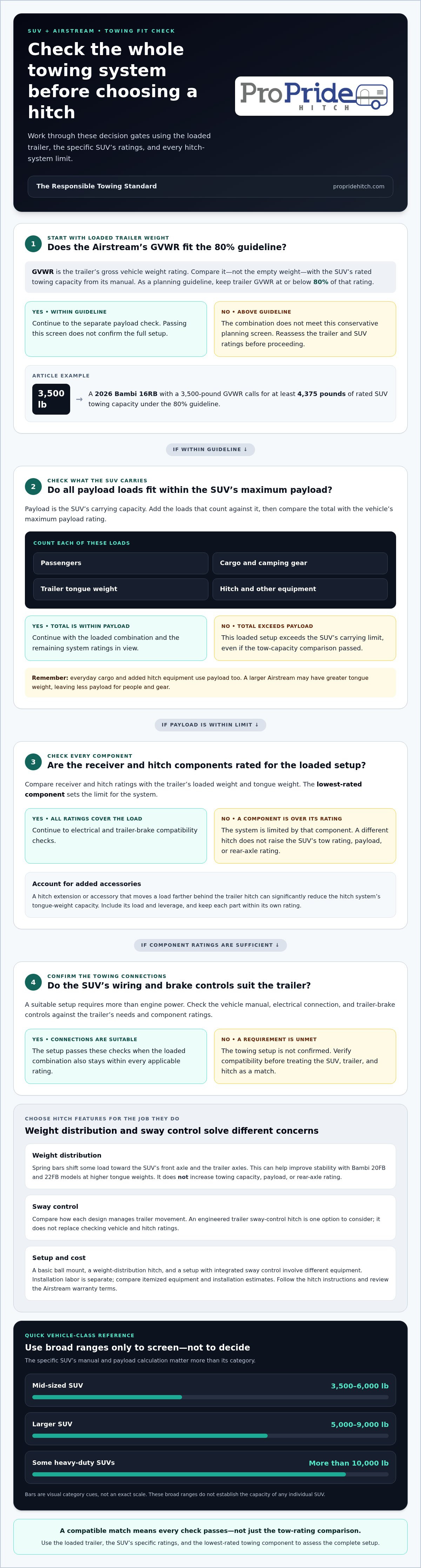
The best hitch for towing an Airstream with an SUV is one that matches the fully loaded trailer and stays within every limit of the SUV, hitch, and towing equipment. A practical screening guideline is to keep the trailer’s gross vehicle weight rating (GVWR) at or below 80% of the SUV’s rated towing capacity.
Checking towing capacity is only the starting point. Passengers, cargo, and tongue weight also count against the SUV’s payload, while the receiver rating, wiring, and brake-controller setup must suit the trailer. This guide explains how to compare those limits, choose weight distribution and sway control, and recognize when an SUV is not the right match. The goal is a compatible setup that lets you make an informed decision before towing.
Key Takeaways
- Compare the Airstream’s loaded weight with the SUV’s towing rating, then account for passengers, cargo, and tongue weight within payload limits.
- Choose weight distribution and sway control based on the trailer and vehicle setup; these systems address different towing concerns.
- Confirm the SUV’s hitch, wiring, and brake-controller setup can support the trailer and its brakes.
- Use the lowest-rated part of the towing system as the limit, and consider how added cargo or hitch accessories affect available capacity.
- Use the article’s decision guide to compare your SUV, Airstream, and hitch as one complete towing system.
SUV towing capacity and payload limitations
Start with the Airstream’s GVWR, not its empty weight, and compare it with the SUV’s rated towing capacity. The 80% guideline gives a conservative starting point: a 2026 Bambi 16RB with a 3,500-pound GVWR calls for at least 4,375 pounds of rated towing capacity.
Vehicle Towing-Capacity Limits
An SUV’s tow rating is a ceiling, not a target that every hitch can raise. The vehicle’s manual gives the rating for its specific configuration, while payload measures how much weight it can carry, including occupants, cargo, and trailer tongue weight. Unlike the 80% guideline or broad SUV-class ranges, these limits apply to the particular tow vehicle and must be assessed together.
The 80% Tow-Capacity Rule
The 80% rule is a planning guideline: keep the trailer’s GVWR at or below 80% of the SUV’s rated towing capacity. It leaves more room between the planned trailer weight and the vehicle’s maximum rating than simply matching the two figures.
SUV Towing-Capacity Ranges
Broad ranges help screen vehicle types, but they don’t establish what a specific SUV can tow. Mid-sized SUVs are described as capable of towing 3,500-6,000 pounds; larger SUVs, 5,000-9,000 pounds; and some heavy-duty SUVs, more than 10,000 pounds. Unlike the manual’s vehicle-specific rating, these ranges are only a starting point for comparing classes.
Payload can rule out a setup even when the SUV’s tow rating appears adequate. Add the weight of passengers, cargo, and the trailer’s tongue weight, then compare the total with the SUV’s maximum payload. The payload limit must exceed that combined load. Include the weight of the hitch and any other equipment carried by the SUV, since they also use payload.
| SUV category | Typical towing-capacity range | How to use the comparison |
|---|---|---|
| Mid-sized SUV | 3,500-6,000 pounds | Compare its specific rating with the Airstream’s GVWR. |
| Larger SUV | 5,000-9,000 pounds | Check both towing capacity and remaining payload. |
| Some heavy-duty SUVs | More than 10,000 pounds | Confirm the individual vehicle’s ratings and limits. |
Choose based on the specific SUV’s manual and payload calculation, not its vehicle category alone.
Use this sequence before selecting a hitch: identify the Airstream’s GVWR, find the SUV’s tow rating in its manual, and apply the 80% guideline as a screening step. Then do the separate payload calculation. For example, an SUV may pass the towing-capacity comparison but exceed its payload once passengers, camping gear, and tongue weight are counted. A daily driver’s everyday cargo matters too, because it can reduce the capacity available for a towing trip.
Weight-distribution and sway-control hitch setup
Weight distribution and sway control address different parts of an Airstream towing setup. Match both to the loaded trailer, SUV ratings, and hitch limits.
Payload, Passengers, Cargo, and Tongue Weight
Passengers, cargo, and tongue weight all use the SUV’s payload, its carrying capacity. Add these loads and compare the total with the vehicle’s maximum payload rating. A larger Airstream may have greater tongue weight, leaving less payload for people and gear. This is separate from sway control: payload measures what the SUV carries, not how the trailer responds to movement.
Hitch Weight and Weight-Distribution Hitches
A weight-distribution hitch uses spring bars to shift some load toward the SUV’s front axle and the trailer axles. It can help improve stability with Bambi 20FB and 22FB models at higher tongue weights. It doesn’t increase the SUV’s towing capacity, payload, or rear-axle rating.
For payload, rear-axle limits, and towing capacity, treat weight distribution as load management, not added capacity. It can change how weight is carried, but the SUV and hitch ratings still apply. Set up the system according to its instructions, and keep the fully loaded combination within every applicable rating.
Accessory Load and Tongue-Weight Reduction
Hitch extensions and accessories that move a load farther behind the trailer hitch can significantly reduce the hitch system’s tongue-weight capacity. This differs from a weight-distribution hitch, which redistributes load but does not increase the hitch rating. Before adding a carrier or extension, account for its load and leverage. Keep each component within its own rating.
Hitch System Costs and Installation
Hitch setups differ in components and installation needs, so compare the complete system rather than the hitch alone. A basic ball mount, a weight-distribution hitch, and a setup with integrated sway control each involve different equipment. Installation labor is a separate cost, and no single price applies to every option. Compare itemized estimates for the equipment and installation work.
A weight-distribution hitch transfers load through its bars, so correct setup matters to the trailer frame. Warranty coverage is governed by the written terms for the Airstream and its hitch setup instructions. Review those terms before choosing a system, and follow the hitch manufacturer’s fitting and adjustment directions.
For sway control, compare how each design manages trailer movement, alongside its weight and ratings. An engineered trailer sway-control hitch is one option to consider as part of that comparison.
Hitch, wiring, and brake-controller requirements
A suitable Airstream towing setup needs more than enough engine power: the SUV’s receiver, electrical connection, and trailer-brake controls must work together. Before buying a hitch package, check the vehicle manual, component ratings, and applicable U.S. requirements separately.
Match the Hitch to the SUV and Trailer
Compare the receiver’s rating with the trailer’s loaded weight and tongue weight, then treat the lowest-rated component as the system limit. A higher tow rating does not override the hitch’s separate limit.
Read the SUV manual for its specific configuration and permitted hitch setup. Factory equipment can affect compatibility, so record the receiver rating and the trailer’s loaded figures before selecting a package. A vehicle described as tow-ready still needs to meet the listed ratings. Confirm that the receiver, ball mount, and coupler fit together and remain within their individual limits.
Check Wiring and Trailer Brakes
The electrical connection must support the Airstream’s lighting and braking functions. The SUV must also support a trailer brake controller, which lets the driver operate the trailer’s brakes. Before travel, connect the trailer and test its lights and brakes. If the controller or wiring is faulty, the tow vehicle and trailer are not functioning as a complete system.
Electrical needs vary by model. The Airstream Basecamp 20Xe has a fully inverted 30-amp electrical system, a detail relevant to its onboard power setup. That figure isn’t a substitute for matching the trailer’s towing connection to the SUV. Check the specific Airstream and vehicle instructions for compatible wiring and control equipment.
U.S. Rules and Safety Checks
For U.S. towing, account for applicable state requirements alongside the SUV and Airstream instructions. No single equipment checklist replaces these checks. As a practical baseline, confirm the rated hitch connection, working trailer lights, and compatible brake-controller support before departure. Keep the loaded combination within the lowest applicable vehicle or equipment rating.
A useful pre-trip sequence is straightforward:
- Compare the trailer’s loaded weight and tongue weight with the SUV and hitch ratings.
- Connect the wiring and test the Airstream’s lights.
- Confirm the brake controller operates the trailer brakes.
- Recheck the connections after loading the vehicle and trailer.
Make the final decision from the exact vehicle and trailer manuals, not a general package label. A 2016 Chevy Express 3500 example shows why ratings must be read together: a commenter reported a 6,000-pound hitch rating and a 9,300-pound tow rating with weight distribution. Those figures describe different limits, so neither should stand in for the other. Match the factory setup, loaded trailer, and electrical controls before calling the combination towable.
Tow rating and trailer loading
A trailer’s dry weight is only its starting weight. Compare the Airstream’s GVWR, its maximum permitted loaded weight, with the SUV’s rating, then account for the weight added for travel. A 2026 Bambi 20FB and 22FB each have a 5,000-pound GVWR, while a World Traveler 22RB has a 4,500-pound maximum GVWR.
Model size alone doesn’t determine the match. A Basecamp 16X has a 3,500-pound GVWR, while a Basecamp 20X has a 5,000-pound GVWR. That calculation is a starting point, not a substitute for checking payload and other ratings.
Loading changes the comparison. Passengers and gear also use the SUV’s payload, so a camper that falls within the tow rating can still exceed another vehicle limit.
Use the Airstream’s GVWR as an upper-bound planning check, then determine the actual loaded trailer weight. Include water, food, clothing, outdoor equipment, and other travel cargo. Distribute cargo thoughtfully and follow the trailer and vehicle instructions. A tow package does not erase the limits of the vehicle, hitch, or payload. Keep every load within the lowest applicable rating.
- Record the Airstream model and GVWR, such as the 5,000-pound Bambi 20FB.
- Estimate the fully loaded trailer, not just its dry or base weight.
- Count passengers and SUV cargo when calculating available payload.
- Include tongue weight in the SUV’s payload assessment.
- Weigh the loaded tow vehicle and trailer combination to understand actual loads.
Mountain routes make careful matching especially important because grades place different demands on the tow vehicle than level roads. They don’t change the ratings. A 2026 Bambi 22FB remains a 5,000-pound GVWR trailer whether the trip crosses flat ground or climbs a pass. Plan around the vehicle’s documented limits and the load you’ll actually carry.
Before departure, compare the loaded combination with the SUV’s towing, payload, and gross combined weight ratings. Gross combined weight rating is the maximum combined weight of the vehicle, trailer, passengers, and cargo. Weighing the loaded rig on a scale helps establish whether actual travel loads match your calculations. If passengers or equipment push any component beyond its rating, reduce the load or choose a more capable tow vehicle.
How do I match hitch capacity to an Airstream’s gross vehicle weight and tongue weight?
Match the hitch to two separate loads: the Airstream’s total loaded weight and the downward load at the hitch. Gross vehicle weight rating (GVWR) is the trailer’s maximum permitted total weight; tongue weight is the portion pressing down on the tow vehicle. Neither figure replaces the SUV’s own towing, payload, or hitch ratings.
Use this sequence to compare capacity:
- Find the Airstream’s maximum weight or GVWR and its stated hitch weight.
- Compare the loaded trailer weight with the SUV’s towing rating.
- Compare tongue weight, passengers, and cargo with SUV payload and hitch limits.
- Keep every load within the lowest-rated component in the towing system.
An Airstream International Signature 25 FB Twin illustrates why both trailer figures matter. The base figure describes the trailer before travel loading; the maximum figure leaves room for added contents. The hitch figure is a separate load to include when assessing the SUV and hitch.
Actual loading changes the result. An adequate tow rating does not prove that the tongue weight is within limits. Compare the loaded trailer and tow vehicle with their respective ratings, and account for hitch hardware carried by the SUV.
Hitch ratings cover different limits. A system may have one maximum for trailer weight and another for tongue weight. Check each rating against the corresponding load rather than comparing the trailer’s GVWR with a tongue-weight limit. A hitch cannot increase the vehicle’s capacity, so check its limits for both towing and tongue weight.
Use the Airstream’s maximum weight as a planning boundary, then weigh the loaded combination to understand actual loads. A scale reading can distinguish a lightly packed trailer from one carrying full travel gear. If the loaded trailer approaches its maximum or the tongue weight strains the SUV’s available payload, reduce cargo or choose a more capable tow vehicle. A higher hitch rating alone cannot resolve a vehicle-capacity shortfall.
Before choosing a hitch, record the Airstream’s model, maximum weight, and hitch weight alongside the SUV’s towing, payload, and hitch limits. For the 25 FB Twin example, evaluate the 7,500-pound maximum and 837-pound hitch weight separately. This comparison identifies which limit governs the setup and helps prevent one adequate rating from masking another exceeded limit.
ProPride: ProPride 3P Hitch
The ProPride 3P Hitch uses patented Pivot Point Projection technology to completely eliminate trailer sway. If your SUV and Airstream meet their towing, payload, and hitch limits, but sway control remains a key concern, it offers a focused next step. It can’t increase the vehicle’s ratings, so complete those capacity checks before choosing a hitch.
Consider how the sway-control design suits your towing priorities and the loaded combination you have assessed. That measured approach reflects The Responsible Towing Standard: choose equipment with the whole towing system in mind.
To explore the ProPride 3P Hitch, visit the ProPride 3P Hitch page.
Plan Your Next Towing Setup with Confidence
Turn your research into a clear setup plan by listing your priorities, such as predictable handling, a comfortable driving experience, or flexibility in how you load the Airstream. Use those priorities to assess whether a hitch design suits your towing goals. The best hitch for towing an Airstream with an SUV is a considered choice, not simply the most elaborate option or the one with the highest rating.
Gather your vehicle and trailer information in one place, and note any questions about how a hitch fits your setup. A focused conversation can clarify the available option and help you decide what to explore next. Responsible preparation makes this important equipment decision more deliberate and gives you a stronger foundation for future trips.
Contact ProPride about your towing setup and take the next step toward a confident Airstream towing plan.
Frequently Asked Questions
What hitch types are best for towing an Airstream with an SUV?
The best hitch for towing an Airstream with an SUV depends on your driving priorities and the specific equipment pairing. A conventional hitch provides the connection; a weight-distribution design adds load-balancing components; and a pivot-point projection system uses a different approach to sway control. Compare how each design works, what setup it requires, and whether it suits your trailer and tow vehicle. Priorities such as sway management can narrow the options.
Which weight-distribution hitch models are compatible with Airstream trailers and SUVs?
Compatibility is specific to the hitch capacity, trailer, and SUV receiver. The ProPride 3P Hitch has capacity options of 600 lb, 800 lb, 1000 lb, and 1400 lb. Use the Airstream’s measured tongue load in its travel-ready configuration to identify a suitable option, then compare the receiver and vehicle limits. Keep the trailer and vehicle manuals available while reviewing the hitch’s model-specific fitting instructions.
Does an Airstream require a weight-distribution hitch, and what does Airstream recommend?
No single hitch type is required for every Airstream and SUV pairing. Follow the guidance for the exact trailer model and tow-vehicle configuration, as recommendations can vary by setup. Keep those instructions handy when comparing hitch options. If the trailer guidance calls for a particular arrangement, use it as a selection criterion rather than assuming another design is interchangeable.
What is the ideal tongue-weight percentage for towing an Airstream with an SUV?
There is no universal percentage for every Airstream and SUV pairing. Use the trailer’s model-specific loading guidance and the allowable tongue-weight limits for the hitch and tow vehicle. For a useful comparison, calculate tongue weight as a share of total trailer weight using measurements taken under the same loading conditions. Keep cargo placement consistent so any changes reflect the setup, not a different load.
Which hitch provides the best sway control for an Airstream and SUV?
The ProPride 3P Hitch uses Pivot Point Projection, which places a virtual pivot point near the tow vehicle’s rear axle. This shortens the lever arm through which trailer movement can influence the vehicle. For a driver comparing the best hitch for towing an Airstream with an SUV, that mechanical design is a distinct approach to sway control. Consider how it fits your vehicle, trailer, and towing priorities.
How do I choose and set up a weight-distribution hitch for an SUV and Airstream?
Choose a hitch that suits the trailer and vehicle, then follow its assembly and adjustment instructions. Set up on level ground with the vehicle and trailer loaded as they will be for travel. Record the adjustment positions so you can identify changes after repacking or altering the vehicle’s cargo. Before towing, inspect the connections and confirm that hitch components are secured as directed by their manufacturers.