
What if the hitch adjustment meant to level your tow vehicle is making the combination less balanced? Yes, you can have too much weight distribution: spring bars that are too strong or adjusted too aggressively can unload the tow vehicle’s rear axle, making the ride harsh or unsettled.
It makes sense to focus on sag when a trailer is attached, but a level-looking vehicle isn’t the only measure of a sound setup. The goal is to distribute the load appropriately, not to apply as much spring-bar force as possible. Too little or too much load transfer can affect how the vehicle and trailer respond on the road.
This article explains how excessive or imbalanced weight distribution can affect trailer sway, vehicle sag, towing capacity, and hitch choice. You’ll also learn why tongue weight and spring-bar rating matter, which signs may point to an adjustment problem, and why tightening a hitch isn’t a substitute for matching the setup to the trailer and tow vehicle. Understanding the forces at work is a practical part of The Responsible Towing Standard.
Key Takeaways
- Match spring-bar strength to the trailer’s loaded tongue weight; bars that are too strong can create a harsh, unsettled ride.
- Use vehicle sag as a clue, not the only measure of a balanced setup. Tongue weight and how the hitch transfers load also matter.
- Understand the limits of the tow vehicle, hitch receiver, and trailer frame before relying on weight distribution to support a heavier load.
- Set the hitch within its recommended adjustment range rather than tightening it simply to make the vehicle look level.
- Learn how hitch design affects sway control so you can choose equipment that suits your towing priorities.
Trailer sway and weight distribution
Yes, you can have too much weight distribution. Excessive load transfer can unload the tow vehicle’s rear axle, affecting tire loading, steering, braking, and handling.
Weight distribution can influence trailer sway, but it can’t replace a balanced, properly loaded trailer. The effect depends on how the hitch transfers load between the tow vehicle’s axles.
Effects on trailer sway
Trailer sway is side-to-side movement between a trailer and tow vehicle while traveling. Weight distribution affects how the combination carries its load, so an imbalance can change how steadily it tracks. A hitch setup that feels firm at low speed may respond differently when the trailer starts moving laterally on the road.
More spring-bar force doesn’t automatically mean less sway. If the bars are rated far above the trailer’s tongue weight, they can make the ride stiff or cause porpoising and jerking over bumps. These reactions can make it harder to judge whether the trailer is tracking smoothly, although they don’t prove that sway is occurring.
Separate the symptoms before changing the setup. Side-to-side trailer movement points to sway; repeated bouncing or sharp jolts over uneven pavement point to a ride-quality concern. Note when the movement happens, such as after a bump or during a lane change. That can help distinguish trailer motion from a stiff spring-bar response.
Braking, steering, and handling effects
Braking, steering, and handling depend partly on how the tow vehicle’s tires carry its load. If a weight-distribution hitch transfers too much load away from the rear axle, its tires carry less of the vehicle’s weight. The rear axle also helps guide the tow vehicle and maintain predictable behavior during braking and turns.
Look beyond a level vehicle stance. A setup that reduces visible sag may still transfer too much load if spring-bar force is excessive. If the steering feels different after hitch adjustment, or bumps produce repeated pitching, reassess the setup rather than tightening it further.
Compare the spring-bar rating with the trailer’s tongue weight and the hitch’s recommended range. Some weight-distribution systems let owners replace spring bars; others require replacing the assembly. This matters if a change to the trailer makes the existing bars a poor match. Don’t assume firmer bars will improve control. The right match supports balanced handling without unnecessary stress.
For a practical assessment, note whether the trailer sways, bounces, or jerks, and under what road conditions. Then consider the bar rating and load transfer together. These details can help identify whether the concern is sway, excessive spring force, or another part of the towing setup.
Vehicle sag and trailer tongue weight
Vehicle sag is a visible clue, but it doesn’t tell you whether the load is balanced. Trailer tongue weight, spring-bar force, and axle loading all affect the tow vehicle’s stance.
Signs of excessive hitch distribution
Signs of excessive weight distribution can include a tow vehicle whose front end sits unusually low, a harsh ride, or repeated pitching over bumps. Spring bars can transfer too much load away from the rear axle, even if they reduce visible sag.
Compare the vehicle’s stance before and after hitching on the same level ground and with the same load. Then note how it responds on a familiar road. A stiff, jerking ride over bumps is a reason to reassess the setup, not simply tighten it further.
Measuring and adjusting hitch settings
Assess weight distribution by comparing axle loads and vehicle stance with the trailer attached against the tow vehicle’s unhitched baseline. Appearance alone can’t show how much load each axle carries.
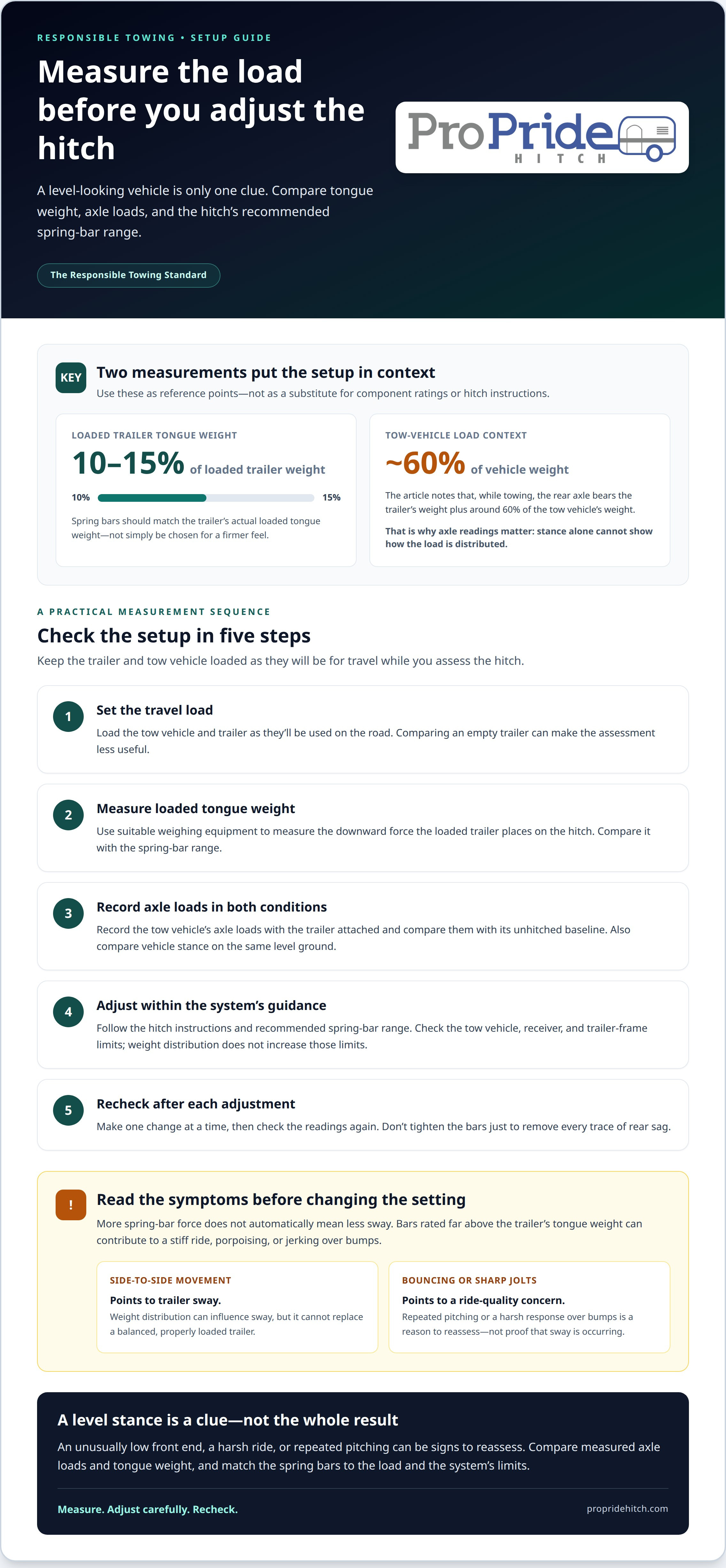
Measure the loaded trailer’s tongue weight with suitable weighing equipment, then record the tow vehicle’s axle loads in both conditions. Adjust the hitch according to its instructions and recommended spring-bar range. Recheck the readings after each adjustment instead of making several changes at once.
Overly tight settings can apply excessive force, so don’t use the bars merely to eliminate every trace of rear sag. Keep the trailer and tow vehicle loaded as they’ll be for travel while assessing the setup. This makes the comparison more useful than measuring an empty trailer.
Rear axle weight unloading
When a weight-distribution hitch unloads too much weight from the rear axle, the rear tires carry less of the tow vehicle’s load. Axle loading affects the balance of the towing combination.
While towing, the rear axle bears the trailer’s weight plus around 60% of the tow vehicle’s weight. Excessive transfer changes that load relationship. If the rear feels unusually light or the vehicle’s handling changes after adjustment, reassess the spring-bar force and compare axle readings instead of relying on stance alone.
Tongue weight and hitch ratings
Tongue weight is the downward force the loaded trailer places on the hitch. It typically represents 10-15% of the trailer’s fully loaded weight. This range matters because spring bars should suit the actual tongue weight, not simply be chosen for a firmer feel.
Match the hitch’s spring-bar range to the trailer’s tongue weight, and account for the trailer frame’s weight-distribution limit. Settings beyond what the frame can handle can add stress, especially on trailers with lighter frames. The tow vehicle’s hitch receiver rating matters too. Follow the ratings and instructions for each part, since the setup’s limits aren’t determined by one component alone.
Weight distribution and towing capacity
Weight-distribution equipment doesn’t erase a tow vehicle’s or trailer’s capacity limits. The permitted setup depends on the ratings for the vehicle, receiver, hitch, and trailer frame.
Manufacturer limits for weight distribution
Manufacturer limits define the maximum loads and hitch use each component is designed to handle. They matter because a higher rating on one part doesn’t raise the limits of the others.
For example, a vehicle label may allow towing up to 12,000 lbs with weight distribution, compared with 8,000 lbs without it. That is one vehicle’s rating example, not a general increase for every tow vehicle. Check the owner’s manual and vehicle label for the applicable towing limits and conditions.
Receiver ratings matter too. A weight-distribution system requires a receiver rated for that purpose, typically a Class III, IV, or V receiver. These classes indicate receiver capacity categories; the actual limit depends on the specific receiver. The trailer frame may also have its own maximum rating. The lowest applicable limit still constrains the combination, even if the hitch or tow vehicle has a higher rating.
A vehicle’s manual may also specify when weight distribution and sway control are required. For example, the 2018 Chevy Traverse owner’s manual requires both when towing more than 5,000 lbs. That instruction applies to that model and should not be treated as a rule for other vehicles.
Choosing a weight distribution amount
The right amount is the force needed to meet the vehicle’s instructions and balance the loaded combination without exceeding any component’s rating. Excessive spring-bar force can unload the rear axle or stress the trailer frame.
Size the weight-distribution hitch for the trailer’s weight range, not simply for the tow vehicle. Choose spring bars suited to the trailer’s actual tongue weight and follow the hitch’s recommended range. A higher rating isn’t automatically a better match.
For context, a trailer’s tongue weight is typically 10-15% of its fully loaded weight. Because cargo changes the loaded weight and tongue load, a setup that suited an empty trailer may not suit it after packing. Base the choice on the loaded configuration and the relevant ratings.
Some tow vehicles specify weight distribution above a particular trailer weight, while others set different conditions. Treat each manual, label, receiver, and trailer-frame limit as part of one system. Weight distribution can affect the permitted towing rating only where the vehicle’s own specifications allow it. It doesn’t make an over-limit combination acceptable.
When a weight distribution hitch may be needed
A weight-distribution hitch may be appropriate when the trailer load places substantial weight on the tow vehicle’s rear axle. One guideline says it may be recommended when the trailer’s gross weight exceeds 50% of the tow vehicle’s gross vehicle weight rating, or GVWR. That comparison is a screening point, not a universal requirement.
GVWR is the maximum loaded weight specified for the tow vehicle. Gross trailer weight is the trailer’s total weight when loaded. Compare those figures with the vehicle and trailer ratings, then follow the tow vehicle manufacturer’s instructions. A percentage-based guideline cannot override a manual that sets different conditions for a specific model or configuration.
The need for weight distribution depends on more than a vehicle’s appearance. Rear-end sag can signal that the trailer is loading the tow vehicle, but appearance alone can’t establish whether the hitch is required or correctly set. A vehicle may look level while exceeding a rating, or show some sag while remaining within its manufacturer’s limits.
- Review the tow vehicle manual. Find the stated towing conditions and whether weight distribution is recommended or required for your configuration.
- Compare loaded weights with ratings. Include passengers, cargo, and trailer contents in the relevant totals, not just the trailer’s empty weight.
- Consider the complete setup. The receiver, hitch, trailer frame, and tow vehicle each have limits that still apply when using weight distribution.
The 50% guideline can help identify when closer attention may be useful. For example, if a trailer’s gross weight is more than half the tow vehicle’s GVWR, examine the manual’s instructions and ratings before towing. Don’t treat that comparison as permission to exceed the vehicle’s towing capacity, payload, or any hitch component’s limit.
Weight distribution can transfer some load from the tow vehicle’s rear axle toward its front axle and the trailer axles. This may help address the load effects of a substantial trailer, but it can’t increase every rating or correct poor loading. If cargo is concentrated at one end of the trailer, redistribute it appropriately before relying on hitch adjustment.
Use the manufacturer’s specific criteria rather than choosing a hitch solely because the trailer appears heavy. A percentage guideline, a vehicle manual, and the ratings for the tow vehicle, receiver, and trailer frame each address different parts of the decision. Together, they help determine whether weight distribution belongs in the setup and which limits must still be respected.
Can a weight-distribution hitch be adjusted too tightly?
Yes. A weight-distribution hitch can be adjusted too tightly when its spring bars apply more force than the setup needs. Spring bars have a recommended weight range and can be adjusted within that range. Staying within it matters because extra tension doesn’t automatically improve towing control.
Spring bars transfer some load from the tow vehicle’s rear axle toward the front axle and trailer. More tension increases that transfer. If the bars are too strong for the trailer’s tongue weight, the combination may ride stiffly or react sharply over bumps. Some owners report porpoising, a repeated pitching motion, or jerking as signs of an overly rigid setup.
Look for a pattern, not one isolated bump. If the trailer and tow vehicle bounce repeatedly on uneven pavement, or the ride becomes harsher after increasing tension, reassess the adjustment. These symptoms don’t prove the hitch is too tight, but they’re useful clues. Compare the spring-bar rating, loaded tongue weight, and hitch instructions before making another change.
A level vehicle stance isn’t the only adjustment target. Tightening the hitch just to remove all visible rear sag can transfer more load than needed. That may reduce the load carried by the rear axle and place additional stress on a trailer frame, particularly one built with lighter materials. Use the vehicle and hitch instructions to guide adjustment, not appearance alone.
For a more controlled adjustment, make one change at a time and note what changes on the vehicle and trailer. Keep the trailer loaded as it will be for travel, since cargo affects tongue weight. If the ride gets worse after an adjustment, return to the previous setting before assessing another change. Don’t assume a firmer spring-bar setup means better balance.
- Match the spring-bar range to the trailer’s loaded tongue weight.
- Use the hitch maker’s recommended adjustment range and sequence.
- Watch for repeated pitching, jerking, or a newly harsh ride after changes.
- Consider the trailer-frame rating as well as the tow vehicle and hitch limits.
Some weight-distribution systems allow spring-bar replacement, while others require replacing the full assembly. This matters if a change to the trailer makes the existing bars unsuitable. A heavier trailer may need a different bar rating, but the replacement must still fit the hitch system and stay within the trailer frame’s limit. Adjust for the actual load, not the maximum force the bars can apply.
Forum participants advised matching bars closely to the trailer because overly strong bars can unload the tow vehicle’s rear axle. They recommended a hitch suited to the trailer’s weight range for a smoother ride and proper handling.
ProPride
ProPride offers the ProPride 3P Hitch for drivers whose main concern is trailer sway. Its patented Pivot Point Projection technology changes where the trailer pivots in relation to the tow vehicle, helping reduce sway. It is designed to greatly limit trailer sway, but no hitch can guarantee sway will never occur. It’s a distinct consideration when choosing equipment: weight distribution manages how the load is shared, while sway control addresses trailer movement.
Keep the fundamentals in view. Match the hitch to the trailer and its loaded tongue weight, follow the relevant vehicle and trailer ratings, and don’t use adjustment to compensate for an overloaded setup. The Responsible Towing Standard starts with understanding what each part of the towing system does.
For details about the ProPride 3P Hitch, contact ProPride to discuss your towing questions.
Make Your Next Towing Decision With Confidence
Knowing that you can have too much weight distribution changes the next step: instead of chasing a perfect-looking stance, keep a repeatable record of your towing configuration. Note the tow vehicle, trailer, cargo arrangement, and hitch setup, along with what you notice on the road. This gives you a useful baseline to revisit after changing equipment, cargo, or trailers.
Use that record to identify what you want your next setup to address. Is your priority understanding how the combination responds, or choosing equipment designed to address trailer sway? A clear goal helps you evaluate your options deliberately instead of making adjustments by guesswork. That preparation reflects The Responsible Towing Standard.
If trailer sway is shaping your next hitch decision, contact ProPride about your towing setup. Keep asking informed questions and make each decision with care. You’re building a more confident foundation for the road ahead.
Frequently Asked Questions
What Is Imbalanced Weight Distribution?
It’s a mismatch between the load a towing setup is intended to carry and how it’s actually carried. A level-looking vehicle alone can’t establish whether the setup is balanced. For instance, if the trailer’s stance changes after cargo is added, reassess the loaded configuration rather than assuming the hitch setting is the cause. Treat visible signs as prompts to investigate, not a diagnosis by themselves.
What Happens to Your Vehicle When you Tow a Trailer?
Your vehicle and trailer move as a connected combination, so the trailer affects how you plan turns and use your mirrors. For example, a trailer may track inside the tow vehicle’s path around a corner. Allow room for that path, and use your mirrors to monitor the trailer through the turn. These driving adjustments help you account for the trailer’s position, not just what you see ahead.
What does weight distribution mean for a vehicle and trailer?
The phrase can describe either how a connected combination carries its load or the hitch system designed to shift some load between axles. Those meanings are related, but they aren’t interchangeable. For example, a trailer can have a well-positioned cargo load while its hitch still needs adjustment. Be clear about which meaning you’re discussing when assessing a towing setup or comparing hitch functions.