
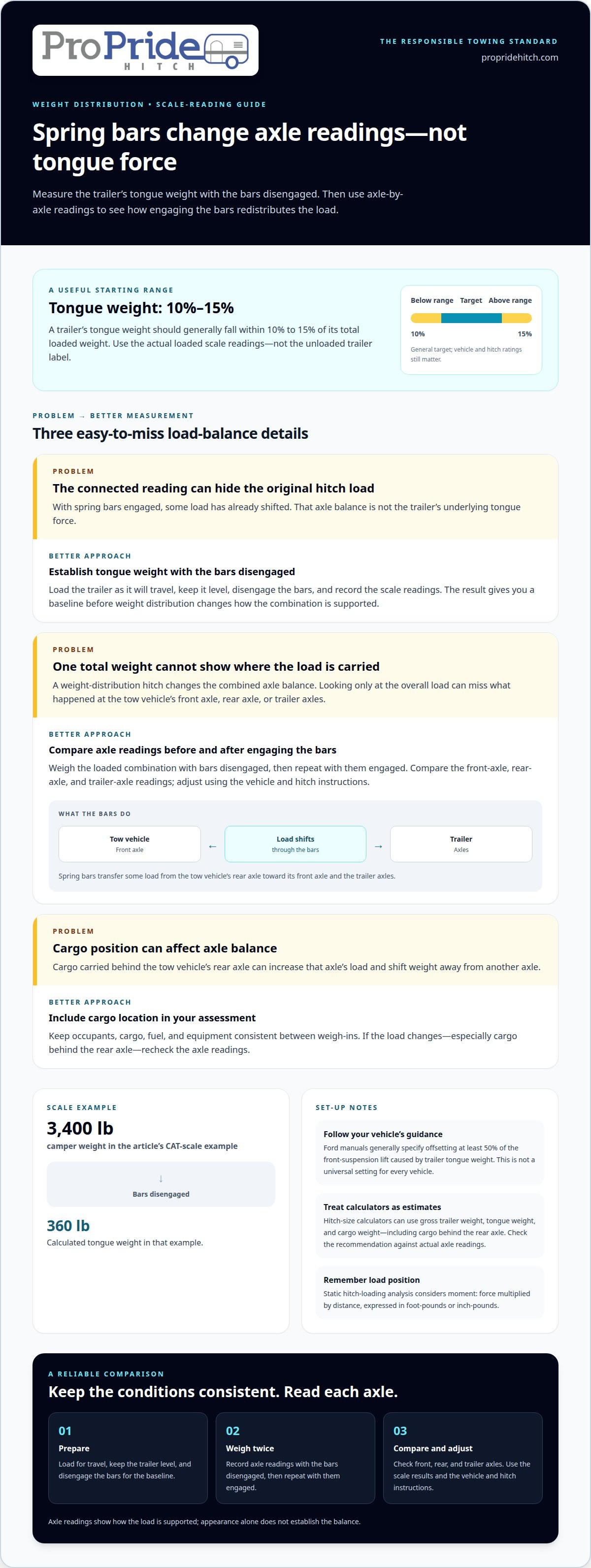
Spring bars can change the scale reading, but they don’t change the trailer’s underlying tongue force. For calculating the correct weight distribution setup, measure tongue weight with the bars disengaged; a trailer’s tongue weight should generally fall within 10% to 15% of its total loaded weight. Once the bars are engaged, they redistribute load among the trailer axles and the tow vehicle’s front and rear axles, so those scale readings describe a different load balance.
It’s easy to assume the reading with the hitch fully connected is the trailer’s true tongue weight. It isn’t: the spring bars are already transferring some load, which can mask how much weight the hitch applies to the tow vehicle before distribution. This guide explains how to measure tongue weight, compare axle loads before and after engaging the bars, and account for cargo behind the tow vehicle’s rear axle. That last detail matters because cargo behind an axle can increase its load and affect the balance you’re trying to achieve.
Key Takeaways
- Use axle-by-axle scale readings to see whether hitch adjustment restores front-axle load without overloading another axle.
- Compare the truck and trailer readings before and after attaching the spring bars to understand where the load shifts.
- Include cargo behind the tow vehicle’s rear axle in your assessment, since its position affects how the load is carried.
- Follow a deliberate sequence when attaching and adjusting the bars and chains, then recheck the resulting axle loads.
- Use your measurements to assess the setup’s weight balance, then consider whether a hitch designed to address trailer sway fits your towing priorities.
Why Without Weight Distribution?
A trailer’s tongue load can lift some weight from the tow vehicle’s front axle and add load to the rear axle. A weight-distribution hitch shifts load across the towing combination. Balanced axle loads support more predictable handling, braking, and tire contact.
Front-Axle Load Restoration
Front-axle load restoration is the return of some load to the tow vehicle’s front axle after the trailer is coupled. The tongue presses down behind the rear axle, which can unload the front axle; spring bars apply leverage through the hitch to counter that effect. Ford manuals generally specify offsetting at least 50% of the front-suspension lift caused by trailer tongue weight. Use the tow vehicle’s guidance when setting the hitch, rather than assuming every vehicle needs the same adjustment.
Load Shifts Among Axles
A weight-distribution hitch uses spring bars to transfer some load from the tow vehicle’s rear axle toward its front axle and the trailer axles. It changes how the combined load is supported, not the trailer’s underlying downward tongue force. For example, a CAT-scale comparison of a 3,400-pound camper found a calculated tongue weight of 360 pounds with the bars disengaged. That reading describes a different axle balance than a weigh-in with the bars engaged.
Static Hitch Loading Analysis
Static hitch-loading analysis examines how a stationary towing combination’s weight acts on its axles and hitch. Start with axle-scale readings, then compare the tow vehicle and trailer before and after engaging the bars. The calculation also considers moment, the force multiplied by distance, expressed in foot-pounds or inch-pounds. A load placed beyond an axle shifts weight away from the other axle, so cargo position matters as much as total weight.
Hitch Ratings and Towing Effects
A weight-distribution hitch rating is the load range the hitch is designed to manage. Hitch-size calculators use gross trailer weight, tongue weight, and cargo weight as inputs, including cargo carried behind the tow vehicle’s rear axle. Treat the result as an estimate, not a substitute for axle readings: a calculator’s recommendation may not suit your specific combination.
To check the setup, weigh the loaded combination on a CAT scale with the bars disengaged, then repeat with them engaged. Compare the front-axle, rear-axle, and trailer-axle readings, and adjust according to the vehicle and hitch instructions. Poor load balance can affect steering response, braking stability, and how evenly tires carry weight. Since these effects depend on actual axle loads, use scale readings rather than appearance alone.
Measuring tongue weight with the weight-distribution bars disengaged
Tongue weight is the downward force a loaded trailer applies to the tow vehicle’s hitch ball. Measure it with the spring bars disengaged to establish the hitch load before the bars redistribute weight. Calculating correct weight distribution setup starts with this baseline, because readings taken with the bars engaged show a different axle balance.
Tongue Weight Measurement
Tongue-weight measurement determines how much downward force the trailer places on the hitch. A CAT scale provides axle readings for the calculation, while a suitable bathroom-scale arrangement can measure hitch load directly. With either method, disengage the spring bars first, keep the trailer level, and note which components are connected. That record makes later comparisons meaningful.
The difference reflects load transfer from the bars, not a change in the trailer’s underlying tongue force. If using a CAT scale, record the tow vehicle’s axle weights with and without the trailer, and follow the scale’s weighing sequence consistently.
Accurately calculating correct weight distribution setup also means repeating measurements under comparable conditions. Keep occupants, cargo, fuel, and equipment consistent between weigh-ins. Changes to the load can alter axle readings and make comparisons unreliable.
Loaded Trailer Tongue Weight
Loaded trailer tongue weight is the hitch force measured after preparing the trailer for travel. Gross trailer weight includes equipment and cargo, so an empty-trailer reading won’t reflect the towing configuration. Load supplies and gear where they’ll ride, then measure with the bars disengaged. Moving heavy cargo afterward can change tongue load, so reweigh after a significant change.
A general target places tongue weight within 10% to 15% of total loaded trailer weight. Divide the disengaged-bar tongue weight by the loaded trailer weight, then compare the result with that range. For example, calculate the ratio using the actual scale readings rather than a trailer’s unloaded label. This provides a useful starting point, while vehicle and hitch ratings remain essential to the overall assessment.
There isn’t one front-to-rear distribution percentage that applies to every vehicle. Follow the vehicle maker’s guidance and use axle readings for your specific combination. Vehicle design and axle loads determine the appropriate adjustment.
U.S. axle-weight limits aren’t one universal figure for every vehicle. Applicable limits depend on jurisdiction and factors such as axle configuration and vehicle class, so assess each axle against the rules governing your trip.
To calculate tongue weight, weigh the loaded trailer with the bars disengaged, then divide that reading by gross trailer weight. Use the result alongside the tow vehicle’s ratings when selecting and adjusting the hitch.
Trailer axle load changes under weight distribution
Spring bars change how a stationary towing combination’s load rests on its axles. To decide where to place cargo, compare actual axle-scale readings. Passengers, equipment, and suspension changes can alter those readings or vehicle height.
To move toward a target axle distribution, use scale readings to identify which axle carries excess load, then reposition cargo and reweigh. Passengers and added equipment affect axle loads according to their positions; suspension modifications can change ride height and how the vehicle settles.
Tow-Vehicle and Trailer Free-Body Diagrams
A free-body diagram sketches the forces acting on the tow vehicle or trailer. Draw each vehicle separately, mark its axles and hitch point, then show the downward tongue force and the upward support forces at the tires. Add the spring-bar forces when engaged. Comparing the diagrams before and after engagement shows why trailer-axle readings can rise while tow-vehicle axle loads change.
Gross trailer weight includes the loaded trailer’s equipment and cargo. For example, a trailer weighing 6,400 pounds at gross vehicle weight has that total distributed between its axles and the hitch; the exact split comes from weighing the combination.
Trailer Cargo and Equipment Effects
Trailer cargo and aftermarket equipment add weight, and their positions affect axle reactions. For example, a tool cabinet behind the trailer axles shifts load away from the other axle group, while cargo placed forward also changes hitch load. Record where heavy items sit before weighing. To work toward a target axle distribution, move cargo deliberately, then reweigh rather than estimating the effect from item weight alone.
Don’t treat spring bars as changing the trailer’s underlying tongue force. They change how the combined load is supported, so compare trailer-axle readings with the bars disengaged and engaged.
Vehicle and Trailer Height Measurements
Height measurements provide repeatable reference points for comparing vehicle and trailer stance before and after adjustment. Park on level ground, use the same measurement points each time, and record the tow vehicle’s front and rear heights along with the trailer height. After engaging the bars, compare those measurements with axle-scale results. Compare the rear bumper measurement after adjustment with its initial measurement as one indicator of the setup.
A height change alone doesn’t show how much load each axle carries. Pair measurements with scale readings to distinguish a level-looking trailer from a balanced load.
Gross Trailer Weight
Gross trailer weight is the total weight of the loaded trailer, including its equipment and cargo. Weigh it in travel-ready condition, because adding supplies or aftermarket equipment changes the total and can alter axle loads. Keep cargo in its intended positions while weighing; moving a heavy item changes the forces shown in the trailer diagram.
Use the loaded total alongside individual axle readings to assess distribution. A single gross-weight figure describes the whole trailer, while axle readings reveal how that weight is carried.
Attaching spring bars and chains
Spring bars are load-bearing arms that connect the hitch head to the trailer-frame brackets through chains. Attach and adjust them according to the hitch maker’s instructions, because bar position and chain tension determine how load transfers across the axles.
Start with the trailer and tow vehicle on level ground, aligned and securely coupled. Keep the trailer loaded as it will be for travel, and set the parking brake before handling the bars. Check that the coupler is seated and latched, the hitch head is secured, and both frame brackets are positioned as instructed. Don’t improvise a bracket location or use chain tension to compensate for an incorrectly assembled hitch.
Hitch-head angle affects spring-bar setup. In one documented positioning procedure, the top of the trailer sits a couple of inches higher than the coupler. That procedure also uses two washers on the adjustment rod and a single mounting bolt at the bottom to hold the head assembly in position. These details apply to that procedure, not as universal settings; follow the instructions for the hitch being installed.
- With the trailer coupled, place each spring bar into its designated hitch-head socket. Confirm that each bar is fully seated and retained by its specified pin or fastener.
- Connect each chain to its matching frame bracket, keeping the bars and chains clear of wiring, brake lines, and other components. Use the bracket-lifting method specified by the hitch maker.
- Secure both sides, then inspect the connections for proper engagement. Compare left and right hardware positions against the hitch instructions before lowering any support equipment.
- After the bars carry tension, check that the trailer and tow vehicle remain aligned. Record the adjustment position so you can reproduce it after future loading changes.
Chain links set the connection length, while spring-bar stiffness and bracket position affect the force applied. Matching visible chain lengths doesn’t guarantee a correct setup: hitch geometry and the loaded combination matter. Make changes only as directed by the manufacturer, then inspect both connections before moving the vehicle.
Finish with a careful walk-around: verify the coupler latch, safety chains, electrical connection, and bar retainers. Then compare axle-scale readings with the bars engaged against the disengaged baseline. If a change improves one axle reading but pushes another toward its limit, stop and reassess instead of adding tension blindly.
Weight carried behind the tow vehicle's rear axle
Weight behind the rear axle is cargo or equipment positioned behind the tow vehicle’s back axle. Position matters: a load beyond an axle shifts weight away from the other axle, and leverage can make the rear axle carry more than the cargo’s own weight.
Treat a rear-mounted carrier or tool load as part of the towing combination, not as a separate detail. Cargo used for hitch sizing includes weight carried behind the tow vehicle’s rear axle. A weight-distribution hitch also needs to manage the load that would otherwise remain on that axle. Leaving rear cargo out of the assessment can make the hitch rating and axle readings misleading.
A moment is force multiplied by distance, expressed in foot-pounds or inch-pounds. The farther a load sits from an axle, the greater its turning effect. For example, a load behind the rear axle increases the downward effect at the rear and can reduce load at the front. The exact change at each axle depends on the load’s weight and distance from the axle.
Use this sequence to evaluate rear cargo:
- Load the tow vehicle with its normal passengers, equipment, and cargo in their travel positions.
- Record the front- and rear-axle scale readings without the trailer, then add the loaded trailer and record them again.
- Keep cargo position fixed while comparing readings with the spring bars disengaged and engaged.
- If rear-axle load is excessive, move cargo forward where practical, remove unnecessary items, or reassess the vehicle and trailer combination.
Changing a load’s position can matter more than removing the same weight from somewhere else. When a truck’s rear axle carries too much weight, increasing the wheelbase may help reduce that axle load. In one dump-truck-and-pup-trailer example, tongue weight overloaded the truck’s rear axle before axle positions and payload were adjusted. This shows why a single total-weight figure can’t reveal the full load distribution.
Spring bars redistribute load, but they don’t erase the effect of rear cargo or increase an axle’s capacity. One reported rig shifted about 200 pounds back onto its trailer axles when the weight-distribution hitch was engaged. Treat that as an example of load transfer, not a universal adjustment amount. Compare your own axle readings, then adjust cargo placement and hitch tension in measured steps.
The practical takeaway is simple: include rear cargo in your loaded setup and judge its effect by axle readings, not cargo weight alone. If a scale shows the rear axle nearing its limit, address the load and its position before relying on hitch adjustment.
ProPride: ProPride 3P Hitch
The ProPride 3P Hitch addresses trailer sway through patented Pivot Point Projection technology. Weight distribution measurements help you understand axle loads, but they don’t address every towing concern. If sway control is also part of your setup decision, the hitch’s design is relevant: ProPride states that its system completely eliminates trailer sway.
Keep the roles clear as you compare equipment. Measure and balance axle loads for your loaded combination, then consider whether the ProPride 3P Hitch aligns with your sway-control priorities. It’s a distinct next step for informed towing decisions, not a replacement for weighing the vehicle and trailer or respecting their load limits.
Visit propridehitch.com to learn more about the ProPride 3P Hitch.
Make Your Next Tow a Measured Decision
Changes to passengers, cargo, or equipment can alter how your vehicle and trailer share the load. Reassess the setup whenever the load changes instead of treating it as a one-time adjustment. Keep a record of scale readings and hitch settings so you can compare later measurements under similar conditions.
A disciplined approach to calculating the correct weight distribution setup gives you a clearer basis for decisions, but axle balance and sway control address different parts of towing. If reducing trailer sway is also a priority, consider whether the ProPride 3P Hitch fits your needs. Thoughtful preparation puts you in a stronger position to choose equipment with confidence.
Contact ProPride about your towing setup and take your next step toward more informed towing.
Frequently Asked Questions
How do you calculate ideal weight distribution for a vehicle?
There isn’t one ideal axle split for every vehicle; use the manufacturer’s loading guidance and each axle’s limits. For towing, compare axle readings under consistent loading conditions, then adjust the hitch according to its instructions. For example, if steering feels light after coupling, assess the front-axle reading rather than aiming for an equal front-and-rear split. Keep passengers and cargo in their normal travel positions during comparisons.
How do you measure axle weights and individual wheel weights accurately?
Use a level scale surface and keep the vehicle in the same loaded condition for each reading. A platform scale can show total axle load; individual wheel scales show how that load is divided from side to side. Ensure all tires rest at the same height during wheel measurements, since uneven support can affect readings. Record each position and repeat the measurement if the vehicle shifts or hasn’t settled.
What equipment is needed to weigh a vehicle and adjust weight distribution?
You’ll need access to a vehicle scale for axle readings, or individual wheel scales when side-to-side detail matters. A notebook or phone helps record loading conditions and readings. Keep the hitch manufacturer’s adjustment instructions handy, along with the tools specified for its hardware. A tape measure can record vehicle and trailer stance, but it can’t replace scale readings when assessing axle loads.
What are the risks of incorrect vehicle weight distribution?
An unbalanced load can leave one axle carrying more weight than intended while reducing the load on another. This can affect steering response, braking behavior, and tire loading. For example, rear cargo combined with trailer tongue load may increase demand on the rear axle while unloading the front. Don’t treat a level-looking trailer or a comfortable ride as proof of correct balance; assess actual axle readings and address cargo placement or hitch adjustment.
What is the recommended front-to-rear weight distribution for different vehicle types?
There isn’t one front-to-rear distribution percentage for every vehicle type. Follow the vehicle maker’s guidance and use axle-scale readings for your specific combination.