A half-ton truck’s maximum tow rating can look reassuring, but it doesn’t tell you whether your loaded truck, travel trailer, and hitch are a suitable match. Finding the best sway control hitch for half ton trucks starts with the ratings and specifications for your actual setup, not the truck category alone.
If you’re comparing friction-based sway control with a pivot-point design, the key difference is how each manages trailer movement. Friction systems resist movement at contact points. The ProPride 3P uses Pivot Point Projection to position a virtual pivot point near the tow vehicle’s rear axle. Neither approach replaces checking your truck’s limits, the trailer’s loaded weight, or tongue weight, the downward force the trailer places on the hitch.
This guide compares those approaches and explains which truck, trailer, and hitch specifications to review. It also covers where the ProPride 3P may fit: ProPride presents it for half-ton owners towing travel trailers up to 7,500 lb, subject to the limits of the specific vehicle and trailer. You’ll learn how its integrated weight distribution works independently of sway control, so you can make an informed choice grounded in The Responsible Towing Standard.
Key Takeaways
- Choose the best sway control hitch for half ton trucks by matching its design to your specific truck, trailer, and towing priorities.
- Understand the difference between friction damping and Pivot Point Projection before comparing hitch options.
- Review weight distribution, frame installation, adjustability, and turning capability to see how a hitch fits your setup.
- Use your truck and trailer documentation to record the ratings and specifications that guide a responsible hitch match.
- Consider how the ProPride 3P’s design may fit a half-ton travel-trailer setup that stays within the applicable vehicle and trailer limits.
Best sway control hitch for half-ton trucks: start with the truck-trailer match
A steady travel-trailer setup is a sensible priority, but “half-ton” isn’t a complete compatibility specification. Truck ratings vary by configuration, trailers differ in model and loaded weight, and hitches have their own limits. The best sway control hitch for half ton trucks is one that fits the documented combination, not simply the truck class.
Which ratings matter before choosing a sway-control hitch?
Start with the manufacturer information for your exact truck. Whether you check the door-jamb sticker on your existing pickup or explore towing packages and vehicle specials at Tom Whiteside Chrysler Dodge Jeep Ram, knowing your exact numbers is essential. Its tow rating sets a limit for the trailer it can pull. Payload is the weight the truck can carry, including occupants, cargo, and the trailer’s downward hitch load. Tongue weight is that downward force at the hitch. These figures describe different demands, so meeting one limit doesn’t confirm that the entire setup is compatible.
Then check the trailer manufacturer’s specifications, including loaded-weight information and tongue-weight guidance. Compare those details with the truck’s ratings and the hitch’s stated limits. A weight-distributing hitch helps manage how trailer load is shared across the towing combination, but it doesn’t increase the truck’s ratings. Keep the relevant manuals or manufacturer specifications together and compare the figures side by side.
Why half-ton truck setups need a trailer-specific assessment
The trailer model matters because its weight and tongue-weight guidance may differ from those of another trailer. Its loaded condition matters too: supplies and other carried items affect the weight being towed. Record the trailer figures for the way you plan to travel, then compare them with the specifications for your exact truck and hitch. Don’t treat a brochure’s maximum tow rating as a substitute for checking your vehicle’s own limits.
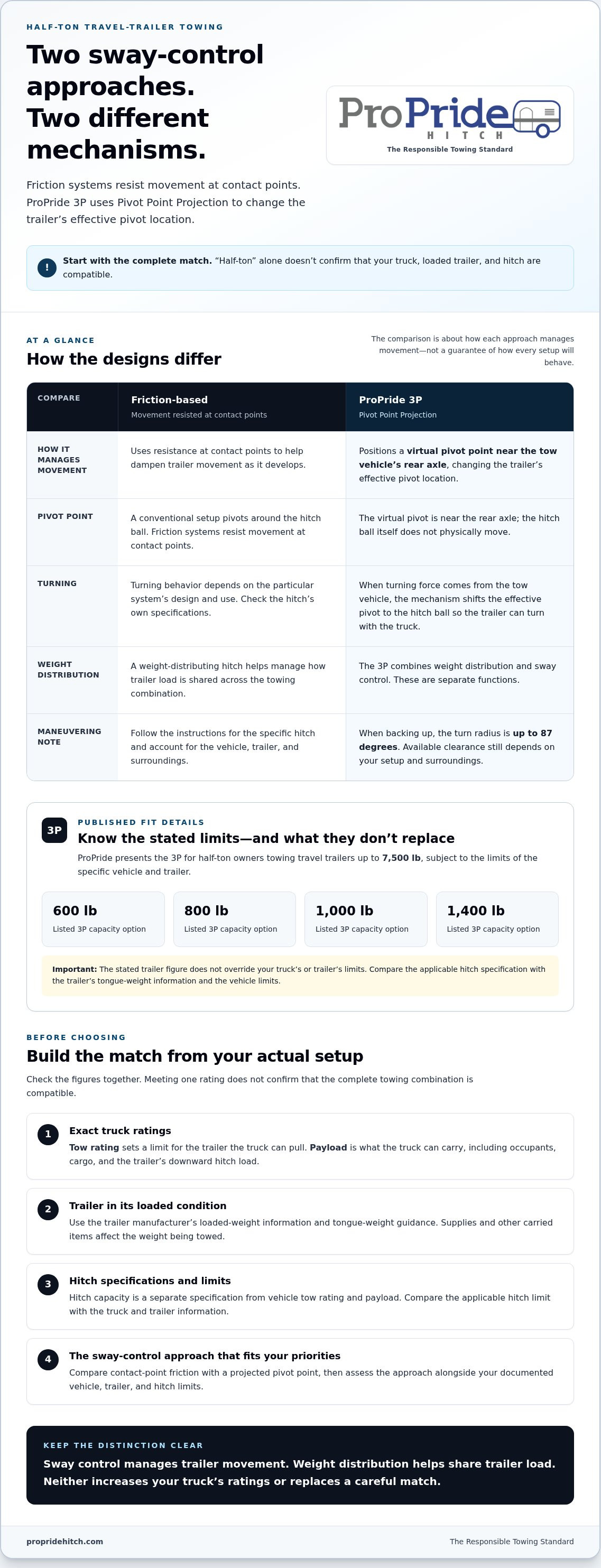
Hitch capacity is a separate specification from vehicle tow rating and payload. The ProPride 3P has capacity options of 600 lb, 800 lb, 1000 lb, and 1400 lb. Compare the applicable hitch specification with the trailer’s tongue-weight information and the vehicle limits. ProPride presents the 3P for half-ton owners towing travel trailers up to 7,500 lb, but that figure doesn’t override the limits set by your truck and trailer manufacturers.
The 3P combines weight distribution and sway control, but those functions don’t replace a careful match. For an overview of its design, see the ProPride 3P trailer sway-control hitch. Before comparing designs, gather your truck’s ratings, trailer details, and hitch specifications. That’s the foundation of The Responsible Towing Standard: make the complete match first, then assess which sway-control approach fits your priorities.
How sway-control hitch designs differ: friction damping and pivot-point projection
Sway control is a hitch feature designed to manage trailer movement while towing. Different systems address that movement in different ways. A friction-based system uses resistance at contact points to dampen movement. The ProPride 3P uses Pivot Point Projection, which changes the trailer’s effective pivot location in relation to the tow vehicle.
With friction-based damping, contact points resist movement between parts of the hitch. The system uses that resistance to help manage movement as it develops. How a particular setup behaves depends on its design and use, so the mechanism alone doesn’t mean every friction-based hitch performs the same way in every towing situation.
Friction damping resists movement at contact points; Pivot Point Projection places the trailer’s virtual pivot point near the tow vehicle’s rear axle.
What does Pivot Point Projection change?
In a conventional setup, the trailer pivots around the hitch ball. Pivot Point Projection gives the ProPride 3P a virtual pivot point near the tow vehicle’s rear axle. “Virtual” means the design changes the effective pivot location without physically moving the hitch ball.
That change shortens the lever arm, the distance through which trailer movement can influence the tow vehicle. It’s an engineering approach to managing sway, not a promise of risk-free towing. Correct loading, suitable vehicle and trailer ratings, and attentive driving still matter. To explore the hitch’s mechanism and fit, review the ProPride 3P trailer sway-control hitch.
Does a projected pivot point prevent normal turning?
No. The ProPride 3P’s mechanism is single-directional. When turning force comes from the tow vehicle, the effective pivot point shifts to the hitch ball, allowing the trailer to turn with the truck.
When backing up with the hitch, the turn radius is up to 87 degrees. This is useful to know before maneuvering into a campsite or storage space, but the room available still depends on your vehicle, trailer, and surroundings. Move deliberately and watch for clearance as the trailer follows the truck.
The practical distinction is the mechanism, not just the label “sway control.” Friction-based designs apply resistance at contact points; Pivot Point Projection changes the effective pivot location. As you assess the best sway control hitch for half ton trucks, consider which approach suits your priorities, then compare it with the ratings and towing conditions of your setup. The Responsible Towing Standard starts with understanding what the equipment does and what it can’t address.
Compare sway control hitch features for a half-ton travel-trailer setup
A useful comparison looks at how each hitch manages movement and what its design means for setup. Friction-based systems use resistance at contact points; pivot-point designs change the trailer’s effective pivot location. Frame attachment and turning capability can vary by model, so check specific product information rather than assuming every hitch in a category has the same features.
| Feature | Friction-based design | ProPride 3P |
|---|---|---|
| Mechanism | Uses resistance at contact points to dampen movement. | Uses Pivot Point Projection to place a virtual pivot point near the tow vehicle’s rear axle. |
| Weight distribution | May be integrated or handled separately, depending on the hitch. | Integrated weight distribution operates independently of the sway-control feature. |
| Frame installation | Attachment requirements vary by model. | No drilling into the trailer frame is required. |
| Adjustability | Features vary by model. | Includes an adjustable hitch bar. |
| Turning capability | Check the individual hitch specifications. | Turn radius is up to 87 degrees when backing up with the hitch. |
This comparison outlines design approaches, not a universal ranking. Use the manufacturer information for any hitch you’re considering and compare the stated features with your trailer and towing needs. Specific setup requirements matter more than a broad category label.
Which hitch features affect setup and long-term use?
The ProPride 3P’s adjustable hitch bar can match different tow-vehicle and trailer heights. Its spring bars bolt into the hitch head, and its weight-distribution jacks sit on top of the trailer frame. Installation doesn’t require drilling into the frame. These details help you evaluate the installation layout and adjustment needs before choosing a system.
The ProPride 3P capacity options are 600 lb, 800 lb, 1000 lb, and 1400 lb. Capacity is one part of matching the complete towing setup, not a substitute for checking truck and trailer limits. Compare the hitch information with the trailer’s specifications; don’t choose an option based only on the truck’s half-ton classification.
How should readers interpret hitch capacity options?
Think of hitch capacity as a specification to compare with the trailer and vehicle information, not as the truck’s tow rating. For a closer look at the ProPride 3P sway-control hitch design, review its features alongside your documented setup. A careful comparison is more useful than choosing by label alone, and reflects The Responsible Towing Standard.
Use this checklist to evaluate sway control for your half-ton truck
Start your comparison with the paperwork, not the hitch label. Set aside the truck and trailer manufacturer information, then record the figures for your exact models and configuration. This makes it easier to assess whether a hitch fits the complete setup rather than relying on one rating or the broad “half-ton” category.
A practical sequence for narrowing down hitch options
- Identify your truck and trailer. Record each model and its applicable manufacturer ratings. For the truck, include the stated towing and payload limits. For the trailer, note its weight and tongue-weight information. Use the figures for your specific vehicles, not maximums advertised for a different configuration.
- Compare the trailer’s loading details. Record the trailer’s documented or measured loading information for the way you plan to travel, following the manufacturer’s guidance. Compare the relevant tongue-weight figure with the hitch’s stated capacity and guidance. Keep the truck’s payload and towing limits in view too. A match on one figure doesn’t establish that the entire setup fits.
- Assess the hitch design against your priorities. Note whether the sway-control mechanism uses friction damping or Pivot Point Projection. Then compare whether weight distribution is integrated, how the hitch attaches to the trailer frame, what adjustments are available, and whether its turning capability suits your maneuvering needs. Check the information for the specific hitch rather than assuming every design has the same features.
Keep your notes together. If you change trailers, carry different loads, or use a different truck configuration, revisit the comparison using the information for that setup. This keeps your decision grounded in your actual equipment and use, rather than assumptions based on a previous combination.
How to make the final comparison responsible
Stable towing depends on the vehicle, trailer, loading, and hitch working as a complete system. A hitch’s sway-control design is one part of that system. It can’t raise manufacturer limits, remove every towing hazard, or replace sound driving practices. Before deciding, put the relevant ratings and design details side by side.
Keep vehicle and trailer limits central: compare your documented setup first, then choose a hitch that fits within those limits. That’s The Responsible Towing Standard in practice: informed, careful evaluation before the trip. If Pivot Point Projection is part of your comparison, explore the ProPride 3P hitch and its design.
Consider the ProPride 3P for half-ton travel-trailer towing
The ProPride 3P may suit a half-ton owner whose truck-and-trailer combination meets the applicable manufacturer limits and hitch guidance. It combines Pivot Point Projection sway control with integrated weight distribution. That makes it worth considering if you’re comparing how a hitch manages sway and distributes trailer load.
Start with your actual setup. Compare your truck’s ratings and the trailer’s loaded weight and tongue-weight information with the hitch specifications. A hitch can’t expand vehicle or trailer limits, so treat compatibility as a complete-system question, not a judgment based only on the truck category or a single hitch feature.
What distinguishes the ProPride 3P design?
Pivot Point Projection changes the trailer’s effective pivot point as part of the hitch’s sway-control design. The 3P also integrates weight distribution, which operates independently of sway control. Its adjustable hitch bar matches different tow-vehicle and trailer heights, and installation doesn’t require drilling into the trailer frame.
Construction details can also inform your setup assessment. The 3P uses a one-piece yoke and a reinforced hitch box. Its spring bars bolt into the hitch head, while the weight-distribution jacks sit on top of the trailer frame. Consider these features alongside your trailer’s frame and the space available for hitch components. Hitch layouts and adjustment methods can differ.
The capacity options are 600 lb, 800 lb, 1000 lb, and 1400 lb. Use the product guidance and your trailer’s specifications to assess the appropriate option; don’t choose based simply on a half-ton truck designation. Capacity is only one part of matching the vehicle, trailer, loading, and hitch.
What should a half-ton owner do next?
Bring the details together before deciding: record your truck’s manufacturer limits, the trailer’s applicable weight and tongue-weight information, and the hitch specifications. Then compare the ProPride 3P product and installation details with that documented combination. This keeps your selection grounded in the limits of your equipment while helping you assess whether the design suits your towing priorities.
A 0.0% APR financing option is available. If the specifications align with your setup and you want to examine the design further, review the ProPride 3P hitch details. Make your decision with the complete system in view, and bring The Responsible Towing Standard to every towing choice.
Make your next towing decision with confidence
The right choice doesn’t come from chasing a label or relying on one headline rating. It comes from matching your actual truck, trailer, and towing priorities. If you’re still weighing the best sway control hitch for half ton trucks, use your documented setup as the basis for comparison, then consider which design supports the way you plan to travel.
Keep your vehicle and trailer information handy, and revisit the match if your equipment or loading changes. A well-informed decision gives you greater clarity before your next trip. That’s The Responsible Towing Standard: preparation grounded in the limits of your equipment.
Ready to take the next step? Review the ProPride 3P hitch design and details to see how it aligns with your towing priorities.
Frequently Asked Questions
Can a half-ton truck use a ProPride 3P hitch?
Yes. ProPride, Inc. presents the 3P for half-ton owners towing travel trailers up to 7,500 lb, but that doesn’t establish fit for every truck configuration. Identify your exact truck model and configuration, then use its manufacturer ratings. Include the trailer’s specifications in the same assessment so the hitch choice reflects your actual combination, not a general truck category.
How does Pivot Point Projection work when turning?
When turning force comes from the tow vehicle, the effective pivot point shifts to the hitch ball, allowing the trailer to turn with the truck. When backing up with the hitch, the turn radius is up to 87 degrees. In a tight campsite or driveway, move slowly and watch the trailer’s path and clearance. The stated turning capability doesn’t account for obstacles around your particular rig.
Is the ProPride 3P also a weight-distribution hitch?
Yes. It combines sway control with weight distribution in one hitch, and the two functions operate independently. Weight distribution manages how the towing load is shared, while sway control addresses trailer movement. When evaluating your setup, consider each function separately and follow the relevant vehicle, trailer, and hitch instructions. One feature doesn’t replace the other.
What capacity options are available for the ProPride 3P?
The options are 600 lb, 800 lb, 1000 lb, and 1400 lb. Compare the trailer’s tongue-weight details with the hitch’s product guidance rather than choosing based on truck class alone. Keep the figures from your trailer documentation with your towing notes and use the product instructions to identify the option that fits your setup.
Does installing the ProPride 3P require drilling into the trailer frame?
No. Installing the ProPride 3P doesn’t require drilling into the trailer frame. Review the installation instructions for the components and steps, and plan the work around your trailer’s layout. The no-drill design describes the frame installation; follow the product instructions carefully and assemble the hitch as directed.
How much does the ProPride 3P hitch weigh?
The exact figure isn’t stated here. If you’re accounting for equipment weight as part of your truck’s payload, use the figure on the ProPride hitch-weight information page and include it in your calculation. Keep that value distinct from the trailer’s loaded weight and tongue weight when organizing your towing figures.
What key design features distinguish the ProPride 3P system?
The ProPride 3P incorporates an adjustable hitch bar, a one-piece yoke, no-drill installation, top-mounted weight-distribution jacks, bolted spring bars, powder-coating pre-treatment, thicker control links, and a reinforced hitch box. Compare these specific construction and installation features with your trailer and towing setup to ensure the best fit for your half-ton truck.