
Your Grand Design trailer is a masterpiece of RV engineering, but even a Reflection or Imagine isn't immune to the laws of physics. If you've felt the terrifying "suck and push" as a semi-truck passes, you know traditional equipment often falls short. Many owners spend years searching for the best sway control hitch for grand design trailers, only to realize that friction-based systems are reactive tools that merely resist sway after it starts. This white-knuckle experience doesn't match the quality of your RV, and it doesn't provide the peace of mind your family deserves.
Safety shouldn't be a game of "good enough." In this guide, you'll discover why informed owners are moving to systems that eliminate sway through advanced engineering. While maintaining a tongue weight between 10% and 15% is a vital first step for any responsible tower, even a perfectly loaded trailer needs the right mechanical foundation. By using the Jim Hensley design legacy and Pivot Point Projection, you can achieve a towing experience that is stable and predictable. It's time to embrace The Responsible Towing Standard for your 2026 travels and turn towing anxiety into total confidence.
Key Takeaways
- Understand why the high-profile side walls on Grand Design Imagine and Reflection models create a "sail area" that makes them uniquely sensitive to crosswinds and passing trucks.
- Learn the technical difference between reactive friction hitches that only resist sway and proactive mechanical systems that eliminate it entirely through Pivot Point Projection.
- Follow our practical guide to find the best sway control hitch for grand design by accurately measuring your trailer's loaded tongue weight rather than relying on factory dry weight estimates.
- Discover how to select the correct spring bar weight for your specific setup to ensure your equipment provides the stability required for a heavy, high-end trailer.
- See how adopting The Responsible Towing Standard protects your family and your investment through the proven Jim Hensley design legacy.
The Physics of Towing a Grand Design: Why Sway Control is Essential
Towing a Grand Design trailer is a premium experience, but it comes with specific physical challenges that many owners don't realize until they're on the open road. Because these units are engineered for maximum interior space and comfort, they often feature high-profile side walls. This creates a massive vertical surface that is constantly battling lateral force. In engineering terms, lateral force is any energy applied to the side of your trailer, such as a gust of wind or the air pressure from a passing vehicle, that attempts to push the trailer off its intended path.
Grand Design Sail Area: Understanding the Wind Profile
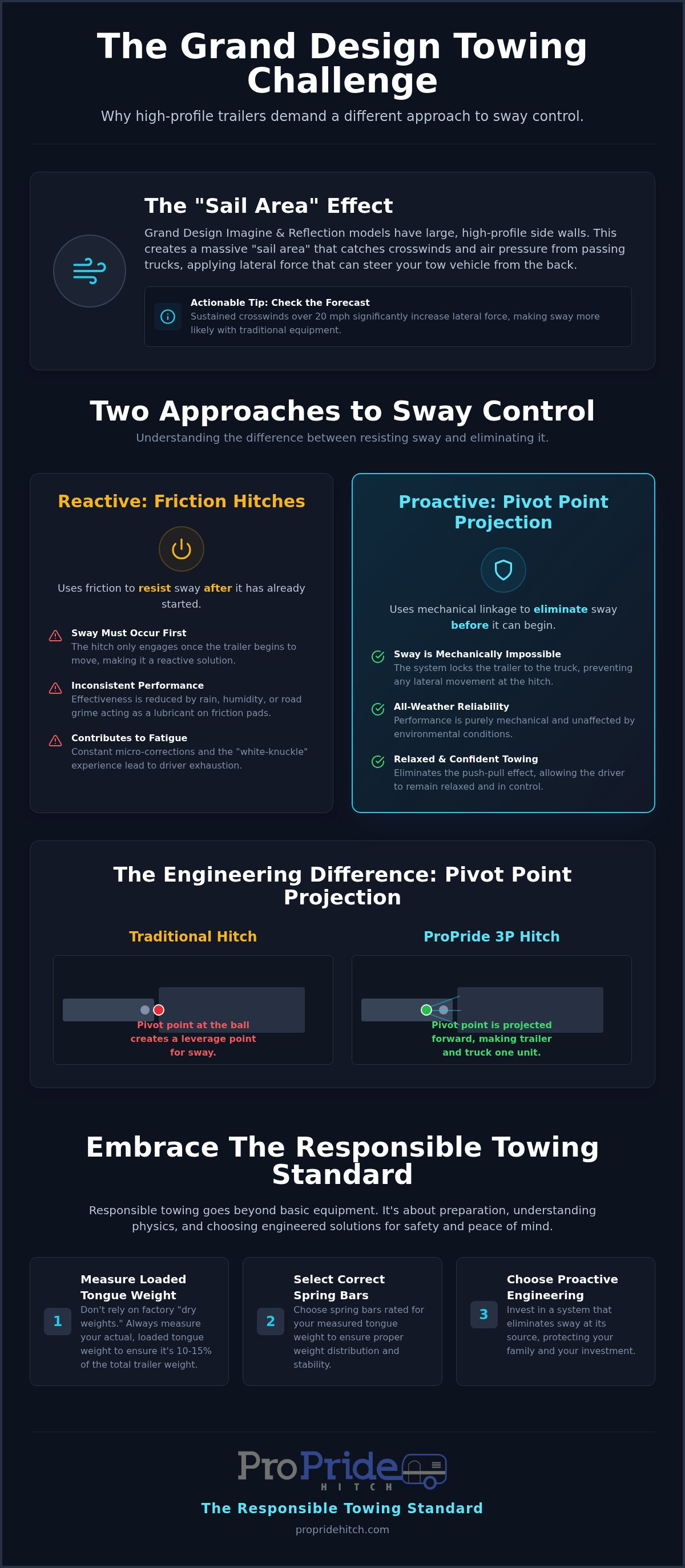
The height and length of Grand Design Imagine and Reflection models are excellent for living, but they create what engineers call a sail area. Sail Area is the total side-view surface area exposed to lateral wind pressure. When you're cruising at 65 mph, your trailer isn't just a weight you're pulling; it's a giant lever. The hitch ball acts as a pivot point, or fulcrum. When wind hits the rear of that long trailer, it uses the length of the frame to gain leverage, exerting a force that can actually steer your truck from the back. This isn't a sign of a bad driver; it's an unavoidable law of physics that standard equipment isn't designed to handle.
Actionable Tip: Before your next trip, check the projected wind speeds along your route. If you see sustained crosswinds over 20 mph, the lateral force on your sail area will increase significantly, requiring even more vigilance if you're using traditional equipment.
The 'White-Knuckle' Reality of Traditional Towing
Every Grand Design owner knows the "push-pull" effect. As a large commercial truck approaches from behind, it pushes a "bow wave" of high-pressure air that hits your trailer's rear, pushing it away. As the truck passes, a low-pressure vacuum sucks your trailer toward the semi. This creates a rhythmic swaying motion that travels up the frame to your truck's steering. While many modern tow vehicles include Trailer Stability Assist (TSA), these systems are reactive. They only intervene by applying brakes after the sway has already become dangerous.
Finding the best sway control hitch for grand design means moving beyond these reactive measures. Constant steering corrections lead to physical exhaustion and mental fatigue, which can turn a five-hour drive into a grueling ordeal. For the responsible researcher, the goal isn't just to manage the sway, but to eliminate the mechanical flaw of the hitch ball pivot itself. Adopting The Responsible Towing Standard means ensuring your hitch is proactive, keeping your truck and trailer locked in a straight line regardless of the wind or traffic. This engineering-first approach is the only way to match the high quality of your RV with a towing experience that is truly safe and stress-free.
Friction vs. Pivot Point Projection: A Technical Comparison
Most Grand Design owners are told that "sway control" is the ultimate goal for a safe trip. However, there is a fundamental difference between controlling a problem and eliminating it. While traditional hitches use friction to resist movement, the ProPride system uses mechanical linkage to prevent it. Understanding this distinction is the first step toward achieving The Responsible Towing Standard. For a heavy, high-profile trailer, the best sway control hitch for grand design isn't one that fights sway; it's one that makes sway physically impossible.
The Reactive Nature of Friction Hitches
Friction hitches are reactive by design. They work by pressing two surfaces together to create resistance. For this resistance to do anything, the trailer must first move. This means sway has already started before the hitch begins to work. If a sudden gust of wind hits your trailer, the friction bars attempt to "brake" that movement. This "good enough" approach has several critical flaws:
- Environmental Interference: Rain, road oil, or even high humidity can act as a lubricant on friction pads, significantly reducing their effectiveness when you need them most.
- Mechanical Resistance: Friction hitches often "groan" or "pop" because they are constantly fighting the natural articulation needed for turning.
- The Over-Tightening Trap: Many drivers try to stop sway by over-tightening their friction bars. This is a dangerous practice that can cause the hitch to lock up during a turn, preventing the truck from steering the trailer properly.
Actionable Tip: If you currently use a friction hitch, regularly inspect the friction pads for glazing or debris. However, remember that no amount of maintenance can turn a reactive friction system into a proactive one.
Pivot Point Projection: The Engineering Solution
The Jim Hensley design legacy moved the industry beyond friction. Instead of relying on two surfaces rubbing together, the ProPride 3P Trailer Sway Control Hitch utilizes a trapezoidal linkage system. This advanced engineering projects the trailer's pivot point forward, placing it near the rear axle of your tow vehicle.
When the pivot point is moved forward, the trailer loses its leverage over the truck. In a standard setup, the trailer pivots on the hitch ball, which acts like a hinge. With Pivot Point Projection, that hinge is effectively moved to the truck's axle. This means the truck can easily turn the trailer, but the trailer cannot "steer" the truck. It is this mechanical advantage that makes the 3P the best sway control hitch for grand design owners who refuse to settle for traditional equipment. If you want to experience the difference that true engineering makes, you can explore the technical specifications of the 3P system to see how it locks your trailer into a straight line.
Why Traditional Sway Bars Fall Short for Grand Design Owners
Grand Design trailers are engineered for luxury and durability, often resulting in higher tongue weights than entry-level units. For example, a loaded Grand Design Reflection can easily exceed 1,200 pounds of tongue weight. While many owners believe a heavy-duty truck is enough to "muscle" through the wind, the reality is that the trailer still exerts massive leverage on the rear axle. Even with a one-ton dually, the lateral forces on a high-profile trailer can cause the truck to feel unsettled. To find the best sway control hitch for grand design, you must look past simple bar-and-chain setups that were designed decades ago for much smaller trailers.
Actionable Tip: Don't rely on the "dry" tongue weight listed in your owner's manual. Use a dedicated tongue weight scale or visit a CAT scale when fully loaded to ensure your hitch is rated for your actual weight, which is often 200 to 300 pounds higher than the factory estimate.
Weight Distribution vs. Sway Elimination
It's a common mistake to confuse weight distribution with sway elimination. Weight distribution is a vertical correction; it uses spring bars to shift weight from the rear axle of the truck to the front axle and the trailer axles. This levels your ride and improves steering, but it does nothing to stop the trailer from pivoting horizontally on the hitch ball. If you're looking for model-specific details on leveling your rig, check out our guide on the Best Weight Distribution Hitch for Grand Design. However, even a perfectly level trailer will sway if the pivot point isn't mechanically locked. True safety requires both weight management and the total elimination of the pivot point's ability to move independently of the truck.
The Cost of 'Good Enough' Equipment
Choosing a "good enough" hitch is a gamble with your family's safety and your RV investment. When you use traditional friction bars, you're accepting a baseline level of instability. This instability leads to driver fatigue, forcing you to cut travel days short because of the mental strain of constant corrections. Adopting The Responsible Towing Standard means recognizing that your hitch is the most critical safety component in your entire setup. The ProPride 3P isn't just a part; it's a lifetime investment that ensures your towing experience matches the premium quality of your Grand Design. By utilizing the Jim Hensley design legacy, you move from managing a dangerous symptom to removing the cause of sway entirely.
Choosing the Right ProPride 3P Setup for Your Grand Design
Choosing the best sway control hitch for grand design requires a shift from guesswork to precision. While entry-level trailers might tolerate "close enough" estimates, the high-profile nature of a Grand Design unit demands an exact match between your equipment and your trailer's physical reality. You're investing in a system that uses Pivot Point Projection to create a rock-solid connection, so the setup must be tailored to your specific model's weight and frame configuration. This process is the foundation of the Jim Hensley design legacy, ensuring that your truck and trailer act as a single, stable unit.
Matching Hitch Capacity to Your Grand Design Model
The first step in your journey is determining the actual loaded tongue weight of your Grand Design. The ProPride 3P system offers different spring bar capacities, typically 1,000lb, 1,400lb, or 1,700lb. If you tow an Imagine XLS, your tongue weight will be significantly lower than a heavy Reflection Travel Trailer. It's a common mistake to think that heavier bars are always better for safety. In reality, over-springing your hitch can lead to a harsh ride and unnecessary frame stress because the bars won't have the proper flexibility to absorb road shocks. Owners must weigh their trailer fully loaded before selecting a hitch bar weight to ensure the system performs as intended.
The Installation Advantage
One of the primary reasons Grand Design owners choose the 3P is the "no-drill" installation process. This is a critical part of The Responsible Towing Standard because it allows you to secure the hitch to the frame without compromising the structural integrity or voiding your manufacturer's warranty. Many Grand Design models feature specific V-nose configurations or underslung couplers that require careful clearance evaluation during the planning stage. The 3P design accounts for these variations, providing a clean fit that traditional bolt-on sway bars simply cannot match. Once the main unit is in place, you'll plan your weight distribution jack placement to achieve perfect balance.
Actionable Tip: When setting up your weight distribution jacks, use a tape measure to check the height of your truck's front wheel well before and after tensioning. You want to return the front end to its original uncoupled height to ensure steering stability. If you find the setup isn't behaving quite right, you can consult our guide on ProPride 3P Hitch Troubleshooting for expert setup support.
By taking the time to conduct this research, you're fulfilling your role as a responsible owner. You can select the ProPride 3P Hitch that perfectly matches your Grand Design and begin your next trip with absolute confidence.
The Responsible Towing Standard: Why ProPride is the Definitive Choice
Choosing the best sway control hitch for grand design isn't just a mechanical decision; it's a commitment to your family's safety. You have already invested in a premium RV because you value quality and engineering. Settling for a traditional friction hitch at the point of connection is like putting budget tires on a high-end tow vehicle. By choosing the ProPride 3P, you are adopting The Responsible Towing Standard, ensuring that every mile you drive is defined by stability rather than stress. Arriving at your destination feeling refreshed, rather than exhausted from fighting the steering wheel, is the ultimate goal of a successful trip.
Actionable Tip: When you upgrade your trailer, remember that the ProPride 3P is a versatile system. It can be moved to your next unit by simply swapping the spring bars if the tongue weight changes. This makes it a lifetime investment that grows with your RV lifestyle.
Engineering Excellence for the Discerning RVer
The 3P is constructed with heavy-duty steel and a durable powder-coated finish designed to withstand the harshest road conditions. This is the direct evolution of the Jim Hensley design legacy, a name that has served as the gold standard of hitch engineering for decades. Because it uses mechanical linkage instead of friction, there are no pads to wear out and no performance loss in the rain. Many Grand Design owners who made the switch from friction-based bars describe the experience as "transformative." They no longer feel the "suck and push" of passing traffic, and the trailer tracks so perfectly that it feels like an extension of the truck frame. This level of precision is why the 3P is widely considered The Best Hitch on the Planet™.
Joining the Community of Responsible Towers
Responsible towers understand that safety is a long-term investment. While entry-level equipment might seem like a way to save money upfront, the ProPride 3P offers high resale value and unmatched durability. It protects your RV from the structural stress caused by sway and protects your family from the physical dangers of losing control. If you are ready to move beyond "good enough" solutions and embrace total sway elimination, it's time to choose a partner that values safety as much as you do. You can select the ProPride 3P Trailer Sway Control Hitch today and experience the peace of mind that comes with the highest engineering standard in the industry.
Elevate Your Grand Design Towing Experience
You've seen how the high-profile walls of your Grand Design create unique physics challenges on the highway. Traditional friction hitches only react after sway starts, but the Jim Hensley design legacy offers a proactive mechanical solution. By utilizing patented Pivot Point Projection, you effectively move the pivot point to your truck's rear axle. This mechanical advantage is why the 3P is the best sway control hitch for grand design owners who prioritize safety and stability over "good enough" equipment. It ensures that your truck and trailer operate as a single, unified machine regardless of crosswinds or passing trucks.
It's time to stop white-knuckle driving and start enjoying the journey with absolute confidence. You can Experience the Safety of the ProPride 3P for Your Grand Design and join the growing community of travelers who uphold The Responsible Towing Standard. Your family and your investment deserve the peace of mind that only true engineering excellence can provide. We're here to help you turn every highway haul into a stress-free adventure. Safe travels are just one hitch away.
Frequently Asked Questions
Is the ProPride 3P hitch compatible with the Grand Design Imagine frame?
The ProPride 3P is fully compatible with the Grand Design Imagine series. Its design specifically accommodates the frame dimensions and coupler styles found on these popular units. Because the hitch is a no-drill system, it attaches securely to the A-frame without compromising the structural integrity of your trailer. This makes it the best sway control hitch for grand design owners who want a secure, bolt-on solution that fits perfectly right out of the box.
How does Pivot Point Projection differ from a standard sway bar?
Pivot Point Projection is a proactive mechanical linkage system, while standard sway bars rely on reactive friction. A traditional bar tries to resist movement that has already started by rubbing two surfaces together. The ProPride 3P uses a trapezoidal linkage to project the trailer's pivot point forward to the truck's rear axle. This prevents the trailer from pivoting on the ball, which effectively eliminates sway rather than just trying to control it after it begins.
Do I need to drill into my Grand Design trailer frame to install a ProPride hitch?
You don't need to drill into your Grand Design trailer frame to install the ProPride 3P. The system is designed for a completely bolt-on installation using heavy-duty brackets that wrap around the A-frame. This approach is a core part of The Responsible Towing Standard, as it preserves the original strength of the steel. It also allows you to remove the hitch and transfer it to a new trailer in the future without leaving permanent holes behind.
Will the ProPride 3P hitch affect my Grand Design manufacturer warranty?
Installing a ProPride 3P hitch won't void your Grand Design manufacturer warranty because the installation is non-destructive. Since no drilling or welding is required on the trailer frame, you aren't making permanent structural changes that would concern a manufacturer. Responsible owners choose this system specifically to protect their investment. Always keep your installation manual handy, but you can rest assured that this premium equipment respects the integrity of your RV's factory build and safety standards.
Which spring bar weight should I choose for a Grand Design Reflection travel trailer?
For a Grand Design Reflection travel trailer, owners typically select either the 1,400lb or 1,700lb spring bar set. These trailers often have high loaded tongue weights that exceed 1,200 pounds once your gear and water tanks are full. It's vital to weigh your rig at a CAT scale to find your actual tongue weight. Choosing the correct capacity ensures your weight distribution is effective without over-springing the frame, which maintains a smooth and stable ride for your family.
Can I use the ProPride 3P with a backup camera and sensor system?
Yes, you can use the ProPride 3P with your existing backup camera and sensor systems. The hitch components sit low enough on the A-frame that they typically don't obstruct the camera's field of view. While the hitch head is larger than a standard ball mount, it doesn't interfere with the electronic Trailer Stability Assist systems found in modern trucks. In fact, the mechanical stability of the 3P makes these electronic sensors less likely to trigger because the sway is eliminated.
How does the ProPride 3P handle tight turns and backing into campsites?
The ProPride 3P handles tight turns and backing into campsites more effectively than traditional friction hitches. Because there are no friction bars to pop or bind, you can turn at sharper angles without worrying about equipment damage. When backing up, the trailer follows the truck's input with precision. You don't have to get out and remove sway bars before navigating into a tight spot, which makes the arrival at your destination much more relaxing and efficient.
Why is the ProPride 3P considered the Responsible Towing Standard for high-wind conditions?
The ProPride 3P is the Responsible Towing Standard for high-wind conditions because it uses physics to neutralize lateral forces. High-profile Grand Design trailers act like sails in crosswinds, but Pivot Point Projection prevents that wind from steering the truck through the hitch ball. By locking the truck and trailer into a straight line, the system ensures that wind gusts cannot initiate the rhythmic swaying motion that leads to a loss of control on the highway, even in 2026 weather extremes.