
Are cheap weight distribution hitches safe? A lower-priced hitch can suit a towing setup, while a more expensive one can be the wrong fit. Price alone doesn’t tell you whether a hitch is safe for your combination. Check whether its ratings match your loaded trailer, whether it’s compatible with your tow vehicle, and whether you can set it up according to the manufacturers’ instructions.
This guide walks you through those checks. You’ll learn how to compare ratings, assess fit and condition, and distinguish weight distribution from sway control. Weight distribution helps balance load across the vehicle and trailer axles. Sway control is designed to limit side-to-side trailer movement. We’ll also look at the ProPride 3P® as an example of a hitch that combines both functions, using Pivot-Point Projection™ to create a virtual pivot point near the tow vehicle’s rear axle. That’s The Responsible Towing Standard: judge the engineering and fit, not the price tag alone.
Key Takeaways
- Are cheap weight distribution hitches safe? Assess the specific hitch by its ratings, compatibility, condition, and setup, not price alone.
- Read your tow vehicle and trailer manuals first to understand their limits and recommendations.
- Gather the loaded trailer and tongue-weight figures, then compare them with the hitch’s published ratings and compatible components.
- Compare each hitch’s included parts, construction details, instructions, and warranty terms. Make sure you’re comparing systems with similar functions.
- Follow the manufacturer’s setup instructions. Don’t tow until you understand how the hitch fits and installs with your combination.
Are Cheap Weight Distribution Hitches Safe? Start With the Right Question
Are cheap weight distribution hitches safe? A lower price doesn’t prove a hitch is unsafe, and a higher price doesn’t prove it’s right for your setup. Safety depends on whether the hitch’s ratings suit the loaded trailer and tow vehicle, its components are compatible, the equipment is in sound condition, and it’s installed and adjusted correctly.
Evaluate the towing combination rather than the price tag. Also separate two functions that are often discussed together. Weight distribution helps balance tongue load across the tow vehicle and trailer axles. Sway control addresses side-to-side trailer movement. A hitch that provides one function doesn’t automatically provide the other.
What does a weight distribution hitch do?
A weight distribution hitch uses spring bars to help spread some of the trailer’s tongue load across the towing combination instead of leaving as much of that load concentrated at the vehicle’s rear. It can help manage load, but it doesn’t increase the tow vehicle’s maximum towing capacity or make an incompatible combination suitable.
Whether to use one depends on the instructions for your tow vehicle and trailer. Read both before choosing equipment or adjusting the setup. For a broader overview of the mechanism and common designs, see this Weight-distributing hitch explanation. A dedicated weight distribution hitch guide can provide more detail on how the system works.
Why price is not a safety rating
Cost doesn’t tell you whether the hitch’s published ratings match your actual load, whether its parts fit your receiver and trailer, or whether a used unit has been damaged. A premium price doesn’t answer those questions either. A carefully selected lower-cost hitch may suit one combination, while a more expensive model may not suit another.
Compare documented specifications, not assumptions. Start with the tow vehicle and trailer manuals, then use the hitch maker’s instructions to understand its ratings, required components, and setup. If you’re considering a used hitch, inspect it for visible damage, deformation, corrosion, missing parts, or unreadable identification and rating information. Appearance alone can’t establish its history or condition.
- Match the hitch’s stated ratings to the loaded trailer figures and the limits in your vehicle and trailer documentation.
- Check that the components and installation instructions apply to your specific combination.
- Evaluate weight distribution and sway control separately when comparing features.
This isn’t about shaming a bargain. It’s about replacing price-based guesswork with evidence you can verify. That preparation is part of The Responsible Towing Standard: if you can’t establish that the hitch fits, is in sound condition, and can be set up as instructed, don’t tow until you resolve those points.
How Ratings, Fit, and Hitch Design Affect Towing Safety
A hitch rating is useful only when you understand how it applies to your towing combination. To assess fit, consider the loaded trailer, tongue weight, tow vehicle limits, receiver limits, and hitch ratings together. Each component has its own role, and one part’s rating doesn’t let you exceed another’s.
Match the hitch to the loaded combination
Start with actual figures, not a guess based on the trailer’s empty weight. Cargo, water, and travel gear affect the load, so use loaded measurements where available. Compare those figures with the specifications and instructions for the vehicle, receiver, trailer, and hitch.
There isn’t one universal rating threshold for every towing combination. The vehicle and trailer manufacturers’ instructions help determine applicable limits and whether weight distribution is appropriate. Check how the hitch manufacturer defines its ratings, too. A rating may refer to a particular load condition or use, so don’t assume that two figures with similar labels mean the same thing.
For example, a hitch rating that appears adequate for the trailer doesn’t override a lower limit stated for the receiver or tow vehicle. If the manuals and hitch documentation don’t give you a clear, compatible picture, pause and resolve the mismatch before towing. Comparing all the relevant limits helps you avoid relying on one number while overlooking another part of the system.
Compare weight distribution and sway control separately
These functions address different concerns. Weight distribution manages how tongue load is carried across the tow vehicle and trailer axles. Sway control addresses side-to-side trailer movement. A hitch may provide one function without the other, so check the documentation for each rather than assuming they come together.
Some sway-control designs use friction to dampen movement after it begins. Other designs use different mechanical approaches. “Sway control” describes a purpose, not one universal mechanism. Compare how a system works and what its manufacturer says it’s designed to do. The presence of a sway-control feature doesn’t prove that the hitch’s weight ratings fit your load. A dedicated sway-control hitch comparison can help clarify design differences.
The ProPride 3P® combines integrated weight distribution with Pivot-Point Projection™ sway control. The system projects a virtual pivot point near the tow vehicle’s rear axle rather than relying on friction-based damping. Review the hitch details alongside your vehicle and trailer documentation. That’s The Responsible Towing Standard: understand what each rating and feature means before choosing.
Cheap Weight Distribution Hitches: Compare Construction and Included Functions
A useful comparison starts with documentation, not a price label or product photo. Put the details for each hitch side by side, then compare systems that provide similar functions. A lower sticker price isn’t a defect by itself, and a long feature list doesn’t prove a hitch suits your combination. The goal is to understand what each option is designed to do and whether its published information answers your questions.
Which product details deserve a closer look?
Use the manufacturer’s specifications and instructions as your evidence. Record the ratings and compatibility information as stated, and check which parts are included. If the listing doesn’t clearly say whether sway control is integrated, separate, or absent, don’t infer the answer from the hitch’s appearance. Pause until you understand the configuration and installation requirements.
| Compare | What to look for |
|---|---|
| Published ratings | Listed load ratings and the conditions or components they apply to. Compare them with your documented towing combination. |
| Compatibility | Manufacturer-stated fit for the tow vehicle, receiver, trailer, and relevant components. |
| Materials and construction | Specific material and construction details in manufacturer documentation. Don’t treat an unverified comment or photo as proof of strength or weakness. |
| Included components | A clear parts list, including components needed for the advertised functions and setup. |
| Instructions | Accessible guidance for installation, adjustment, use, inspection, and maintenance. |
| Warranty terms | The written coverage, exclusions, duration, and claim process, if a warranty is offered. |
These categories help show whether you’re comparing equivalent systems. A hitch with weight distribution alone isn’t a like-for-like comparison with one that also includes sway control. Likewise, don’t assume a separately sold part is included. Note any gaps in the product information instead of filling them with assumptions.
What a low price can, and cannot, tell you
Price may reflect differences in design, included parts, or functions, but it can’t establish material quality, condition, compatibility, or suitability on its own. Avoid generalizations about budget brands or assumptions about how long a hitch will last without reliable product-specific evidence.
Use a simple decision rule: choose based on verifiable specifications and fit. If ratings, construction details, warranty terms, or instructions are missing or unclear, pause and find the relevant manufacturer documentation. That gap isn’t automatic proof that the hitch is unsafe, but it does mean you don’t yet have enough information to assess it. If the details are clear, compare the stated functions and requirements with your setup before deciding.
For a concrete example of evaluating design and function together, review the ProPride 3P hitch specifications alongside the same categories for other options. The 3P integrates weight distribution and sway control through a pivot-point projection design, so compare those functions with what each hitch actually provides. Keep the focus on documented features and fit, not price as a shortcut for judging safety.
Use This Pre-Purchase Checklist Before Towing With Any Weight Distribution Hitch
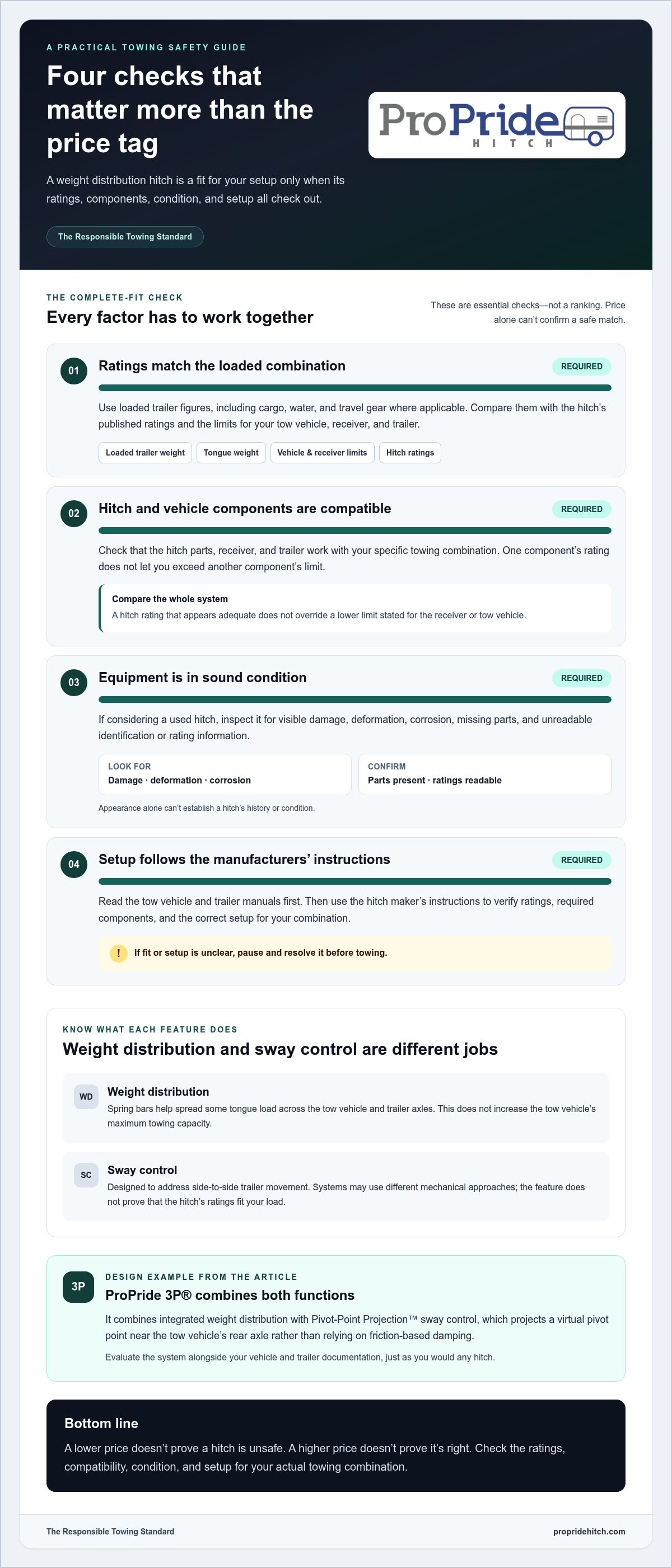
Before choosing a hitch or heading out with one, work through these checks in order. They help you determine whether the equipment matches your towing combination and whether you understand how to use it. If you can’t establish compatibility or follow the installation instructions, don’t tow until you’ve resolved the uncertainty.
- Read the tow vehicle and trailer instructions. Find the vehicle’s towing guidance and receiver limits in its manual or on its labels. Review the trailer manufacturer’s instructions, too, including any guidance about weight distribution. Use the information for your specific equipment rather than relying on a general rule of thumb.
- Gather figures for the loaded trailer. Use trailer documentation and measured figures where available. Account for the load as you’ll actually tow it, rather than assuming the empty trailer figure represents your travel setup. Record the relevant trailer weight and tongue weight for comparison with the hitch documentation.
- Compare all applicable ratings. Check the limits for the tow vehicle, receiver, trailer, and hitch. Confirm that the hitch’s published ratings cover the intended use while respecting every other component’s limit. A higher rating on one part doesn’t authorize exceeding a lower applicable rating elsewhere.
- Review the hitch documentation and parts. Confirm that product information explains compatibility, included components, and the hitch’s stated functions. Make sure the instructions cover assembly, adjustment, and use. If the documentation leaves a key point unclear, pause rather than guessing how the system is meant to fit or function.
- Inspect the equipment and follow its setup instructions. Before use, look for visible damage, missing parts, or excessive wear, especially on used or previously installed equipment. Follow the manufacturer’s guidance for inspection and the specific hitch’s setup procedure. Don’t substitute a generic procedure for the instructions that apply to your equipment.
Know when to pause
Each step should give you a clear picture of the applicable limits, compatibility, condition, and required setup. If a rating is unreadable, parts are missing, damage is visible, or the instructions don’t make sense, stop and resolve the issue before towing. A careful pause is better than relying on a guess under load.
Keep the relevant manuals, measurements, and hitch instructions together so you can refer to them during setup. When reviewing a specific model, compare its product details with your vehicle and trailer documentation. The Responsible Towing Standard starts with understanding the equipment before you tow.
Responsible Towing: Consider Design as Well as Price
Once you’ve checked fit and documentation, consider how a hitch’s design addresses your towing priorities. The price tag can’t explain the engineering choices behind a system. Look at its stated design, intended functions, and setup requirements, then decide whether they align with your documented needs.
How the ProPride 3P® fits the evaluation framework
The ProPride 3P® combines integrated weight distribution with patented Pivot-Point Projection™ sway-control technology. The system projects a virtual pivot point near the tow vehicle’s rear axle, using a different approach from friction-based sway control. The hitch also has an adjustable hitch bar and does not require drilling into the trailer frame. These are practical design details to consider as you assess fit and installation for your trailer.
The ProPride 3P® is available in 600 lb, 800 lb, 1000 lb, and 1400 lb capacity options. Compare the product’s stated ratings and instructions with your own vehicle and trailer documentation. The capacity option alone doesn’t establish fit: your loaded setup and the limits of every component still matter.
Review the product details for your towing combination
Compare the specifications and instructions with your vehicle and trailer documentation. Pay particular attention to the information that determines fit and setup for your combination. A distinctive design still needs to meet the requirements of the equipment it’s paired with.
That’s The Responsible Towing Standard: weigh engineering and function alongside compatibility, not in place of it. Take the next step in your research and review the ProPride 3P® Hitch details against your towing documentation. An informed comparison puts you in a stronger position to choose equipment with confidence.
Make Your Next Towing Decision With Confidence
Are cheap weight distribution hitches safe? The answer comes from evaluating the specific hitch and towing combination, not making a blanket judgment about every lower-cost option. Take your time. A careful choice helps you understand how your equipment fits together before you tow.
Keep the product information and setup instructions you relied on in one place. If your trailer load or towing equipment changes, revisit your decision rather than assuming the original setup still fits. This simple habit makes future checks more deliberate and keeps responsible preparation part of every trip.
To take a closer look at a hitch designed with both sway control and weight distribution in mind, review the ProPride 3P® Hitch details. The Responsible Towing Standard begins with informed choices. Compare the hitch’s features and specifications with your towing documentation as you decide what fits your setup.
Frequently Asked Questions
Can a cheap weight distribution hitch be safe?
Yes, a lower-cost hitch can suit a particular setup. The answer to “are cheap weight distribution hitches safe?” depends on the equipment and towing combination, not price alone. Compare documented ratings and compatibility, inspect the hitch’s condition, identify its included functions, and understand its setup instructions. Every applicable limit for the tow vehicle, receiver, trailer, and hitch still applies. A suitable hitch can’t make an incompatible combination safe.
Does a weight distribution hitch increase a vehicle’s towing capacity?
No. A weight distribution hitch doesn’t raise the tow vehicle’s, receiver’s, or trailer’s published ratings. The system may redistribute load among axles, but that changes load management, not the limits set for the equipment. A hitch rated for a particular use can’t authorize towing beyond the vehicle’s stated limit. Check each manufacturer’s documentation and respect every applicable limit in your combination.
Can I use a weight distribution hitch with a half-ton truck?
Possibly. A half-ton label alone can’t establish whether a weight distribution hitch fits. Suitability depends on the specific truck and receiver, trailer, hitch ratings, loaded setup, and each manufacturer’s guidance. A truck’s class isn’t a substitute for those details. Compare the documented limits across your combination before choosing equipment. Another owner’s successful setup doesn’t establish compatibility for your truck and trailer.
Does every weight distribution hitch include sway control?
No. Products differ, so check the exact model’s stated functions and included parts rather than judging by its shape. Weight distribution and sway control address related but distinct concerns, and one doesn’t establish that the other is present. Some sway-control designs use friction-based damping; others use pivot-point projection. Read the product documentation to understand which method the hitch uses and whether a separate component is part of the setup.
What happens if a hitch’s rating is higher than my trailer’s tongue weight?
A higher rating alone doesn’t confirm that the hitch is correctly matched. The manufacturer’s stated operating range and your loaded tongue-weight figure both matter. Check how the hitch documentation defines its rating and intended range, then compare that information with the vehicle, receiver, and trailer limits. Follow the product instructions and towing documentation. Don’t infer correct setup from one number or apply a universal calculation.
Can I safely buy a used weight distribution hitch?
Possibly, but prior use alone can’t establish whether a hitch is fit to tow. Identify the exact model, verify its ratings and included parts, and inspect for damage, excessive wear, or missing hardware. Make sure you can access and understand the instructions, and that the hitch matches your current vehicle and trailer. If its condition or history prevents a reliable assessment, don’t tow with it.
Can I tow safely without a weight distribution hitch?
It depends on the specific tow vehicle, receiver, trailer, loaded combination, and manufacturers’ instructions. Don’t assume every trailer requires weight distribution or that none do. Check the guidance for your exact setup, especially if the load or equipment has changed. This is separate from sway control: whether weight distribution is appropriate doesn’t determine whether your combination needs a sway-control feature.