
Your hitch rating isn’t the same as your safe towing limit. The most important advanced towing safety techniques start with staying within the ratings of your tow vehicle, hitch, and trailer.
It’s sensible to focus on trailer sway and handling, but weight ratings matter before you pull onto the road. Exceeding a limit can put extra strain on the equipment and undermine control. This guide explains how to manage sway, inspect towing connections, leave safe following space, adjust speed and braking, and keep your load within rated limits.
You’ll also learn practical ways to position and secure cargo, respond calmly if sway begins, and make turns and descents more predictable. Each step follows the same principle: stable towing starts with a correctly matched, carefully checked setup.
Key Takeaways
- Balance and secure trailer cargo to reduce movement and help maintain stable handling.
- Before departure, inspect the hitch, coupler, safety chains, breakaway cable, tires, lights, and connections.
- Leave extra following space and adjust it for road and weather conditions so you have time to respond.
- Use gradual acceleration, braking, and steering, and slow down for turns and steep grades.
- Compare the loaded trailer weight with the ratings of the tow vehicle, hitch, and trailer before towing.
1. Preventing and responding to trailer sway
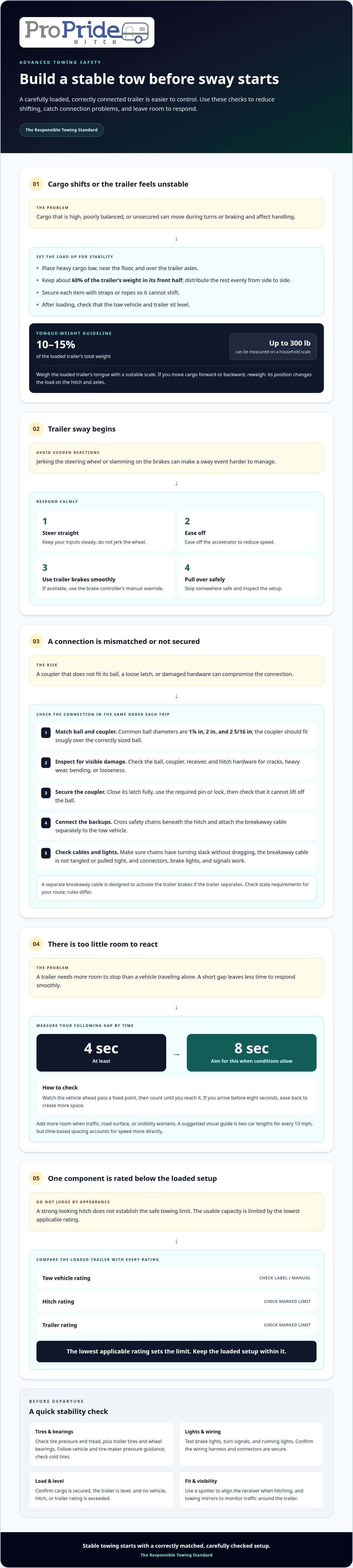
Stable trailer handling starts before you hit the road. During loading, place heavy cargo low, near the floor, and over the trailer axles. Keep about 60% of the trailer’s weight in its front half, and distribute the rest evenly from side to side. Secure each item with straps or ropes so it can’t shift during turns or braking. After loading, check that the tow vehicle and trailer sit level.
For tongue weight, weigh the loaded trailer’s tongue using a suitable scale; loads up to 300 pounds can be measured on a household scale. One guideline recommends tongue weight of 10-15% of total trailer weight. Adjust cargo position, then reweigh: moving cargo forward or backward changes the load on the hitch and axles. Keep the load balanced, and don’t exceed any vehicle, hitch, or trailer rating.
If sway starts, stay calm, steer straight, and ease off the accelerator to reduce speed. Don’t jerk the steering wheel or slam on the brakes. If your trailer brake controller has a manual override, apply the trailer brakes smoothly, then pull over somewhere safe. A towing course can build handling skills, while an inspection can identify worn or faulty components. Equipment costs vary with the equipment selected and the inspection or course involved.
- Before departure, check tow-vehicle and trailer tire pressure and tread, plus trailer tires and wheel bearings.
- Test brake lights, turn signals, and running lights; inspect the wiring harness and confirm connectors are secure.
- Inspect the hitch, coupler, safety chains, and breakaway cable; check load position and trailer level.
- Use a spotter to align the receiver when hitching, and towing mirrors to monitor traffic around the trailer.
A weight-distribution hitch uses bars to help spread tongue load across the tow vehicle and trailer axles. Set the tow vehicle and trailer at the correct interface height, attach and adjust the bars according to the hitch instructions, then check that the loaded combination sits level. Sway-control setup varies by hitch design, so follow its adjustment instructions rather than guessing.
For tire pressure, follow the tow vehicle’s specified pressure and the trailer tire maker’s guidance for the installed tire and load. Check pressure before travel while the tires are cold, and confirm each tire’s load rating suits the weight it carries. When backing, place a hand at the bottom of the steering wheel and move it toward where you want the trailer to go. If the trailer starts to jackknife, pull forward to realign before continuing.
2. Hitch, coupler, safety-chain, and breakaway-cable checks
Before connecting, match the hitch ball to the trailer coupler. Common ball diameters are 1-7/8 inches, 2 inches, and 2-5/16 inches; the coupler must fit snugly over the correctly sized ball. A mismatched connection can loosen or fail under towing forces. Check both components for cracks, heavy wear, bending, or other visible damage before each trip.
Once the coupler is seated, close its latch fully and secure it with the required pin or lock. Check visually and give it a firm physical check to confirm it cannot lift off the ball. Inspect the hitch attachment and fasteners, too. A sound coupler cannot compensate for a damaged receiver or loose hitch hardware.
Choose components by their marked ratings, not appearance alone. The lowest applicable rating limits the usable towing capacity. Read the labels and manuals, then make sure every part is compatible with the trailer’s loaded weight.
Attach safety chains to the tow vehicle’s designated connection points, crossing them beneath the hitch. Crossed chains can help catch the tongue if the coupler separates. Leave enough slack for turns, but not so much that the chains drag or catch on the road. Most states require safety chains, and correct attachment helps keep this backup connection functional.
Connect the emergency breakaway cable to the tow vehicle separately from the safety chains. If the trailer separates, the cable is designed to activate the trailer brakes. Check that it isn’t tangled, damaged, or pulled tight during turns. Before moving, confirm the trailer brake and light connectors are attached, the brake lights and signals work, and the cable is in place.
State requirements differ. Many states require a separate braking system and breakaway switch for trailers loaded above 1,500 pounds; Alabama requires trailer brakes at 3,000 pounds or more. Trailer dimension limits can vary by state, so check the rules for every state on your route.
Make the inspection repeatable: check the coupler latch, hitch pin, chain attachments, cable, and electrical connectors in the same order before each departure. This simple sequence can catch a missed connection before the trailer is moving, when fixing it is harder and riskier.
Available hitch ball sizes also include 1 7/8-inch, 2- inch, 2 5/16-inch and 3-inch; verify the fit, lock and pin, and inspect the brakes and breakaway cable before travel.
3. Following distance
A trailer needs more room to stop than a vehicle traveling alone. Leave at least a four-second following gap, aiming for eight seconds when conditions allow. To measure it, watch the vehicle ahead pass a fixed point, then count until you reach that point. If you arrive before eight seconds, ease back to create more space. This check is more reliable than judging distance by appearance, especially when a heavy load changes how quickly your rig responds.
Another suggested guide is two car lengths for every 10 mph of speed. Treat this as a practical visual estimate, not a reason to close the gap. Time-based spacing accounts for your speed more directly: at higher speeds, the same number of car lengths disappears faster. Choose one method, apply it consistently, and add more room when traffic, road surface, or visibility worsens.
Following distance also gives you time to recognize a hazard without making sudden inputs. If the vehicle ahead brakes, ease off the accelerator early and brake smoothly. Keep the steering straight while slowing, and avoid sharp lane changes. On a downhill stretch, use a lower gear where appropriate and leave extra space, since gravity and trailer weight increase braking demands.
Speed and spacing work together. A lower speed gives you more time to respond, but it doesn’t excuse tailgating. A conservative towing recommendation caps speed at 45 mph; follow posted limits and road conditions, and travel below the limit when legally permitted. Strong crosswinds, rain, uneven pavement, or a heavy load call for more caution and a wider gap. If traffic compresses ahead, reduce speed early instead of reacting with hard braking.
Before a trip, inspect the tow vehicle and trailer for problems that could make it harder to maintain a safe gap. Check tire pressure and tread, lights, mirrors, and brake function. Confirm the load is secure and within ratings, since overloading can affect control and stopping response. If the trailer begins to sway, keep the vehicle straight, decelerate gradually, and pull over safely. Don’t shorten your following gap to keep pace with faster traffic.
In busy traffic, let other drivers merge rather than defending your space with acceleration. Then rebuild the gap smoothly. On a two-lane road, avoid following closely behind a vehicle you may need to pass. A longer view and open space help you judge the move. If a large vehicle blocks your view, increase your distance until you can see the road ahead again.
Use the same eight-second check after stops, lane changes, and traffic interruptions. A consistent routine helps prevent you from creeping closer without noticing. Safe spacing isn’t a fixed distance for every road: speed, load, traction, visibility, and braking response all affect how much room you need.
4. Speed, braking, and steering while towing
When towing, smooth inputs matter more than quick reactions. Accelerate gradually so the trailer doesn’t tug against the hitch, and ease off the throttle before slowing. Sudden acceleration, braking, or steering can unsettle the combination. Allow enough time for each maneuver, especially with a heavy load or on uneven pavement.
Start braking earlier than you would without a trailer. Apply steady pressure rather than waiting and braking hard, because the added weight increases the effort needed to slow down. Keep the steering straight during ordinary braking and avoid abrupt lane changes. If traffic slows ahead, ease off early, then brake progressively as needed.
Test the trailer brakes and brake controller before traveling, following the controller and vehicle instructions. In a safe, clear area, confirm the trailer brakes respond smoothly, then adjust the controller as directed until braking feels controlled rather than abrupt. If the trailer pushes the vehicle or the brakes grab sharply, stop and reassess the setup before entering traffic.
On a steep descent, select a lower gear before the slope and use engine braking to help control speed. Don’t coast downhill in neutral or rely only on continuous hard braking. If the brakes feel less responsive, pull over safely and allow them to cool before continuing. On an uphill grade, maintain a steady pace and let faster traffic pass when safe.
Turns need room. Signal early, begin the turn later than usual, and take it wider so the trailer’s inside wheels clear the curb or shoulder. Use your mirrors to track the trailer, especially near parked vehicles or narrow intersections. For example, a right turn may require positioning farther from the curb before turning, while keeping the vehicle within its lane.
Choose a speed that fits the road, visibility, and load. A towing recommendation sets a maximum of 45 mph, but conditions may call for slower travel. Follow posted limits, and travel below them when legally permitted if the trailer feels unsettled or the road is rough. Rain, wind, steep grades, and poor visibility all reduce the time available to respond.
Before departure, check that the trailer brakes, lights, and electrical connections work. Recheck after a stop if a warning appears or braking behavior changes. Avoid sudden steering or braking, and leave extra room for the vehicle and trailer to slow. On curves, maintain a controlled speed before entering, then steer steadily through without accelerating sharply.
5. Hitch and towing-system weight ratings
The lowest applicable rating sets the safe towing limit, not the largest number on a single component. Compare the tow vehicle’s towing capacity and payload with the hitch, trailer, and loaded combination ratings. A vehicle’s loaded-weight limit and towing capacity are different constraints, so check each separately. Check the owner’s manual and vehicle labels before choosing a trailer or loading cargo.
A vehicle’s available payload depends on its loaded weight and GVWR. Include passengers, cargo, and the trailer’s tongue weight, which presses down on the vehicle’s hitch. For towing capacity, use the vehicle manufacturer’s stated limit and compare it with the loaded trailer weight. Then check the hitch and trailer ratings. Every limit must accommodate the load for the combination to operate within its ratings.
Hitch classes are a useful starting point, but the class alone doesn’t confirm that a setup is suitable. The listed gross trailer weight (GTW) ratings typically fall into standard ranges:
- Class I: Up to 2,000 pounds for light utility trailers and small accessories.
- Class II: Up to 3,500 pounds for small boats, pop-up campers, and utility trailers.
- Class III: Up to 5,000 to 8,000 pounds for medium-sized campers, boat trailers, and livestock trailers.
- Class IV: Up to 10,000 to 12,000 pounds for large travel trailers, equipment haulers, and fifth-wheel setups.
Check the specific hitch label, because the installed equipment’s rating governs. A Class III label, for example, doesn’t make an overloaded vehicle safe. The tow vehicle, hitch, 2-inch ball, coupler, and trailer must all have ratings appropriate for the actual load. Never treat one component’s maximum rating as extra capacity for another.
Before departure, calculate the trailer’s loaded weight, including cargo, water, and equipment for the trip. Compare it with the trailer’s Gross Vehicle Weight Rating and the tow vehicle’s towing limit. Also include people and belongings inside the vehicle when calculating payload. If the combined weight exceeds the Gross Combined Weight Rating (GCWR), the vehicle-and-trailer combination is over its stated limit. Avoid overloading, even if the hitch rating appears sufficient.
Use measured loaded weights when available, not an empty-trailer figure or a rough estimate. Cargo added after weighing changes the total and may change tongue weight. Recheck the figures whenever passengers, equipment, or trailer cargo changes. A weight-distribution hitch can affect how load is shared across axles, but it doesn’t increase the ratings of the vehicle, hitch, or trailer.
If sway control is part of your setup decision, review this trailer sway-control hitch alongside the ratings for your tow vehicle and trailer. The correct choice begins with the numbers on the equipment, then confirms that every part of the loaded system remains within its own limit.
ProPride: ProPride 3P Hitch
The ProPride 3P Hitch uses patented Pivot Point Projection technology to completely eliminate trailer sway. It addresses sway at the hitch’s pivot point, rather than relying on friction to resist trailer movement. For drivers who have checked their loading, connections, and weight ratings but want a hitch designed specifically to eliminate sway, it offers a focused next step.
A hitch can’t replace correct loading, sound tires, careful speed, or staying within every weight limit. Keep those fundamentals in place while choosing equipment that fits your towing needs. That’s The Responsible Towing Standard: understand the system, its purpose, and how it fits your setup. Visit propridehitch.com to learn more about the ProPride 3P Hitch.
Make Every Trip a Deliberate Decision
Make what you’ve learned a repeatable mindset, not a checklist you rush through in the driveway. Before each trip, take time to notice changes: a different load, an unfamiliar route, or weather that could affect how the rig responds. If something feels wrong, choose a safer plan before setting out. That decision is part of responsible towing, not a failure to keep moving.
The strongest advanced towing safety techniques pair sound equipment choices with steady judgment behind the wheel. Keep learning, stay attentive to how your setup behaves, and make adjustments before small concerns become urgent ones. If sway control is an important part of your next towing decision, explore how ProPride approaches that challenge, then consider how the option fits your vehicle and trailer.
Contact ProPride about towing safety to take the next step with a clear understanding of your needs. Thoughtful preparation can help you travel with greater confidence.
Frequently Asked Questions
What advanced towing safety techniques should drivers use?
Build a go-or-no-go decision into every towing plan. Before departure, consider the complete combination, the route’s grades and road conditions, and whether you feel prepared for the required maneuvers. For example, a narrow route with tight turns may call for an alternate road, even when the trailer and vehicle are within their ratings. Practice backing and low-speed control in an open area before a demanding trip.
What are safe following distances, speeds, and braking techniques when towing?
Choose a pace and following gap that leave room for traffic changes, then increase that margin when visibility or traction worsens. If traffic bunches up, ease off early rather than carrying speed toward a sudden stop. Avoid accelerating to close a gap after another vehicle merges. On wet pavement, adjust your speed before curves or intersections, where braking and steering demands can overlap.
How do you safely handle trailer sway, crosswinds, and emergency maneuvers?
Respond to changing trailer movement with calm, deliberate control rather than a sharp correction. In crosswinds, watch for repeated side-to-side movement and reduce exposure by choosing a safe place to pause if control becomes difficult. Scan farther ahead than usual so you can respond to hazards without swerving at the last moment. If an obstacle appears, prioritize maintaining a controlled path over making an abrupt lane change.
What should drivers inspect before and during a long towing trip?
Before leaving, confirm the tow vehicle and trailer are road-ready, then check them again during natural stops. Look for shifted cargo, loose straps, fresh tire damage, warning lights, or new vibrations. If you notice a change, stop somewhere safe and investigate before continuing. Keep inspection tools and a flashlight accessible so you’re ready to check without having to find equipment later.
What are the recommended tire pressures and load ratings for towing vehicles and trailers?
Follow the tow vehicle’s specified tire pressure and the trailer tire maker’s guidance for the installed tire and load. Check pressure when the tires are cold, and make sure each tire’s load rating suits the weight it carries.